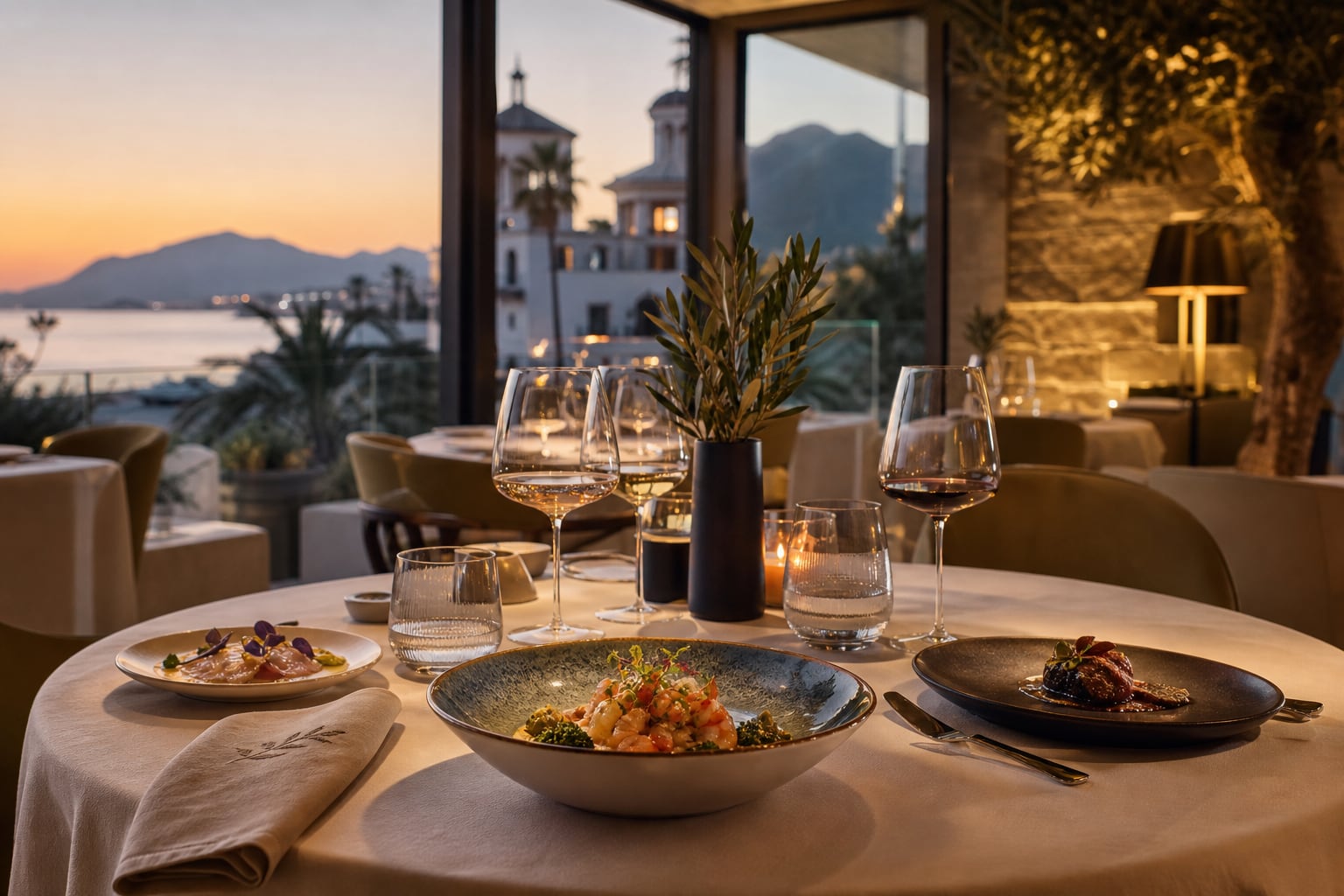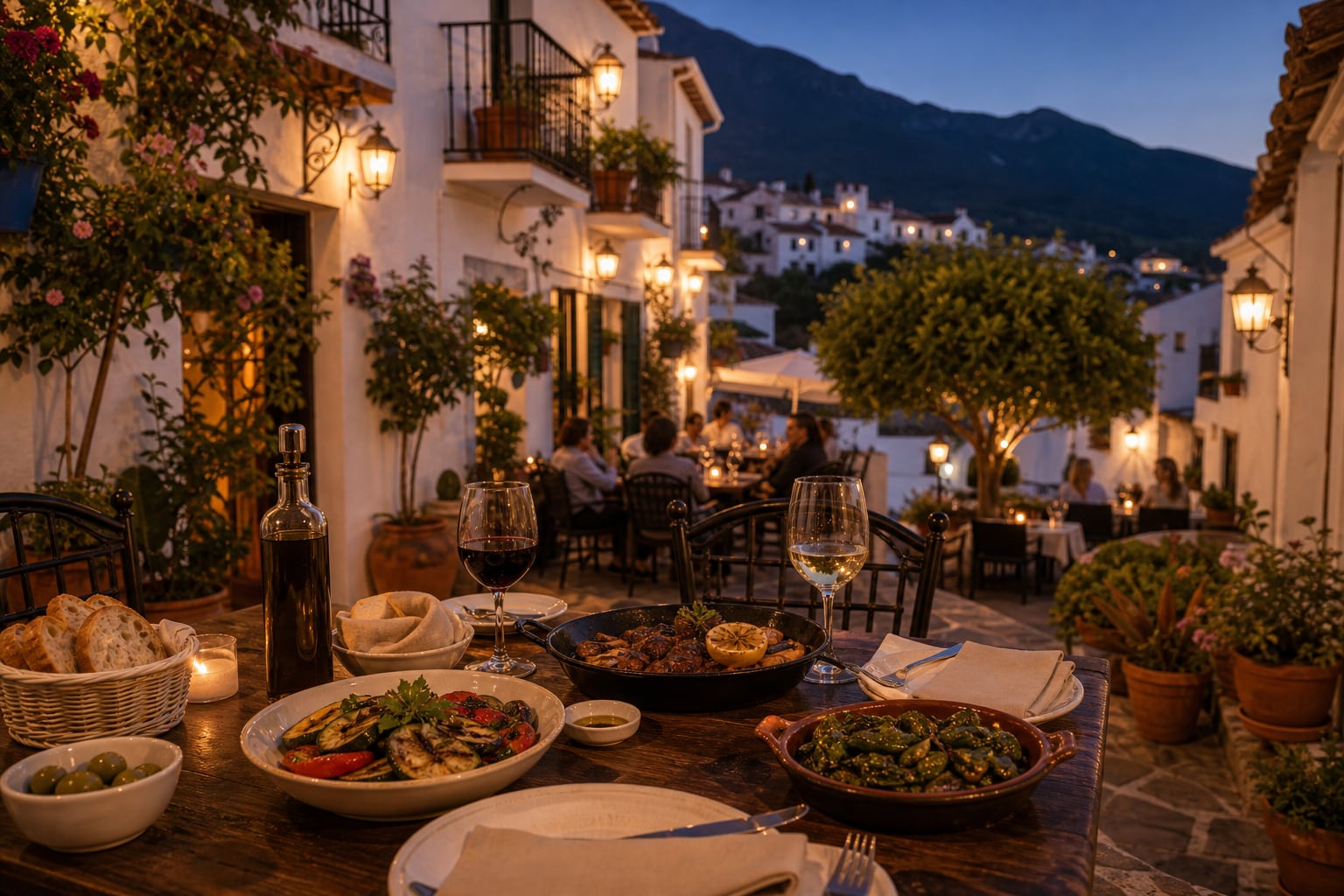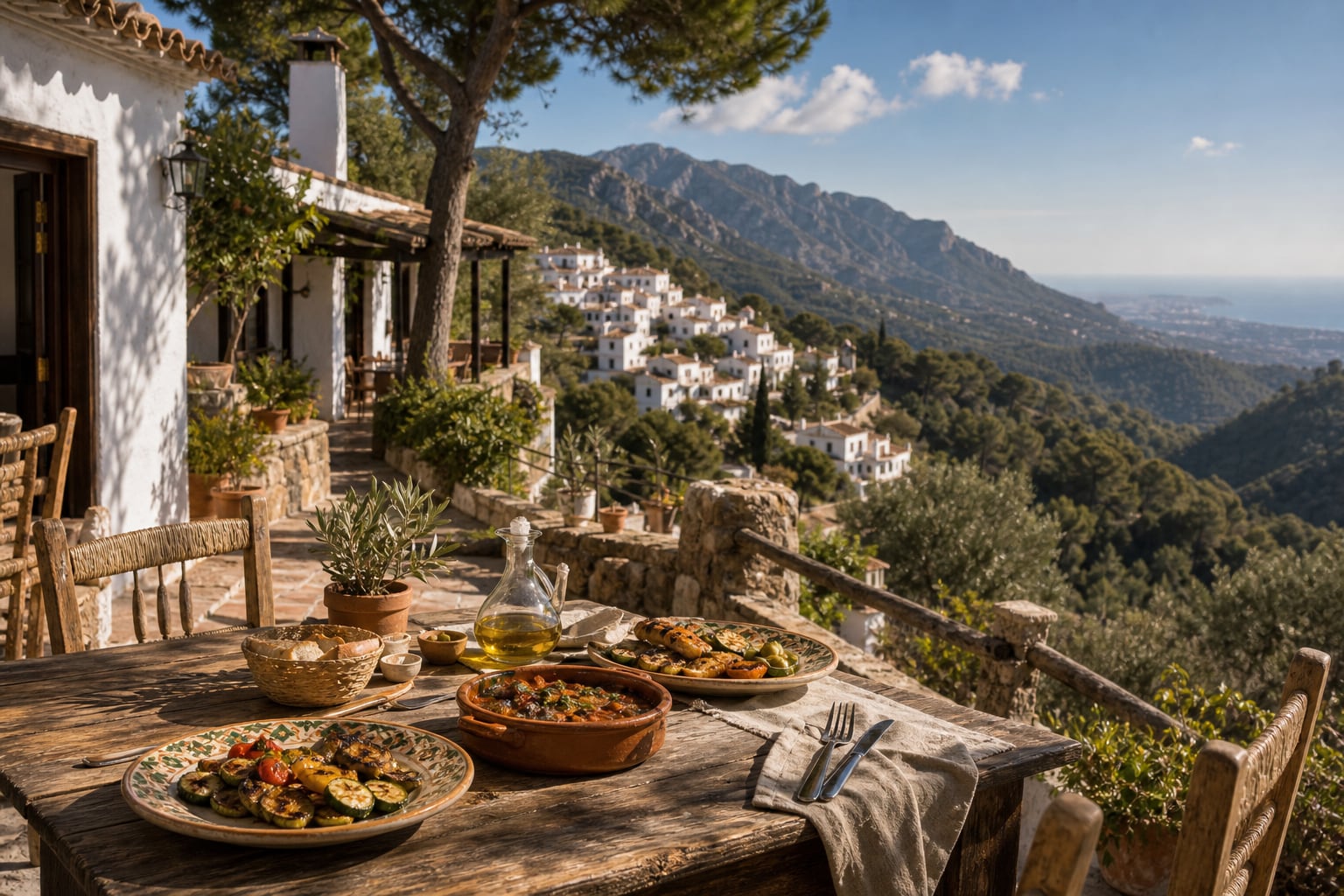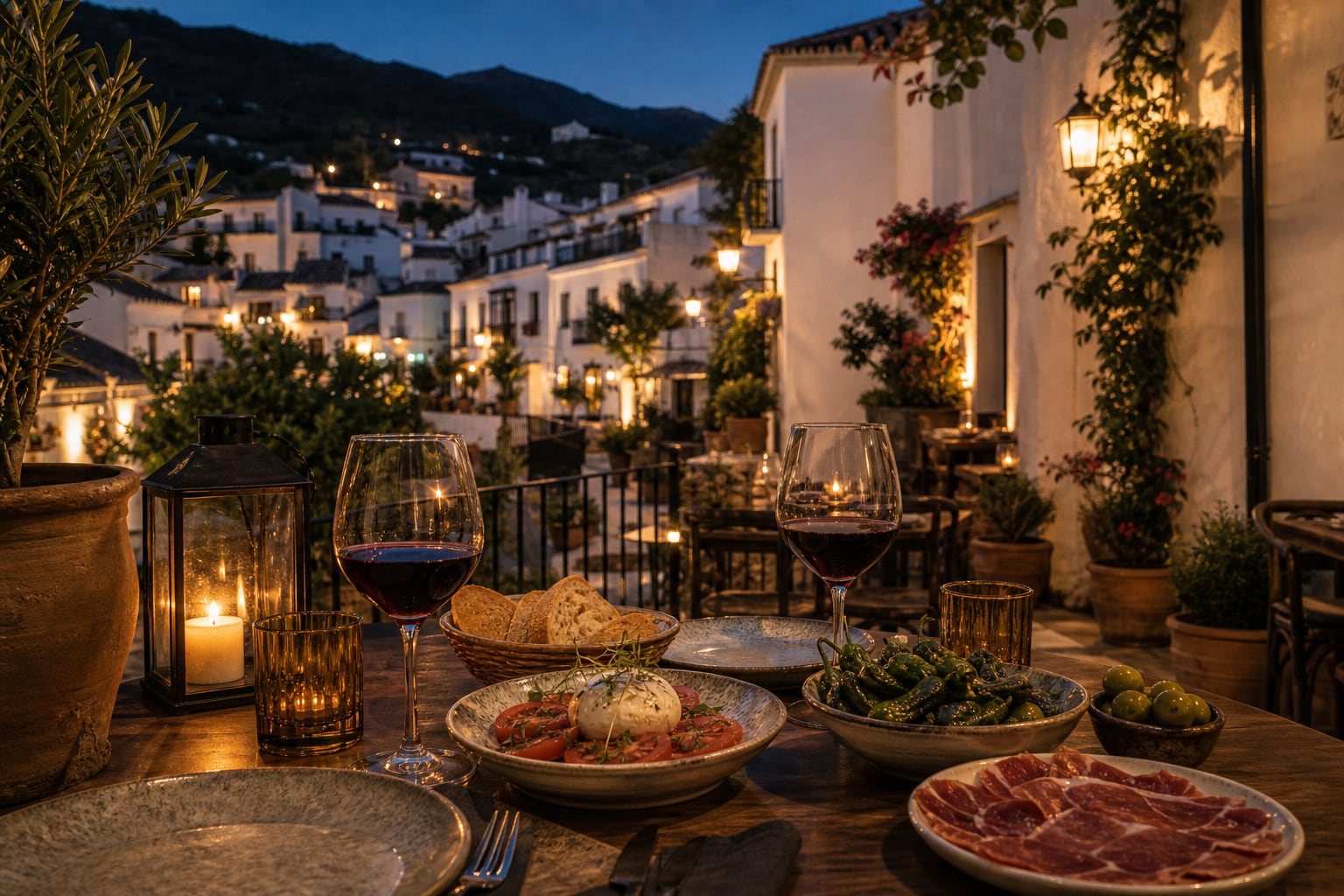
By half past one on a Friday in late May, the Plaza de España in Benahavís has quietly changed shape. The morning's delivery vans have gone, the bell tower of the church of Nuestra Señora del Rosario throws a hard diagonal of shade across the cobbles, and the square fills with the particular sound of a Spanish village getting ready to feed people: chairs scraped into position, ice tipped into steel buckets, an order called back through a kitchen door propped open against the heat. The smell drifting up Calle Málaga is unmistakable to anyone who has spent a season on this coast — slow-cooked oxtail, garlic meeting hot oil, the sweet edge of a dessert trolley wheeled out into the sun.
Benahavís is a village of fewer than ten thousand residents, folded into the Guadalmina valley roughly seven kilometres up from the sea. It has no beach, no marina and no glossy shopping promenade. What it has instead is a reputation, built patiently over half a century, as the dining room of the Costa del Sol — and for anyone weighing where to buy in the Marbella area, that reputation deserves to be taken seriously. A village that has organised its whole identity around the table tends, in the end, to be a very good place to own a home.
A village that learned to cook
Benahavís did not set out to become a restaurant town. For most of its history it was a working mountain settlement of farmers and herders — known as Benahavís under Moorish rule, its economy built on barley, wheat and olive oil, its skyline still marked by the ruined castle of Montemayor that once watched the coast for pirates. The change began in the 1970s, when the first wave of foreign buyers settling the new urbanisations inland of Marbella and San Pedro discovered that the easiest good lunch within reach was up the valley road, in the old village.
What followed was a slow, compounding effect. A handful of family kitchens earned a following; visitors began driving up specifically to eat; more restaurants opened to meet them; and the name of the village became, at least locally, a shorthand for a long and serious lunch. Today the Benahavís tourist office describes the pueblo plainly as the place with the biggest concentration of restaurants in the region, and residents like to point out that the village holds more restaurant covers than it has people to fill them. With more than forty restaurants and tapas bars serving a population of roughly 9,500, the boast is not far off the mark.
The cooking itself still belongs to a mountain village rather than a beach resort. Menus lean on game and slow methods — venison, partridge, rabbit, suckling pig, oxtail braised until it slides off the bone — alongside the dressed pork sirloin that locals treat as the village's signature plate. Fish appears too, most characteristically as zarzuela, the rich seafood stew, but Benahavís is at heart a place to eat the kind of food that takes hours to make and rewards a table in no hurry to leave it.
Geography reinforced the identity. The village sits where three rivers meet, in a steep green valley with the Sierra de las Nieves — designated a national park in 2021 — rising behind it. That setting gave Benahavís cooler evenings than the coast, narrow cobbled streets shaded by orange trees, and the kind of jasmine-scented summer night that makes a two-hour dinner outdoors feel like the only sensible plan.
Where the village actually eats
The clearest way to understand Benahavís is simply to walk it. The historic core is small enough to cross on foot in ten minutes, and almost every street holds at least one kitchen worth stopping for. Los Abanicos, on Calle Málaga a few steps from the centre, is the address most often named as the village's gastronomic anchor: it opened in the early 1980s as a modest casa de comidas, is now run by the second generation of the same family, and pairs a menu of local and classic Spanish dishes with what it fairly calls one of the most extensive wine lists on the Costa del Sol.
A short walk away on Calle Pilar, Amanhavís takes a different tack. The restaurant attached to the small boutique hotel of the same name builds several short, daily-changing menus around whatever the chef has found at the market that morning — creative Andalusian cooking that has kept it among the village's benchmark kitchens for years rather than seasons. It is the Benahavís address for an occasion dinner rather than a casual midday plate.
The Plaza de España, the handsome main square, carries much of the everyday trade. El Guarda 1926 works the square with Mediterranean cooking and a strong seafood list; Flor de Lis, a few doors along, leans Galician, with the plainly grilled fish and meat that rewards genuinely good raw materials. Around the corner, Los Faroles is the quiet traditionalist's choice — one of the oldest kitchens in the village, still sending out ternera en salsa and pepper chicken to a loyal local following.
What is most striking, eating across the village over a few days, is the value. This is not the pricing of Puerto Banús or the Golden Mile. Benahavís built its name on serious cooking at village prices, and a long, wine-accompanied lunch here generally costs a clear fraction of what the same meal would on the seafront fifteen minutes downhill. For a holidaymaker that gap is a pleasant surprise; for a resident it is the weekly economics of living somewhere you can comfortably walk to dinner.
The school that staffs the coast
One detail explains why the standard across so many Benahavís kitchens stays consistently high: the village runs its own hospitality school. The Escuela de Hostelería de Benahavís, founded more than two decades ago by the town hall together with provincial partners, trains young cooks and front-of-house staff, and has become a real reference point for the trade well beyond the village boundary.
Its graduates do not stay only in Benahavís. The school has supplied kitchens and dining rooms across the Costa del Sol and further afield for years, which means the village quietly functions as a talent pipeline for the wider regional restaurant scene. A village that trains the coast's chefs is, unsurprisingly, a village that eats well itself.
The school also keeps Benahavís firmly on the gastronomic calendar. It hosted the Andalusian round of the MGA Gastronomic Awards in 2026, and for several editions running it has staged the ChefsForChildren initiative, which gathers dozens of recognised chefs to cook with and teach local children. For a place this small, that is an unusual concentration of culinary activity — and a sign that the dining-room identity is something Benahavís actively maintains rather than simply inherits.
Wine from the mountains behind the village
A serious eating culture needs serious wine, and Benahavís has two sources of it close at hand. The first is the province's own production: wines carrying the Sierras de Málaga and Málaga denominations of origin, from the sweet Moscatel and Pedro Ximénez styles Málaga has made for centuries to the increasingly respected dry reds and whites grouped under the regional Sabor a Málaga seal. Most village wine lists give them proper room.
The second is the Serranía de Ronda, the mountain country that begins where the Costa del Sol's foothills end, roughly an hour inland. The official Ronda wine route now links sixteen wineries, many of them small and family-run, working vineyards above 750 metres where cool nights and warm days favour elegant, structured reds. Names worth knowing include F. Schatz, the organic pioneer founded by a German winemaker who was among the first to replant vines here after phylloxera; Descalzos Viejos, set inside a restored sixteenth-century convent above the Ronda gorge; and Bodegas La Sangre de Ronda, housed in a mansion more than two hundred years old.
For a Benahavís resident this is one of the quieter pleasures of the location. The drive up to Ronda through the Serranía is among the finest roads in the province, and it ends in the very cellars that supply the wine lists you will have been working through down in the village. Here, food and wine are not marketing categories bolted onto a brochure — they are a short, scenic loop you can complete on a free afternoon and carry home in the boot of the car.
What a restaurant village does for property
None of this would count for much if Benahavís were awkward to reach or priced beyond reason. It is neither. The village sits about seven kilometres up a well-kept valley road from San Pedro de Alcántara, which puts Puerto Banús and the coast around fifteen minutes away, central Marbella inside half an hour, and Málaga airport under an hour. It is close enough to the sea to be genuinely practical, and far enough from it to stay calm — the sort of inland market that buyers working with Domosmar increasingly ask about.
On price, Benahavís reads as a firm mid-to-upper market rather than a stretched one. According to Idealista's March 2026 data, the municipality averaged €5,458 per square metre, up a substantial 13.1% on the year. That headline figure hides real variety. The village core itself sat closer to €4,950 per square metre — and was climbing fast, more than 20% higher than a year earlier — while the established golf and gated districts ranged well above it, with La Quinta near €6,080 and the rarefied La Zagaleta–El Madroñal close to €8,000.
That spread is the practical point for a buyer. Benahavís is not one market but several, fanning outward from the pueblo: the old village for character and walkability; La Heredia and La Alquería for low-rise, Andalusian-style developments; La Quinta, Los Arqueros and Los Flamingos for golf-side living; and La Zagaleta and El Madroñal at the very summit of the Costa del Sol's price ladder. What ties them together is the village at the centre — and the plain fact that a thriving, year-round restaurant scene is one of the most dependable supports a local property market can have.
It matters for rental performance, too. A home a short drive from a village that draws diners in every month of the year is easier to let, easier to enjoy out of season, and far less exposed to the dead winter weeks that hollow out purely beach-driven locations. A place where the kitchens stay open and busy in January is a place that holds its appeal — and, more often than not, its value.
Benahavís rewards the buyer willing to look past the obvious coastal postcards. It offers the Costa del Sol's climate and access without its crowding, a real Andalusian village still organised around the long table, and a property market that has grown steadily rather than spiked. For anyone who measures a place partly by how well they will eat there on an ordinary Tuesday, few locations on this coast make the argument as plainly.
If that sounds like the kind of base you have been picturing, Domosmar can help you weigh it properly. Browse current Benahavís homes for sale and the wider Costa del Sol portfolio, find more area guides on the Domosmar blog, and when you are ready, get in touch for buyer-led advice on where in the valley genuinely fits the way you want to live.