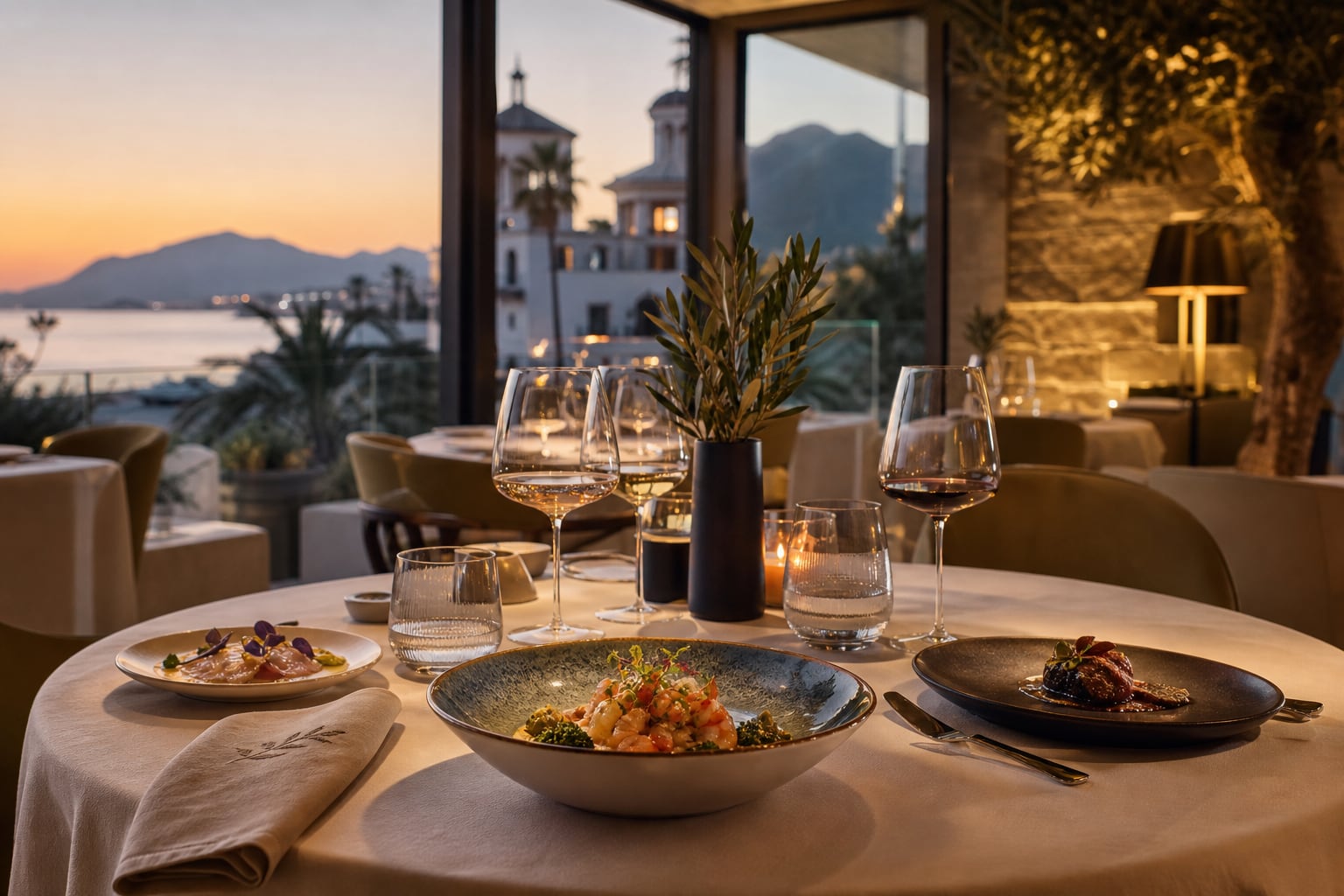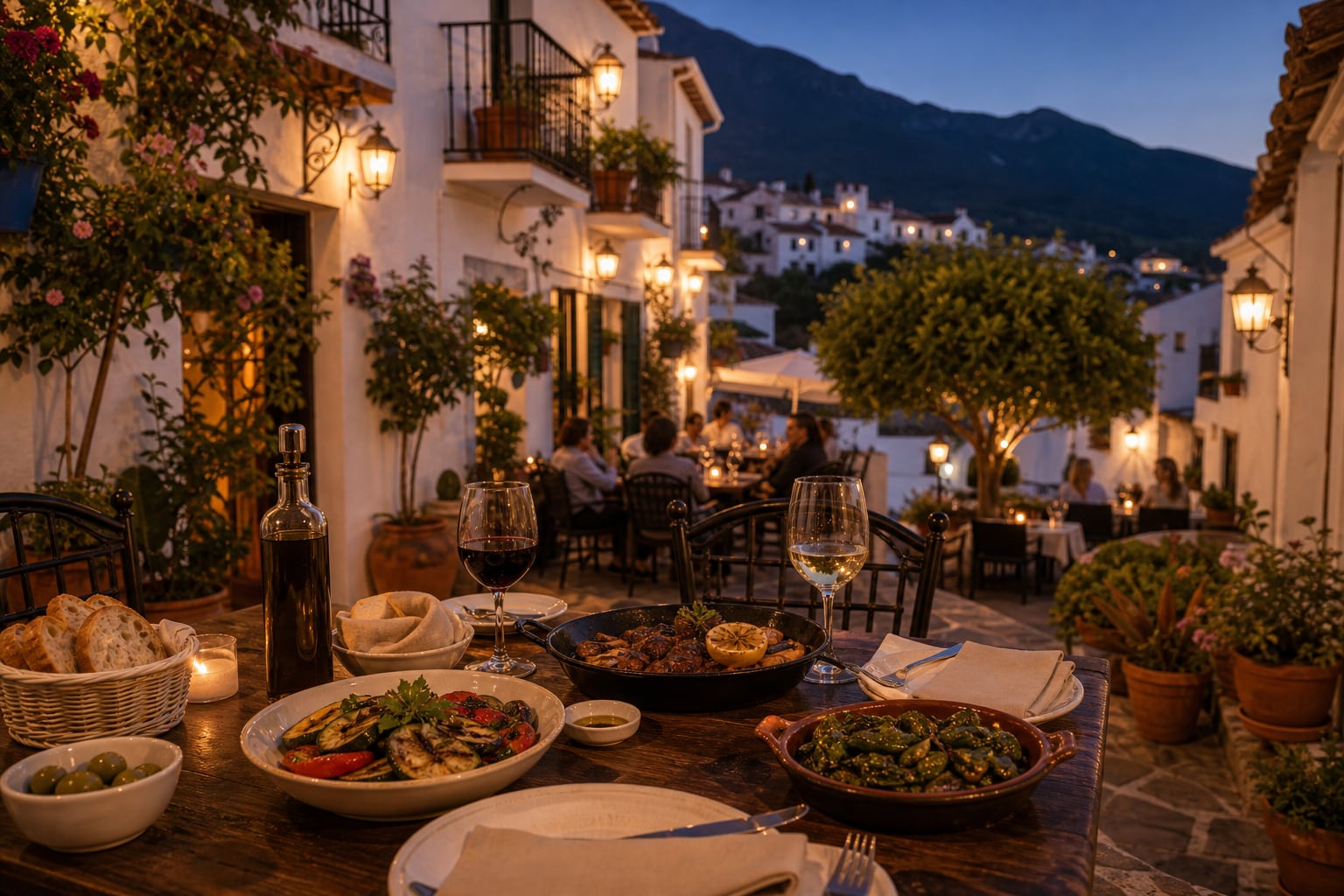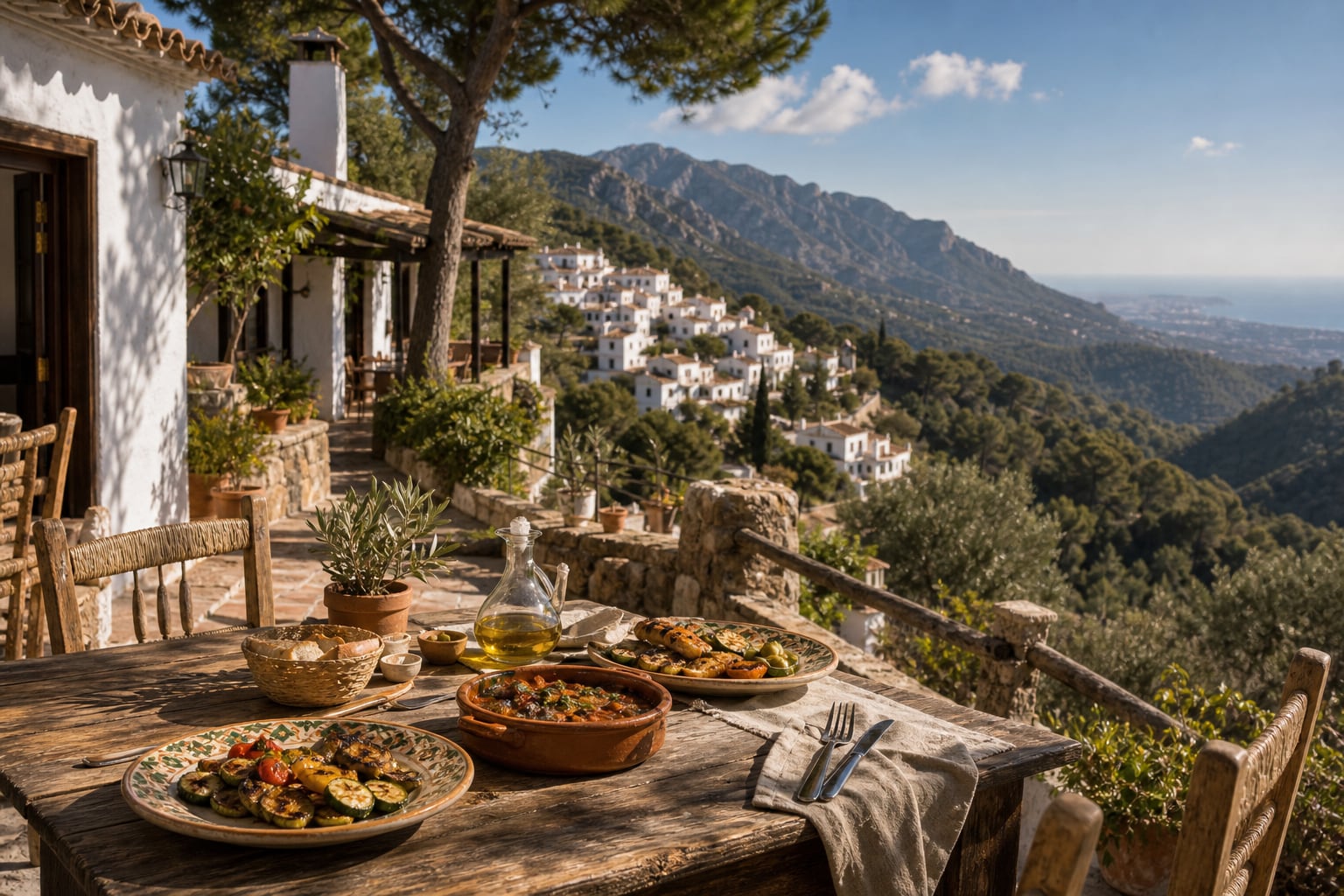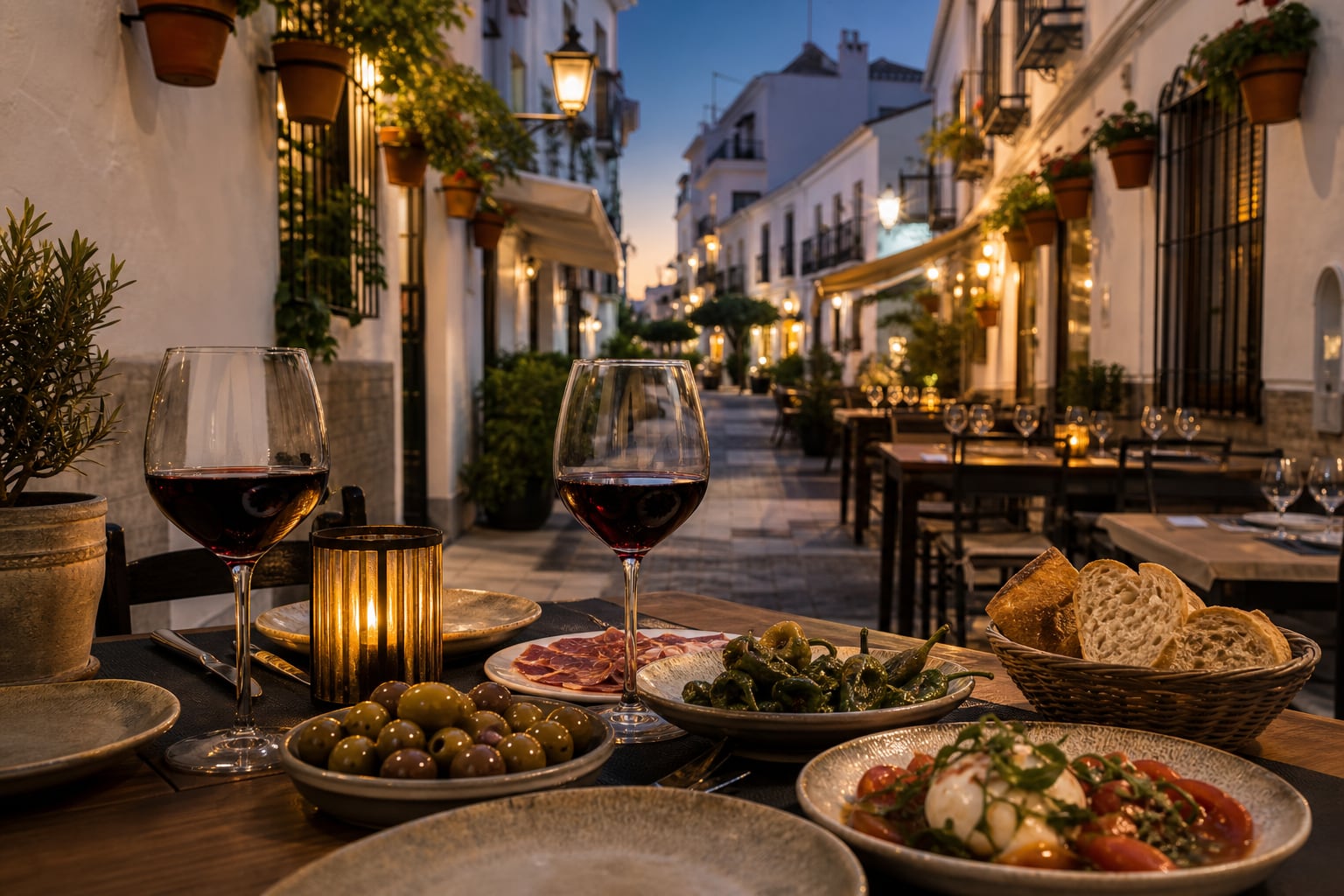
At half past seven on a Friday evening, Calle Caridad is already filling up. The tables at The Boab Tree are set — white linen, a single tea light, no printed menu visible because the short seasonal list changes with the week's best produce. Down the same cobbled lane, the open kitchen at Abanico is sending wood-fire smoke and char across the warm Andalusian air. Four blocks to the south, Estepona's working fishing port has finished unloading its catch; the day's pescado has been moving through the market since mid-morning, and this evening it will appear in a pan at El Pescador on the promenade, or in a daily special somewhere in the old town. This is the Casco Antiguo of Estepona at dinner hour — compact, locally provisioned, and one of the most underestimated food scenes on the Costa del Sol.
The town earned its 'Garden of the Costa del Sol' label through a sustained municipal programme of flower-potted streets, pedestrianised squares, and consistent public works investment. According to a February 2026 Idealista analysis, the town's local council committed its largest-ever annual budget of €132 million to the year, with €35 million earmarked specifically for urban maintenance and enhancement. New-build prices on the New Golden Mile — the prestigious stretch linking Guadalmina to the Estepona entrance — reached €7,000 per square metre at the close of 2025, with the premium segment running between €6,000 and €8,000 per square metre. A fiscal incentive of €6.6 million reduced IBI (council tax) by an average of 20% for residential owners, a direct benefit for buyers treating this as a primary rather than a secondary residence.
But the food culture of a town is one of the more reliable indicators of a place worth owning in. It signals year-round population density, supply chain depth, civic pride, and — most practically — whether an ownership experience will be genuinely enjoyable every week of the year, not just in high summer. On all of those measures, Estepona has quietly earned a new ranking. For more context on how individual districts across the western Costa del Sol compare as buying propositions, the Domosmar area guides cover the market in detail.
What Estepona Gets Right About Eating
The working fishing port is the structural advantage that no amount of interior design can replicate. Estepona's port lands catch daily — gilthead bream, sea bass, red mullet, octopus, anchovies — and the proximity to source gives the town's restaurants a freshness that menus in Marbella, supplied from further afield, cannot always match. El Pescador, on the promenade, is the most direct expression of this: a bright, unstuffy room built around what arrived from the sea that morning. Razor clams, turbot, and swordfish are cooked without ceremony, and the pricing is significantly below comparable seafood on the Puerto Banús side.
The more significant shift has come in the old town itself. Kuvo is the restaurant most credited with changing the conversation about what serious eating looks like in Estepona — a modern, technique-driven kitchen operating in a town where, until recently, culinary ambition meant a paella with views. Abanico takes a different approach: it blends Andalusian cooking with Argentine grilling, built around the abanico ibérico — a cut from the outer ribs of the Iberian pig that is largely unknown outside Spain. The wood grill runs most evenings, and the terrace fills early. The Boab Tree, on Calle Caridad itself, is dinner-only with a short seasonal menu that changes week to week; the artichokes with foie gras is a signature starter, and the covered terrace is among the most pleasant settings in the old town for a long, unhurried meal. Between these three, plus the fish restaurant on the promenade, the old town offers a dining circuit that holds interest across an entire season without repetition.
What these restaurants share is an approach that favours product over spectacle — a local philosophy rather than a branded one. The geography helps: the pedestrianised lanes around Plaza de las Flores and Calle Caridad are dense enough to walk between restaurants, and the scale is intimate enough that you are likely to recognise faces across tables after a season. For a buyer considering whether they want to live somewhere or merely visit, the density and quality of this kind of neighbourhood eating matters considerably more than which beach club has opened this summer.
The Wines Grown Above the Coast
Most visitors to the Costa del Sol have heard of Málaga wines — the amber-coloured, intensely sweet Moscatel or Pedro Ximénez fortified wines that have been made in this province for centuries. What fewer realise is that, alongside the historic DO Málaga, a second and distinct appellation — DO Sierras de Málaga — was created in 2001 specifically to accommodate dry table wines made in the same geographic territory. The two appellations share the same land but different bottles: sweet, fortified, and oxidative wines carry the DO Málaga label; dry, unfortified still whites, rosés, and reds carry DO Sierras de Málaga.
The DO covers 998 hectares of vine spread across the province at altitudes ranging from 300 to 900 metres above sea level — conditions that cool the ripening process and preserve the acidity that coastal Andalusia at lower elevations cannot achieve. The region receives around 3,000 sunshine hours per year, a figure that places it in the top tier of European wine regions by solar intensity, while the mountain elevation moderates the heat that would otherwise over-ripen the grapes on the vine. Permitted white varieties for DO Sierras de Málaga include Chardonnay, Sauvignon Blanc, Gewürztraminer, Riesling, and Viognier alongside the indigenous Pedro Ximénez and Moscatel; reds run Tempranillo, Cabernet Sauvignon, Merlot, Syrah, and Romé. The result is a DO with unusual stylistic breadth — a characteristic more associated with the New World than with a traditional Andalusian appellation.
The sweet Moscatel tradition has not disappeared, and nor should it. The Moscatel de Málaga — made from Moscatel de Alejandría grapes often left to raisin in the Andalusian sun after harvest — is one of the most singular dessert wines produced anywhere in Spain. Served lightly chilled alongside a slice of local almendrado pastry or the fresh goat's cheese made in the Ronda hills, it represents a flavour entirely specific to this latitude. Locals, and increasingly serious restaurants in the area, pair it precisely in this context — not as a casual pour but as a considered conclusion to a meal.
Ronda's High-Altitude Bodegas
The Serranía de Ronda is the subzone that has done the most to reframe what Málaga province can produce in still, dry wine. Ronda sits at roughly 750 metres altitude in a natural bowl in the Serranía, and the vineyards surrounding it benefit from calcareous clay soils and a strongly continental climate: hot days, genuinely cool nights, and a diurnal temperature range that concentrates flavour in grapes while retaining freshness. From Estepona, the drive is around an hour — north on the A-7 to San Pedro de Alcántara, then up through the Serranía on the A-376, past cork oak and pinsapo fir, until the plateau opens and the famous gorge appears above the town.
Cortijo Los Aguilares is one of the estates most associated with putting Ronda on the international wine map. The property — an 800-hectare estate five kilometres from Ronda — was established in the 1990s and now plants 19 hectares of vine on calcareous clay soils, with varieties including Pinot Noir, Tempranillo, Merlot, Cabernet Sauvignon, and Petit Verdot, aged in French Alliers oak barrels. In 2009, a 2008 Pinot Noir from Cortijo Los Aguilares won Gold at Le Mondial du Pinot Noir in Switzerland — a result that drew international attention from critics who had not previously considered Andalusia as Pinot country. The result proved less an anomaly than an early signal: the altitude and the soil here can produce structured, aromatic reds that hold up against international benchmarks.
Bodega F. Schatz occupies the other end of the stylistic range. Friedrich Schatz, from a winemaking family in the Württemberg region of Germany, established his bodega in Ronda before the DO Sierras de Málaga was formally created — making it the oldest continuously operating winery in the modern Ronda appellation. All of its wines are produced without added sulphites, and the bodega is best known internationally for monovarietal wines from Lemberger/Blaufränkisch and Muskattrollinger — grape varieties found virtually nowhere else in Spain. The Lemberger produces a wine of unusual freshness and structure for the latitude: medium body, precise red fruit, and a finesse that sits at odds with expectations of hot-climate southern Spanish red wine.
The DO as a whole has grown from 9 wineries at its founding in 2001 to 45 producers today — a trajectory that reflects both growing international interest in the appellation and the arrival of serious investors who see the combination of altitude, terroir, and climate as genuinely competitive with better-known Spanish wine regions. For buyers living in Estepona, Benahavís, or along the western Golden Triangle, the Ronda wine route is a legitimate half-day excursion that a surprising number of long-term residents have yet to make.
Twenty Minutes East: Marbella's Fine Dining Firmament
When the occasion calls for something beyond the neighbourhood table, Marbella's Michelin-starred restaurants are approximately twenty to thirty minutes east of Estepona on the A-7. The most significant address is Skina, at Avda. Cánovas del Castillo 9 in central Marbella, which holds two Michelin stars and is run by sommelier Marcos Granda with chef Mario Cachinero leading the kitchen. The restaurant serves seasonal Andalusian haute cuisine across a tasting menu that changes with the best produce the region can offer at any given moment — the vegetable garden, the Mediterranean, the mountain suppliers — backed by a wine list of over 6,000 references, curated around Marcos Granda's particular focus on terroir-driven Spanish and international bottles.
The restaurant runs to 14 covers by design. A reservation in high season requires planning weeks in advance, which is part of the character: this is a kitchen cooking for a table it can actually see and respond to, not a production line. For a buyer considering the cultural richness of week-to-week life in the Marbella area, the existence of a two-starred restaurant at this scale — alongside Nintai, Marcos Granda's 12-seat omakase address in the same city — represents something more than a dining option. It reflects a level of culinary seriousness that has arrived and settled in the western Costa del Sol over the last decade and shows no sign of contracting.
The broader fine dining and beach club ecosystem has widened considerably around both towns. Nikki Beach and Ocean Club on the Marbella shoreline, and Trocadero Arena on the Puerto Banús side, have progressively invested in food quality in recognition that the international buyer community they serve has become considerably more discerning about what they eat. The result is that a resident on the western Costa del Sol today has access to a range of serious eating — from a wood-fire terrace on Calle Caridad in Estepona to a two-starred tasting room in central Marbella — that was simply not available at this density a generation ago.
What the Table Tells You About Buying Here
A food scene as dense and varied as this one does not exist in isolation from the wider social and economic conditions of a place. It requires year-round residents who eat out through January and February, not just August and September. It requires a supply infrastructure — working ports, hill farms, olive groves — that has been in place for generations. And it requires a buyer and owner community that both demands and supports quality. Estepona and the western Golden Triangle increasingly have all three. The Old Town's casco antiguo properties — traditionally more affordable than comparable historic-centre stock in Marbella — have attracted a wave of restoration investment, with original casa mata houses now presented as boutique residences that reflect the quality of the environment around them.
For buyers in the broader market, the price structure remains favourable relative to Marbella's central zones. Average asking prices across Estepona reached approximately €4,400 per square metre in mid-2025, compared to significantly higher figures in Marbella's Golden Mile and Sierra Blanca. The luxury new-build corridor on the New Golden Mile is now pricing between €6,000 and €8,000 per square metre for the premium segment — comparable to Marbella East benchmark levels — while the Old Town and Las Mesas districts continue to offer a different proposition: walkable, pedestrianised, market-provisioned, and increasingly internationally recognised. The municipal IBI incentive of €6.6 million, delivering an average 20% saving on property tax, provides a concrete financial benefit for the growing number of buyers treating Estepona as a primary rather than secondary residence.
The evening table on Calle Caridad is not, in itself, a reason to buy a property. But it is a reliable proxy for the kind of place Estepona has become: a town with civic infrastructure, year-round social life, locally sourced food, a wine country within an hour's drive, and a fine dining tier accessible within twenty minutes. These are the conditions that make a second home into a primary one, and a purchase into a decision you do not revisit. The western Costa del Sol is no longer asking to be compared favourably to anywhere else. It is setting its own terms.
If you are considering Estepona or the wider Marbella area and want to understand which properties best reflect this kind of ownership experience, browse the current Domosmar listings or get in touch directly — we can help you identify the neighbourhoods and properties that match what you are actually looking for, not just what happens to be on the market.