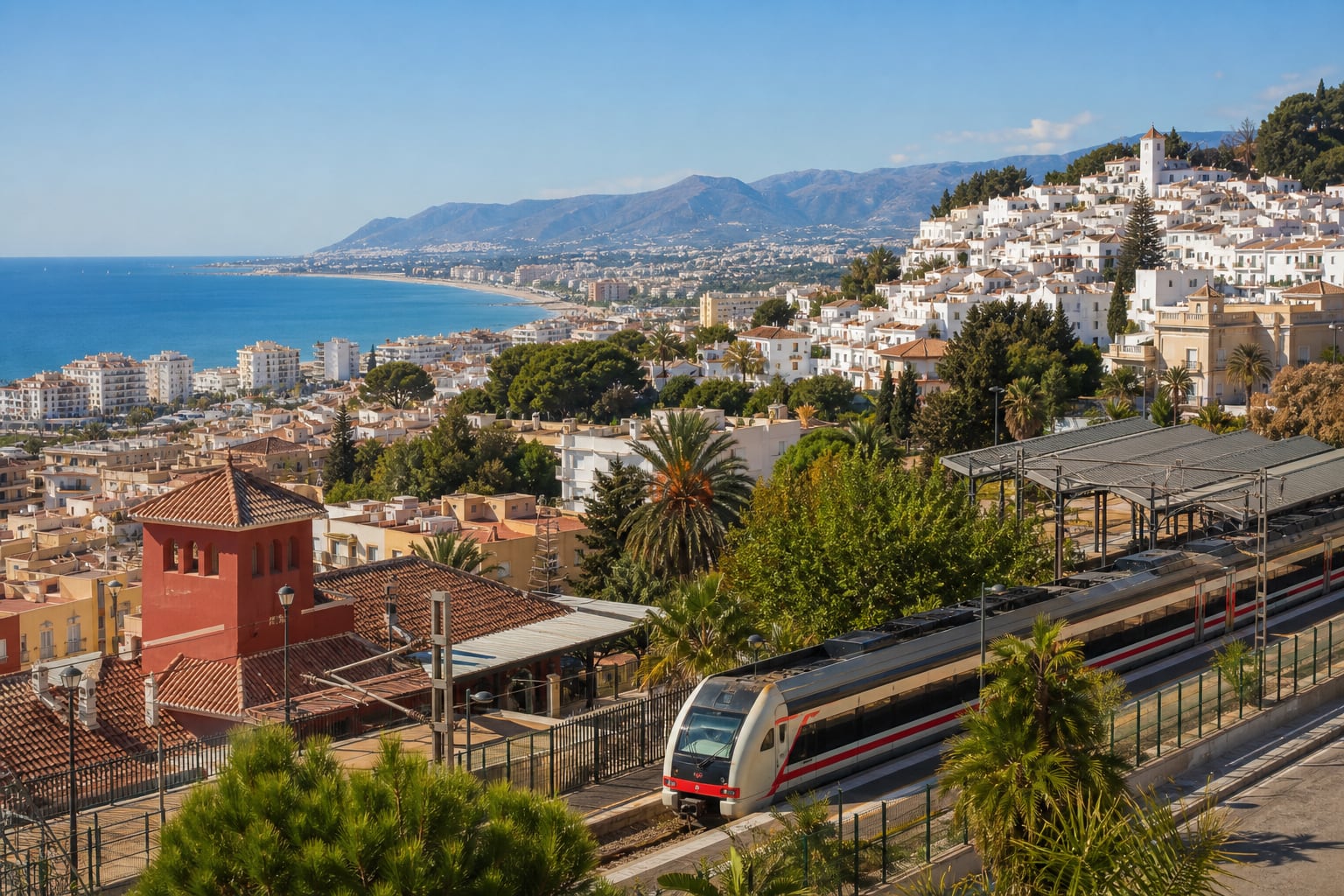
- Marbella definitively approved its new Plan General de Ordenación Municipal (PGOM) on 18 September 2026. The city had still been operating under the general planning framework approved in 1986.
- The new PGOM identifies 53 million m² of urban land, versus approximately 40 million m² under the previous planning framework. That is an increase on the order of one-third, but urban classification does not by itself create an immediate right to build.
- Marbella City Council says around 18,000 existing homes had been left outside a regular planning situation by the municipality’s complex planning history. The PGOM creates a new normative base for dealing with those situations; it is not a blanket automatic legalisation of every property.
- New urban actions are expected to reserve 20% of buildability for affordable housing. The plan also links future growth to water, sanitation, energy, mobility, green space and other infrastructure.
- Marbella’s advertised asking price reached €5,956/m² in August 2026, up 4.0% year on year and a record in Idealista’s current series. Within the municipality, the same index ranged from €4,600/m² in San Pedro de Alcántara to €8,336/m² in Nagüeles-Milla de Oro.
- Bottom line: the new PGOM is best read as a planning-certainty event rather than a promise of instant construction or instant price growth. For buyers, a clearer citywide framework is positive — while property-specific legal and planning checks remain essential.
Forty years is a long time for a property market to outgrow its planning map. On 18 September 2026, Marbella definitively approved a new Plan General de Ordenación Municipal — the PGOM — replacing, in its general-ordering determinations, the framework the city had been using since 1986. In a municipality where asking prices now average almost €6,000/m² and individual neighbourhoods sit above €8,000/m², that is not an administrative footnote. It is part of the infrastructure of the market itself.
The headline numbers are substantial. The new plan identifies 53 million m² of urban land, compared with approximately 40 million m² in the previous framework. Marbella City Council also says around 18,000 existing homes had been left outside a regular planning situation by the municipality’s unusually complicated planning history. New urban actions are intended to reserve 20% of buildability for affordable housing, while growth is being tied explicitly to transport, water, sanitation, energy and public facilities.
It would be easy to turn that into a simplistic story about Marbella suddenly opening the gates to more development. That is not what the PGOM does. Nor does it automatically legalise 18,000 homes on a Friday afternoon. The more useful buyer interpretation is quieter and more important: one of Europe’s most valuable second-home markets now has a modern general planning framework on which detailed planning, infrastructure and individual property decisions can be built.
Forty Years of Growth on an Old Planning Map
Marbella in 1986 and Marbella in 2026 are recognisably the same coastline but very different property markets. The municipality has expanded as a year-round international city, not simply a seasonal resort. Nueva Andalucía has matured into one of southern Europe’s best-known residential golf districts; the Golden Mile has moved further into the global prime market; San Pedro has become a substantial town in its own right; and eastern Marbella has developed a chain of established residential areas from Río Real to Elviria and Cabopino.
Yet the general planning baseline was still the plan approved on 3 June 1986. Marbella’s own planning portal describes that document as complex and outdated after a long history of interruptions and planning disputes. The point for a buyer is not to revisit every chapter of that history. It is to understand why a current plan matters so much in a city where land values, building standards, infrastructure demands and residential patterns have moved on dramatically.
Planning certainty has a commercial value even when it is difficult to express as a percentage. Developers need to understand what can be built and what infrastructure must accompany it. Banks and lawyers need a coherent framework against which to assess projects and individual homes. Existing owners need a route for resolving inherited planning situations. Buyers need to know that the city’s growth assumptions are based on today’s law rather than a plan drawn up before the modern Costa del Sol market existed.
The timing is particularly relevant because Marbella is not waiting for a planning document in order to attract demand. Our recent analysis of the 428-home planning proposal around Río Real showed where one part of future residential growth may sit. The new PGOM gives that kind of project a more contemporary citywide context.
What 53 Million m² of Urban Land Actually Means
The figure that will attract most attention from investors is the move from approximately 40 million m² to 53 million m² of urban land. On the face of it, that is an increase of roughly 13 million m² — in the region of one-third. It sounds like a vast new development pipeline.
That is not the right way to read it. Urban classification is a planning category, not a stack of tomorrow’s building licences. Some land is already occupied. Some areas need detailed planning. Some require infrastructure, reparcelling or other administrative steps. The PGOM sets the general structure of the municipality: where urban growth belongs, which systems and connections the city needs, and how the broad territorial pieces fit together. It does not convert every square metre into immediate residential buildability.
For buyers, that distinction is reassuring rather than disappointing. A mature property market does not benefit from indiscriminate supply. Marbella’s appeal depends on scarcity in some locations, but also on functioning roads, utilities, public space, schools, beaches and services. The approved plan explicitly links new development with the infrastructure and facilities needed to support it. That is more important over a ten- or twenty-year ownership horizon than a headline promise to produce homes quickly.
There is also a housing-policy change built into the growth model. Marbella says urban actions proposed under the new framework will reserve 20% of buildability for affordable housing. In a municipality where private-market values are high enough to make local housing affordability a structural issue, the plan is attempting to add a broader housing mix rather than treating every future square metre as an international luxury product.
The 18,000-Home Question: More Certainty, Not a Blanket Legalisation
The most sensitive number in the announcement is 18,000. According to Marbella City Council, around 18,000 homes were left outside a regular planning situation as a consequence of the municipality’s past planning evolution. For owners who bought in good faith, that legacy has created years of uncertainty around a subject that should normally be routine: the planning status of an existing home.
The new PGOM is important because the municipality now has a current legal framework from which those inherited situations can continue to be ordered. The council describes it as a new normative base offering greater legal certainty to good-faith third parties and families connected with affected properties. That is materially different from saying every one of the 18,000 homes becomes fully regularised automatically on approval day.
For a buyer, the practical rule therefore remains familiar: investigate the exact property, not only the postcode. A modern city plan improves the background against which due diligence is done, but the independent lawyer should still check the Land Registry, planning status, licences, first-occupation documentation where applicable, community matters and any property-specific conditions. Marbella’s new framework should make those enquiries more intelligible over time; it does not make them unnecessary.
This is also why the change is potentially positive for established stock, not only new build. A planning reset is often discussed through future projects, yet thousands of current homes sit inside the same urban system. Greater clarity around inherited situations can improve confidence in the secondary market and reduce the number of cases where a buyer walks away simply because the planning history is too opaque to interpret comfortably.
The POU Is the Next Document Buyers Should Watch
Spain’s planning acronyms can make a straightforward idea sound forbidding. Under Andalucía’s current LISTA framework, Marbella is no longer relying on one all-purpose municipal plan. The city is working with two instruments: the PGOM, which establishes the broad general and territorial structure, and the Plan de Ordenación Urbana (POU), which develops the detailed urban ordering inside the city.
The PGOM is now definitively approved. The POU is still being processed. Marbella’s own announcement is explicit that the 53 million m² framework will be developed in detail through that future document. This is the reason buyers should resist both extremes in interpreting the news: it is much more than a preliminary concept, but it is not the final detailed answer to every plot and street in the municipality.
For a buyer looking at a completed apartment, the POU may never become a daily concern. For someone buying very early off plan, evaluating development land or considering a property with a complicated planning history, it matters more. The sensible question is not simply “does Marbella have a new plan?” but “which instrument governs this specific issue, and what stage has the relevant detailed planning reached?”
That should not turn a property search into an urban-planning seminar. The independent lawyer and architect, where needed, do the technical work. The value for an ordinary buyer is knowing that a citywide press release and a property-specific planning certificate are different levels of information.
Growth Is Being Tied to Infrastructure, Not Just More Building
One of the more encouraging parts of the PGOM is what sits behind the housing numbers. The plan reserves space for future mobility infrastructure, including the possibility of a rail connection, while also setting out new road links, expanded cycling networks and parking. It links urban growth to the availability of water supply, sanitation and energy infrastructure rather than treating utilities as something to solve after homes have been approved.
For the Costa del Sol, this sequencing matters. Our recent reporting has looked separately at Marbella’s missing rail connection, Málaga Airport’s expansion and the electricity-grid reinforcement around Mijas. These can sound like unrelated infrastructure stories. In practice they describe the same challenge: international demand has grown faster than parts of the physical network beneath it.
The PGOM cannot build a railway by drawing a line on a map, nor can it guarantee when another administration will fund one. What it can do is avoid making future infrastructure harder by failing to reserve the necessary corridors. Likewise, identifying growth areas does not create water or electricity capacity; linking planning decisions to those capacities makes the system more realistic.
This is where the positive buyer case is strongest. Marbella does not need unlimited development to sustain its market. It needs enough well-planned supply to keep the city functioning, while protecting the qualities that make its best neighbourhoods desirable. Infrastructure-led growth is a more credible long-term proposition than growth measured simply by the number of cranes on the skyline.
Marbella’s Market Is Already Pricing Scarcity
The new plan arrives in a market that is hardly waiting for a catalyst. Idealista’s August 2026 asking-price index put Marbella municipality at €5,956/m², up 4.0% year on year and at the highest point in its current series. That is an advertised asking-price measure, not a completed-transaction price, and Idealista notes a methodology improvement from July 2026. Even with those qualifications, the internal spread is revealing.
| Marbella area | Aug 2026 asking price | YoY change | Buyer reading |
|---|---|---|---|
| Nagüeles–Milla de Oro | €8,336/m² | +5.9% | Prime scarcity and established luxury demand sit far above the municipal average. |
| Nueva Andalucía | €6,239/m² | +5.7% | A mature international residential market with limited easy infill. |
| Marbella municipality | €5,956/m² | +4.0% | Useful citywide benchmark, but it hides very different micro-markets. |
| Río Real–Los Monteros | €5,531/m² | -5.3% | Eastern Marbella has prime beachfront and golf stock but is not moving in a straight line. |
| Marbella Pueblo | €5,170/m² | +4.1% | Town-centre walkability increasingly carries its own premium. |
| Elviria–Cabopino | €4,623/m² | +2.1% | Lower entry level than central prime Marbella, with a different beach-and-residential mix. |
| San Pedro de Alcántara | €4,600/m² | +2.6% | A substantial year-round town whose pricing remains below the municipality’s prime zones. |
This price map helps explain why a new planning framework matters differently from neighbourhood to neighbourhood. The Golden Mile does not need a large amount of new supply to remain expensive; scarcity is part of its identity. San Pedro and eastern Marbella have more varied development patterns. Río Real is already part of a future-growth conversation. A citywide PGOM therefore does not create one Marbella property market. It gives several distinct markets a common general framework.
Domosmar’s live catalogue on 21 September contained 54 available new-build developments indexed to Marbella municipality. The median advertised development entry price was approximately €1.27 million, with current entry points in the database running from about €390,000 to €6.4 million. These are Domosmar catalogue figures rather than a census of every project in Marbella or a record of achieved sales, but they demonstrate the breadth of product the planning system now has to accommodate.
The strongest buyer lesson is not to assume that more planning capacity automatically means lower prices. In a global market, new supply can be absorbed while prime scarcity remains. What a clearer framework can do is improve the pipeline: projects can be judged against a current plan, infrastructure requirements can be identified earlier, and the market can make a cleaner distinction between genuinely scarce locations and places where sensible additional housing is possible.
What the New Planning Framework Changes for a Buyer
For someone buying a straightforward new apartment with a building licence, bank guarantee and clear development documentation, the new PGOM may not change the reservation process at all. The practical buying sequence remains the same. The value sits further upstream: the project is being delivered inside a city whose general planning rules now reflect current Andalusian legislation and current urban reality.
For a resale buyer, the change may be more tangible where a property has an inherited planning question. A lawyer can now assess that property against the new general framework and, as the POU develops, against more current detailed ordering. That does not guarantee a favourable answer in every case. It gives the legal conversation a more modern starting point.
For an off-plan buyer, the questions remain reassuringly concrete. Is the building licence granted? Are advance payments protected? What is the expected completion sequence? Does the project have the utility and access arrangements required for delivery? Our guide to off-plan deposit protection in Spain covers the payment side, while the new-build completion and handover guide explains what happens when the development reaches the other end of the process.
The broader conclusion is positive. Marbella has spent decades proving that buyer demand can survive planning complexity. A clearer framework does not create the appeal of the Golden Mile, the beaches of Los Monteros, the golf around Nueva Andalucía or the year-round life of San Pedro. Those are already there. What it can do is remove part of the friction around how a successful city evolves.
That is why the PGOM deserves attention without hype. It is not a new resort, a marina or an airport terminal. It is the rulebook underneath all of them. For a market already trading at record asking prices, a modern rulebook is a useful piece of long-term infrastructure in its own right.
Sources & Data Notes
- Ayuntamiento de Marbella — definitive PGOM approval, 18 September 2026. Primary source for the approval date, 53 million m² urban-land figure, approximately 18,000 inherited housing situations, 20% affordable-housing buildability reserve and infrastructure provisions.
- Marbella Nuevo Plan Municipal and the PGOM proposal-final documentation — official explanation of the LISTA-era two-plan system (PGOM and POU) and the underlying planning documents.
- Idealista — Marbella asking-price index, August 2026. Municipality and district figures are advertised asking prices, not completed transactions. Idealista notes a methodology improvement from July 2026.
- Domosmar live development catalogue — snapshot 21 September 2026: 320 available developments overall, including 54 records indexed to Marbella municipality; median Marbella advertised development entry price approximately €1.27 million. These are Domosmar catalogue figures, not total market supply or achieved sale prices.
- The discussion of individual legal and planning checks is general buyer information, not personalised legal advice. A property’s exact position depends on its own title, licences, planning history and current administrative status.
Browse the current Marbella new-build selection, compare established and emerging districts in our Marbella family-life and neighbourhood guide, or explore the wider Costa del Sol property collection. If you want a shortlist that separates location, planning stage, delivery timing and real buyer value, contact Domosmar.