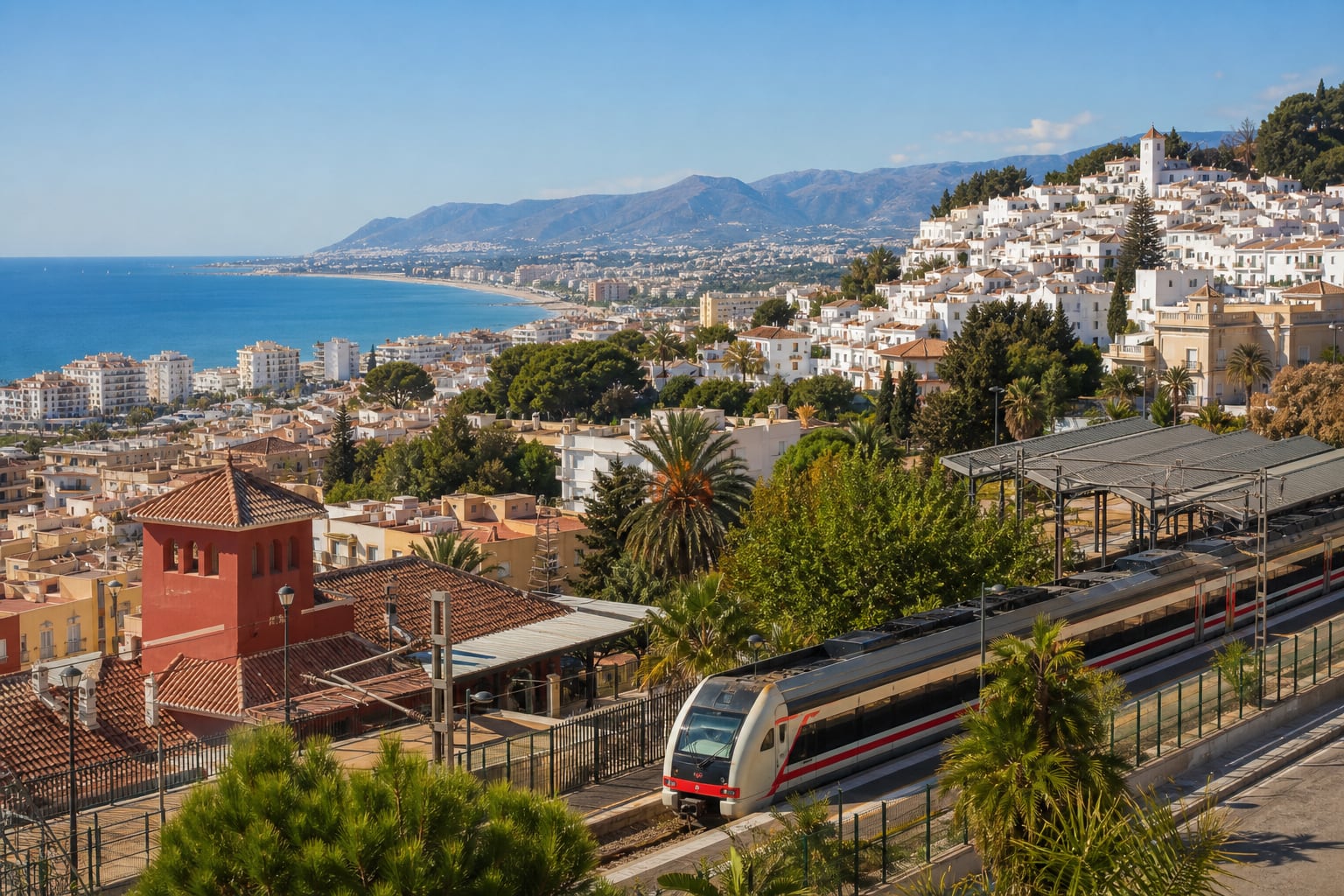
A passenger can land at Málaga-Costa del Sol Airport, walk downstairs to the Cercanías platform and be in Fuengirola in 34 minutes. Then the railway ends. Marbella, barely the next major city along the same coast, still has no station; Estepona has none either. For a property market built on international access, that break in the map is one of the strangest pieces of infrastructure on the Mediterranean.
Málaga Airport handled 26.76 million passengers in 2025, a record, and another 13.23 million in the first half of 2026, up 6.7% year on year. Yet anyone continuing west beyond Fuengirola still transfers to road. That matters to residents, workers and tourists; it also matters to buyers deciding whether a Costa del Sol home can function without a car.
A coastal railway has been discussed for decades. What has changed is that there is now a live Ministry of Transport feasibility study covering the full corridor from Nerja to Algeciras. What has not changed is the timetable: the study is still a study, and the latest information puts its completion in April 2027. Buyers should therefore treat the railway as a long-term possibility, not as an amenity they are purchasing today. The more interesting question is what the absence of rail already tells us about the property markets along the coast — and which addresses would benefit most if the missing link were eventually built.
The coast is already split into two transport markets
East of Fuengirola, the C-1 line stitches together Málaga, the airport, Torremolinos, Benalmádena and Fuengirola. The practical effect is easy to underestimate until you live with it. A buyer in central Torremolinos or Arroyo de la Miel can reach the airport by train, continue into Málaga for dinner, and connect at María Zambrano to Spain's long-distance rail network without touching a steering wheel. Renfe's normal C-1 timetable runs at roughly 30-minute intervals, with additional services at peak events, and Aena quotes the airport-to-Fuengirola journey at 34 minutes.
West of Fuengirola, the logic changes abruptly. Mijas Costa, Marbella, San Pedro, Benahavís and Estepona are overwhelmingly road-dependent. There are airport coaches and interurban buses, but no rail alternative when the A-7 slows. That distinction is one reason our Benalmádena guide reads differently from a guide to Marbella property: the former can genuinely be sold as a rail-connected second-home base; the latter still assumes a car, taxi or driver for most airport journeys.
This is not a small-town anomaly. Marbella is one of Spain's largest cities without a railway station, and its property market is considerably more expensive than most towns that do have one. The absence of rail has not prevented the city becoming an international luxury market. In fact, it makes Marbella a useful case study in how powerful the other fundamentals — climate, schools, hospitality, security, beaches and scarce prime land — have become.
A feasibility study is not a construction programme
The current process began in 2025, when the Ministry of Transport commissioned a feasibility study for a coastal rail corridor between Algeciras and Nerja for €991,911 including IVA. The scope is divided into five sections: Málaga–Fuengirola, Fuengirola–Marbella, Marbella–Estepona, Estepona–Algeciras and Málaga–Nerja. It is designed to compare major upgrades to the existing C-1 with possible new railway infrastructure and to test technical, environmental, financial and socio-economic viability.
That language matters. No route has been approved, no stations have been fixed and no construction budget has been authorised. The latest reporting, based on a Ministry transparency response, says the study will now run until 2 April 2027, several months later than the earlier timetable. It also reports potential demand of up to 60 million journeys a year across the wider corridor, including around 46 million between Málaga and Estepona. Those are demand-model estimates, not ticket sales and not a forecast that guarantees the line will be built.
For property buyers the sensible reading is therefore conservative. A reservation contract signed in 2026 should not be justified by a hypothetical station in 2032, 2035 or any other date somebody chooses to guess. The rail study is relevant because it confirms the scale of the mobility problem and the seriousness with which it is finally being measured. It is not relevant as a completion-date promise. Property brochures have a bad habit of turning infrastructure studies into future certainties; buyers should resist that temptation.
Twenty-six million airport passengers meet one rail terminus
The pressure behind the railway debate is easiest to see at the airport. Aena recorded 26,760,549 passengers in 2025, up 7.4% on 2024, with 22.25 million international passengers. The airport handled 186,990 aircraft movements and served 276 routes. In the first six months of 2026 it processed another 13,226,525 passengers, 6.7% more than in the same period a year earlier; just over 11 million of the commercial passengers were international.
That growth is directly relevant to second-home demand. Northern European buyers do not judge accessibility by kilometres on a map; they judge it by door-to-door friction. An apartment that can be reached from the terminal without hiring a car competes differently from one that requires a motorway transfer. This is particularly true for owners making frequent three- or four-night trips, older buyers who would prefer not to drive abroad, and families whose teenage children want some independence once they arrive.
Marbella has overcome that handicap through the strength of the destination itself. The Golden Mile, Puerto Banús and Nueva Andalucía attract buyers willing to accept road dependence because the property, restaurant, school and leisure offer is hard to substitute elsewhere. But the trade-off remains real. A central apartment in Marbella Pueblo can be genuinely walkable once you are there; getting there from the airport is still a different question.
The property-price map does not follow the railway map
If rail access were the dominant force in Costa del Sol pricing, the towns already on the C-1 would be the expensive end of the coast. They are not. Idealista's July 2026 asking-price data put Torremolinos at €4,218/m², Benalmádena at €4,175/m² and Fuengirola at €4,451/m². Further west, where the train disappears, Mijas averaged €3,684/m², Estepona €4,902/m² and Marbella €5,950/m². Marbella therefore commanded roughly 34% more per square metre than Fuengirola despite having no railway station.
The annual movements were equally varied. Torremolinos was up 11.1% year on year, Benalmádena 7.5%, Fuengirola 3.8%, Mijas 8.9%, Marbella 4.6% and Estepona an exceptional 17.0%. These are asking prices, not completed sale prices, and idealista changed its methodology from July 2026, so the figures should be read as a current market gauge rather than a deed-by-deed valuation. Even with that caveat, the pattern is clear: rail connectivity is one amenity among many, not the master variable setting values.
Within Marbella the same lesson becomes even stronger. Nagüeles–Milla de Oro stood at €8,269/m² in July, Nueva Andalucía at €6,249/m² and Elviria–Cabopino at €4,620/m². None has rail. The prices are being set by proximity to the sea, prestige, views, plot scarcity, schools, golf, restaurants and the quality of the housing stock. A railway could improve usability and widen the buyer pool; it would not erase the hierarchy already created by those fundamentals.
Where a future station could matter most
The likely property effect, if a rail line is eventually approved, would not be uniform. The biggest practical gain would be in dense, walkable areas where residents could reach a station on foot: central Marbella, San Pedro, central Estepona, La Cala de Mijas and similar town-based markets. A station several kilometres from a gated hillside villa would be useful, but it would not suddenly make that villa car-free. This is an inference from how buyers use these locations today, rather than a promise of future capital growth.
That distinction is important for anyone choosing between Estepona, Mijas and Marbella. A buyer prioritising a lock-up-and-leave apartment, frequent flights and the ability to spend a week without a car should assign more value to future public transport than somebody buying a six-bedroom villa with a garage, staff and school runs. The railway discussion is therefore not really about whether 'Marbella property' rises. It is about which micro-markets become easier to use.
There could also be an effect on rental depth. Rail access tends to expand the pool of people who can use a property without a hire car: weekend visitors, city workers, older tourists and younger family members. That does not automatically mean higher yields; rents, community fees, licensing rules and purchase prices still determine the arithmetic. But accessibility can reduce one of the frictions that limits demand outside peak summer weeks, particularly in town-centre apartments.
Do not buy the railway before it exists
There is a useful discipline for buyers whenever a large infrastructure project appears in a sales conversation: value the property as if the project never happens. If the home still works on that basis, any future railway is optional upside. If the case only works because somebody has drawn a station on a map, the risk is being transferred from the seller to you.
That is especially true here. The Ministry's study is real, funded and under way, but it is not due to report until April 2027. After that would come political decisions, route selection, environmental work, design, land questions, procurement and construction. The correct time horizon is therefore measured in years, not in the completion date of an apartment currently being sold off-plan.
What buyers can rely on today is more prosaic and more useful. Málaga Airport is growing at record pace. The C-1 gives the eastern Costa del Sol a genuine rail advantage. Marbella and Estepona remain road-dependent, yet both have continued to attract international demand and, in Estepona's case, unusually strong recent asking-price growth. That tells you something important: the western coast does not need a train to justify its existence as a property market. A train would make parts of it considerably easier to live in.
For an owner, ease of use eventually becomes value. The question is not whether a railway would be 'good for Marbella' in the abstract; it plainly would improve connectivity. The question is whether the particular home you are considering already gives you the access, walkability and year-round practicality you need. Buy that first. Let the train, if and when it arrives, be the bonus.
Domosmar works across the full Costa del Sol, including the rail-connected eastern corridor and the road-dependent markets from Mijas through Marbella to Estepona. Browse our current Costa del Sol properties or contact the team for a shortlist based not only on price and bedrooms, but on how often you will travel, whether you want to live without a car, and how you actually intend to use the home.