- Fuengirola began work on its biggest municipal investment to date on 1 September 2026: €48.77 million to rebuild the Los Boliches sports complex, consolidate the town's courts and create a major underground car park.
- The project adds 1,070 parking spaces across three underground levels beneath a site of roughly 14,500 m². Above them will sit a new football ground, indoor sports halls and an outdoor recreational pool with 312.5 m² of water surface.
- Fuengirola's own 2026 budget presentation put the registered population at 85,959, up from 41,713 in 1996. A town that has more than doubled its population in 30 years has to extract more capacity from a very compact urban footprint.
- Los Boliches averaged €3,837/m² in August 2026 asking prices, up 7.5% year on year. Fuengirola overall stood at €4,451/m², while nearby Las Gaviotas was materially higher at €5,634/m².
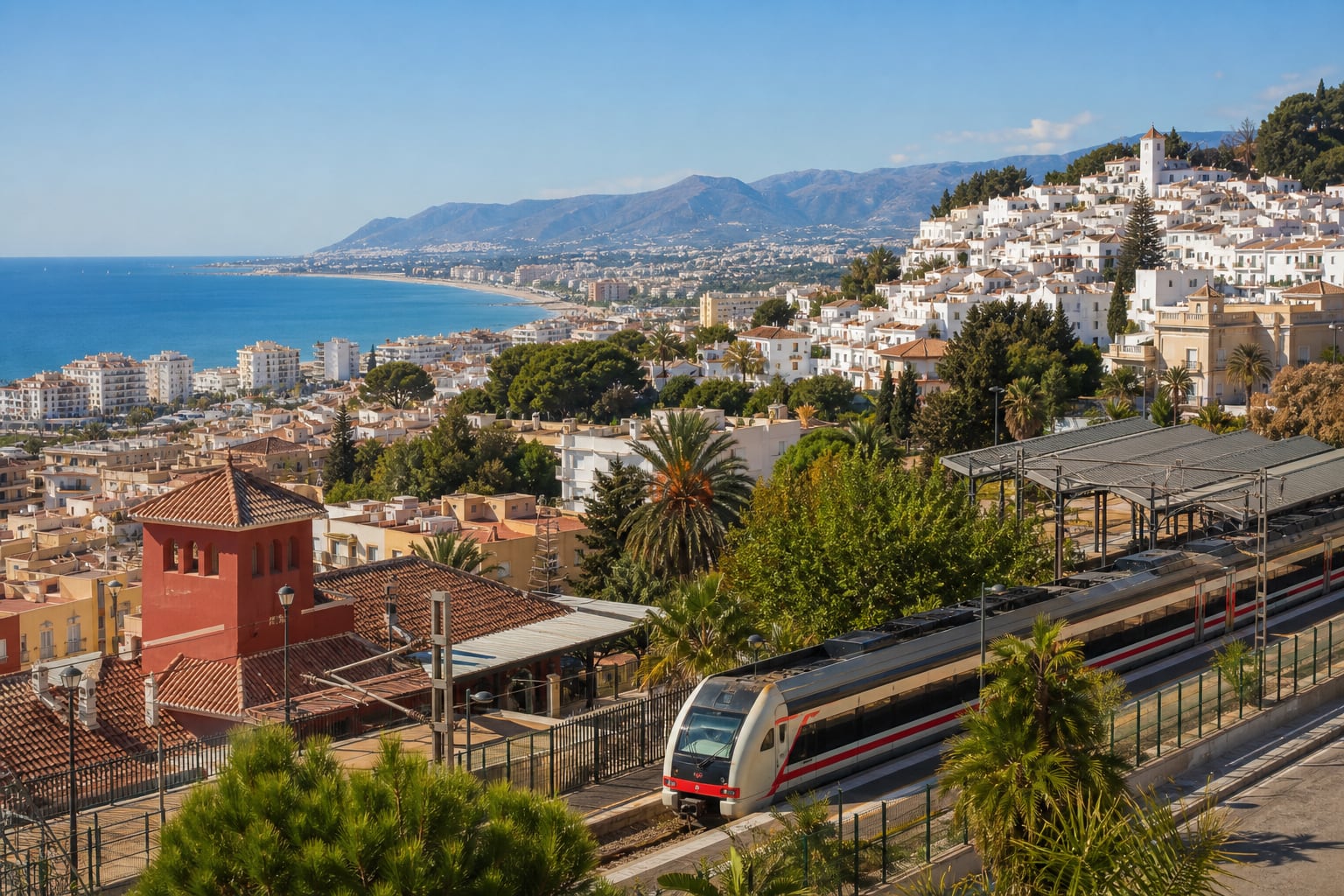
- Los Boliches also sits on the C-1 Cercanías line. Renfe says the 32 km Málaga–Fuengirola route currently runs at 20-minute intervals and is due to receive seven higher-capacity trains from 2028 through a €66.7 million rolling-stock investment.
- Bottom line: Los Boliches is a useful case study in mature Costa del Sol urbanism: instead of solving growth only by spreading outwards, Fuengirola is putting cars and services below ground so more of the surface can remain devoted to homes, sport, streets and everyday life.
At first glance, 1,070 parking spaces sounds like a traffic story. In Los Boliches, it is really a land story. On 1 September 2026 Fuengirola began demolishing the existing Santa Fe–Antonio Basilio sports complex for a €48.77 million rebuild that will put those spaces on three underground levels, then reconstruct sport and public services above them. In a town where the coastline is urban, the railway runs through established neighbourhoods and developable land is finite, the interesting word is not “parking”. It is underground.
That distinction matters to property buyers because Los Boliches is not being planned as a new peripheral district with empty plots and generous roads. It is an established coastal neighbourhood trying to become more functional without losing the qualities that make it attractive: the beach, the train, shops, cafés, schools, ordinary Spanish street life and the ability to do a surprising amount on foot. The new complex is therefore a test of a wider Costa del Sol question: how does a successful, already-built town add capacity without simply adding more surface congestion?
For Fuengirola, the answer is increasingly to make the ground work twice. Cars go below. Sport, public services and people stay above. It is expensive urban engineering, but in Los Boliches the alternative — using 14,500 m² of scarce central land mainly as open parking — would be an even more expensive use of location.
Why €48.77 Million Makes Sense in a Town That Has Doubled
Fuengirola’s 2026 municipal budget presentation contains the statistic that best explains the pressure. The town hall put the registered population at 85,959, compared with 41,713 in 1996. In other words, the registered population has more than doubled in three decades. The municipal budget for 2026 is €113.665 million, with the investment chapter rising 63% from the previous year.
Against that background, €48.77 million is not a small neighbourhood refurbishment. As simple scale arithmetic, it is equivalent to about 43% of one year’s entire municipal budget. That does not mean 43% of the 2026 budget is being spent in one cheque — the project is multi-year and the comparison is not an accounting allocation — but it shows why the town describes the scheme as the largest investment in its history.
The land constraint is equally important. Fuengirola is unusually compact for a Costa del Sol municipality. Unlike Marbella, Mijas or Estepona, it cannot keep answering growth by opening large new districts many kilometres from the original centre. The mature parts of Fuengirola have to become better at carrying more residents, visitors, services and vehicles inside a fixed footprint. That puts a premium on infrastructure that can stack uses vertically rather than spread them horizontally.
What the Los Boliches Project Actually Adds
The town hall’s 1 September start-of-works announcement confirms a site of roughly 14,500 m², up from a little over 13,000 m² today. Below it, 1,070 parking spaces will be arranged on three underground floors. That is a meaningful change from the tender stage at the end of 2025, when the project was described as around 1,000 spaces on two levels. The final awarded design has therefore increased both the number of spaces and the underground depth.
Above ground, the sports programme is substantial rather than cosmetic. It includes a reoriented football pitch, refurbished indoor hockey and volleyball halls, a further multipurpose pavilion, changing rooms, spectator areas, storage, a technical training classroom, first-aid space and the usual operational rooms. The most visible addition will sit on the roof: an outdoor recreational pool with 312.5 m² of water surface. Earlier tender detail specified 25 metres by 12.5 metres.
The court headquarters adds another layer. Current judicial services are dispersed among four buildings totalling about 4,300 m²; the new complex will consolidate them in roughly 7,272 m² with separate access from the sports facilities. It is not a property amenity, but it removes a fragmented public service from several premises and puts it into one purpose-built site.
The current programme allows three months for technical planning and 29 months for construction, shorter than the original tender’s four-plus-32-month maximum. Importantly for everyday life, the municipality says the underground car park is intended to be delivered and opened once that element is complete, even if work continues elsewhere in the complex. For Los Boliches residents, that sequencing is more useful than waiting for one ceremonial opening day at the end of the entire project.
Los Boliches Is Still Cheaper Than Fuengirola’s Premium Beach Districts
Infrastructure becomes commercially interesting when it meets the price map. Idealista’s August 2026 asking-price index put Fuengirola overall at €4,451/m², up 3.0% over twelve months. Los Boliches stood at €3,837/m², up 7.5% year on year and at a new high for that district in the current series.
That puts Los Boliches roughly 14% below the Fuengirola-wide asking average. The contrast inside the municipality is more revealing. Las Gaviotas averaged €5,634/m² and El Higuerón €5,596/m², while Los Pacos stood at €3,485/m² and Centro Ciudad at €3,330/m². These are advertised area averages, not completed sale prices, and the methodology was updated in July 2026. Even so, they show that “Fuengirola” is not one price point.
| Fuengirola area | Aug 2026 asking €/m² | Annual change | €500k arithmetic area | Broad buyer reading |
|---|---|---|---|---|
| Los Boliches | €3,837 | +7.5% | 130 m² | Established beach-and-train district with local street life |
| Fuengirola overall | €4,451 | +3.0% | 112 m² | Municipal benchmark across very different micro-markets |
| Centro Ciudad | €3,330 | +1.3% | 150 m² | Urban convenience and town-centre services |
| Los Pacos | €3,485 | +6.3% | 143 m² | Residential hillside market with more car use |
| El Higuerón | €5,596 | +2.5% | 89 m² | Newer premium hillside and resort-style stock |
| Las Gaviotas | €5,634 | +12.7% | 89 m² | Higher-priced coastal stock beside Los Boliches |
The simple €500,000 arithmetic gives the distinction a physical shape: about 130 m² at the Los Boliches average, versus 89 m² at the Las Gaviotas average. No sensible buyer should shop by that calculation alone, but it explains why Los Boliches can be interesting to someone who wants an established, walkable coastal neighbourhood without paying the highest Fuengirola price band.
Domosmar’s live catalogue on 7 September 2026 contains 16 available Fuengirola developments, with a median advertised development entry price of about €484,500. That is a snapshot of our stock rather than a census of the market, and much of the new-build offer sits outside the traditional Los Boliches fabric. The useful comparison is therefore often new-build specification versus established-neighbourhood convenience rather than new versus old in the same street.
Rail, Beach and Parking Are Not Competing Amenities
The temptation with an urban district is to treat parking as evidence that a place is insufficiently walkable. Los Boliches shows why that is too simplistic. The neighbourhood is served by a Cercanías station and sits beside Fuengirola’s continuous urban coastline, yet residents still own cars for school runs, golf, larger supermarket trips, airport collections and journeys west towards Marbella and Estepona. The best urban model is not necessarily car-free. It is one in which the car can disappear when it is not needed.
Rail is already a serious part of the equation. Renfe says the C-1 Málaga–Fuengirola line is 32 km long and currently operates at 20-minute intervals. The Málaga Cercanías network carried 15.54 million passengers in 2025, with demand concentrated heavily on the C-1. Parts of the route are already at operating limits because almost half the line remains single track.
From 2028 Renfe plans to add seven S452 high-capacity trains to the C-1 through a €66.7 million rolling-stock investment. Each is planned at six cars and up to 900 passengers including standing passengers. Los Boliches already has the station, so greater capacity on the existing line can matter without waiting for an entirely new transport corridor.
Then there is the coastline. Fuengirola Town Hall describes seven kilometres of beaches maintained year-round, with adapted access across the municipal shoreline and a specific assisted bathing area in Los Boliches. This is the kind of urban beach environment where the value of a car is often highest when the car is parked: arrive, leave it underground, then walk to the sea, train, lunch and shops.
The Trade-Off Is 29 Months of Works in an Established Neighbourhood
A project of this scale is not a free improvement. Demolition began on 1 September, and the current construction programme runs for 29 months after the technical planning phase. If the schedule holds, work extends into early 2029. Noise, construction traffic, temporary route changes and the loss of existing facilities while rebuilding are real short-term costs for the immediate neighbourhood.
That matters especially to buyers purchasing for immediate personal use or short-term letting. A beautiful apartment overlooking a major works site has a different two-year ownership experience from the same apartment after completion. The practical response is not to avoid Los Boliches; it is to check the exact position of the property against the construction footprint, access roads and likely phases. A five-minute walk away can feel very different from a balcony directly facing demolition.
The longer view is more positive. Unlike speculative infrastructure that may remain on a plan for years, this project has moved into physical works. The parking component is also intended to open before the whole complex if it is completed first. That creates a reasonably clear distinction between temporary disruption and permanent amenity. Buyers with a 2029-plus horizon can judge the finished proposition; buyers needing calm immediately should price the intervening period into the decision.
Why This Matters to a Second-Home Buyer
Second-home buyers often overvalue the spectacular feature and undervalue the boring one. The sea view wins the first viewing. The garage wins the 20th arrival. A large communal pool photographs better than a train station. A neighbourhood that lets you walk to breakfast is less dramatic than a rooftop terrace, but it may be used every morning. Los Boliches works because several unglamorous conveniences sit close together.
This is particularly relevant for buyers who use the Costa del Sol frequently rather than for one long summer stay. As we argued in our piece on Málaga Airport and the weekend second home, repeated short stays reward frictionless arrival and everyday ease. Los Boliches offers that with rail, beach and local services; our earlier analysis of why the train currently stops at Fuengirola explains the wider transport advantage.
For a buyer around the half-million-euro mark, this is also why Fuengirola deserves comparison with newer, more spread-out markets. Our €500,000 Costa del Sol new-build analysis found strong choice in Mijas and other value markets. Fuengirola offers less land for large resort-style schemes, but it compensates with a denser urban structure. The decision is not only how much new home €500,000 buys; it is how much city comes with it.
Fuengirola’s Bet Is That Density Can Be an Asset
Density gets a bad name when it produces traffic without services, apartment blocks without public space or growth without infrastructure. It becomes an asset when everyday destinations are close enough to walk, public transport is usable and scarce land performs several jobs. The Los Boliches complex is interesting because it is spending heavily on the less visible side of density: storage for cars below ground, bigger public services, more sports space and a rebuilt civic facility on an existing urban site.
The €48.77 million project will not transform every street in Los Boliches, nor should buyers assume a direct euro-for-euro uplift in nearby property values. Infrastructure rarely works that neatly. Its importance is more practical: 1,070 cars can be stored without taking 1,070 surface spaces; courts that occupy four buildings can be consolidated; sport can remain in the neighbourhood; and a dense district can add capacity without moving its centre of gravity further from the coast.
That is the broader buyer lesson. On the Costa del Sol, “new” does not always mean a new residential development. Sometimes the more interesting improvement is what happens around an existing home. Los Boliches is being asked to work harder because Fuengirola has grown. If the project is delivered well, building down may be exactly what allows the neighbourhood above it to keep working.
Sources & Data Notes
- Fuengirola Town Hall — Los Boliches complex start of works, 1 September 2026
- Fuengirola Town Hall — 2026 municipal budget and population figures, 25 November 2025
- SUR in English — current Los Boliches project scope, 2 September 2026
- Idealista — Fuengirola and district asking-price indices, August 2026
- Renfe — C-1 capacity and seven new S452 trains planned from 2028, August 2026
- Fuengirola Town Hall — current municipal beach and accessibility information
The property figures above are asking-price indices, not completed transaction prices. The Los Boliches construction figures describe the current public project and can change if the programme is formally revised. Domosmar inventory figures are a live stock snapshot taken on 7 September 2026 and should not be read as total market supply.
If Fuengirola’s mix of beach, rail and urban convenience fits your brief, browse current Fuengirola properties, compare the wider Costa del Sol new-build collection and nearby Mijas properties. For a shortlist that weighs walkability, station access, parking, construction timing and the amount of new-build specification you actually need, contact Domosmar and we will compare the practical ownership experience, not only the brochure photographs.