The sharpest rise in property prices anywhere in Marbella over the year to April 2026 did not happen on the Golden Mile, in the golf valley of Nueva Andalucía, or behind any of the gated barriers that guard the hills above the coast. It happened in the middle of the town itself. According to idealista's April 2026 price report, the district it labels Marbella Pueblo — the zone covering the historic centre and the working streets around it — reached €5,689 per square metre, a rise of 30.1% in twelve months. No other part of the municipality came close.
That figure deserves a second look, because it runs against the story most buyers arrive with. For two decades the money on the Costa del Sol has flowed outward — to the beachfront resorts, the golf urbanisations, the branded villas on the ridgelines. The centre of Marbella, with its 1960s apartment blocks and its narrow one-way streets, was where you rented for a season, not where you bought for the long term. The April data, and the wave of new development now reshaping the centre's streets, suggest that assumption is being quietly revised. This is a guide to Marbella Pueblo: what the town centre actually is, who is buying there, and why its numbers have started to behave like prime.
A thirty-per-cent year in the middle of town
Set the district figures side by side and the hierarchy is clear. The Golden Mile — idealista's Nagüeles–Milla de Oro zone — remains the most expensive ground in Marbella at €6,872/m², followed by Nueva Andalucía at €5,978/m². Marbella Pueblo now sits third at €5,689/m², ahead of Las Chapas–El Rosario, Río Real–Los Monteros, San Pedro de Alcántara, and the coast's most affordable district, Elviria–Cabopino, at €4,514/m². The municipality as a whole averaged €5,596/m² in April 2026, up 9.0% year on year and within a whisker of the February high of €5,607.
What separates the centre from everywhere else is the speed of the move. A 9% municipal rise is strong by any measure; a 30.1% jump concentrated in a single district is exceptional, and it did not happen because the coast suddenly discovered a new stretch of beach. Part of the answer is arithmetic. A district long dominated by resale flats from the 1960s and 1970s is now absorbing a run of higher-specification new-build apartments, and each completion pulls the recorded average upward. But mix alone does not explain a third in a year. Buyers are also paying more because they increasingly want what the centre offers and the resorts cannot manufacture: a town that works in February as convincingly as it does in August.
The new stock is visible on the ground. Contemporary schemes have begun to appear on infill plots between the old blocks, and new-build apartments in the centre now start at around €530,000 for the smaller units, climbing well into seven figures for the larger penthouses and boutique villas among the current Marbella Centre developments. That is a wide spread, and it reflects a district in transition — one where a modest two-bedroom resale on a tired 1970s block and a brand-new lock-up-and-leave apartment can sit on the same street with a six-figure gap between them.
Zoom out to the whole municipality and the underlying market looks steady rather than frothy. The median Marbella apartment changed hands at roughly €630,000 in July 2026 on a gross rental yield of about 5.1%, with the studios and one-bedroom flats that form the centre's staple stock among the stronger performers. Prices are still climbing faster than rents, which is the tension every buyer should price in — but the direction of travel in Marbella Pueblo has been unusually consistent.
A grid you can actually walk
The reason the centre holds its value has less to do with square metres than with the fact that you can live there without a car. The spine of the town runs along Avenida Ricardo Soriano, which becomes Avenida Ramón y Cajal as it heads east — a single high street carrying the banks, pharmacies, supermarkets and chain stores that the resort urbanisations have to drive to. Step off it in any direction and you are within a few hundred metres of a bakery, a health centre, a school run and the sea. Very little in a golf community five kilometres inland can match that density of ordinary usefulness.
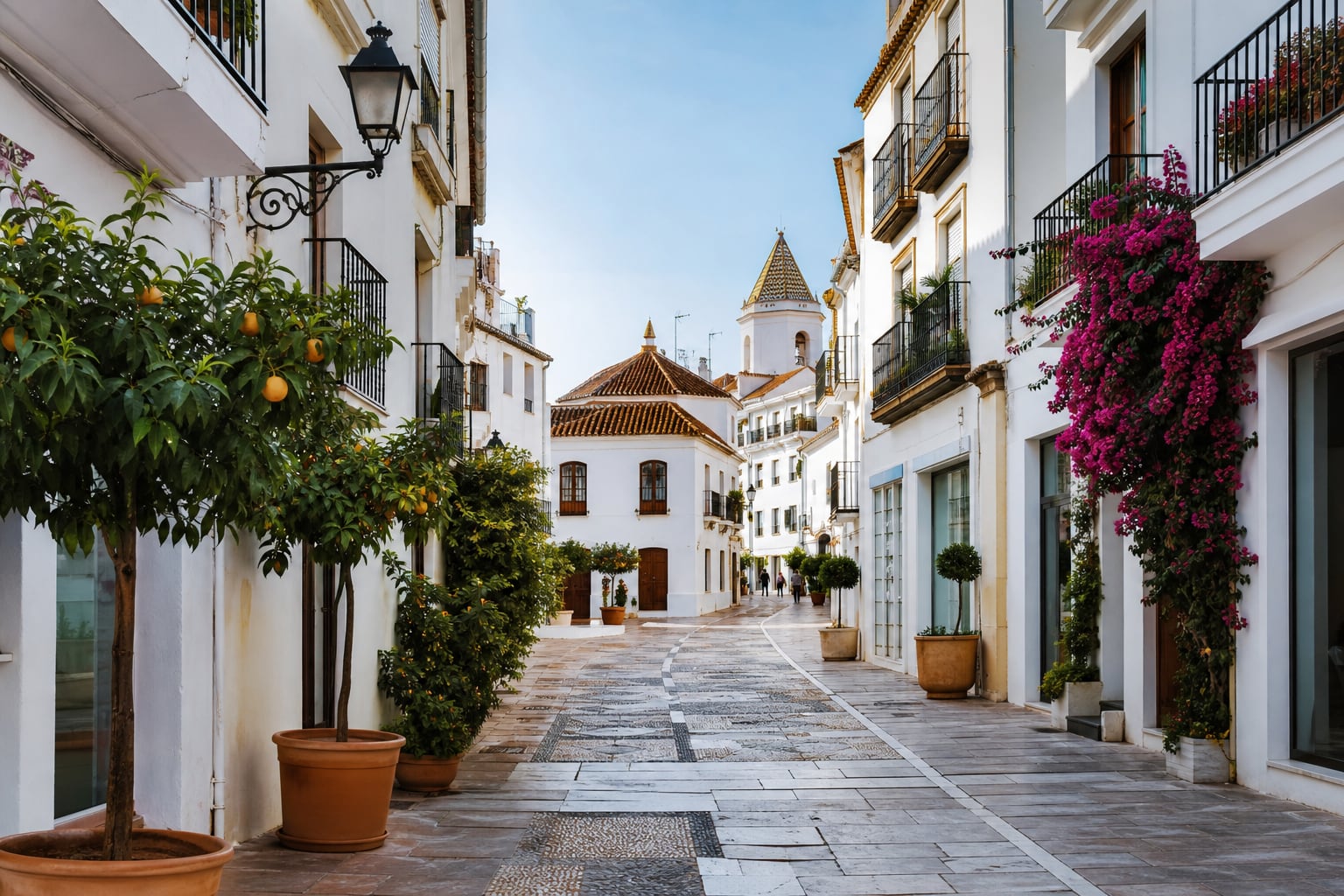
The town's set piece sits between the high street and the water. Avenida del Mar, the marble promenade that links the shaded La Alameda gardens to the seafront, is lined with ten original bronze sculptures by Salvador Dalí, cast in Verona by the Bonvicini foundry and set among fountains and café terraces. It is the kind of open-air collection most towns would fence and ticket; here it is simply the route residents take to the beach, with the most central underground car park in Marbella tucked directly beneath it. A few streets north, the whitewashed lanes of the Casco Antiguo open onto the orange trees of the Plaza de los Naranjos, and to the west the Parque de la Constitución hides an open-air auditorium among its terraces.
Daily life runs on the same walkable logic. The Mercado Municipal, the town's covered produce market on the edge of the old quarter, still sets the rhythm of the morning for a certain kind of resident, and the fish stalls close by lunchtime. The central beaches — La Fontanilla to the west of the promenade and Playa de Venus to the east — are a flat five-minute walk from most of the district's apartment blocks, and the Paseo Marítimo strings them together for anyone who prefers to arrive on foot rather than hunt for a space.
This is the quality that does not appear in a price-per-metre table but underwrites it. An apartment on the Golden Mile or in Nueva Andalucía buys prestige and space; an apartment in Marbella Pueblo buys the ability to leave the car keys in a drawer for a week. For a growing share of buyers — retirees, remote workers, downsizers — that is worth paying for, and it is the single hardest thing for a new resort to build from scratch.
Who is actually buying in the centre
The buyer profile in Marbella Pueblo is broader than almost anywhere else on the coast, and that breadth is part of its resilience. Spanish families who have lived in the town for generations sit alongside northern-European retirees who want a lock-up-and-leave flat within walking distance of a doctor, and a newer cohort of remote workers who value a functioning town over a gated pool they rarely use. Where the Golden Mile and the golf valleys sell a lifestyle, the centre sells a life — and it does so across a much wider range of budgets.
For investors, the arithmetic is friendlier here than in the prime resorts. Marbella's smaller apartments — the studios and one-bedroom flats that the centre supplies in quantity — carry the strongest gross yields in the municipality, with studios running above 5.5% against a citywide apartment average near 5.1%. Median entry prices reflect the same pattern: roughly €300,000 for a studio, close to €390,000 for a one-bedroom and around €565,000 for a two-bedroom across Marbella as a whole in mid-2026. Central stock also tends to let year-round, drawing long-term tenants and resident professionals rather than depending purely on the summer holiday market that the beach urbanisations live and die by.
The contrast with the trophy end of the market is instructive. Gross yields on prime Golden Mile stock typically run between 3% and 5% before costs, and once community fees, IBI and management are deducted the net figure often lands between 1.5% and 3%. A well-bought central apartment does not promise spectacular capital appreciation of the kind a branded villa might, but it tends to work harder as an income asset and is far easier to let when the owner is away. Anyone buying to rent should still check the community's own rules and the current position on tourist-licensing before committing, as short-let regulation across Andalucía continues to tighten.
What the centre gives up — and what it doesn't
Honesty about the trade-offs matters, because the centre is not for everyone. Much of the resale stock is genuinely old, and a 1970s block may come without a lift, without private parking and without the sweeping communal gardens and pools that define the resort product a few kilometres away. Parking is the recurring complaint — the underground car parks are good but not free, and a street space in August is a minor sport. And August itself is the price of living where everyone wants to holiday: the same walkability that empties the streets in February fills them shoulder to shoulder for six weeks in summer.
Against that, the fundamentals are hard to argue with. A public health centre and private clinics sit within the town, with the larger private hospitals a short drive along the Golden Mile and in Nueva Andalucía. Málaga airport is about 45 minutes east on the AP-7, and Puerto Banús is roughly ten minutes west along the coast for anyone who wants the marina life without paying to live on top of it. The one genuine structural gap is rail: Marbella still has no railway station, and until the long-discussed coastal line is built, the car and the bus remain the way in and out — a limitation the centre shares with every town between here and Estepona.
For a buyer weighing the centre against the coast, the decision usually comes down to a single question: do you want amenity delivered by your urbanisation, or by your town? The resort answer is a concierge, a gym and a gate. The Marbella Pueblo answer is a market, a promenade and a front door you can walk out of into a working city. The 30.1% figure suggests a growing number of buyers have decided which they prefer.
The case for the centre
For most of the modern era, central Marbella was the part of the map serious money drove through on its way to somewhere more exclusive. The 2026 figures read like the market catching up with something residents already knew: that a walkable town centre with a Dalí promenade, a working market and the sea at the end of the street is a rare asset, and rarity eventually finds its price. The re-rating of Marbella Pueblo is not a bubble in search of a reason so much as prime demand rediscovering an address it had overlooked. For a buyer who wants to own inside the town rather than beside it, that shift is the opportunity — and the earlier stages of a re-rating are usually the better ones to enter.
Domosmar tracks new-build and resale stock across the town centre and every district around it. To see what is currently available in the heart of Marbella, browse our Marbella Centre listings or the wider Costa del Sol property collection, and contact our team for a shortlist matched to your budget and the way you intend to use the home.