Three hundred waiters brought up from Seville served 22 kilos of beluga caviar to 1,700 guests on the night Puerto Banús opened in May 1970. Grace Kelly and Prince Rainier were there; so were the Aga Khan, Roman Polanski and Hugh Hefner, and a young Julio Iglesias was paid 125,000 pesetas to sing for the room. Fifty-six years on, José Banús's marina remains the most photographed square kilometre on the Costa del Sol — and, for property buyers, one of the least understood. Behind the superyachts and the Lamborghini showroom sits a ring of gated apartment complexes that trade on their own logic, at asking prices running from roughly €500,000 to €5 million, in a market that behaves quite differently from the postcard.
The confusion starts with the name. "Puerto Banús" properly describes the marina and the commercial village around it, where freehold homes are scarce — most of the buildings on the waterfront itself are given over to shops, restaurants and short-term rentals. The residential market that estate agents mean when they say Puerto Banús is the belt of urbanisations behind and to either side of the port: some pressed directly against the sand, some a street or two inland, each with its own price band and buyer. For anyone weighing a Marbella-area purchase, knowing which complex sits on which line — and what that line costs — matters far more than the postcode on the brochure.
A Village Built in One Go
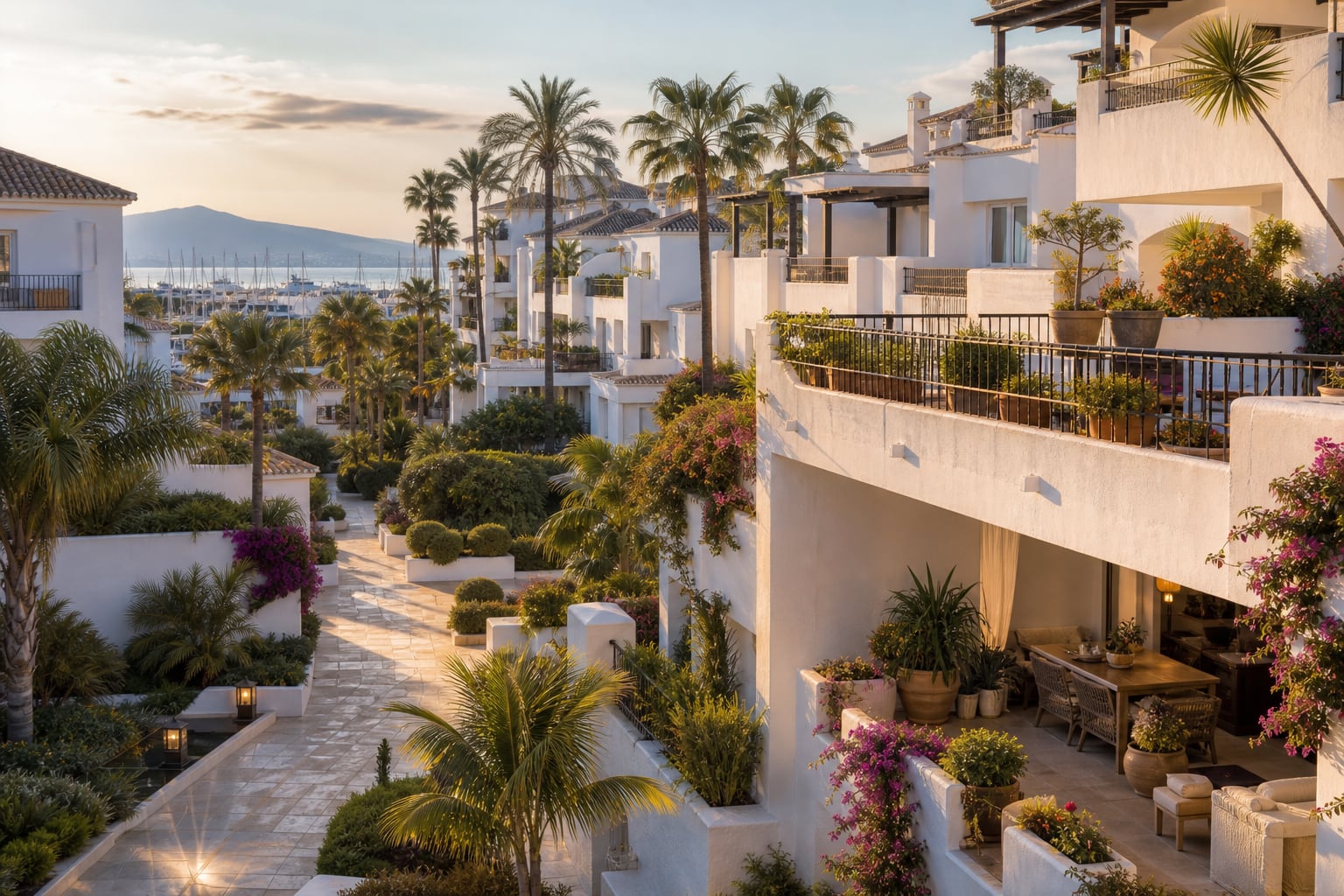
Puerto Banús was conceived as a piece, not accreted over centuries, and that is still its defining oddity. José Banús, the Madrid developer who gave the port his name, originally contemplated tower blocks on the site. It was the architect Noldi Schreck — who had worked on Beverly Hills — together with the young Mexican-Spanish architect Marcos Sainz who persuaded him to build a whitewashed Andalusian village around a luxury harbour instead, making it, according to the account collected on the port's Wikipedia entry, the first port designed entirely by a single architectural team.
The result sits six kilometres southwest of Marbella town, within the district of Nueva Andalucía. The marina holds 915 berths for vessels of 8 to 50 metres across 15 hectares of sheltered water, and the Municipality of Marbella estimates the port draws close to five million visitors a year. The set dressing is famous enough to need little introduction: the boutiques of Dior, Gucci and Dolce & Gabbana along the front line, Salvador Dalí's three-ton bronze rhinoceros installed in 2004, Zurab Tsereteli's 26-metre "La Victoria" rising behind the control tower, and the plaza named after Málaga-born Antonio Banderas, anchored by an El Corte Inglés that ranks among the busiest department stores in Spain.
One structural point separates Banús from almost every other address on the coast: the moorings themselves are privately held and trade through the port's own brokerage, so a berth is an asset with a price history, much like the apartments behind it. We covered the berth economics — and how the five harbours of the coast compare — in our guide to the Costa del Sol's marinas and the property behind them. Here the subject is the bricks.
The Front Row: Playas del Duque to Los Granados
The most valuable homes in Puerto Banús line the beaches on either side of the harbour mouth. On the boulevard approaching the port stands Playas del Duque, the grande dame of the eastern approach: a gated complex of generously built apartments in mature gardens, where — according to the January 2026 area guide published by Marbella brokerage MPDunne — three-bedroom apartments start around €825,000 and run past €2 million for the best positions.
East of the port, directly on the sand, sit Los Granados I and II — arguably the strongest apartment addresses on this stretch of coast outside the Golden Mile hotels. Both phases are gated with 24-hour security, subtropical grounds and direct beach access, and the ground-floor units and duplex penthouses come with private pools. Asking prices in the Los Granados complexes start near €2.95 million and reach €5 million for duplex penthouses; a frontline three-bedroom of 365 square metres was listed this year at €4.9 million, which works out to roughly €13,400 per square metre. West of the harbour, Laguna de Banús and Malibu complete the front row, both built around indoor pools, spas and gyms in tropical gardens.
Those per-metre figures deserve context. On the Golden Mile proper, two districts east, verified frontline resales in the Marbella Club and Puente Romano complexes have traded above €15,000 per square metre — we mapped that strip in our zone-by-zone Golden Mile guide. Against that benchmark, the Banús front row offers frontline Mediterranean living, walkable nightlife and a globally recognised address at a meaningful discount to the hotel corridor next door. Whether that discount narrows is one of the open questions of the next few years.
One Street Back, Half the Price
Step one line back from the sand and the arithmetic changes sharply. The band of complexes behind the port — Medina Gardens, El Embrujo, Ventura del Mar, Jardines del Puerto, Terrazas de Banús, La Alcazaba, Playa Rocío, Benabola and Marina de Banús among them — forms the volume market of Puerto Banús. Entry listings occasionally appear around €400,000, but stock at that level is thin; a more realistic floor is the €525,000 at which two-bedroom apartments in Embrujo Playa have been offered this year. Most of these communities were built with the resort infrastructure the area is known for — pools, gated perimeters, underground parking — and sit within a few minutes' walk of both the marina and the beach.
The second line also produces the most interesting value-per-metre cases in the area. A fully renovated duplex penthouse of 176 square metres in Jardines de las Fuentes, second line to the beach, was asking €1.49 million this year — around €8,500 per square metre, or a little over half the rate commanded by the frontline three-bed at Los Granados. For buyers who care about light, space and walk-everywhere convenience more than about a sea view from the sofa, that gap is the single most useful number in this article.
Houses exist here too, though they are the exception. The villa pockets within walking distance of the port — Villa Marina, La Alzambra, Atalaya de Río Verde and Cortijo Blanco — carry asking prices from about €3.5 million upwards. They occupy an unusual niche: detached family privacy inside what is functionally a resort village, a combination that barely exists elsewhere between Marbella and Estepona.
What the District Index Says — and What It Hides
Puerto Banús does not get its own line in the price indices; it is counted within Nueva Andalucía, the district that also contains the Golf Valley. On idealista's February 2026 index the district stood at €5,654 per square metre — its historical maximum — up 6.6% year on year, figures reported in idealista's March 2026 analysis of where to invest in Marbella, which named Nueva Andalucía one of the town's three standout investment areas. By April the same index had pushed on to €5,978, an 8.6% annual rise. For comparison, Nagüeles–Milla de Oro recorded €6,789 per square metre in February and Los Monteros, the fast riser of East Marbella, €8,772.
The district average conceals an unusually wide spread. Garden apartments up in the Golf Valley, around Las Brisas, Aloha and Los Naranjos, trade near the index; the Banús front row trades at more than double it. That is worth holding in mind when reading any headline about Nueva Andalucía prices: the same district number covers a fairway-view flat a ten-minute drive inland and a beachfront duplex above the sand. Our live inventory across the district is collected on the Nueva Andalucía properties page.
On the rental side, idealista's assessment of the district is "balanced appreciation, strong rental potential and consistent international interest" — and Puerto Banús is the part of the district where that rental demand is most visible. The port's five million annual visitors need somewhere to stay, the season runs far beyond the summer peak, and well-kept apartments within walking distance of the marina let readily for most of the year. Owners should note the flip side: several of the waterfront buildings are dominated by short-term rental use, which is precisely why buyers seeking a quiet permanent residence tend to choose the gated complexes a street or two back rather than the marina front itself.
The Part the Cameras Miss
Day-to-day life in Puerto Banús is more practical than its reputation suggests. The El Corte Inglés on the Antonio Banderas plaza — trading here since 1992 — functions as the neighbourhood's supermarket, food hall and department store in one. Two beaches flank the marina, each with watersports concessions and beach bars, and the Paseo Marítimo boardwalk lets residents walk to San Pedro de Alcántara in one direction or towards Marbella town in the other without touching a road. Málaga airport is roughly forty minutes east along the A-7 or AP-7, and the microclimate under the Sierra Blanca ridge produces a mean annual temperature around 18°C.
The eating and drinking are as layered as the property. Los Bandidos and the Argentinian grill El Gaucho hold the old-guard end; Jack's Smokehouse feeds families on the waterfront; the pizzeria Picasso has queues that have outlasted most of the nightclubs around it. In summer the tempo is set by the beach clubs — Ocean Club on the west side among them — and the bar terraces run into the small hours. Anyone considering a purchase should also visit in January, when the port is quiet, many terraces are half-empty, and the appeal shifts from the scene to the setting. Buyers who find the winter calm disappointing usually belong up the hill in the Golf Valley; buyers who find it restful have self-selected correctly.
That honest seasonal profile shapes who owns here: lock-up-and-leave second-home owners, rental investors, and owners who want maximum life-per-week during their stays. What Puerto Banús is not — and has never pretended to be — is a sleepy Andalusian village. The village aesthetic was always a stage set; the substance underneath is a compact, walkable, superbly serviced resort quarter with a finite number of homes.
And finite is the operative word. The port and its residential ring were built out decades ago under planning rules that no longer exist; no comparable marina-front land remains between Marbella and Estepona, and the district index sits at a record with mid-single-digit growth. For a buyer who wants the Costa del Sol at its most concentrated — beach, harbour, shopping and nightlife inside a ten-minute walk — the apartments behind José Banús's harbour remain one of the most liquid and internationally recognisable assets on the coast, with a front-row-to-second-line price structure that still rewards buyers who study it complex by complex.
If Puerto Banús is on your shortlist, browse our current new-build and resale homes across the Costa del Sol, or talk to the Domosmar team about which complex — front row, second line, or up in the Golf Valley — actually fits the way you plan to use the property.