Where do you keep the boat? For a certain kind of Costa del Sol buyer that question comes before bedrooms, before orientation, before the school run. The answer is more generous than most newcomers expect. Between Benalmádena's pastiche-Andalusian waterfront and Estepona's working fishing quay — a stretch of coast you can drive in under fifty minutes — five marinas hold just over 3,000 berths between them: more than 1,000 at Puerto Marina Benalmádena, 915 at Puerto Banús, 447 at Estepona, 377 at Marbella's town port and 169 at Cabopino.
That density of nautical infrastructure matters to buyers who will never own so much as a paddleboard, because each harbour anchors a distinct residential micro-market. The apartment above a berth in Puerto Banús trades in a different universe from the townhouse behind the boardwalk at Cabopino, and the gap between them is measurable in euros per square metre. This is a tour of the five harbours as a sailor sees them — and as a buyer should.
Puerto Banús: 915 Berths and a Market of Its Own
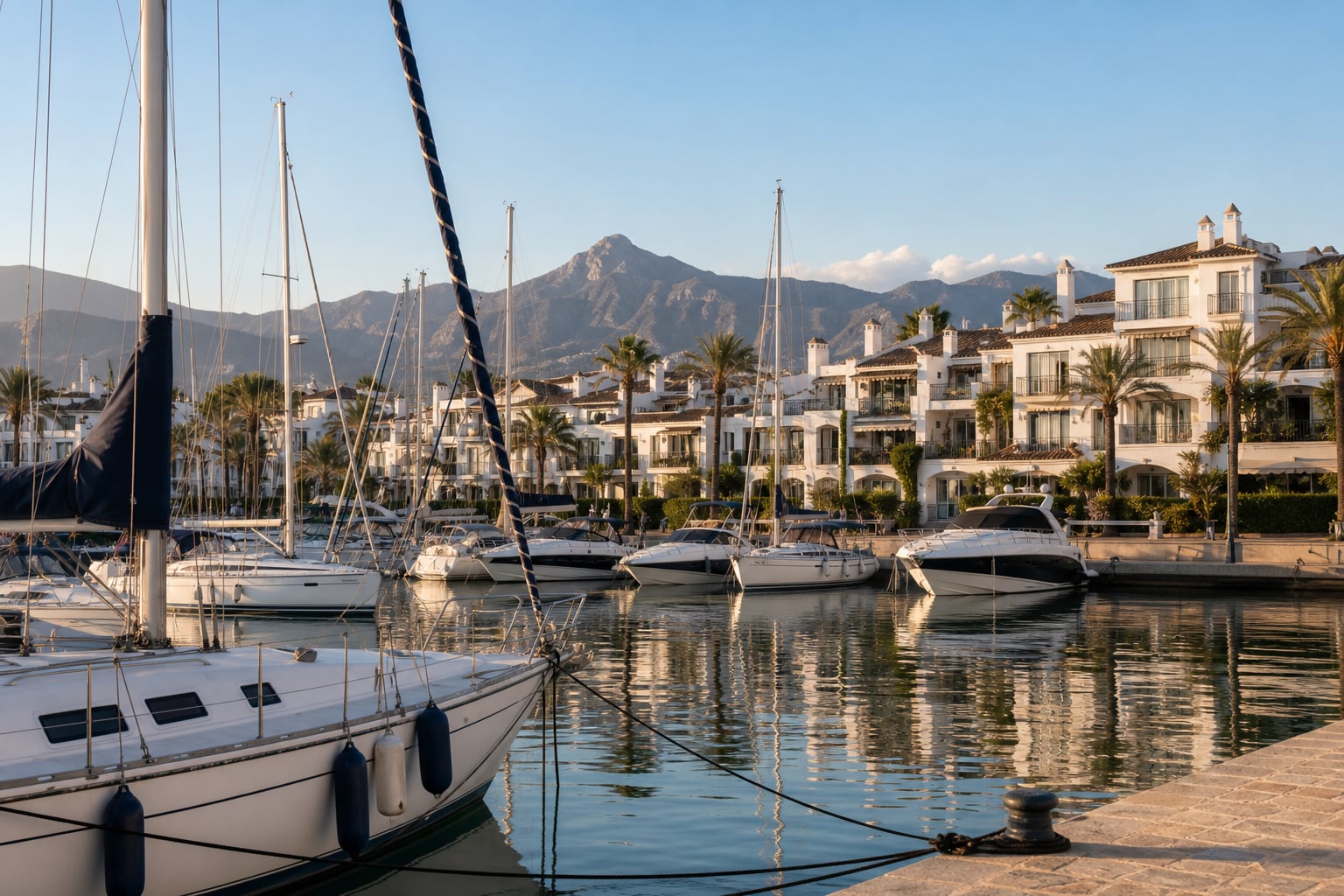
José Banús opened his marina in 1970, and half a century later it remains the flagship. Marina Puerto Banús spreads 915 berths across 15 hectares of sheltered water and takes vessels up to 50 metres alongside, with anchorage arranged for anything larger. The working infrastructure behind the show is serious: a refuelling station with fuel supplied directly at berths on the Dock of Honour, a 50-tonne travelift in the boatyard, a diving service, and onsite brokers handling charter and yacht sales year-round.
What surprises many newcomers is that the berths themselves are privately held. Moorings in Puerto Banús are bought and sold like property, with the port operating its own brokerage and advisory service for purchases and rentals, and publishing its mooring tariffs annually. A berth here is an asset with a paper trail, a running cost and a resale market — which is precisely why serious owners treat the choice of home port as part of the same financial decision as the choice of home.
The residential market wrapped around the port reflects that. On idealista's April 2026 index, the Nueva Andalucía district — which includes Puerto Banús and the apartment complexes immediately behind it — stands at €5,978 per square metre, up 8.6% year on year. One district east, Nagüeles–Milla de Oro sits at €6,872 per square metre, its all-time high. We mapped that strip zone by zone in our Golden Mile property guide; the short version is that the closer you get to the water between the port and Marbella town, the harder the market becomes to enter.
The Town Quay: Marbella's Port and the Club Behind It
Eight kilometres east of Banús, Marbella keeps a different kind of harbour. The Puerto Deportivo de Marbella sits in the middle of town, a few minutes on foot from the Casco Antiguo, with 377 berths for boats of 6 to 20 metres. It is built on two levels — port terraces above, nautical premises below — and it is unmistakably a local institution rather than a showcase: the bars fill with residents, the pontoons with modest sailing boats and fishing outings, and the calendar with regattas rather than superyacht arrivals.
The sporting heart of the port is the Real Club Marítimo de Marbella and its sailing school, which runs through the whole school year and swells into summer camps from June. The fleet tells you how seriously it takes the job: Optimist dinghies and Lasers for juniors, Platu 25 keelboats for regatta crews, windsurf boards, kayaks and support RIBs. Summer camp places are capped at 40 children per week, with one qualified instructor on the water for every eight sailors, all certified by the Andalusian Sailing Federation. For families weighing up Marbella against other Mediterranean bases, a walkable town-centre sailing school of that standard is a quietly decisive amenity.
The property numbers around the town port are the sleeper story of 2026. Idealista's Marbella Pueblo district — the old town and the streets running down to the seafront — recorded €5,689 per square metre in April 2026, up 30.1% in a single year, the steepest rise of any district in the municipality. The centre of Marbella spent years priced below its beachfront neighbours; that discount is closing fast.
Cabopino: The Small Harbour on the Dunes
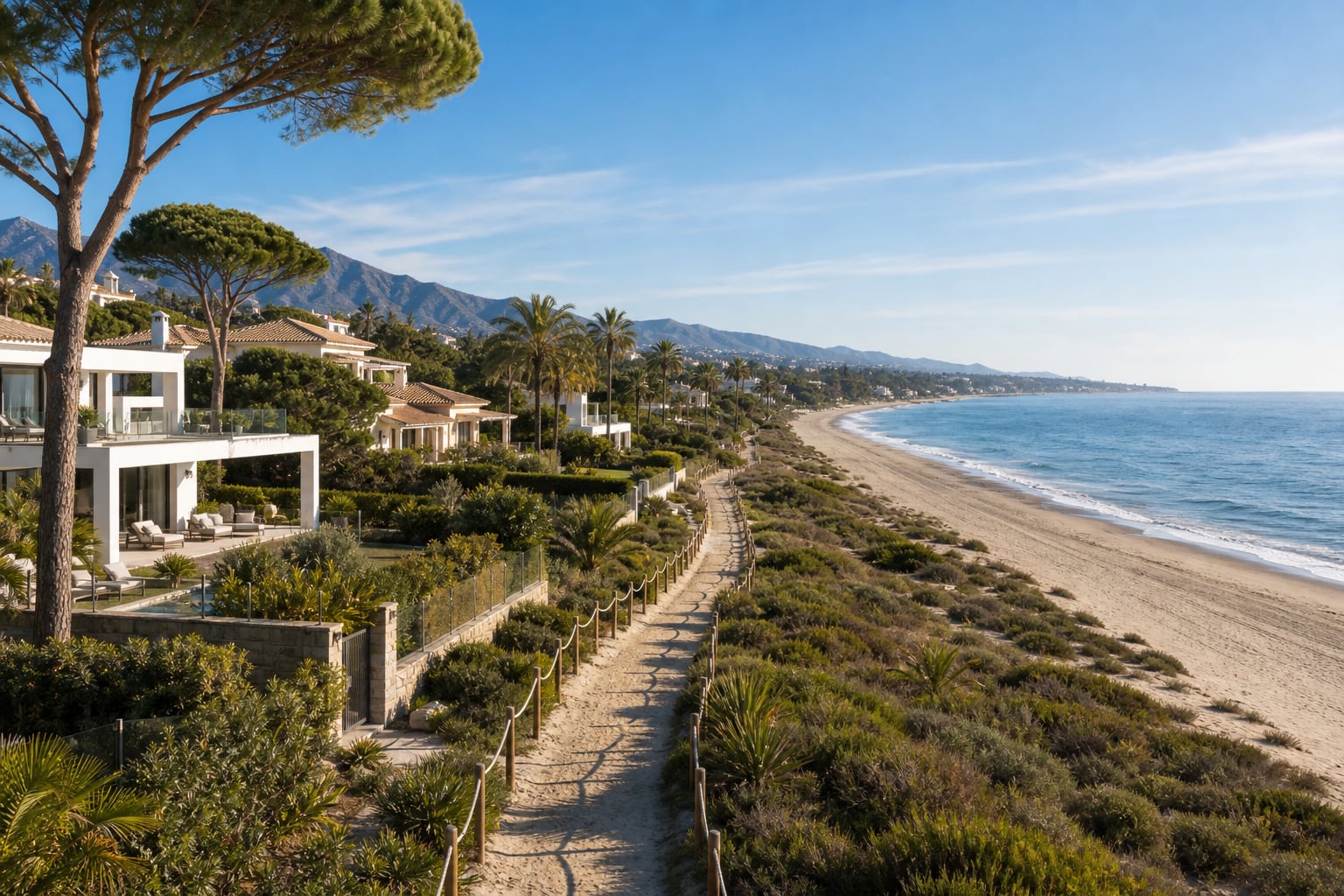
At Marbella's eastern boundary, past Elviria and Las Chapas, the coast road drops to a harbour that most visitors to Puerto Banús never see. Cabopino is the smallest marina on this stretch — 169 berths, a wooden boardwalk, a handful of restaurants at the water's edge — and it sits directly beside the protected sand dunes of Artola, one of the last undeveloped dune systems on the Costa del Sol. The scale is deliberate and the atmosphere is closer to a Cádiz fishing village than to anything eight kilometres further west.
It is also, by the numbers, the value end of Marbella's coastline. The Elviria–Cabopino district trades at €4,514 per square metre on the April 2026 idealista index — the most affordable of Marbella's seven measured districts, roughly a third below Nueva Andalucía and 34% below the Milla de Oro. For a buyer who wants a small motorboat on a pontoon five minutes from the front door, pine-forest urbanisations and one of the best beaches in the municipality, the eastern harbour makes a strong practical case that has little to do with glamour.
The Bookends: Estepona's Working Port and Benalmádena's Thousand Berths
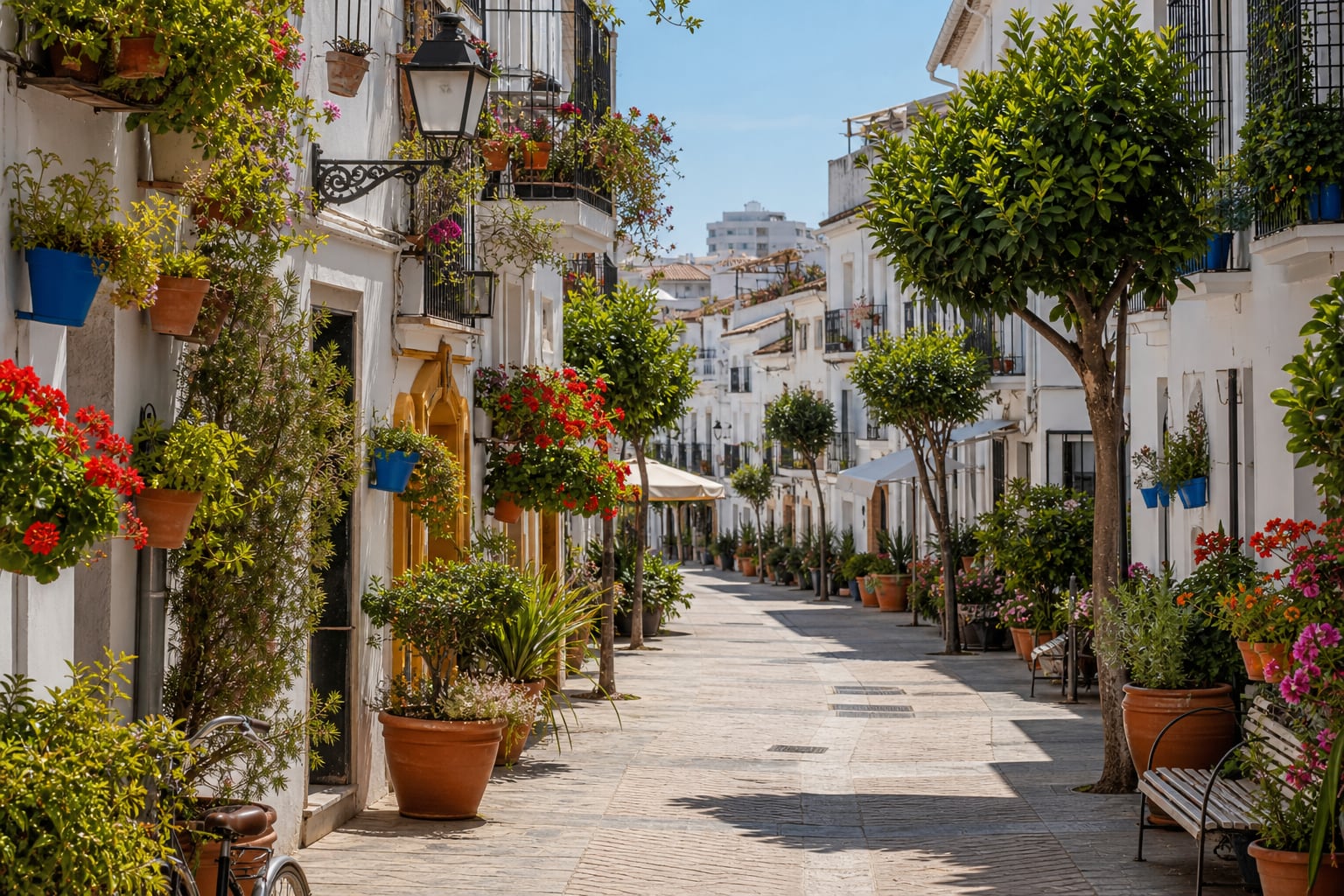
West of Marbella, Estepona runs the harbour most integrated into daily town life. The Puerto Deportivo de Estepona holds 447 berths for boats up to 35 metres, shares its breakwater with a genuine working fishing fleet, and hosts a weekly market on the quayside that draws as many locals as tourists. The port sits a short walk from the flower-hung lanes of the old town — a food-and-fish ecosystem we explored in our Estepona old town guide — and that adjacency is the point: this is the marina for owners who want the boat to be part of a town, not a resort.
At the opposite end of the coast, Puerto Marina Benalmádena is the giant: more than 1,000 berths for boats of 6 to 35 metres, wrapped in an islanded fantasy of apartments and bridges that has divided architectural opinion since it opened. The sailing credentials are not in dispute. The port has flown the European Blue Flag every year since 1987 and was twice named best marina in the world, in 1995 and 1997, by the international marina press. Its trump card is logistical: Málaga airport is eight kilometres away, which for a lock-up-and-leave boat owner flying in from Northern Europe is a shorter transfer than many airport hotels.
And the top of the market now has its own dedicated infrastructure forty-five minutes east of Marbella. IGY Málaga Marina, on the Paseo de la Farola in Málaga's city harbour, operates 33 superyacht berths for vessels of 20 to 180 metres with up to 2,000-amp shore power — capacity that simply did not exist on this coast a few years ago, and a signal of where the Costa del Sol's nautical economy is heading.
What the Berth Does to the Bricks
Marbella as a whole stands at €5,596 per square metre on the April 2026 idealista index, up 9.0% year on year and within a fraction of its all-time high — the full district table is in idealista's Marbella price report. Read against the marina map, the pattern is consistent: the two districts flanking Puerto Banús are the most expensive in the municipality, the town-port district is the fastest-rising, and the small-harbour east remains the discount. Harbours do not create these markets on their own, but they concentrate the restaurants, morning footfall and year-round service economy that keep waterfront neighbourhoods liquid in every season.
For buyers, the practical advice is to match the harbour to the life rather than the postcode to the prestige. An owner with a 25-metre motor yacht and a taste for the front row belongs in the Banús orbit. A family that wants children in Optimists on Saturday mornings is better served by an apartment or townhouse within reach of Marbella's town port. A couple keeping an eight-metre day boat will find Cabopino or Estepona cheaper, calmer and no less Mediterranean. And an owner who measures everything in minutes from the arrivals hall has Benalmádena. Increasingly we see buyers shortlist the marina first and let the property search follow from it — the reverse of how most agencies present the coast.
However you rank them, the five harbours between Benalmádena and Estepona are permanent infrastructure in a market where buildable coastline is finite — and the neighbourhoods around them hold their value accordingly. Whether the brief is a frontline apartment behind the moorings of Nueva Andalucía, a renovated home in Marbella's fast-rising old town, or a quieter base above the dunes at Cabopino, the sailing coast offers an entry point at almost every level of the market.
Browse our current portfolio of new-build and resale homes across the Costa del Sol, or talk to the Domosmar team about which of the five harbours fits the way you actually plan to live — boat or no boat.