At seven o'clock on a weekday morning in May, the beach in front of the Marbella Club Hotel is almost entirely deserted. The sun has already cleared La Concha mountain — the 1,215-metre limestone peak that defines the northern skyline of the entire Golden Mile — and is warm enough that the hotel's beach team is beginning to set out the first row of sun loungers on the pale sand below the garden terraces. A lone swimmer cuts through the flat Mediterranean. In the residential complex of Las Torres de Marbella Club, which occupies the plot immediately east of the hotel, shutters fold back on a fourth-floor apartment whose terrace faces the full arc of the sea from Puerto Banús to the Sierra Bermeja hills in the west. The owner bought in 2019 at around €9,500 per square metre. By the time Idealista reported Marbella's overall average at a new all-time high of €5,162/m² in May 2025, comparable units in the same complex were trading well above €15,000 per square metre. The gap between those two numbers is the story of the Golden Mile.
For a buyer approaching the Marbella market seriously, the term "Golden Mile" is both a useful shorthand and a potential source of confusion. It names one of the most recognisable addresses in European luxury real estate, yet it encompasses four or five meaningfully different micro-markets — each with its own price band, buyer profile, and ownership dynamic. Understanding the distinctions between the beachfront strip, the upper residential belt, and the hillside villa enclaves is the difference between buying the right asset and paying a premium for a postcode that only partially fits your brief.
What the Golden Mile Actually Is — and Where It Ends
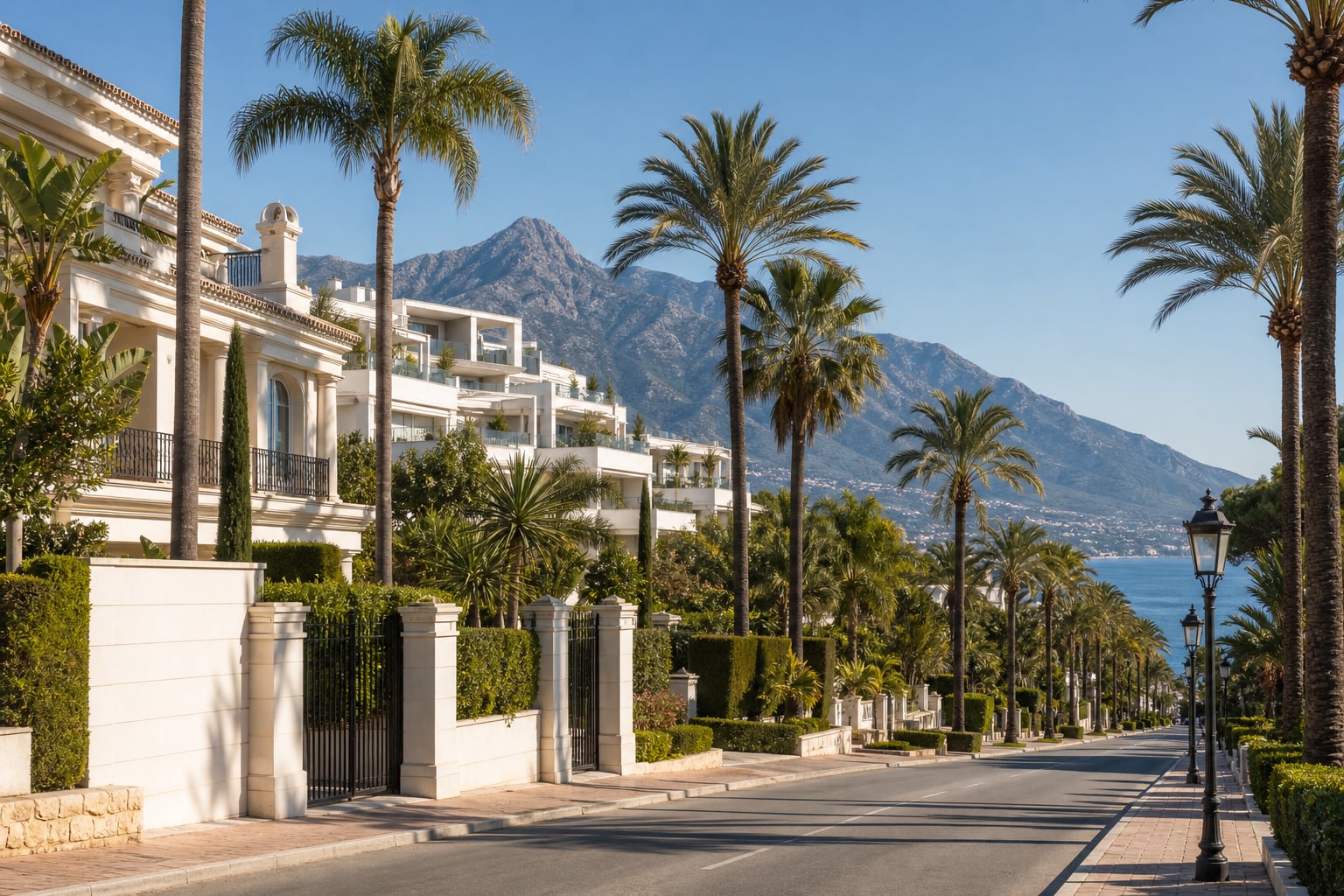
The original Golden Mile — Milla de Oro in Spanish — refers to the stretch of the old N-340 coast road running westward from the western edge of Marbella town for approximately five kilometres to the entrance of Puerto Banús. This was the route along which Marbella's most celebrated addresses were established from the 1950s onward: the Marbella Club Hotel, founded by Alfonso de Hohenlohe in 1954; the Puente Romano Beach Resort, opened in 1979 and built around a genuine first-century Roman bridge; and the summer palace constructed for King Fahd of Saudi Arabia, whose compound occupies a large plot between the two hotels and remains one of the most visited landmarks on the entire coast, even in its current state of disuse. The road itself — now the A-7 — carries the kind of historical weight that no marketing budget can manufacture, which is part of why addresses here command prices that bear little relation to the Costa del Sol average.
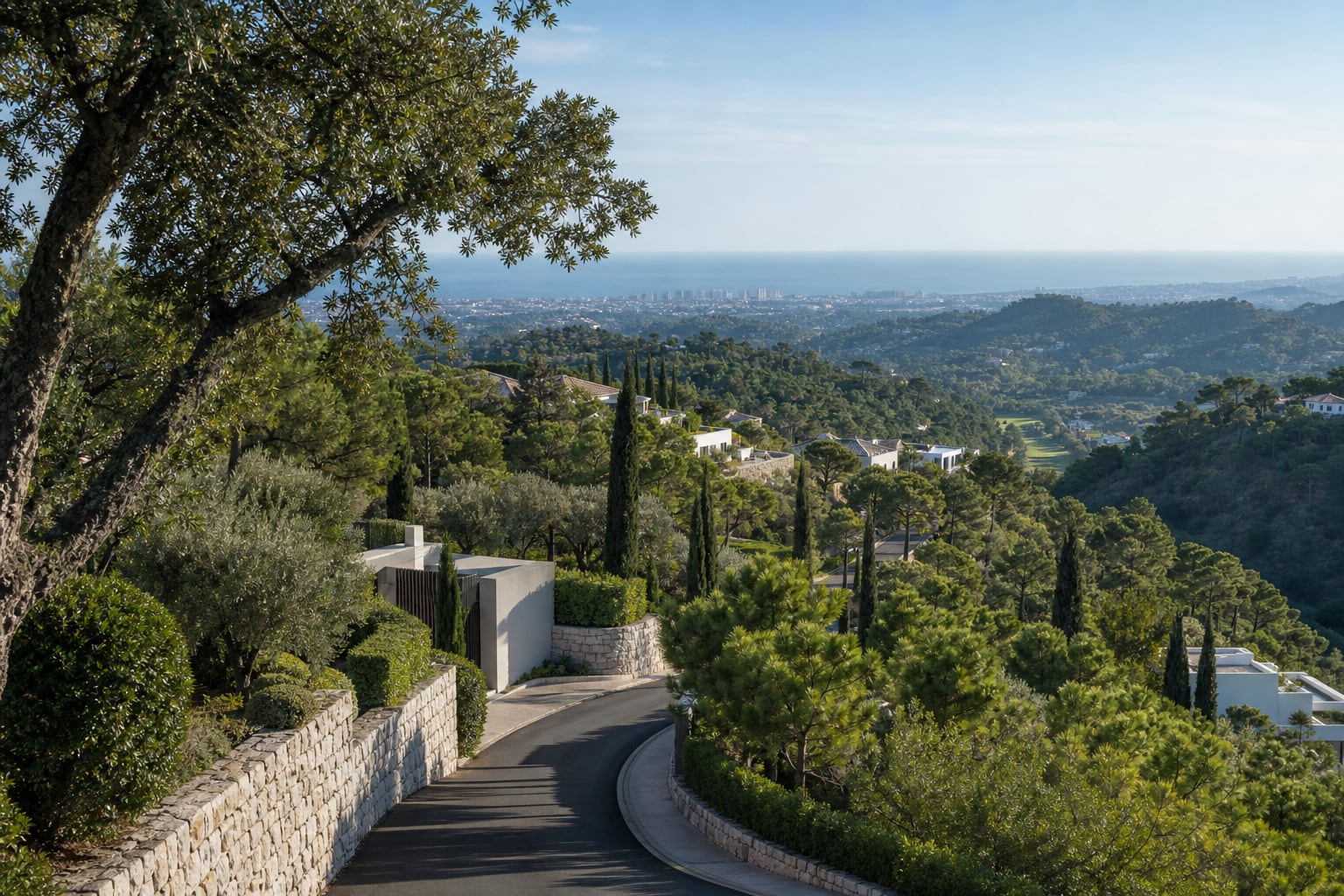
Over the past two decades the name has expanded to encompass the hillside communities that climb the lower slopes of La Concha and the Sierra Blanca range above the beachfront strip: principally Sierra Blanca, Cascada de Camoján, and Rocío de Nagüeles. These are gated, low-density urbanisations at elevations between 150 and 400 metres, offering views over the entire coast and — in clear conditions — across to Morocco. They are priced differently from the beachfront, attract a different buyer, and function as a distinct sub-market, though they sit within the same Nagüeles–Milla de Oro district that Idealista uses for its price tracking. Buyers should keep the distinction in mind.
There is also, separately, a "New Golden Mile" — a marketing name applied to the coastal strip between San Pedro de Alcántara and Estepona, roughly 15 to 25 kilometres west of Marbella town along the A-7. It has its own developments and its own price trajectory, but it is not the Golden Mile. The two are worth distinguishing clearly before any viewing schedule is drawn up.
The Beachfront Strip: Established Complexes and the €15,000/m² Floor
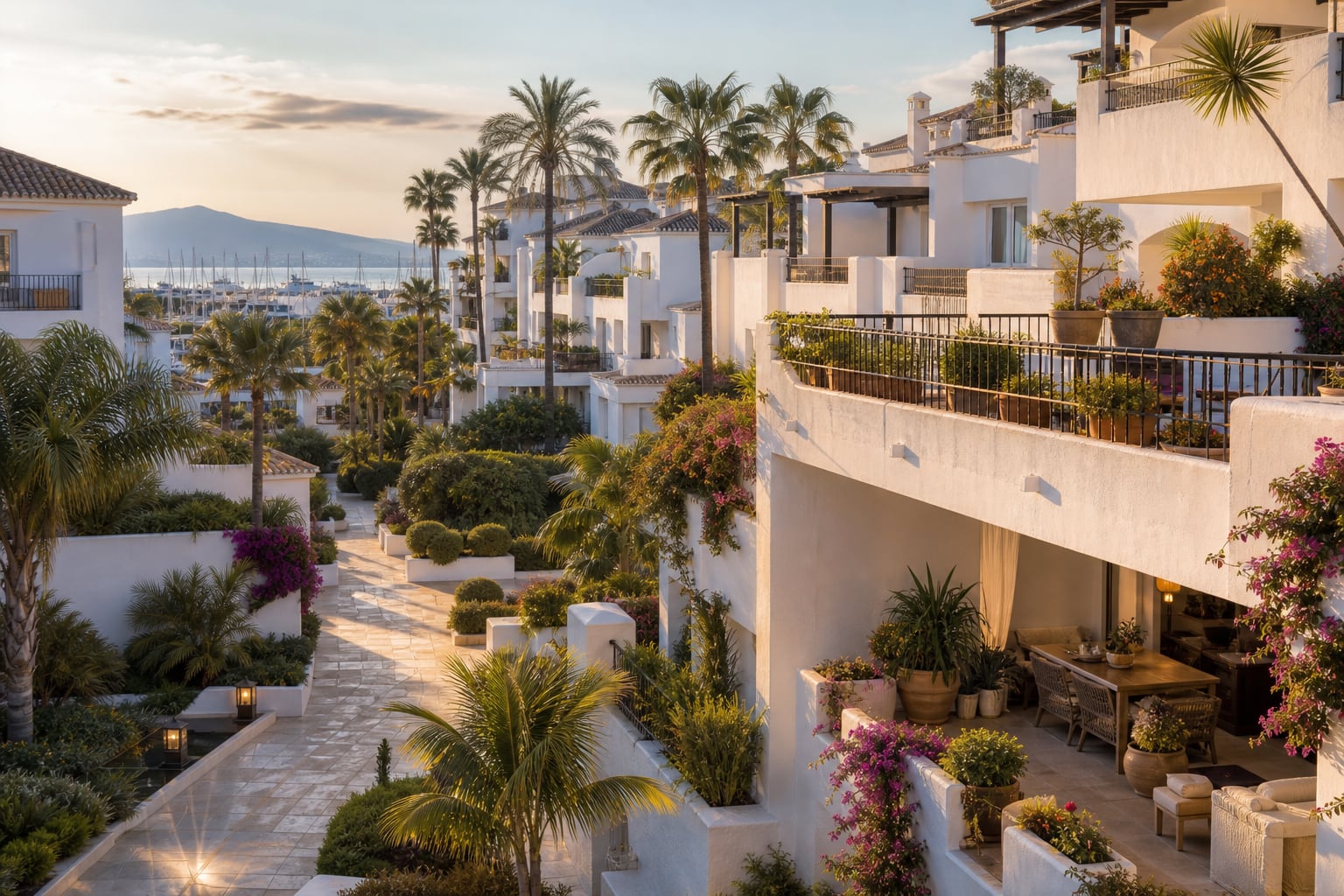
The most directly sought-after real estate on the Golden Mile is the cluster of residential complexes that share a boundary with the beach or sit immediately behind the hotel gardens. Las Torres de Marbella Club, Jardines del Marbella Club, Marina de Puente Romano, and a handful of smaller gated complexes occupy plots that are functionally irreplaceable — the coastline here is largely built out, and the combination of hotel-adjacent amenity, beach access, and the specific microclimate produced by La Concha's presence creates a residential experience that cannot be replicated elsewhere on the Costa del Sol at any price. Frontline and near-frontline apartments in these complexes have recorded verified resale prices between €15,000 and €24,020 per square metre in recent transactions, with refurbished penthouses and units with direct beach or pool access commanding the upper end of that range.
Availability is, unsurprisingly, extremely limited. Owners in these complexes hold for the long term, and resale stock turns over slowly. When apartments do come to market, they typically sell within weeks. Ground-floor units with garden terrace access in established frontline complexes are rarely priced below €2 million for a two-bedroom configuration; three-bedroom penthouses with panoramic sea views regularly exceed €5 million. The scarcity is structural: these plots were developed decades ago under planning codes significantly more permissive than anything applicable today, and no equivalent beachfront land remains to build on at comparable density.
Behind the frontline, the mid-tier of the beachfront belt — second-line and third-line complexes running 200 to 400 metres back from the water along the residential roads parallel to the A-7 — offers a more accessible entry point. According to Idealista's price tracking for the Nagüeles–Milla de Oro district, the area average reached €6,422/m² in May 2025, representing annual growth of 4.6% and making it consistently the highest-priced sub-market in Marbella. More recent aggregated data from the same source puts the figure at approximately €6,789/m² as of early 2026, with year-on-year growth of around 6.9%. At this level, a well-maintained 150 m² apartment with sea views starts at around €1 million; a 200 m² apartment with a south-facing terrace and communal pool access sits between €1.3 million and €2.5 million depending on position and finish.
The Hillside Layer: Sierra Blanca, Cascada de Camoján, and the Villa Belt
The gated hillside communities above the strip operate on a different logic entirely. Sierra Blanca — the most prominent of them, occupying the lower southern slopes of the eponymous ridge and enclosed by a perimeter wall that runs several kilometres across the mountainside — is a low-density estate of large detached villas, mostly set on plots of 1,500 to 5,000 square metres, with private pools, staff quarters, and the kind of absolute privacy that the beachfront strip cannot provide. The community sits at elevations between roughly 200 and 450 metres, high enough to escape the coastal humidity in August while remaining only eight minutes by car from Puerto Banús. The views — south across the full breadth of the Mediterranean, east towards Marbella Old Town and the Sierra de las Nieves, west towards Gibraltar on clear days — are among the most consistently spectacular on the Costa del Sol.
Villas in Sierra Blanca are typically priced from €4 million upward, with a significant concentration of transactions in the €6 million to €12 million range for well-maintained five- and six-bedroom properties with modern refurbishments. Ultra-prime listings — large-footprint estates with cinema rooms, indoor pools, full smart-home integration, and professionally landscaped grounds — reach €20 million and above, with a small number of exceptional properties testing levels approaching €30 million. On a per-square-metre basis, Sierra Blanca frequently achieves €15,000 to €18,000/m² for prime villas, a figure comparable to the best frontline apartment complexes below — reflecting the premium the market places on space, privacy, and panoramic elevation.
Cascada de Camoján, immediately adjacent to Sierra Blanca on the western edge of the ridge, is smaller, more tightly controlled, and — if anything — even more private. Many of its villas are among the most extravagantly specified properties on the coast; it is not unusual for a single renovation project here to run to €3 million or more before the asking price is set. Rocío de Nagüeles, slightly lower on the hillside and more accessible in terms of entry price, forms the third anchor of the hillside belt and offers a route into the Sierra Blanca address book at a price point that starts broadly around €2.5 million for a resale villa in need of updating. Together, these three urbanisations represent a deeply supply-constrained corner of the market: planning restrictions mean no meaningful new stock is being added, and the existing villa owners — many of them long-term residents from the Gulf states, Northern Europe, and the UK — do not sell frequently.
The Buyer Profile in 2025–2026: Old Guard and New Money
The Golden Mile has always drawn a cosmopolitan ownership base, but the nationality composition of active buyers has shifted noticeably. British buyers remain the single largest foreign-national group across the Marbella market, with a presence on the Golden Mile that traces back decades and shows no sign of weakening despite post-Brexit residency changes. Dutch and Belgian buyers have historically been significant too, though market data from 2025 showed Dutch transactions up 26% year-on-year while Belgian activity softened slightly. The most striking growth vectors, however, are American and Polish buyers: US transactions in the Marbella area rose approximately 25% in 2025, driven partly by dollar-euro dynamics and partly by a broader American appetite for European lifestyle real estate; Polish buyers grew by an extraordinary 43.7%, reflecting the continued economic ascent of Warsaw's upper-middle and wealthy classes. Gulf state buyers — Saudi, Emirati, and Kuwaiti — remain highly active on the Golden Mile specifically, with a historic affinity for the area that predates most of the Northern European ownership base.
What most of these buyers share, regardless of origin, is a clear preference for move-in-ready properties with contemporary interiors, large terraces, and minimal maintenance requirements. The era of the buyer who purchased a dated villa and spent years renovating it is giving way to one who expects the property to function as a five-star residence from the day of handover. This dynamic is pushing prices for fully refurbished and new-build properties significantly above the per-square-metre average for the area — and creating a discernible opportunity for buyers willing to take on a cosmetic or structural renovation project in a prime location, since the gap between updated and unupdated stock on the Golden Mile is currently among the widest it has been in two decades.
New Build on the Strip — and Why Supply Will Stay Tight
New build development on the original Golden Mile is rare by definition. The beachfront is built out, the hillside communities are protected by their own urbanisation plans, and the approvals process in Marbella — which has operated under tightened planning oversight since the judicial annulment of its previous general plan — adds significant time and cost to any new project. This does not mean new stock is entirely absent, but it is categorically different in scale from what is being delivered in Estepona or Mijas.
The most discussed new-build project on the strip in recent years is UNO Beach, a boutique development of 50 beachfront apartments and penthouses at El Ancón — one of the last undeveloped coastal plots on the Golden Mile — with prices ranging from €4 million to above €13.5 million. The project was substantially pre-sold during its construction phase, with remaining availability concentrated in larger configurations. Also significant is Epic Marbella, a development within the hillside belt notable for being the only residential project in Europe featuring Fendi Casa-designed interiors: Phase 1 was delivered in 2024, with subsequent phases under construction. Projects of this scale and specification set pricing benchmarks that anchor expectations for the broader resale market around them — which is partly why the hillside belt has seen such consistent capital appreciation even in the absence of significant new supply.
The structural implication for buyers is straightforward: new build on the Golden Mile proper will remain rare, resale stock will remain tightly held, and the supply-demand imbalance that has driven pricing for the past decade is unlikely to change direction. Buyers who are prepared to act quickly when the right property comes to market — and who have their NIE number, mortgage pre-approval or proof of funds, and legal representation already in place — are materially better positioned than those who move at leisure.
The Investment Case: Yields, Capital Growth, and a Long-Term Floor
The Golden Mile's investment case rests on two distinct components that reinforce each other. The first is rental income: beachfront and near-beachfront apartments in the Puente Romano and Marbella Club corridor generate gross rental yields in the range of 4 to 6% annually when managed professionally, with peak-season weekly rates for a well-positioned three-bedroom apartment running well above €5,000 per week in July and August. The Costa del Sol receives over 300 days of sunshine per year, and its mild winters — daytime temperatures rarely falling below 15°C even in January — mean the lettable season extends well beyond the two-month peak that constrains equivalent properties in Northern Europe. The shoulder months of May, June, September, and October are increasingly fully booked for quality product on this stretch of coast, as a growing cohort of remote workers and longer-stay visitors extend what were once fortnight holidays into multi-month arrangements.
The second component is capital appreciation. Marbella's average property price posted year-on-year growth of 9.8% in the twelve months to May 2025, according to Idealista's Marbella price tracking, making it among the strongest-performing prime urban markets in Southern Europe over that period. The Nagüeles–Milla de Oro sub-district has risen consistently and shows no fundamental supply dynamic that would suggest a reversal. Panorama Marbella's annual market report, one of the longest-running independent analyses of this market, has documented the consistent long-term trajectory of values in this corridor through multiple economic cycles — including the 2008–2013 correction that affected lower-quality Costa del Sol stock severely but left prime Golden Mile assets relatively insulated by their combination of scarcity, international demand, and intrinsic quality of location.
For buyers who are weighing the Golden Mile against other European prime markets — the Côte d'Azur, the Swiss lakes, Lisbon's waterfront — the relevant comparison is not yield or capital growth in isolation but the combination: a liquid, internationally recognised address, a year-round lifestyle proposition, well-established legal and fiscal frameworks, and seven decades of transacted history that provides genuine price resilience in a way that newer luxury destinations cannot yet demonstrate. The Golden Mile's track record, for all the caveats that apply to any property market, is the most compelling argument it has.
If you are at the stage of identifying specific properties on the Golden Mile — whether beachfront apartments, hillside villas, or new-build opportunities — the most productive next step is to align your brief with what is actually available in the market right now. Browse current Domosmar listings across Marbella and the Costa del Sol to see the kind of stock we work with, and get in touch directly to discuss your requirements — budget, area preferences, ownership structure, and timeline — so we can give you a focused, honest assessment of where the right match is most likely to appear and how to position yourself to move when it does.