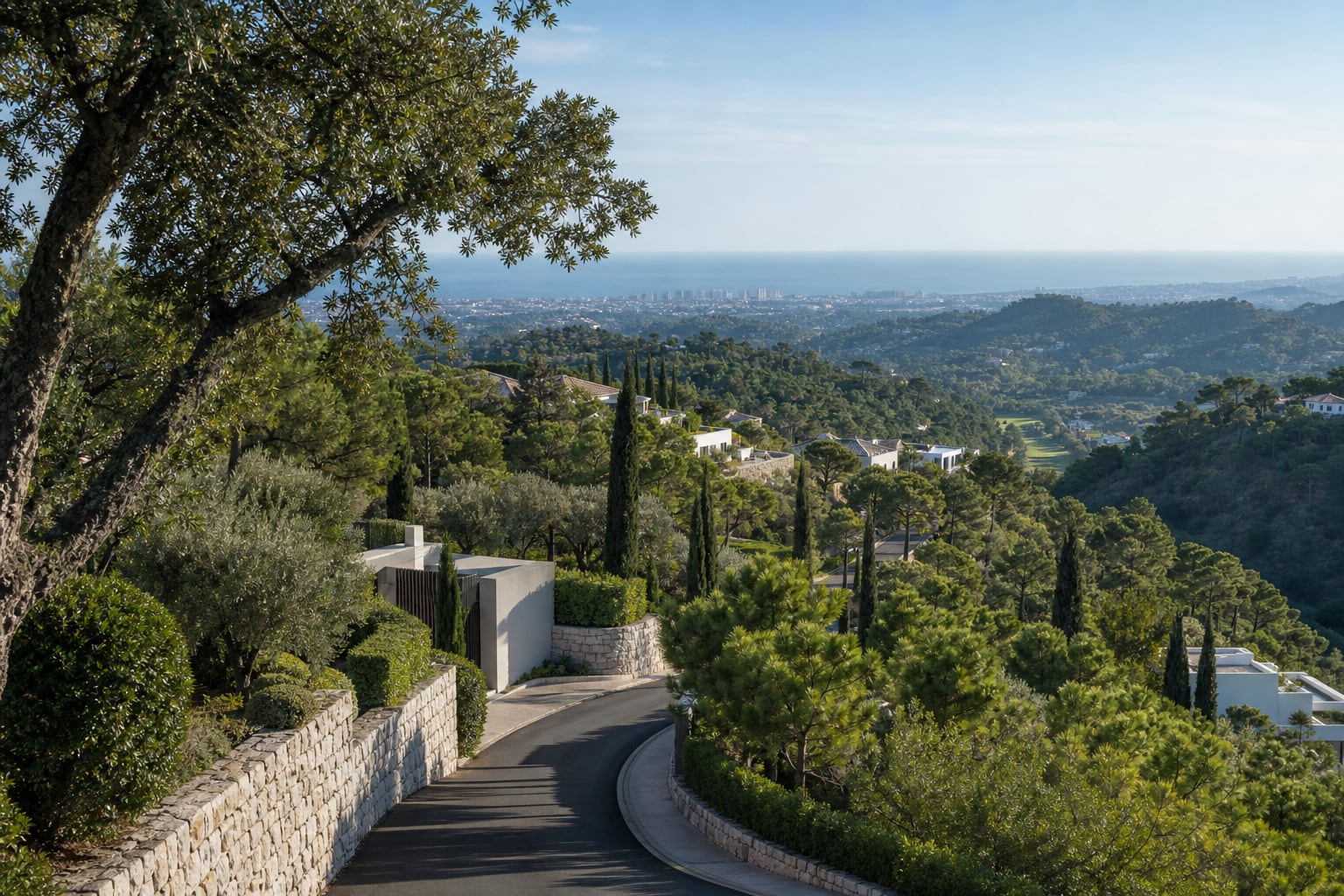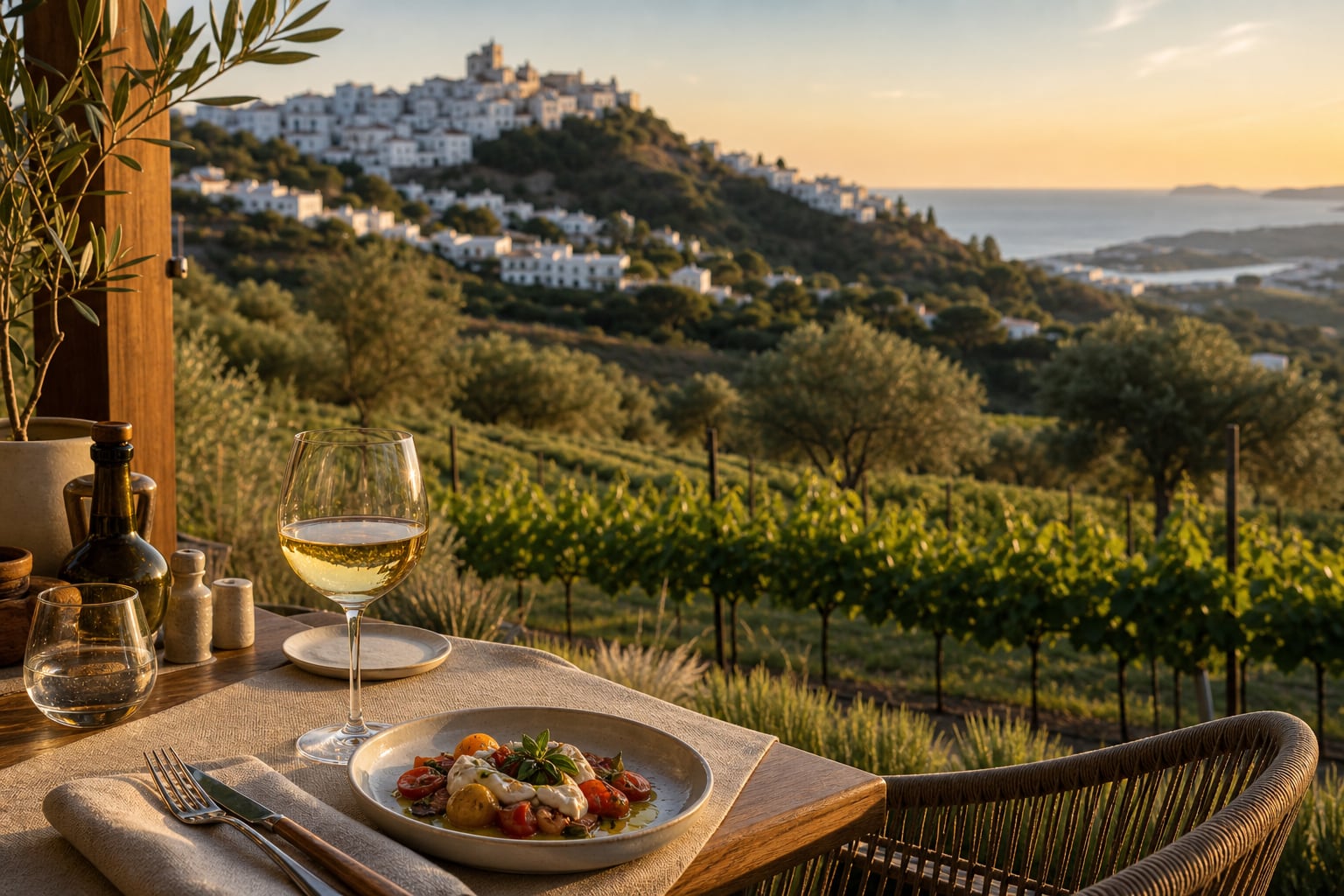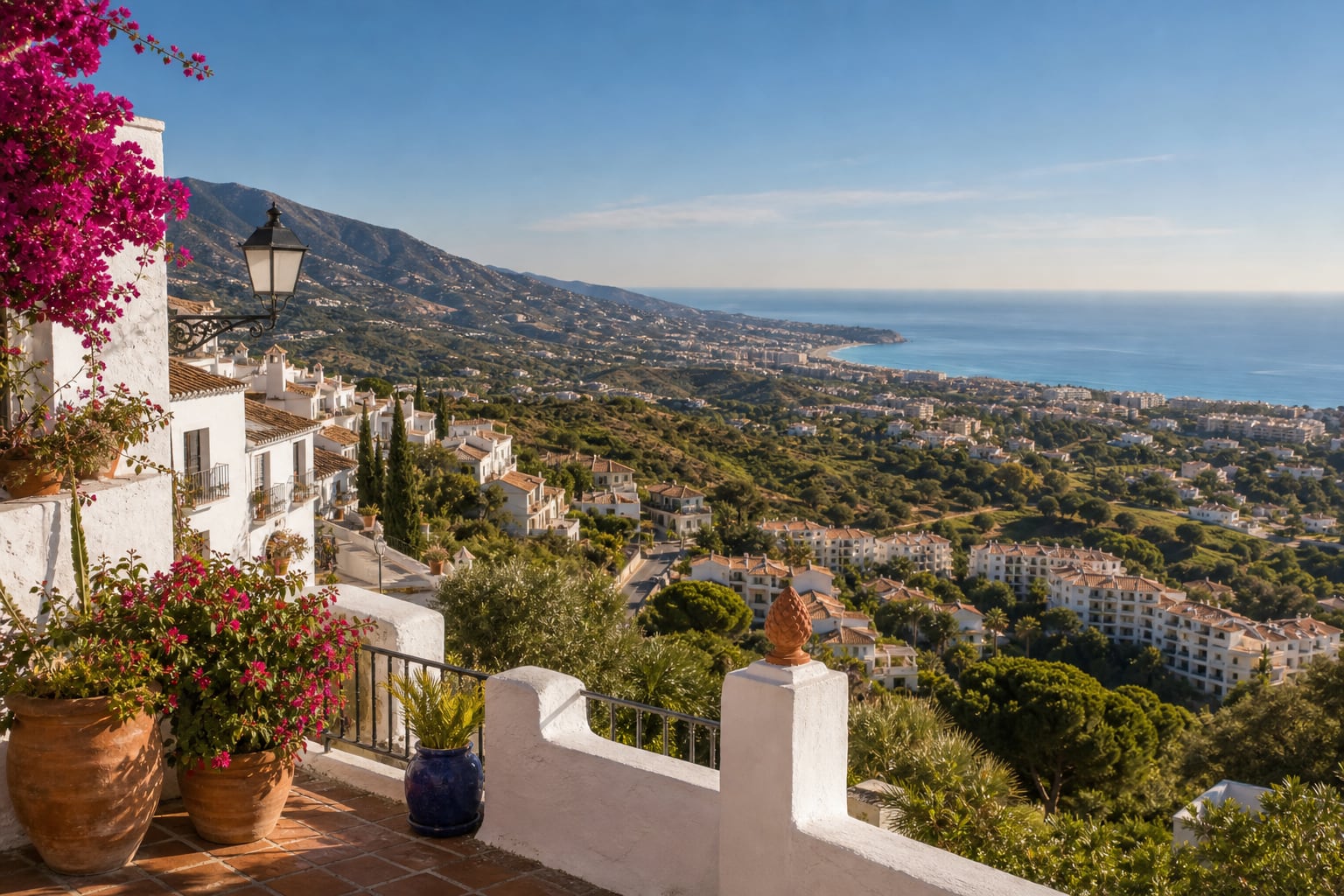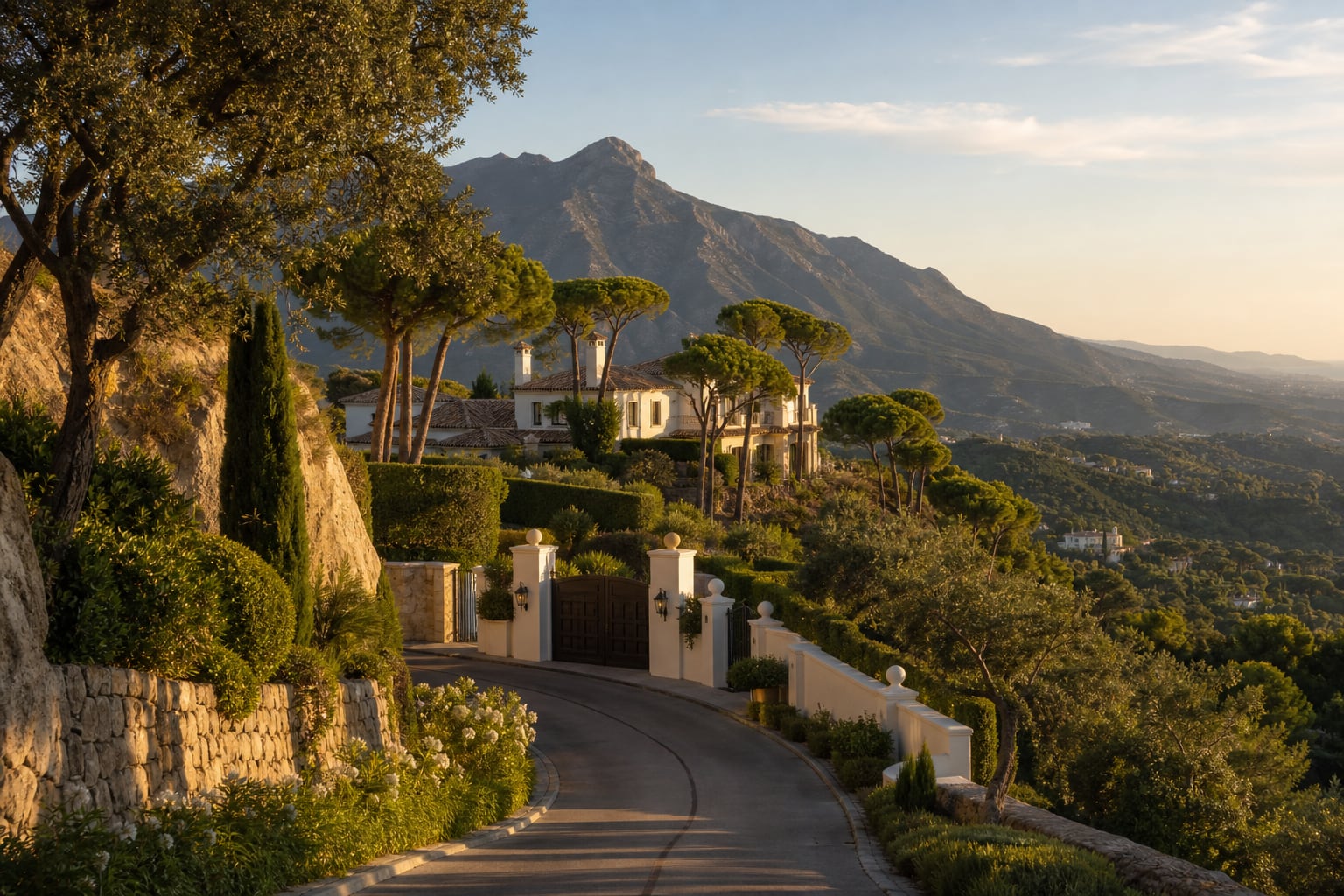
The A-355 road that climbs inland from the AP-7 motorway between Marbella and Estepona is one of the great short drives on the Costa del Sol. At half past seven on a Tuesday morning in late April, the mountain air carries wild rosemary and cistus blossom, the roadside maquis in full flower. Behind and below, Puerto Banús sits quiet at the marina — superyachts unmoved, the Sierra Bermeja warming in the first light to the west. The drive covers barely eight miles and takes fourteen minutes. At its end, the whitewashed houses of Benahavís village appear above the gorge cut by the Río Guadalmansa. The municipality has fewer than 10,000 registered inhabitants, a catering college that has operated since 2013, and — by the consensus of every serious culinary guide on the Costa del Sol — more restaurants per capita than any comparable settlement in Andalusia. Above it, behind a pine-forested ridge, lies La Zagaleta: 900 hectares of gated residential land, two private championship golf courses, a helipad, an equestrian centre, and the highest recorded property valuations in Spain.
The White Village and Its Gastronomic Identity
Benahavís is constitutionally a village, but its economy and character have been shaped by proximity — to Marbella's wealth, to Estepona's growing market, and to the golf courses and gated urbanisations that fill the surrounding foothills. The result is a village main street — Calle Málaga — that runs almost entirely to terraced restaurants, the oldest of which have been feeding the residents of the surrounding estates and their guests for the better part of four decades. This is not a village with a few restaurants, as a guidebook entry might suggest. It is, functionally, a restaurant village that also has houses — and that distinction matters to a buyer assessing whether a place supports genuine year-round habitation.
Los Abanicos, at Calle Málaga 15, consistently tops the lists compiled by residents of the surrounding urbanisations. The kitchen produces traditional Spanish cuisine with the consistency that comes from years rather than ambition: the rabo de toro — slow-braised oxtail — is what regulars order and what the kitchen does best. Los Faroles, one of the village's oldest establishments, occupies its own terrace on the same street and has a regional reputation built on pepper chicken and braised veal that extends well beyond the immediate municipality. On Calle Pilar, Amanhavis operates from inside a beautifully restored rustic house; its dining room, designed to feel like a private home rather than a commercial space, draws a clientele that makes the drive from the coast specifically for it. La Escalera de Balthazar offers the village's most contemporary fine-dining experience, and Restaurante Sabor — which opened in March 2024 — quickly developed its own following for a tapas programme delivered with evident kitchen ambition.
The Escuela de Hostelería Benahavís, which has operated since 2013, provides a continuous pipeline of trained kitchen and front-of-house staff into the village's establishments. It also runs its own public lunchtime restaurant on weekdays — a multi-course menu open to all at prices that consistently surprise visitors accustomed to coastal restaurant pricing. This catering infrastructure is part of what distinguishes Benahavís from the many attractive mountain villages scattered across Málaga province. The dining scene here is self-sustaining in a way that does not depend on summer tourist traffic, which means the village functions as a genuine community year-round rather than closing quietly for the winter.
The municipal planning framework has reinforced this character by maintaining strict restrictions on commercial and residential density. Benahavís is one of the few municipalities in Málaga province where the planning department has operated with consistent restraint, which means the village's street scale, landscape setting, and sense of proportion are not under the kind of structural threat from expansion that has reshaped comparable settlements on the coast. For a buyer weighing whether a property here represents a long-term primary home or a significant second-home investment, this planning stability is a meaningful structural reassurance that is not available in many equally attractive coastal addresses.
La Zagaleta: The Architecture of Absolute Seclusion
The entrance to La Zagaleta is not publicly signposted. Two gated access points — both staffed around the clock by dedicated security personnel — are the only routes into the estate; residents and invited guests must be pre-authorised by name before any vehicle is admitted. Inside the perimeter, the estate unfolds across 900 hectares of mature Mediterranean forest — pine, holm oak, carob and wild maquis — broken by the fairways of two private golf courses, the rooflines of approximately 250 completed villas, and extraordinary sightlines across the Strait of Gibraltar that make this ridgeline position among the most sought-after in southern Europe. The 420 designated residential plots carry a minimum plot size of 3,000 square metres; with roughly 250 homes currently standing, the average villa commands more than three hectares of protected surrounding land in terms of the privacy buffer it enjoys.
The two 18-hole parkland golf courses within La Zagaleta operate exclusively for residents and their invited guests. The original course was designed by Bradford Benz in 1991 and comprehensively redesigned by Marc Westenborg in 2016; the second, designed by Steve Marnoch, opened in 2005. There are no public tee times and no green fee accessible to a visiting golfer at any price — these are private amenities, not commercial facilities. The main clubhouse, at 5,100 square metres, contains a bowling alley, billiard room, library, indoor and outdoor swimming pools, tennis courts, summer and winter restaurants, a bar and a discotheque, as well as meeting rooms and an events pavilion. A heliport within the estate means that arriving by helicopter is logistically straightforward for owners who prefer it, and a fully staffed equestrian centre provides a further amenity that is rare even at comparable price points elsewhere in Europe.
Engel & Völkers market data places the average transaction price per square metre at approximately €7,000 within La Zagaleta, with individual villa values ranging from €4 million at the entry level to above €34 million for the most contemporary and comprehensively specified builds. The 2021 sale of Villa Cullinan — reported at €32 million, and cited at the time as Europe's most expensive residential transaction — remains the most frequently referenced benchmark on the estate. The 2025 listing of Villa Enso at €34 million indicates that the ceiling continues to move upward rather than consolidate. A number of La Zagaleta's most exceptional properties have never reached the open market, changing hands between principals through private introductions facilitated by the small number of brokers with genuine access to the estate's seller network.
La Zagaleta functions, analytically, as a micro-market largely independent of broader Costa del Sol sentiment. In cycles where the wider Marbella area has seen softening demand, the estate has continued to attract committed buyers — particularly from Northern Europe and the Gulf states — for whom the combination of landscape scale, enforced privacy, and first-rate private club infrastructure justifies the price against any European alternative. These buyers are not comparing La Zagaleta with a villa in Nueva Andalucía: they are comparing it with comparable estates in the Luberon, the Swiss cantons, and the Quinta do Lago. On that comparison, the estate consistently wins on climate, price per hectare, and the quality of the surrounding protected landscape.
The Price Architecture: What Different Budgets Actually Buy
The overall municipal average asking price for Benahavís was running at approximately €5,200 to €5,460 per square metre in 2025 — one of the highest municipal averages in Málaga province, and firmly in the upper bracket of Costa del Sol pricing. That average is heavily influenced by La Zagaleta and the upper-market estates, and conceals a considerable range of accessible product. A buyer with €335,000 can enter the municipality; a buyer with €30 million can still be stretched within it. The range is unusual even by Marbella-area standards.
El Madroñal occupies a distinctive middle position: a gated residential estate accessed through a staffed entrance, with plots typically exceeding 5,000 square metres, but without the golf-club infrastructure and membership obligations of La Zagaleta. For buyers who want comparable plot sizes and physical security to La Zagaleta without the associated community structure, El Madroñal is the clearest alternative within the municipality. Land trades from approximately €460,000 for smaller parcels to close to €3 million for the most elevated and view-commanding plots. The villa stock here has historically been more traditional in architectural style than the contemporary builds now dominant in La Zagaleta, but a sustained wave of renovation and full-rebuild projects over the past several years has introduced a more contemporary layer into what was once a uniformly traditional community.
Los Arqueros Golf & Country Club — designed by Seve Ballesteros and positioned on the border between Benahavís and Nueva Andalucía — provides the most accessible entry point into the municipality. Apartments and townhouses within the Los Arqueros urbanisation begin at around €335,000, while detached villas on and around the course reach €5.5 million and above for the most recent builds. The urbanisation is a genuine ten minutes from Puerto Banús via the A-355, and the golf course operates with public tee times — a different amenity model from La Zagaleta, but a genuine one that benefits residents without membership overhead. La Quinta Golf & Country Club, a few kilometres further toward the village, anchors a second cluster of urbanisations — Buenavista de La Quinta, La Quinta Hills — where detached villa product typically falls in the €2 million to €7 million range depending on specification, position, and whether the property has been recently renovated or rebuilt.
For buyers at the €2 to €6 million level comparing Benahavís against comparable product in Marbella's Sierra Blanca or Estepona's El Paraíso, the calculation is broadly this: more altitude, more privacy, more land, less immediacy to the beach. The trade-off between coastal convenience and the quality of the mountain setting is the central variable. Buyers who have spent a full summer in La Quinta or El Madroñal tend to resolve that trade-off firmly in favour of altitude — the temperature differential and the quiet of the mountain air are not abstract benefits once experienced as daily conditions rather than weekend excursions.
Who Is Buying and Why the Profile Matters
The Benahavís municipality has one of the highest proportions of foreign property buyers recorded anywhere in Spain. According to analysis published in the Benahavís Collection 2025 market report and cross-referenced with independent research by By Bright, 84.3% of buyers in the municipality in 2025 were foreign nationals. For context: foreign buyers typically account for between one-third and two-fifths of total transactions in Marbella, and closer to 30–35% in Estepona. The five leading buyer nationalities in Benahavís in 2025 were the United Kingdom at 17.7%, Sweden at approximately 10%, Belgium at approximately 9%, Germany at approximately 8%, and the Netherlands at approximately 7.7%, with the remaining 47% distributed across other European nations, the United States, the Middle East and Latin America.
This buyer profile has structural implications for anyone assessing the long-term direction of values. The municipality is not dependent on any single nationality's confidence or on domestic Spanish demand — an insulation from many of the macro-economic pressures that move mid-market coastal property elsewhere in the province. Buyers at the La Zagaleta and El Madroñal tier are almost never taking Spanish mortgages; their decisions are not meaningfully correlated with European Central Bank rate cycles in the way that a typical first-time buyer's decision in mainland Europe would be. The buyers selecting Benahavís are choosing it from a genuinely global menu of alternatives, and they are, by definition, buyers who have already committed to the western Costa del Sol as their preferred geography.
The motivations that drive that selection are consistent across brokerage research and agent-level experience. Privacy is primary: the gated structure of virtually every Benahavís urbanisation — from La Zagaleta at the apex to Los Arqueros at the accessible entry point — means that no public road delivers a vehicle to an individual villa. Climate at altitude is the second driver: Benahavís runs consistently two to four degrees cooler than the coast in the summer months, which is the practical difference between a terrace that is comfortable at noon in July and one that is not. Golf proximity — the municipality borders or contains more than a dozen courses within a twenty-minute drive — and the fourteen-minute run to Puerto Banús complete the practical case. These are structural features of a specific geography, not preferences subject to revision, and they are not available in combination anywhere else on the Costa del Sol.
Supply Constraint, Long-Term Value, and the Buying Case
Benahavís municipality covers approximately 148 square kilometres — one of the largest by area in Málaga province — and yet supports fewer than 10,000 permanent residents. The ratio of protected and largely undevelopable land to resident population is unusual in a region that experienced significant coastal overdevelopment from the 1970s onward. The municipal planning framework has preserved the landscape character of the Guadalmansa valley and the surrounding hills to a degree that the coastal strip has not achieved, and there is no structural reason to expect that to change: significant portions of the territory to the north overlap with the Sierra de las Nieves National Park, and the municipality's rural protection designations are consistent and well-established.
Within La Zagaleta, the supply picture is particularly clear. Approximately 170 of the original 420 residential plots remain undeveloped — a finite and depleting inventory. The pace of new villa construction has accelerated in recent years as buyers have recognised that the remaining available land is limited, which tends to anchor prices on completed properties rather than compress them. Elsewhere in the municipality, the combination of topography, planning controls, and land values at the upper tier makes speculative development at anything below the premium price point essentially uneconomic. New supply entering the Benahavís market is, almost by definition, high-specification — which means it sets price references upward rather than downward. This dynamic — finite land, depleting inventory, premium-only new construction — is a meaningful structural support for values at every price tier in the municipality.
The wider amenity context accessible from a Benahavís base continues to strengthen. The Westin La Quinta Golf & Spa provides hotel-standard dining and facilities within the municipality itself. The broader circuit accessible within thirty minutes includes Dani García's Leña in Marbella, Skina (two Michelin stars, Calle Aduar, Marbella Old Town), El Lago (one Michelin star, Aloha Golf, Nueva Andalucía), and the full range of beach clubs — Nikki Beach, Ocean Club — below on the coast. Finca Cortesin, the five-star resort near Casares that hosts European Tour golf events, is approximately thirty-five minutes by car. This combination — mountain privacy, protected landscape, fifteen minutes from one of Europe's most active marina environments — is simply not available from any other municipality on the Costa del Sol.
For a buyer considering a property in the Marbella area who has not yet spent serious time in Benahavís municipality, the scale and diversity of what the micro-market offers tends to be a genuine surprise. Entry-level apartments at Los Arqueros begin at around €335,000; mid-range gated villas at La Quinta and El Madroñal occupy the €2 to €7 million range; fully private estates in La Zagaleta reach multiples of that. The common thread across every price tier is a combination of landscape, privacy, and coastal proximity that is not replicated anywhere else in Málaga province. The asking price growth of approximately 14.8% year-on-year to mid-2025, recorded in Engel & Völkers market data, reflects both sustained international demand and the structural scarcity of correctly positioned product — and there is no obvious mechanism that reverses either of those conditions in the near term.
The Domosmar team works across the full Benahavís price spectrum — from La Quinta and Los Arqueros through El Madroñal to La Zagaleta — and maintains current, specific knowledge of which urbanisations are seeing the most competitive buyer demand and where value remains relative to the wider market. Browse current Benahavís and Marbella properties on our listings page, visit the Domosmar blog for further market analysis across the Costa del Sol, or contact us directly to discuss your requirements with the team. For buyers at the upper end of the market, our principals maintain direct relationships with sellers in La Zagaleta and El Madroñal whose properties are not currently listed on any public portal.