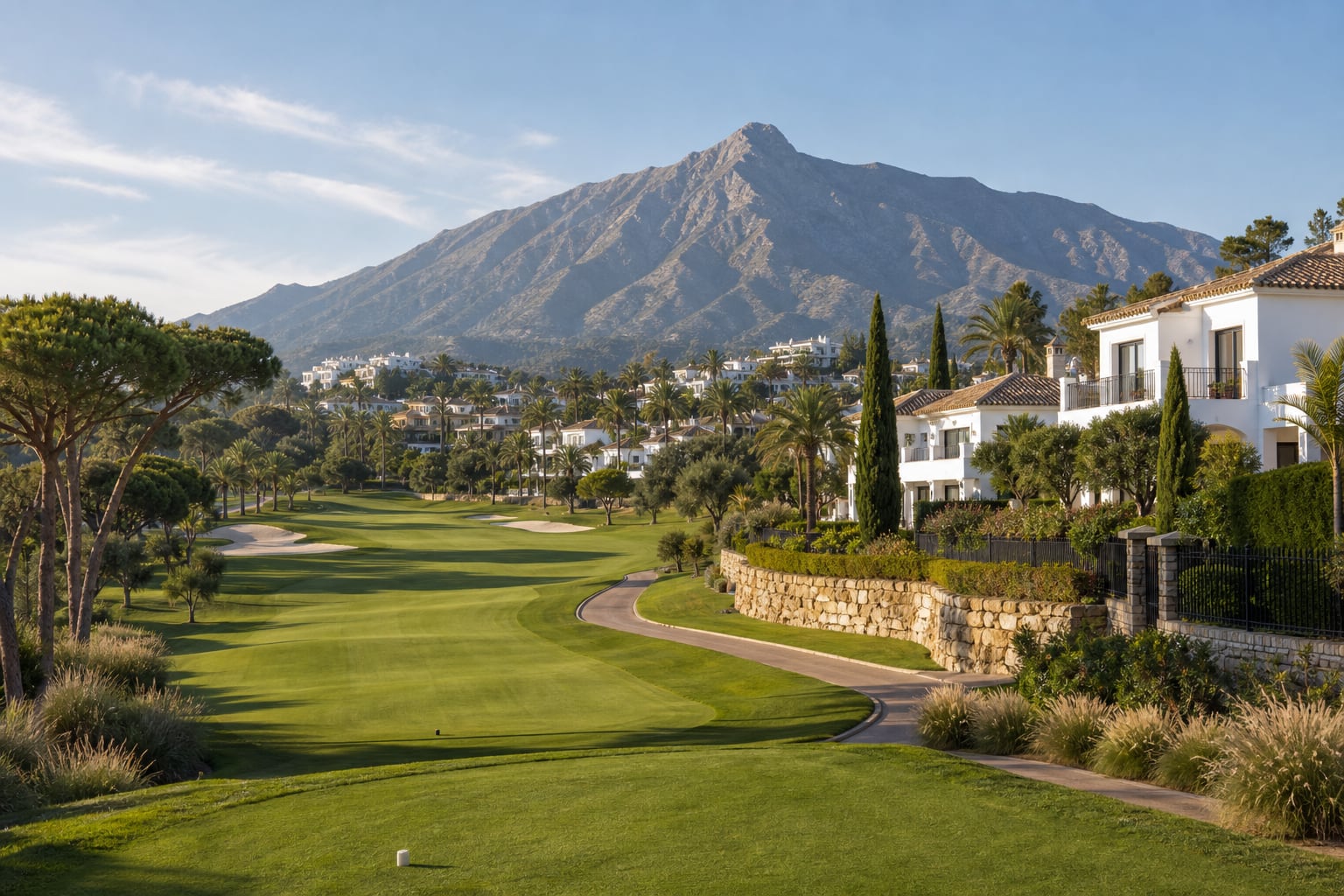
By half past seven on a May morning, La Quinta Golf & Country Club is already busy. The car park beside Urbanización La Quinta in Benahavís fills quietly — a group of early starters who flew into Málaga the evening before, a pair of Spanish members who have held this Saturday slot for years, a British couple fitting in eighteen holes before the afternoon beach. The first tee sits at altitude above the valley floor with La Concha peak to the east, and on clear mornings a narrow silver strip of Mediterranean is visible to the south. The temperature is already 20°C. It will not rain today, or for the foreseeable stretch after that. Marbella receives around 320 sunny days per year, and the morning light here has a particular quality — low and golden, turning the fairway grass almost amber before the first round is halfway done.
This scene, repeated in some form across four championship courses within a few kilometres of each other, is one of the most concrete lifestyle arguments for owning property in the Marbella area. Nueva Andalucía — known locally as the Golf Valley, or Valle del Golf — contains more significant championship golf per square kilometre than almost any other residential area in Europe. That concentration, and the critical mass of international buyers it attracts year on year, does more to underpin this neighbourhood's property market than any individual design trend or new-build delivery cycle. It creates a community anchored by a shared daily rhythm: early tee times, long lunches on terrace restaurants overlooking fairways, and evening light stretching until nine o'clock for much of the year.
The Costa del Sol is frequently referred to as the "Costa del Golf" — a label that reflects the more than 70 golf courses spread along this coastline. But the Golf Valley is where that number condenses into something more specific: a residential neighbourhood defined not by a postcode but by its relationship to a sport, and to the buyers that sport brings from across northern Europe, the Gulf states and the Americas.
Nueva Andalucía — A Valley Shaped by Golf
Nueva Andalucía sits immediately north of Puerto Banús, reached by taking the road inland from the marina and climbing gradually through the first villas and apartment clusters. The valley reveals itself as the road rises — fairways appearing on both sides between pine trees and cork oaks, the scale of the golf estate becoming apparent only when you are already inside it. Real Club de Golf Las Brisas, Los Naranjos Golf Club and Aloha Golf Club all occupy the valley floor and lower slopes, their boundaries essentially adjoining one another. La Quinta Golf & Country Club, a few minutes further west across the Benahavís municipal border at higher altitude, closes the circuit to the north. Together they form a continuous band of championship golf beginning around ten minutes from Puerto Banús marina and extending into the Benahavís hills.
The arrangement was not accidental. When the first courses were laid out from the late 1960s into the 1980s, the valley was largely undeveloped agricultural land. The golf clubs arrived before the urbanisations — the residential developments grew around the fairways rather than alongside them, a planning sequence that makes this area quite different from most European golf resort developments where houses come first and a course is added later to justify the marketing. In the Golf Valley, the golf is genuinely central to the neighbourhood's identity. Properties with direct golf frontage or course views from a terrace consistently attract stronger demand than otherwise comparable homes set further from the fairways, a dynamic that has held across multiple market cycles and is visible in the pricing premium for well-positioned golf-front stock.
The Golf Valley also carries the infrastructure of a mature international community. Aloha College, one of the Costa del Sol's most established English-language schools, is within easy reach of the valley's urbanisations. Commercial amenities along the streets around the established residential developments cover day-to-day needs without requiring a trip into Marbella centre, which is approximately 12 minutes by car. Málaga International Airport — served by direct routes to most major northern European cities and increasingly to long-haul destinations — is around 45 minutes to the east.
The Four Championship Courses at the Valley's Heart
Real Club de Golf Las Brisas is, by common consensus, the prestige address of the Golf Valley. Designed by Robert Trent Jones Sr and opened in 1968, its defining characteristic is eleven lakes integrated throughout the layout — water features that are both visually dramatic and technically demanding in equal measure. Las Brisas operates as a private members' club, with a membership entrance fee in the region of €25,000 and an annual subscription of approximately €3,000. Visitor access is typically arranged by introduction from an existing member rather than through a public tee sheet. The exclusivity is intentional and reflects the club's position in the social fabric of the area: to understand who holds membership at Las Brisas is, in large part, to understand who is buying in the urbanisations surrounding it.
Aloha Golf Club, designed by Javier Arana and similarly structured as a private members' club, occupies the western flank of the valley. Arana is recognised as one of the most significant Spanish golf architects of the twentieth century, and his Aloha layout — which has hosted professional events including the Andalucía Open — rewards accurate iron play and course management over raw power. The surrounding urbanisation, with its layered terraces of villas and townhouses stepping down toward the fairways, represents some of the most established residential stock in Nueva Andalucía, with properties that have changed hands within the same international networks for decades. The combination of mature landscaping, course views and the quiet authority of a private club that does not need to advertise makes the Aloha side of the valley one of the area's most sought-after micro-locations.
Los Naranjos Golf Club, by contrast, welcomes visitor bookings directly through its online tee sheet, with green fees running between €150 and €220 for 18 holes depending on season and time of day. The course, also designed by Robert Trent Jones Sr, meanders through stands of mature orange trees — the naranjos of its name — and cork oaks that give the fairways a genuinely parkland character uncommon in Mediterranean golf. The Hacienda Los Naranjos restaurant, overlooking the 18th green, has built a following well beyond the membership. Adjacent to the golf course, Los Naranjos Padel offers eighteen padel courts and two pickleball courts across 20,000 square metres — a facility that speaks to how the Golf Valley has evolved from a narrowly golf-focused enclave into a broader active lifestyle destination attracting a wider demographic of buyers and residents.
La Quinta Golf & Country Club, across the Benahavís municipal border at higher altitude, offers 27 holes divided into three nine-hole configurations — A (San Pedro), B (Ronda) and C (Guadaiza) — designed by Manuel Piñero, a former three-time World Champion and one of Spain's most prolific course architects. The Westin La Quinta Golf Resort & Spa operates within the complex, and visitor bookings are accepted directly, with green fees starting from around €114 for 18 holes. The altitude extends comfortable playing conditions well into July and August when lower courses can become hot by midday, and the views from the upper holes — Mediterranean to the south, Sierra Blanca to the east, the ridge of the Ronda mountains to the north — are among the most striking available from any fairway in the Marbella area.
Finca Cortesin and Valderrama — The Wider Golfing Corridor
The Golf Valley is remarkable within its geography, but it sits inside a wider corridor that includes two of the most significant course experiences in European golf — both within a reasonable drive of Marbella's Old Town and relevant to any buyer thinking about the Costa del Sol as a whole. Finca Cortesin Golf, on the estate near Casares village approximately 40 minutes west along the A-7, was designed by Cabell B. Robinson and opened in 2007. The course was selected as the venue for the 2023 Solheim Cup — the most prestigious women's team competition in world golf — and has also hosted the Volvo World Match Play Championship on multiple occasions. It carries GEO Certified environmental accreditation, operates a Nicklaus Golf Academy on site for coaching and performance work, and posts green fees of €385 in low season and €460 in high season for 18 holes, with buggy, range balls and trolley included. A visit to Finca Cortesin is not simply a round of golf; the five-star hotel, spa, beach club and several on-site restaurants mean that most visits extend well beyond the eighteenth green.
Real Club Valderrama, approximately 40 minutes further west in Sotogrande (Cádiz province), occupies a category of its own. Ranked consistently as the best golf course in Spain and among the top 100 in the world by multiple independent rankings, the club was designed by Robert Trent Jones Sr in 1974 on a cork-oak-covered estate whose atmosphere is immediately distinctive. It hosted the 1997 Ryder Cup — the first time the competition had been held on continental European soil — sixteen editions of the Volvo Masters and multiple World Golf Championships. Valderrama is primarily a private members' club, but a limited allocation of visitor tee times is available at approximately €300 to €320 per round. For many buyers who arrive on the Costa del Sol undecided about the area, a round at Valderrama is the visit that converts lifestyle interest into genuine property intent. There is something about playing a course of that quality in that climate, and then driving back along the coast to Marbella in the late-afternoon light, that makes the practical question of where to buy feel suddenly pressing.
Together, the Golf Valley courses, Finca Cortesin and Valderrama form a circuit of golfing experiences that would take weeks to exhaust. For buyers who are serious golfers this is the primary lifestyle draw. For those who live alongside golfers without playing themselves, the infrastructure built around these clubs — restaurants, padel and tennis facilities, hotel operations, well-maintained road networks — raises the ambient quality of daily life in ways that extend well beyond the sport itself.
Padel, Active Living and the All-Year Outdoor Calendar
Golf built the Golf Valley, but padel increasingly defines its day-to-day social life. The sport — played in pairs on an enclosed glass-walled court combining elements of tennis and squash — has grown from a Spanish speciality into a global phenomenon over the past decade, and the Costa del Sol has been near the centre of that growth. Los Naranjos Padel's eighteen courts and pickleball complex in Nueva Andalucía form one of the most serious racquet sport facilities in southern Spain, typically fully booked from early morning at weekends. The World Padel Tour, the sport's premier professional circuit, has held events in the Marbella area, and the calibre of play visible at Golf Valley clubs on a given Saturday reflects a resident community with genuine sporting depth — not holiday participants, but year-round players who have organised their lives around this lifestyle.
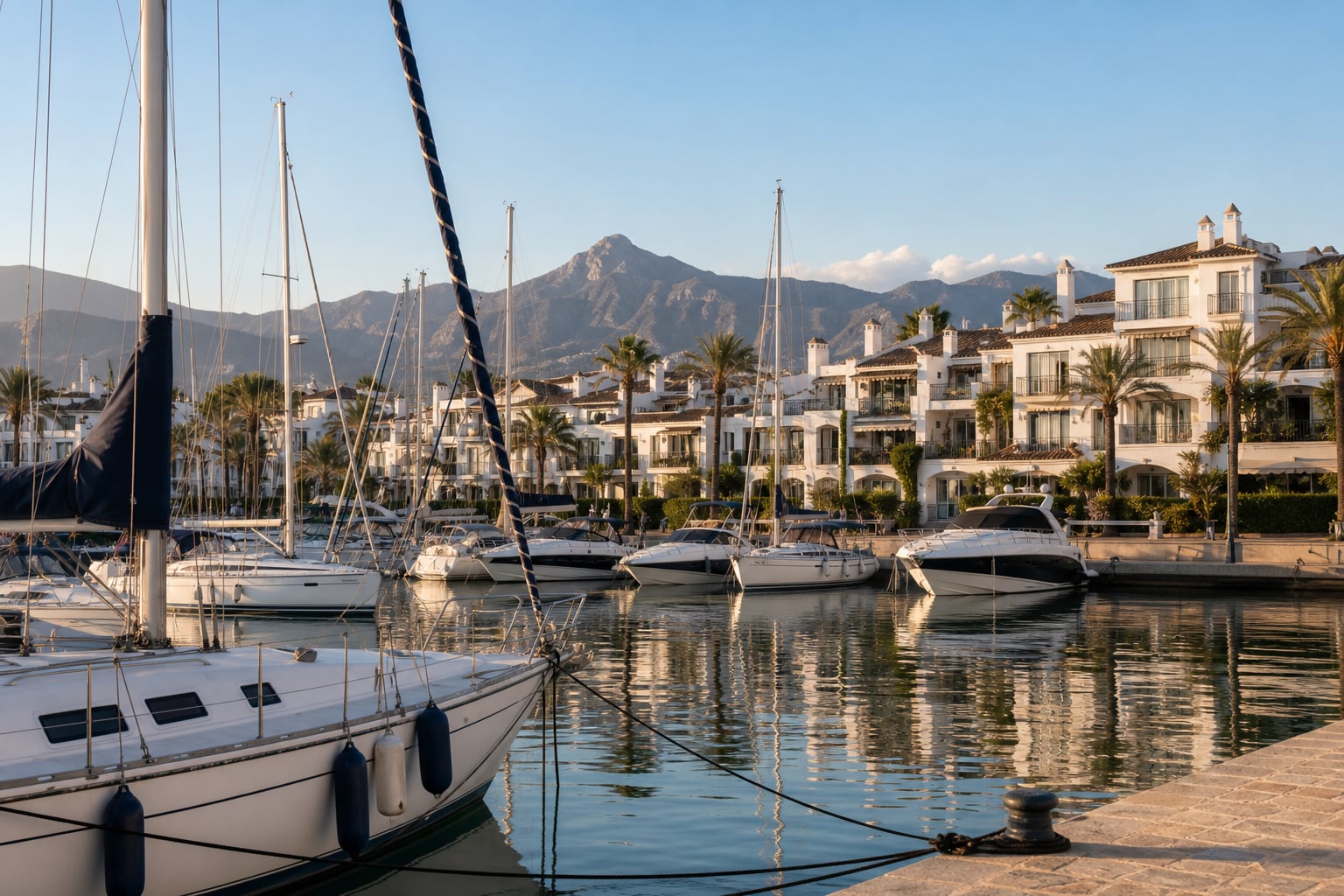
For buyers seeking an active outdoor life that is not tied to a single sport, the Golf Valley and its surroundings offer an unusually dense range of options. The Sierra de las Nieves National Park, accessible in under 30 minutes by car from Nueva Andalucía, provides serious hiking terrain with waymarked routes rising above 1,700 metres. Puerto Banús marina, around ten minutes south, offers sailing, water skiing and boat charter. Mountain bike trails in the Benahavís hills have developed significantly in recent years, adding another dimension to what is fundamentally one of the most activity-friendly climates in Europe. Marbella's average annual temperature of around 18–19°C and winter daily highs that rarely fall below 15°C mean that virtually no outdoor activity has a true off-season. The 320 sunny days figure is frequently cited, but the more practical point is that there is no month in which you would ordinarily cancel an outdoor plan on weather grounds.
Golf Proximity and the Property Market in Nueva Andalucía
The connection between golf and property values in the Golf Valley is structural rather than incidental. Nueva Andalucía reached an average price of €5,654 per square metre in early 2026 — its historical maximum — representing annual growth of approximately 6.6%. Within that average, homes with direct golf frontage or course views attract stronger demand than otherwise comparable properties set further from the fairways, a dynamic that has been consistent across market cycles because the underlying demand drivers — principally international buyers seeking a lifestyle base with genuine asset characteristics — have remained stable. The Golf Valley has not been immune to broader market movements, but its relative performance against more generic Costa del Sol locations has been resilient over decades.
Nueva Andalucía is a largely built-out neighbourhood. New development concentrates on infill plots and occasional larger sites on the upper valley edges rather than the large-scale delivery cycles that can shift supply-demand balances in other locations. Most buyers in the Golf Valley are choosing between resale properties — townhouses and apartments in urbanisations that date from the 1980s and 1990s, alongside newer villas built on plots released over the intervening decades. Entry points vary significantly by position and condition: a well-positioned two-bedroom apartment in a golf-facing urbanisation has been marketed from around €600,000, while a detached villa with direct frontage onto one of the championship courses can reach several million euros depending on plot size, built area and quality of finish. The area offers some of the Marbella region's more accessible price-per-square-metre entry points compared to the Golden Mile or Sierra Blanca, positioning it well for buyers who want genuine golf lifestyle access without the premium of the most prestigious coastal addresses.
The rental market in the Golf Valley is supported by the same dynamics that drive ownership demand. Golfers booking stays of one to two weeks visit the area throughout the year, with the shoulder seasons — late September through November and March through May — now nearly as active as the summer peak. A well-maintained apartment with course views, managed professionally on the main short-stay platforms, can generate meaningful rental income during periods of non-occupancy. Buyers should factor in community fees (gastos de comunidad), IBI council tax and non-resident income tax (IRNR) when calculating net returns, and should obtain current figures from a local managing agent. The point is not that the Golf Valley is primarily an investment location — most buyers here purchase for their own use — but that the rental market provides a genuine income floor that reduces the effective cost of ownership during periods when the property is not in use.
Finding Your Position in the Golf Valley
Buying in the Golf Valley rewards a considered approach to micro-location. The choice of which course to adjoin matters in practice: the social atmosphere, privacy, noise characteristics and resale liquidity of a property overlooking Los Naranjos differ from one beside Aloha or Las Brisas, and each carries distinct characteristics that become apparent only after genuine time spent in the area. Position relative to the valley's internal road network, driving distance to Puerto Banús and proximity to everyday commercial amenities are factors that experienced buyers weigh carefully alongside price per square metre. An area guide to the Marbella, Benahavís and Estepona markets as distinct micro-markets offers useful broader context for placing the Golf Valley within the regional picture and understanding how it compares to alternative locations at similar price points.
Current availability in Nueva Andalucía spans a range of product types and price levels. Isla Bela is one of the area's current new-build opportunities: luxury apartments in Nueva Andalucía, within easy reach of the Golf Valley's courses and infrastructure, available from €825,000. Looking at what is currently on the market across all product types gives the most accurate picture of what different budgets achieve at 2026 pricing levels throughout the neighbourhood.
The scene at La Quinta's first tee on a Saturday morning — unhurried, international, grounded in a climate and landscape that consistently deliver on what they promise — is as useful an indicator as any price chart of what the Golf Valley actually provides for the people who live here. Whether golf is the primary reason for being in this part of Marbella or simply one element of a broader outdoor life, it is difficult to overstate how thoroughly the sport and its infrastructure have shaped Nueva Andalucía. The courses arrived first, the neighbourhood grew around them, and more than fifty years on that sequencing is still visible in how the area functions, who it attracts, and what it reliably delivers for the buyers who make it their base.
If you are considering a property in Nueva Andalucía, Benahavís or anywhere along the Marbella golf corridor, browse current listings on Domosmar for a focused view of what is available across the area, or speak to us directly to discuss which specific locations and price brackets fit your situation. We know the Golf Valley well enough to tell you which side of which road, and which course frontage, makes a material difference to the day-to-day experience of living there.