- AEMET says summer 2026 was Spain’s hottest since the national series began in 1961. The June-to-August mean temperature was 24.5°C, 2.4°C above the 1991–2020 average.
- By 9 September, Spain had accumulated 61 days under heat-wave conditions in 2026. That exceeded the previous record of 41 days in 2022 and the 36 days counted in 2025.
- Málaga’s coastal climate is sunny even in an ordinary year. The AEMET airport baseline gives average daily maxima of 30.5°C in July and 30.8°C in August, with 347 and 316 sunshine hours respectively.
- Spain’s building code limits July solar gains in new private residential buildings. The CTE sets a qsol,jul limit of 2.00 kWh/m² per month for the conditioned floor area.
- Terraces are already close to standard in the new-build market. In Domosmar’s 13 September catalogue snapshot, 278 of 320 available developments — 86.9% — are flagged with terraces, while 215 — 67.2% — are flagged with swimming pools.
- Bottom line: on the Costa del Sol, the useful question is no longer simply how large the terrace is. It is whether the architecture makes that terrace — and the rooms behind it — comfortable when the sun is strongest.
Sixty-one days is a strange number to put into a property brochure, but it may be more useful than another photograph of an infinity pool. On 9 September, Spain’s state meteorological agency, AEMET, reported that 2026 had already produced 61 days under heat-wave conditions across the Peninsula and Balearic Islands — a record. The June-to-August summer itself was the hottest in the national series, with an average temperature of 24.5°C, 2.4°C above the 1991–2020 norm.
For Costa del Sol buyers, the point is not that every day in Marbella, Estepona or Mijas was part of a heat wave. AEMET’s 61-day figure is national. The more useful conclusion is that summer comfort can no longer be treated as an air-conditioning specification buried near the back of a brochure. On a coast where large areas of glazing, generous terraces and outdoor living are central to the product, shade is architecture.
That changes what deserves attention on a viewing. A 40 m² terrace with no useful afternoon shade can work less well in July than a smaller recessed terrace. A wall of glass can be beautiful at 10am and difficult at 5pm if it faces west without external protection. A pergola, deep overhang, external blind or correctly specified solar-control glass is not there to make the home darker. The best examples make the sunshine more usable for more hours of the year.
The Heat Story Is Persistence, Not One Spectacular Afternoon
The most striking part of AEMET’s September assessment is duration. Spain’s previous record was 41 heat-wave days in 2022; 2025 registered 36. By 9 September 2026 the tally had reached 61. AEMET identified an eight-day event from 20 to 27 June, a 23-day heat wave from 2 to 24 July, a 24-day event from 28 July to 20 August and a further six-day episode provisionally dated 2 to 7 September.
Málaga’s normal coastal climate already makes solar control a practical issue before any exceptional year is added. AEMET’s Málaga Airport climatology records an average daily maximum of 30.5°C in July and 30.8°C in August, with 347 sunshine hours in July and 316 in August. The same baseline still gives 255 sunshine hours in September. In other words, a Costa del Sol home does not need a record-breaking day to receive a great deal of summer solar energy.
This is good news for the lifestyle buyers are actually purchasing. Long bright seasons are why terraces, pools and large openings towards the sea have become so important. The architectural task is not to retreat from the climate; it is to make that climate easier to live with. The best summer-comfort features are therefore the ones that let you keep the doors open, use the terrace at lunch and enjoy the view without asking the cooling system to solve every problem by itself.
Spain’s Building Code Already Treats Solar Gain as a Design Problem
The Spanish Código Técnico de la Edificación is useful here because it turns a vague idea — “this should not overheat” — into a performance requirement. Under DB-HE1, new buildings have to control solar gains through the thermal envelope. For private residential use, the parameter known as qsol,jul is limited to 2.00 kWh/m² per month of useful conditioned floor area in July.
That figure is not an electricity bill and it should not be read as a simple limit on how much sun can hit a window. It is a technical measure of solar gains through openings in the building envelope under the prescribed calculation method. What matters to a buyer is the principle behind it: modern Spanish residential design is expected to deal with summer sun as part of the envelope, rather than assume that mechanical cooling will compensate for unrestricted glass.
The CTE commentary makes another point that is especially relevant in real homes. The compliance calculation can assume mobile shading devices are fully activated for the solar-control check, but the document notes that effective annual performance depends less on perfect day-to-day use of those devices and more on the other elements of the design — fixed shading, the characteristics of the openings and the way the façade is actually conceived. In plain English, a home that works only when every blind is lowered at exactly the right moment is less elegant than one whose architecture does part of the work automatically.
A Deep Terrace Can Be Part of the Thermal Envelope
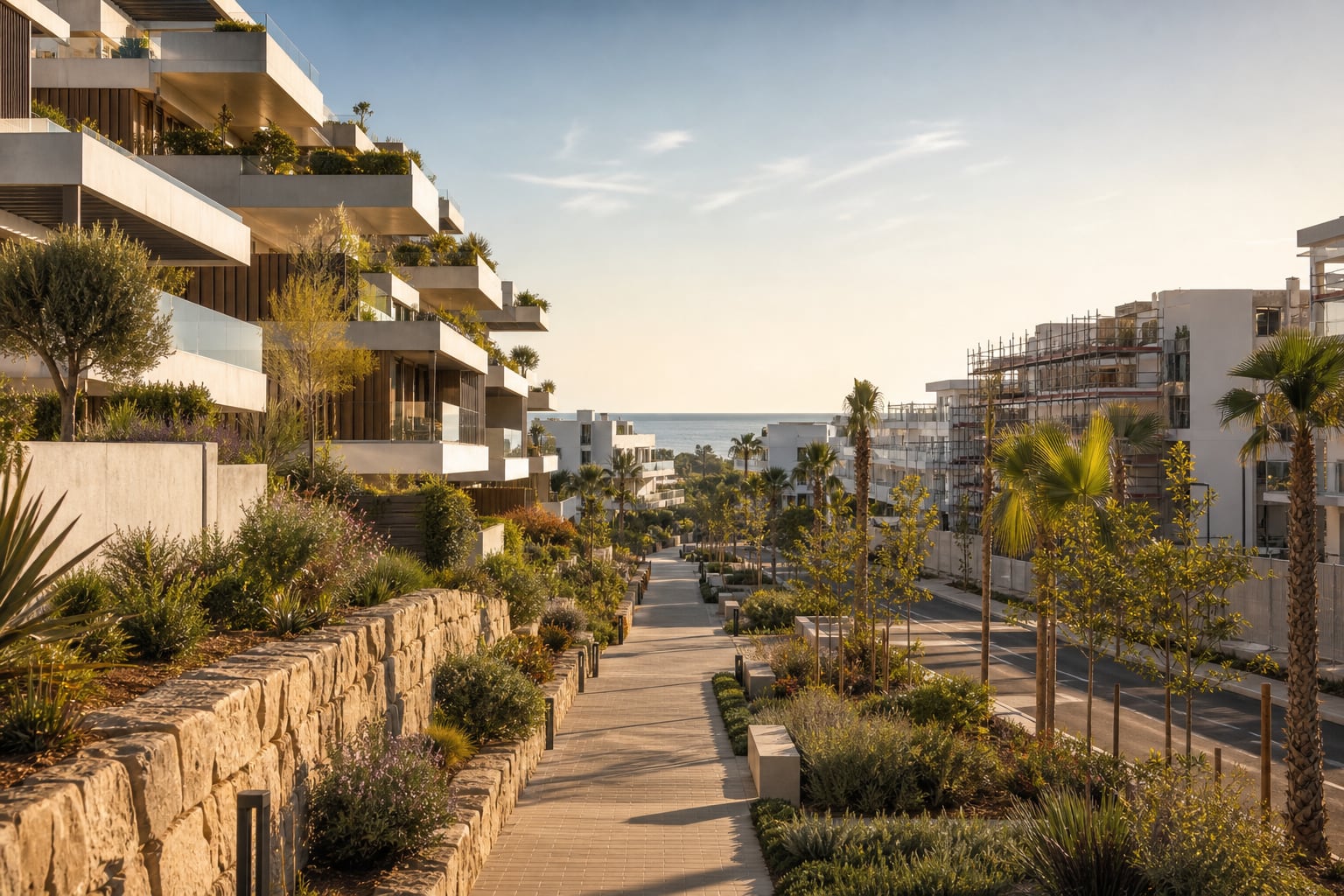
This is where the Costa del Sol’s obsession with terraces becomes architecturally interesting. A terrace is not only extra outdoor floor area. If the slab or roof above projects far enough beyond the glazing, it can become a fixed shading device. The same feature that creates an outdoor dining room also reduces the amount of high summer sun reaching the living room behind it.
The solar geometry helps. In our earlier guide to orientation and winter sun in Marbella, we calculated that the sun reaches roughly 76.9° above the horizon around the June solstice, but only about 30.1° around the December solstice. A well-proportioned horizontal overhang can therefore block much of the high-angle summer sun while still allowing lower winter rays to penetrate beneath it. The dimensions have to suit the actual façade; “deep terrace” is not a magic formula. But the principle is one of the oldest and most useful pieces of Mediterranean design.
This is also why terrace depth can matter more than headline terrace area. A very long, shallow strip may inflate the square-metre figure without creating a comfortable outdoor room. A deeper covered section can take a dining table, keep the façade shaded and still open to an uncovered section for sun loungers. The strongest layouts often give buyers both conditions instead of forcing them to choose between full sun and permanent shade.
For off-plan buyers, this is visible on the section drawing rather than the glossy floor plan. Look at the distance from the sliding doors to the edge of the slab above, whether the penthouse has a pergola or fixed canopy, and whether a lower-floor terrace sits under another balcony. The render may show a parasol in exactly the right place. The building section tells you what shade exists when the parasol has been put away.
West Is the Hard Case: Glass, Louvres and the Five-O’Clock Sun
Horizontal overhangs are particularly effective when the summer sun is high. West-facing façades create a different problem. Late in the day, the sun is lower and can pass beneath a roof projection, striking large areas of glazing at the point when the building has already absorbed hours of heat. The reward is obvious — evening light and sunsets — but good western design usually needs more than a roof slab.
External vertical or adjustable louvres, shutters and screens can intercept that lower-angle radiation before it reaches the glass. Solar-control glazing can reduce transmission while preserving views. Interior blinds are still useful for glare and privacy, but they act later in the chain: some solar energy has already passed through the glazing. None of these features is universally “best”. The point is that orientation should influence the shading strategy rather than every façade receiving the same treatment.
Cross-ventilation belongs in the same conversation. A dual-aspect or corner apartment with openings on more than one façade can make use of evening air in a way a deep single-aspect plan cannot. It does not replace cooling on the hottest days, but it can extend the hours when mechanical systems are unnecessary. Ceiling fans, shaded openings and sensible night ventilation are unglamorous compared with a rooftop pool; they can be far more noticeable during a two-week August stay.
The best test is not whether a specification sheet says “air conditioning”. Almost every serious contemporary development can cool a living room. The better question is how much work the system has to do. Our guide to energy-efficient Costa del Sol new builds looks at insulation, heat pumps and energy ratings in more detail. Solar control is the architectural counterpart to those systems: first reduce the unwanted gain, then cool what remains efficiently.
What 320 Live Developments Say About the New-Build Product
Terraces are no longer a niche amenity on the Costa del Sol. In Domosmar’s live catalogue on 13 September 2026, 278 of 320 available developments are explicitly flagged with terraces. That is 86.9%. Swimming pools appear in 215 developments, or 67.2%. The median advertised development entry price in the same snapshot is approximately €642,500.
Those are Domosmar catalogue fields, not a census of the entire Costa del Sol and not a technical audit of every development. They do show how normal the indoor-outdoor proposition has become. A terrace is now expected in much of the market. A pool is common. That means the buyer’s advantage increasingly comes from judging quality rather than checking a box marked “terrace”.
The Buyer’s Summer-Comfort Check Is Mostly Visible
You do not need to perform an energy model during a property viewing. Most of the useful questions are visible in the architecture or answerable from the specification. The table below is less a technical checklist than a way of translating design into daily use.
| Design element | What it does | Useful buyer question |
|---|---|---|
| Deep overhang / recessed terrace | Creates permanent shade and can reduce high-angle summer sun on glazing | How far does the slab or canopy project beyond the principal doors? |
| External blinds, shutters or louvres | Controls direct radiation before it reaches the glass | Are they external, adjustable and included in the delivered specification? |
| Solar-control glazing | Reduces solar energy transmitted through large glazed areas | What glass specification is used on the principal south- and west-facing openings? |
| Dual aspect / cross-ventilation | Allows air to move through the home when conditions permit | Can opposite or adjacent façades be opened safely at the same time? |
| Insulated envelope | Slows heat transfer through walls, roof and windows | What energy rating and envelope specification are expected at completion? |
| Efficient active cooling | Handles the remaining cooling load after passive measures have done their job | Is cooling zoned by room, and how is the system generated and controlled? |
On a completed home, change the viewing hour. A west-facing living room deserves to be seen late in the afternoon, not only before lunch. Feel the glass, look at where the sun reaches the floor, see whether the terrace dining area is shaded and notice whether every shutter has already been closed. On an off-plan home, ask for the site plan, façade drawings and section through the terrace rather than relying solely on a furnished floor plan.
Also look for choice. The most liveable outdoor spaces often have a covered zone and an open zone, allowing breakfast in sun, lunch in shade and evening use as the angle changes. A penthouse with a completely exposed terrace can be spectacular but may need a pergola or awning to become an everyday room. A ground-floor home can gain natural shade from the building above but needs privacy and airflow to be checked. “More terrace” is not always the same as “more usable terrace”.
Shade Is Not the Opposite of the Costa del Sol Lifestyle
For buyers, summer 2026 is a useful reminder to value that work. Spain’s record heat does not make the Costa del Sol less attractive; the coast’s light and long outdoor season remain central to its appeal. It does make the difference between a photogenic terrace and a well-designed one easier to understand. A shaded dining area, correctly treated west-facing glass and a home that can breathe are features you notice every afternoon.
The most convincing new builds therefore do not ask buyers to choose between winter sun and summer comfort. They use orientation, overhangs, glazing and movable shading to offer both. That is a more durable kind of luxury than simply adding another square metre of uncovered terrace: the ability to use the home when the weather is at its best and when it is at its most demanding.
Sources & Data Notes
AEMET’s 61-day figure and the record 2026 summer temperature are national figures for Spain and should not be read as a local heat-wave count for Marbella or Málaga province. Málaga summer temperature and sunshine figures use AEMET’s long-run Málaga Airport climatology as a coastal reference. The qsol,jul figure and comments on fixed and mobile shading use the current DB-HE energy-efficiency documentation from Spain’s Código Técnico de la Edificación. Domosmar’s 320-development, terrace, pool and €642,500 median-entry figures are a live catalogue snapshot taken on 13 September 2026 and are not a census of all Costa del Sol supply.
- AEMET — 61 heat-wave days in 2026 and Spain’s record-hot summer, 9 September 2026
- AEMET — Málaga Airport climatology and monthly sunshine/temperature baseline
- Código Técnico de la Edificación — DB-HE Energy Saving, solar-control requirements
- IDAE — technical guidance on daylight, overhangs and solar screening
If outdoor living is central to your brief, browse the current Costa del Sol new-build collection, including Marbella properties and Estepona properties. For a shortlist that compares terrace depth, orientation, shading and energy specification rather than simply counting outdoor square metres, contact Domosmar.