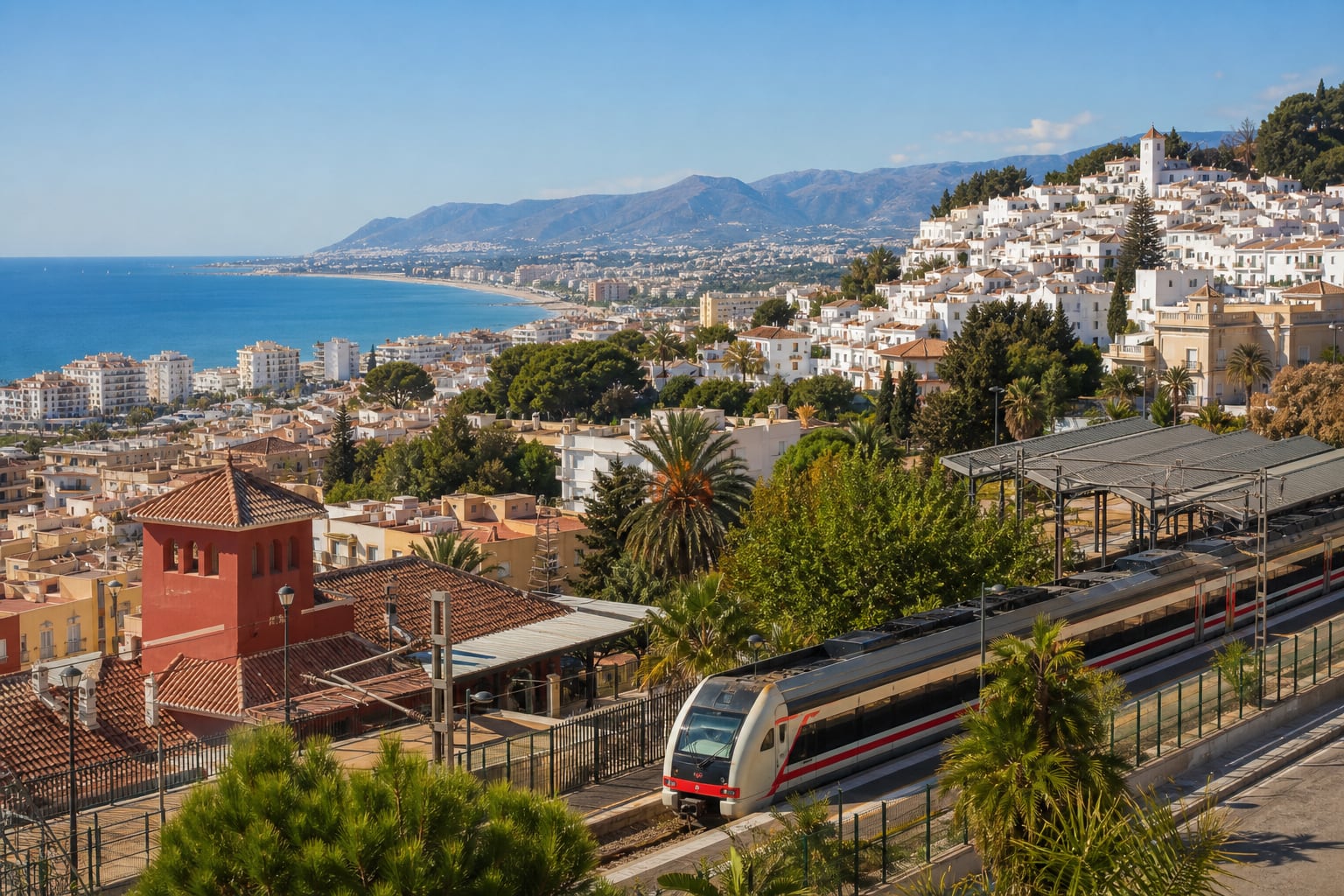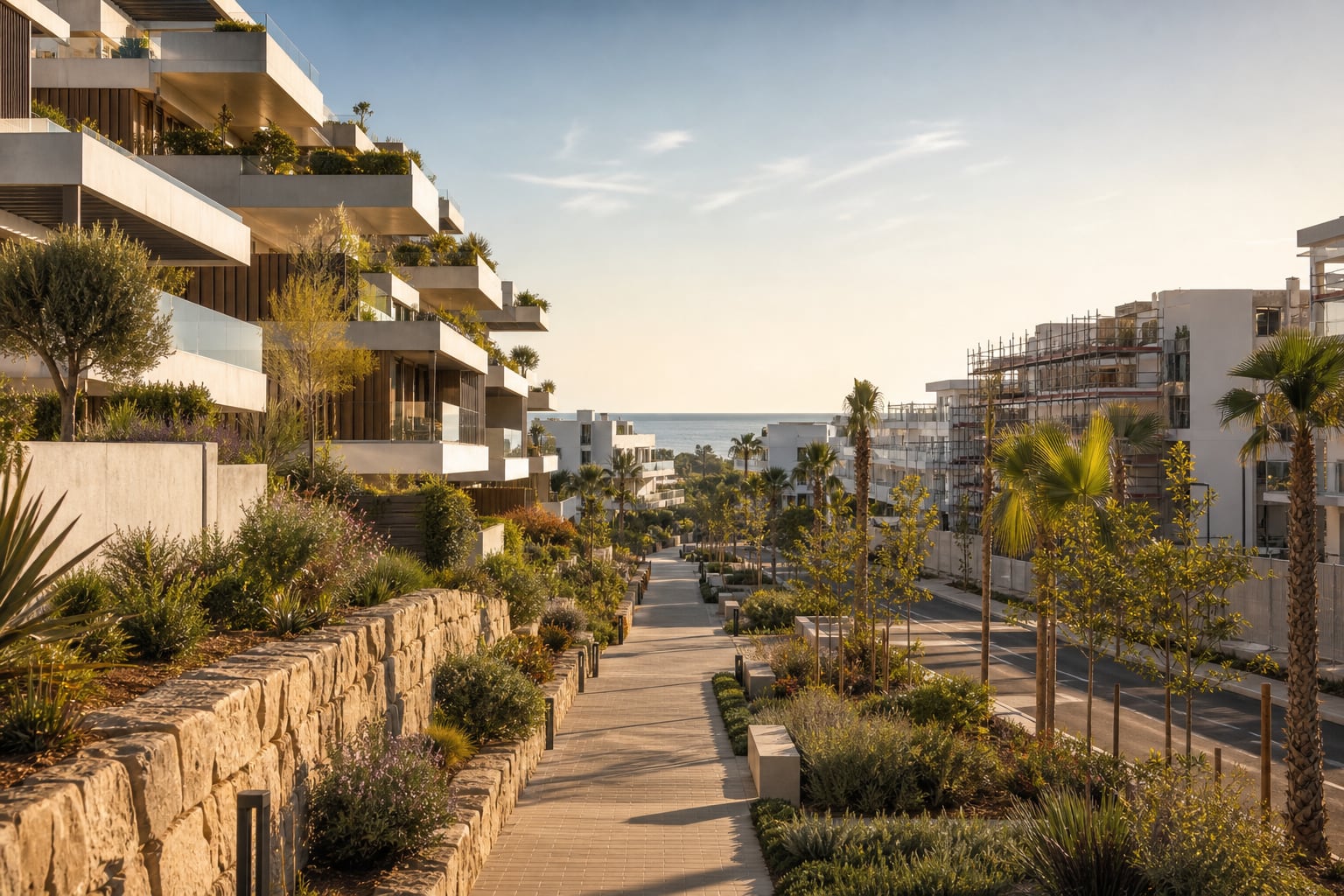
Drive the A-7 coast road east out of Estepona a little after eight in the morning, before the day's heat settles over the hills, and the story tells itself through the skyline. On the stretch between the town's eastern edge and Guadalmina, tower cranes punctuate the slope in both directions — over apartment blocks half-clad in pale stone, over villa plots still pegged out in rebar and string line, over show-home cabins with their flags already raised for the day. Count them across that ten-minute drive and you rarely get below a dozen. A few kilometres on, the same road passes through Marbella, and the count drops sharply.
It is a particular kind of sight on the Costa del Sol in 2026. For most of the past decade, the coast's construction activity has been discussed as a single regional story — the Costa del Sol is building, the Costa del Sol is short of homes. Stand on this road, though, and a sharper picture comes into focus. Estepona is doing something its more famous neighbours are not: it is building, at scale, and it is doing so right now.
That distinction matters more than it first sounds. The Costa del Sol's prime market is, by almost every serious account, running short of new homes — and where construction is actually permitted, and how quickly it can happen, has quietly become one of the most important questions a buyer can ask. Estepona has spent several years turning itself into the answer to that question. For anyone weighing a purchase across Marbella, Benahavís and Estepona, understanding why is no longer optional.
A town that set out to build
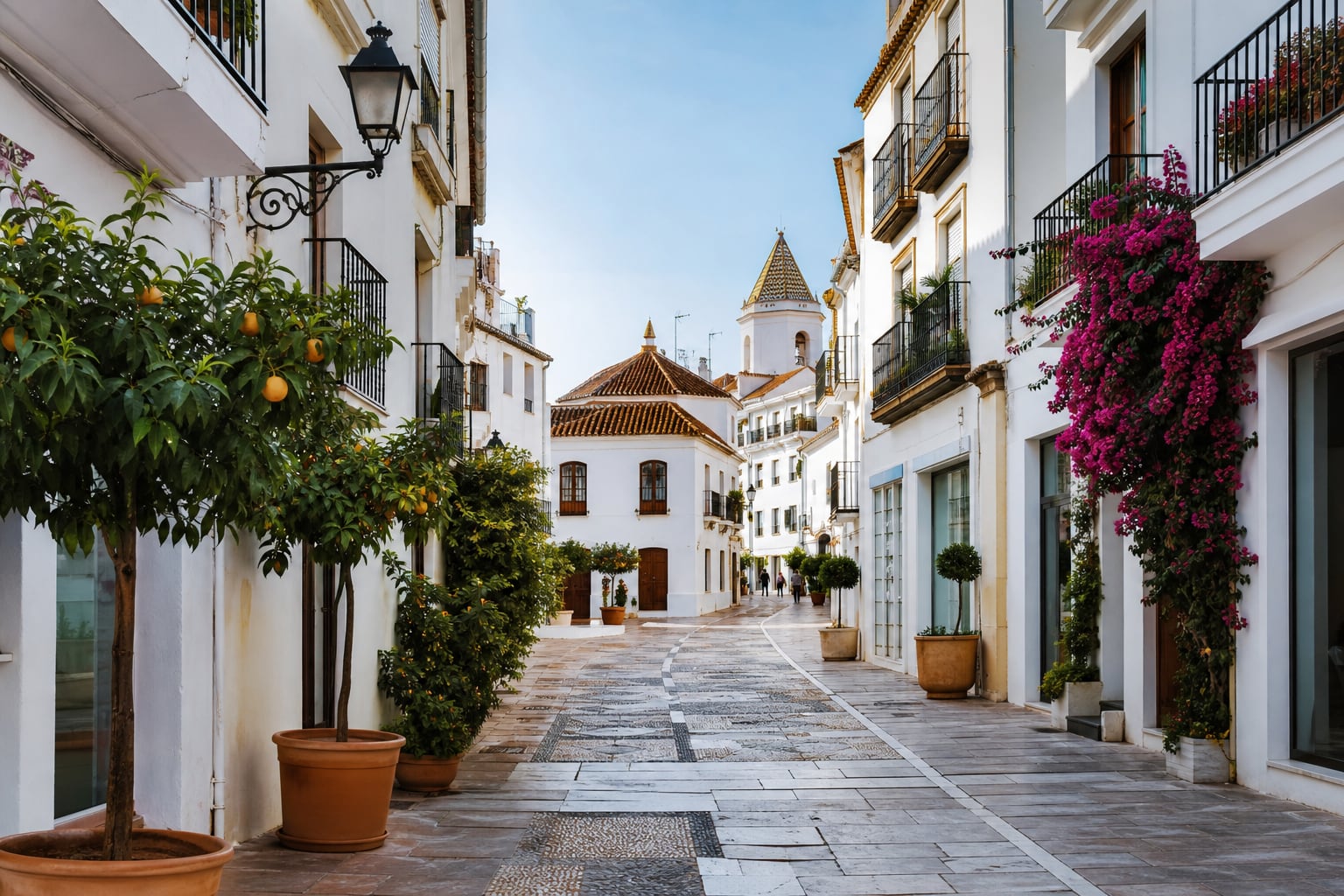
Estepona's shift from a quiet working town into the busiest construction market on the western Costa del Sol did not happen by chance. The municipality has spent the past decade methodically rebuilding itself — first its old town, marketed without irony as the Jardín de la Costa del Sol, the Garden of the Costa del Sol, and then its development pipeline. By early 2026, the result was visible in the numbers as much as on the skyline, and it had changed how the wider coast talks about the town.
New-build prices in Estepona reached €7,000 per square metre at the close of 2025 — a record high for the town, with the most exclusive coastal projects pushing well beyond it, according to idealista. That is a striking figure for a place that, only a few years ago, was treated as the value option of the so-called Golden Triangle — the cheaper third behind Marbella and Benahavís. The label no longer fits the top of the market.
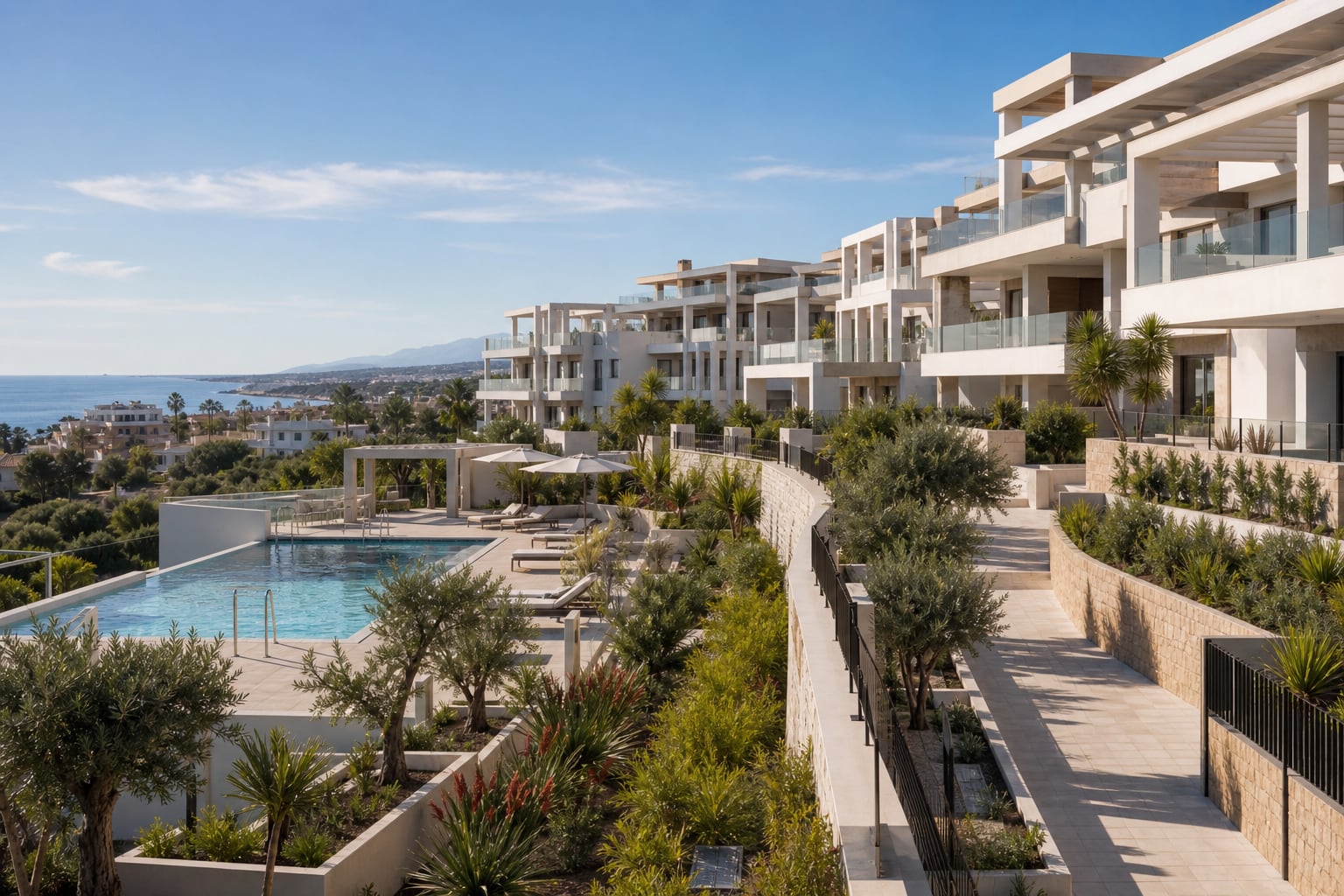
The flagship example is Tyrian Residences, a 40-home beachfront development by Prestige Expo and Grupo BZH, with prices running from €3.6 million to €8.5 million and completion scheduled for summer 2026. In late 2025 it was named the best residential project in Spain at the European Property Awards in London — a distinction that, a decade ago, would almost certainly have gone to an address in Marbella rather than Estepona. The award was a marker of how far the town's ambitions now reach.
Behind the marquee projects sits sheer volume. Industry counts through 2025 put more than 50 residential developments in progress across the municipality, with several thousand homes scheduled for delivery between 2024 and 2026 — a pipeline with little parallel on this stretch of coast. The town has also placed public money behind the private boom, approving its largest-ever annual budget of €132 million, of which €35 million is earmarked purely for urban maintenance and public space.
What that spending buys is not incidental to the property story. A town that keeps its streets, gardens and seafront immaculate gives developers a backdrop they can sell against, and gives buyers a reason to believe today's prices will hold. Estepona has understood, more clearly than most Spanish coastal towns, that the public realm and the private market rise or fall together.
Why Estepona can build when its neighbours can't
To understand why Estepona stands apart, it helps to look closely at what is — and is not — happening a few kilometres east. Marbella spent much of the past two years working through a new general planning framework, the PGOM, which received regional approval from the Junta de Andalucía in February 2026. It is a genuine milestone for the city. It is also the start of a long process: the detailed plan that will actually govern what can be built on any given plot, known as the POU, is not expected to be in force until 2027 or 2028.
In the meantime, Marbella's new-build supply has stayed tight. A round of planning licences approved by the town hall in July 2025, worth close to €67 million, drew attention precisely because approvals on that scale had become rare — and much of it was concentrated on a relatively small number of homes in Nueva Andalucía. For a market with this much international demand, that is not a great deal of new product reaching the ground.
Estepona's planning environment, by contrast, has been built for speed. The municipality has openly prioritised faster processing of building permits, has reduced its debt by more than €300 million, and in 2025 cut property tax, the IBI, by an average of around 20%, funded by a dedicated €6.6 million package. Lower carrying costs, quicker approvals and a council visibly courting investment have together made Estepona the path of least resistance for builders priced or planned out of Marbella.
None of this is a criticism of Marbella's approach. Controlled, strategic supply tends to support values over the long term, and Marbella's prestige is not in question. But it does explain the immediate picture, and the immediate picture is what a buyer in 2026 has to act on. If you want to buy a brand-new home on the western Costa del Sol this year, a disproportionate share of the genuine choice sits inside one municipality — and that municipality is Estepona.
Where the cranes are
The building is not spread evenly across the town. Estepona's new-build activity concentrates in three areas, and each one tells a buyer something different about the market and the kind of ownership on offer.
The first is the New Golden Mile, the coastal corridor running from Guadalmina back towards the town — the stretch with the cranes you counted from the A-7. This is the premium end: new-build prices here run between €6,000 and €8,000 per square metre, and the buyer profile is international and accustomed to branded, professionally serviced developments. It is where the marquee projects, Tyrian among them, have clustered, and it is being lifted further by a €113 million redevelopment of Estepona's marina that will raise the standard of the whole corridor.
The second is Las Mesas, the fast-rising district immediately behind the town centre. Here the appeal is contemporary apartments within walking distance of the restored old town and the seafront — a more urban, lock-up-and-leave proposition that has drawn primary-residence buyers and second-home owners in roughly equal measure. Quality new stock in this band has tended to sit in the €700,000 to €1 million range, which makes it one of the more accessible entry points into a genuinely walkable Costa del Sol town.
The third is the Casco Antiguo, the old town itself. There is no large-scale new construction here, by design — but there is a steady supply of meticulously restored casas mata, the traditional low town houses, repositioned as boutique homes. It is the smallest of the three markets and the hardest to buy into, yet it anchors the others. The polished, flower-filled old town, knitted together with the rest of Estepona by the pedestrianised Avenida San Lorenzo boulevard, is a large part of why the New Golden Mile can ask €7,000 a metre at all.
What a building boom does to prices
The intuitive assumption is that heavy construction should hold prices down — more supply, softer prices. On the Costa del Sol in this cycle, it has not worked that way, and that is the part buyers most need to sit with before they draw conclusions.
Estepona's town-wide average stood at roughly €3,910 per square metre in mid-2025, according to idealista — more expensive than the wider Andalusian average, but still clearly below Marbella, where prime and new-build stock trades materially higher. That gap is the engine of the boom. Estepona offers Marbella-adjacent location, the same more-than-300-days-of-sunshine coastline and a comparable lifestyle at a visible discount, and buyers have responded by absorbing new supply almost as fast as it appears.
The pace of sales tells the story. Through late 2025 and into 2026, well-priced new releases in Estepona and Marbella were reported reaching 60 to 80% reserved within weeks of launch. Independent appraiser Tinsa recorded strong double-digit annual growth across Marbella, Estepona and Benahavís over the course of 2025, and most forecasters expect mid-single-digit price growth to continue into 2026. The backdrop to all of it is scarcity: in mid-2025, idealista recorded the steepest annual fall in the number of homes for sale across Spain that it had ever measured.
In other words, Estepona is building faster than anywhere else on this coast, and prices are still rising. For a buyer, that combination is unusual and worth weighing carefully. It means new supply is not, in itself, a reason to wait for a discount that may not come — but it is a strong reason to buy where the choice genuinely exists. Demand here, as one leading Costa del Sol developer put it to idealista, continues to outstrip what the coast can realistically build.
Reading the boom as a buyer
A market like this one rewards buyers who treat the boom as a chance to choose well, not merely to choose quickly. The first practical point is range. Estepona's pipeline spans an unusually wide spectrum — from apartments around the €450,000 to €700,000 mark in areas such as Selwo and the town's western edge, through the €700,000 to €1 million band in Las Mesas, to villas approaching and beyond €2 million towards the Sotogrande side. Our Estepona listings show how broad that span really is, and few Costa del Sol towns offer this much choice inside a single municipality.
The second is timing. Much of what is selling is off-plan — bought before completion, on staged payments. That structure has real advantages: early pricing, first choice of unit and the latest specification. But it also means delivery dates, the developer's track record and the precise detail of the bank guarantee protecting your deposit matter every bit as much as the brochure renders. A development counted among the fifty-plus in progress is only an asset to you if it completes on schedule and to the standard promised.
The third is comparison. The reason to understand Estepona's boom is not to conclude that Estepona always wins — it is to buy the western Costa del Sol with clear eyes. For some buyers, Marbella's tighter supply and long-established prestige will still justify the premium, and our Marbella listings exist for exactly that comparison. How supply and planning quietly shape these neighbouring markets is a recurring theme across the Domosmar blog. The point is simply this: in 2026, the buyer who overlooks Estepona is overlooking most of the new homes actually being built.
Estepona in 2026 is a rare thing in prime European property — a market with real momentum and real choice at the same time. The cranes along the A-7 are not a warning sign. They are, for now, simply where the western Costa del Sol's new homes are going up, and they will not be putting up first-choice units forever. The skill lies in picking the right one before the town's discount to Marbella narrows any further.
If you are weighing Estepona against Marbella or Benahavís, the most useful place to start is with the homes themselves. Browse current Estepona and Costa del Sol new-build listings on Domosmar, and when you want a grounded, buyer-led view on which development genuinely fits your budget and your timeline, speak to our team. We will give you the honest comparison — not the brochure.