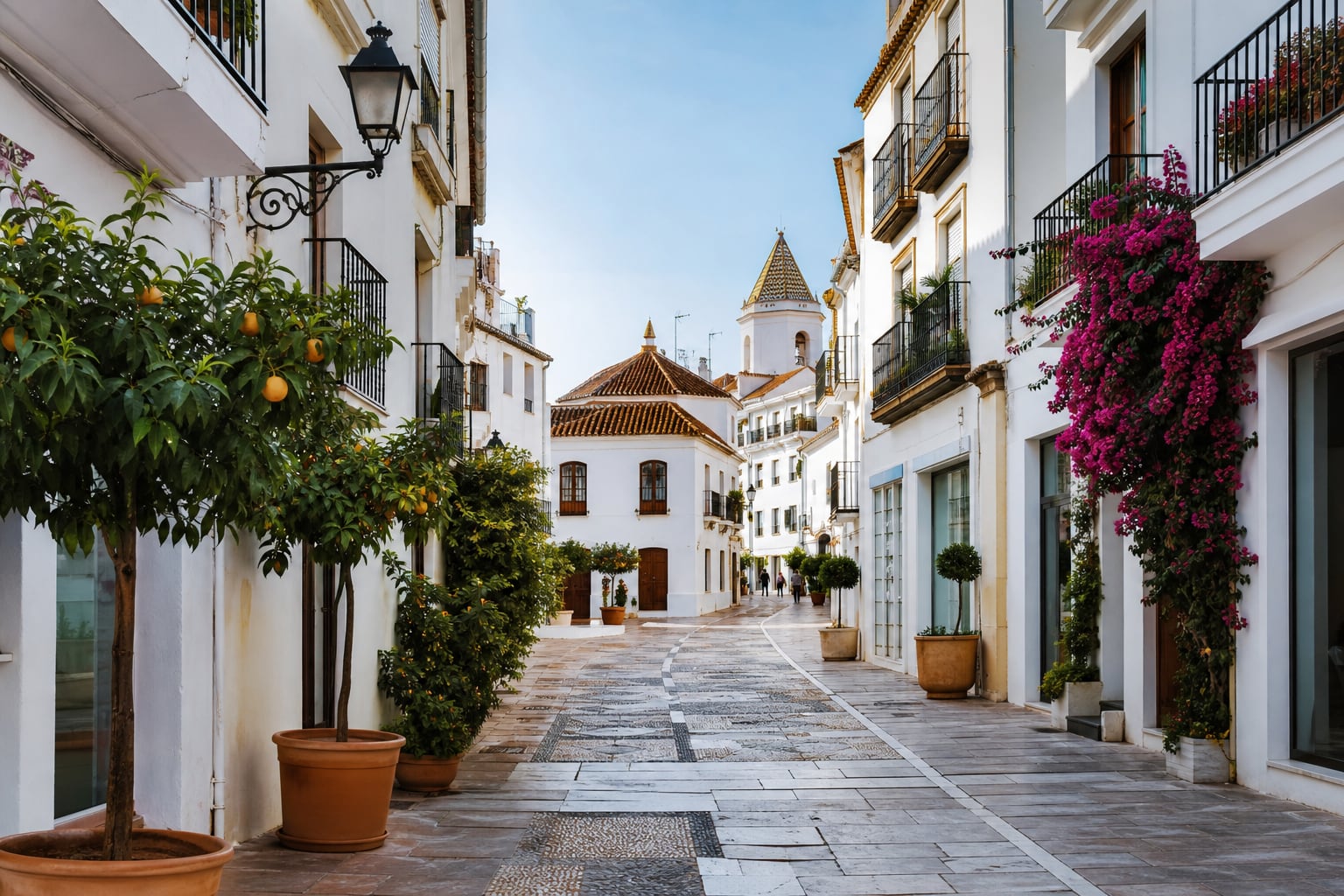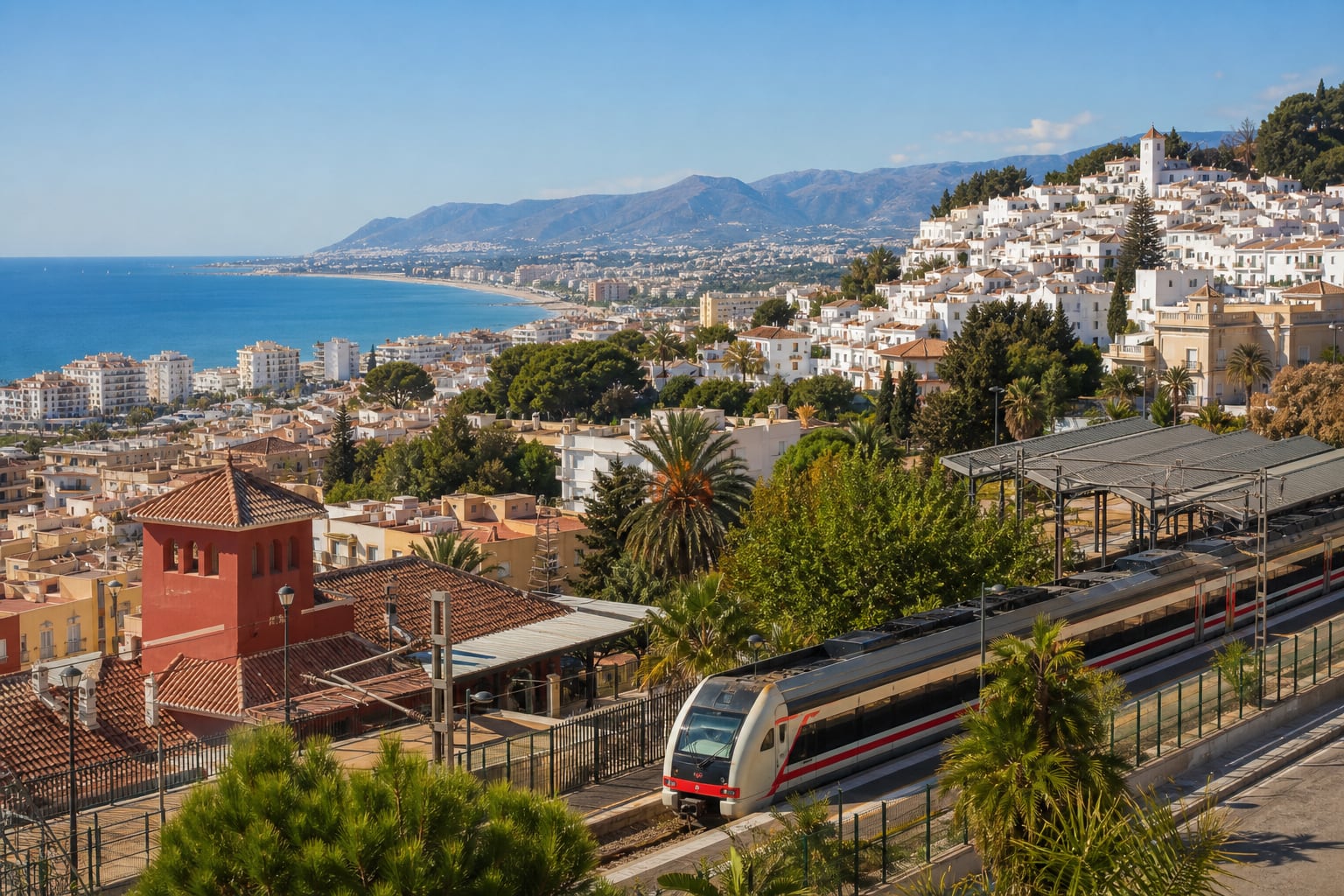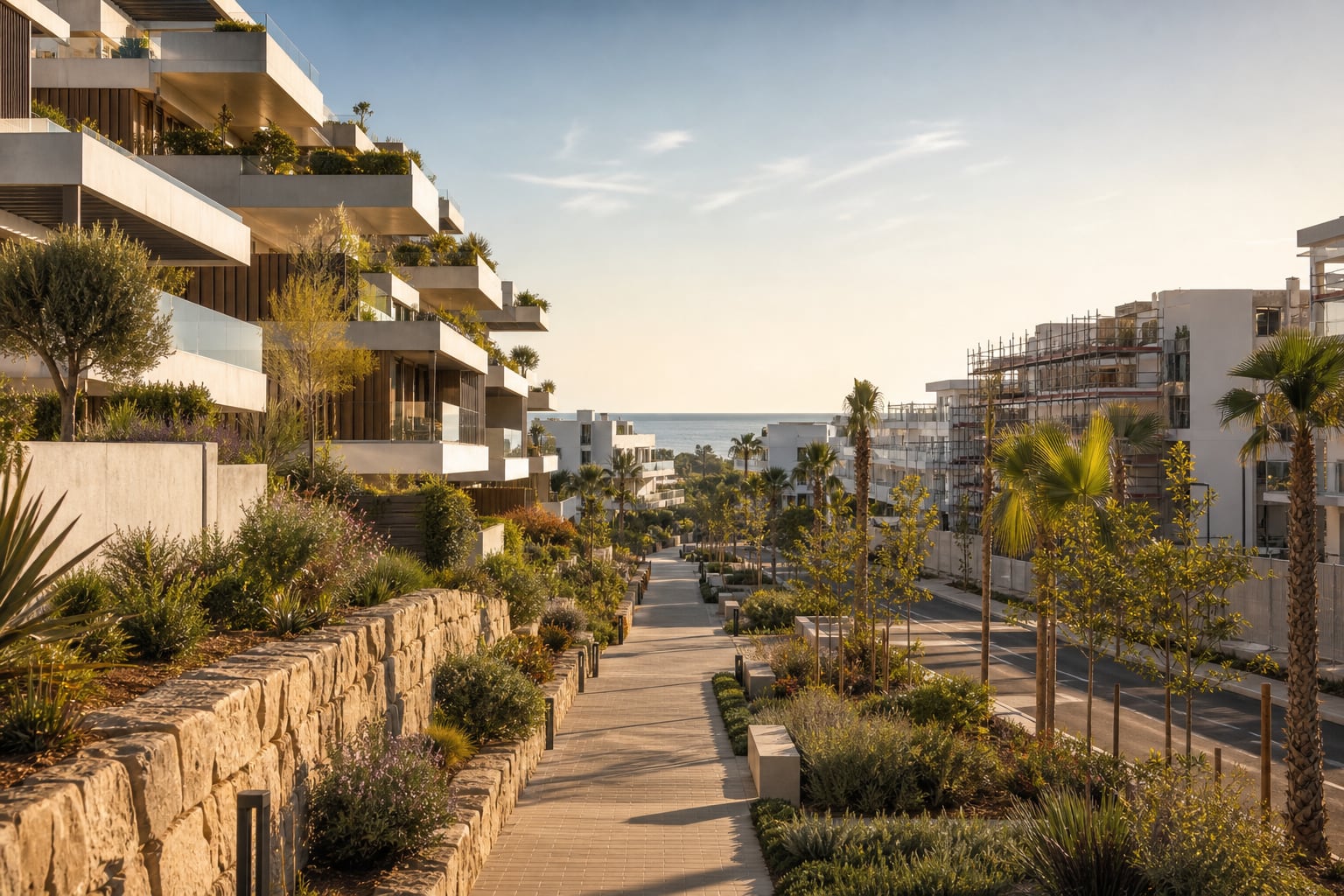
At seven in the morning on Estepona's Paseo Marítimo, the light coming off the water is still soft and the surface of the Alboran Sea barely disturbed. A few regulars are already walking the palm-lined promenade that runs alongside Playa de la Rada; the chiringuito near the Puerto Deportivo won't open for another two hours. But look north from the seafront — toward the ridge where the A-7 highway curves inland through the Selwo and Cancelada corridors — and the outline of tower cranes against the morning sky has become a permanent part of the view. Estepona is building at a pace the market has not seen in over a decade, and that activity is the most visible expression of something the data now confirms with unusual clarity.
The so-called Golden Triangle — the three municipalities of Marbella, Estepona and Benahavís that together form the premium core of the Costa del Sol — posted average asking-price growth of 11.9% year-on-year in May 2025, according to Idealista figures published by DOM3, the association of high-end Costa del Sol agencies. Beneath that headline figure, the three municipalities are not moving together. Estepona is leading the pack by a margin that warrants specific attention; buyer nationality data for the first half of 2025 shows a market that is meaningfully more diverse than it was three years ago; and Spain's abolition of its Golden Visa programme on 3 April 2025 has prompted the first serious reassessment of where genuine demand originates. For anyone considering a purchase in the Marbella area, understanding all three of those threads is the essential starting point for reading the current market accurately.
The Transaction Record Behind the Headlines
8,708 properties changed hands across the Golden Triangle in 2024, a 5.64% increase on the prior year, according to official registry data presented by Panorama Properties, Diana Morales Properties and Pure Living Properties at a DOM3 professional event in May 2025. Marbella led in transaction volume with 4,745 sales; Estepona contributed 3,162; Benahavís accounted for 801. Of the total, 7,519 — or 86.4% — were resale properties rather than new builds, a proportion that reveals how much of the current market is still moving through existing stock. That figure also helps explain why new-build completions in Estepona are generating such acute pricing pressure: they represent genuine supply into a market where alternatives are constrained by whatever resale inventory happens to be available at any given moment.
The international character of that transaction volume is striking. In Q1 2025, Spain registered a record 21,525 foreign property buyers — representing 14.1% of all national sales — according to registry data cited by DOM3. In the province of Málaga, foreign buyers account for 34.75% of transactions. In Marbella's high-end segment, that proportion is dramatically higher: Christopher Clover, CEO of Panorama Properties, noted at the May 2025 DOM3 event that more than 90% of his agency's sales are to non-Spanish buyers. Marbella finished 2024 with approximately 167,000 registered residents, of whom more than 55,000 — roughly one in three — are foreign nationals representing 152 different nationalities. The practical reality of daily life in Marbella reflects that demographic precisely. It functions as a full-time, year-round city with the infrastructure to match: international schools including Aloha College in Nueva Andalucía and Laude San Pedro along the western corridor, private hospitals including Hospiten Marbella and Quirónsalud, and a retail and dining landscape that does not shut down in October the way a purely seasonal resort would.
Looking into 2025, the pace of activity has remained firm even as it has matured. The buyers active in this market today are, on average, more selective and less willing to pay over-inflated vendor expectations than they were at the peak years of 2022 and 2023. DOM3 president Charly Simon observed at the organisation's May 2025 round table that "the resale market must adjust its expectations — continuous price hikes in this segment could lead to a disconnect from real demand and slow down transactions." That tempering is, paradoxically, a mark of market health: it signals depth and discernment rather than the feverish momentum that tends to precede a correction. A market in which buyers are selective but active, and in which transaction volumes are growing at mid-single-digit rates rather than doubling annually, is one that has found a durable pace.
An Uneven Map: How Each Municipality Is Moving
The 11.9% average conceals significant divergence at the municipal level. Estepona recorded the strongest growth: +15.1% year-on-year as of May 2025, per the DOM3 Idealista data, with its average asking price reaching approximately €4,400/m² by mid-year. Within the municipality, the sharpest acceleration was in Playa Bahía Dorada at +28.3% year-on-year, followed by central Estepona town and the Selwo zone, each up approximately 23%. These are the areas where new development is most concentrated — precisely the neighbourhoods where buyers are weighing current new-build prices against resale stock that may have been listed during a quieter moment. The gap between those two reference points is what is pulling asking-price data upward. For buyers still orienting themselves across the three municipalities, our overview of the three neighbouring markets covers the character of each in more qualitative depth.
Benahavís posted a 10.8% increase over the same period. Its sub-zone data reflects the particular logic of that municipality: Los Flamingos was up 21.0%, La Zagaleta and El Madroñal combined for 18.6%, and El Paraíso — which straddles the Estepona-Benahavís border — recorded 17.7% growth. Each of those areas is characterised by large, gated developments with limited resale inventory, which means that any notable transaction at current market prices has a disproportionate effect on the area's average. The underlying dynamic in Benahavís is one of genuine scarcity: the municipality is predominantly green-zoned rural land with building rights over a limited footprint, so supply additions are infrequent and well-absorbed. Demand for La Zagaleta in particular — a 900-hectare private estate in the hills above Marbella with its own golf courses, equestrian facilities, and a helipad — has shown no meaningful softening, with buyers specifically citing its security arrangements as a primary motivation alongside the estate's elevation-cooled microclimate relative to the coast below.
Marbella's own growth rate — 9.8% — is the most moderate of the three, reflecting the maturity of its established prime zones. Its Nagüeles and Golden Mile corridor was averaging approximately €6,400/m² in mid-2025, placing it alongside comparable micro-markets in Lisbon's Príncipe Real or London's Chelsea in terms of absolute price per square metre. Within Marbella, the highest growth rates in May 2025 were coming not from the established prime zones but from the eastern and transitional stretches of the municipality: Elviria–Cabopino was the fastest-moving Marbella sub-zone at +22.4% year-on-year, while Las Chapas–El Rosario was up 14.1% and San Pedro Alcántara registered 13.9%. This pattern suggests that buyers who cannot access the Golden Mile at its current level are redistributing demand westward toward San Pedro and eastward toward Elviria — creating secondary appreciation fronts as pressure from the core zones flows outward. It is a pattern familiar from other mature luxury markets: once the prime core approaches a price ceiling for a given buyer cohort, adjacent areas offering similar lifestyle access at a lower entry point experience compressed and rapid growth.
A Shifting Atlas of International Demand
The nationality composition of buyers in the Golden Triangle has shifted more substantially over the last two years than at any comparable period in recent memory. Foreign buyers collectively accounted for 63% of transactions in the first half of 2025, according to H1 market data from The Agency Marbella. British buyers remain the largest single national group at approximately 16% of transactions — a proportion that has proved remarkably stable despite a decade of currency and political turbulence. Dutch buyers, already a consistent presence in the market, were up 26% in volume terms in 2025. The steepest proportional increase came from Polish buyers, whose transaction count was up 43.7% — a shift that reflects the growing wealth of Central European professional classes and a broader pattern of diversification away from domestic property markets where yields have compressed sharply. American buyers were up approximately 25% over the same period, drawn by a combination of lifestyle appeal, the relative value of the euro, and the growing profile of the Costa del Sol among ultra-high-net-worth networks that previously circulated primarily between Miami, New York, and European ski destinations.
That diversification matters for several reasons beyond its surface interest as a demographic trend. It means the market is less exposed to any single national economy's cycle — a meaningful consideration for buyers assessing resale liquidity over a five-to-ten-year horizon. It also means the agency and marketing infrastructure has broadened: firms in Marbella and Estepona are now working with Polish, Ukrainian, and American buyer networks that simply were not active in this market a decade ago. The Ukrainian buyer presence — up 26.3% in 2025 — reflects a longer-term trend of wealth repositioning that has continued with notable consistency. For these buyers, a full-time residence in an established European destination with Málaga Airport 45 minutes east along the A-7 and direct connections to Warsaw, Amsterdam, and London represents a specific set of logistical and lifestyle requirements that the Costa del Sol meets with unusual completeness.
Scandinavian buyers — historically a dominant force across Marbella and Estepona, particularly in the New Golden Mile corridor and in urbanisations such as Aloha Golf and Las Brisas in Nueva Andalucía — showed mixed dynamics through 2024 and into early 2025, with some hesitation linked to interest-rate exposure in Nordic domestic markets. The expectation among local agencies is that lower European rates through 2025 and 2026 should stabilise and likely re-accelerate that demand. The overall picture is one of exceptional breadth. At the May 2025 DOM3 round table, Clover noted that Panorama Properties had sold properties to buyers from 45 different nationalities over the preceding two years. When a market's demand base is that geographically wide, no single recessionary shock can hollow it out quickly — a structural argument for the Golden Triangle's sustained price trajectory that deserves more weight than headline percentage figures alone.
Supply, Land, and the New-Build Equation
The supply picture across the three municipalities is sharply asymmetric, and that asymmetry shapes where buyers should look depending on what they want from their purchase. In Marbella, Ignacio Díaz of the Town Hall noted at the May 2025 DOM3 event that the municipality has approximately 9,000 properties yet to be developed — but that a significant portion of this potential supply depends on the approval of a new General Plan, which remains in progress. The practical effect is that Marbella's new-build pipeline is constrained by planning, not by demand. Developers waiting on plot releases cannot bring product to market quickly even where pre-sales would justify doing so, which means that pressure on existing resale stock is not relieved in the near term. It is one reason why established addresses — Sierra Blanca, the Golden Mile corridor between Marbella town and Puerto Banús, the hillside roads above Nagüeles — continue to hold price per square metre at a level that many coastal European markets would regard as exceptional. The scarcity is structural, not cyclical.
Estepona's position is different. The municipality has significantly greater land availability than Marbella — a structural advantage that underpins its outsized growth rate in both transaction volume and asking prices — and its Town Hall has been more active in advancing planning permissions for new development zones. The result is an active pipeline across multiple areas: the New Golden Mile corridor between Estepona and San Pedro Alcántara, El Paraíso with its gated residential communities, the Selwo zone, Valle Romano, and Cancelada all have schemes with completion timelines running through 2026 and 2027. The typical profile of these projects — contemporary low-rise apartment complexes and gated villa developments with high-specification finishes, communal pools, and sea or mountain views — has proved strongly appealing to the Dutch, Northern European, and American buyer cohorts growing fastest in the market. Entry prices for quality new builds along the New Golden Mile begin at around €500,000 for a two-bedroom apartment and extend well beyond €2,000,000 for prime sea-view positions, placing Estepona within reach of buyer profiles that cannot or choose not to enter the Marbella Golden Mile at its current ceiling. For a closer look at what matters when evaluating these schemes, our piece on new developments beyond the brochure covers the questions worth asking before committing.
The 86.4% resale share of 2024 Golden Triangle transactions should not be read as evidence that new builds are marginal to the market. It reflects the lag inherent in project development: completions counted as sales are the product of pre-sales contracts signed one to three years earlier, and the volume of those earlier pre-sales suggests that the new-build share of total transactions will increase meaningfully through 2025, 2026, and 2027 as schemes deliver. For buyers choosing between resale and off-plan, the current window presents a specific dynamic: resale prices in established Marbella addresses are supported by limited stock and strong demand, while off-plan prices in Estepona's emerging corridors still offer a value gap relative to where comparable completed product is trading — and to where market analysts broadly expect it to trade by the time of delivery.
After the Golden Visa: Demand Without the Shortcut
On 3 April 2025, Spain formally abolished the Golden Visa programme — which had granted residency rights to non-EU nationals purchasing property worth €500,000 or more — under Organic Law 1/2025, as confirmed by Spanish immigration lawyers following its publication in the Official State Gazette. The end of the programme was broadly anticipated after the Sánchez government announced its intention to cancel it in early 2024, but the formal closure still prompted a period of recalibration as agencies and buyers assessed what it means in practice. The answer, at the market level, is considerably less disruptive than many early commentators suggested.
Nationally, the Golden Visa represented approximately 0.3% of total Spanish property transactions by volume. In Marbella's prime segment, its weight was higher — it may have accounted for up to roughly 10% of high-value transactions at its peak. But that figure also means that approximately 90% of luxury transactions in Marbella occurred entirely independently of the Golden Visa, driven by buyers whose motivation was lifestyle, climate, tax efficiency, or long-term capital preservation rather than the acquisition of a residence permit. Non-EU nationals retain the full legal right to purchase property in Spain without restriction; the only change is that doing so no longer automatically generates a residency permit. For the large majority of foreign buyers in this market — EU passport holders from the Netherlands, Poland, Germany, or Scandinavia who need no visa to reside in Spain, or non-EU buyers who qualify for the Non-Lucrative Resident Visa or the Digital Nomad Visa — the April 2025 change has no practical consequence on their ability to buy or to live here.
The market's response to abolition has been consistent with that assessment. Transaction volumes through the first half of 2025 have not contracted; price growth has not reversed. The profile of this market — buyers purchasing often without mortgage financing, taking a long-term view, drawn by reasons that existed before the Golden Visa and will persist after it — is structurally resistant to a policy change of this nature. DOM3's Charly Simon put it directly at the May 2025 event: "Marbella now stands alongside Dubai, Miami and London when discussing global luxury property destinations." For the buyer considering a villa above Puerto Banús or an apartment on the New Golden Mile in Estepona, the end of the Golden Visa is, in all likelihood, a footnote to the decision rather than a chapter.
Taken together, the 2025 data draws a clear picture. Price growth in the Golden Triangle is fastest at the entry points — Estepona and the transitional zones of eastern and western Marbella — and most durable at the established prime core, where supply is structurally constrained and demand comes from an increasingly global buyer pool. The 63% foreign-buyer share of H1 2025 transactions, and the growth of Polish, Dutch, and American buyer activity alongside the long-standing British and Scandinavian base, means that demand diversification is a market strengthener rather than a source of volatility. The Golden Visa closure has clarified demand rather than diminished it. For buyers prepared to act with the specific, grounded understanding this data provides, the conditions across Marbella, Estepona and Benahavís remain among the most compelling of any prime European coastal market in 2025.
If you are evaluating property in this market, Domosmar's current listings cover apartments, townhouses and villas across Marbella, Estepona and the wider Costa del Sol, with a focus on quality product at transparent pricing. To discuss specific areas, realistic budgets, or the practical realities of buying in each municipality, get in touch directly — no pressure, no generic stock lists, clear answers to the questions that actually matter before you commit.