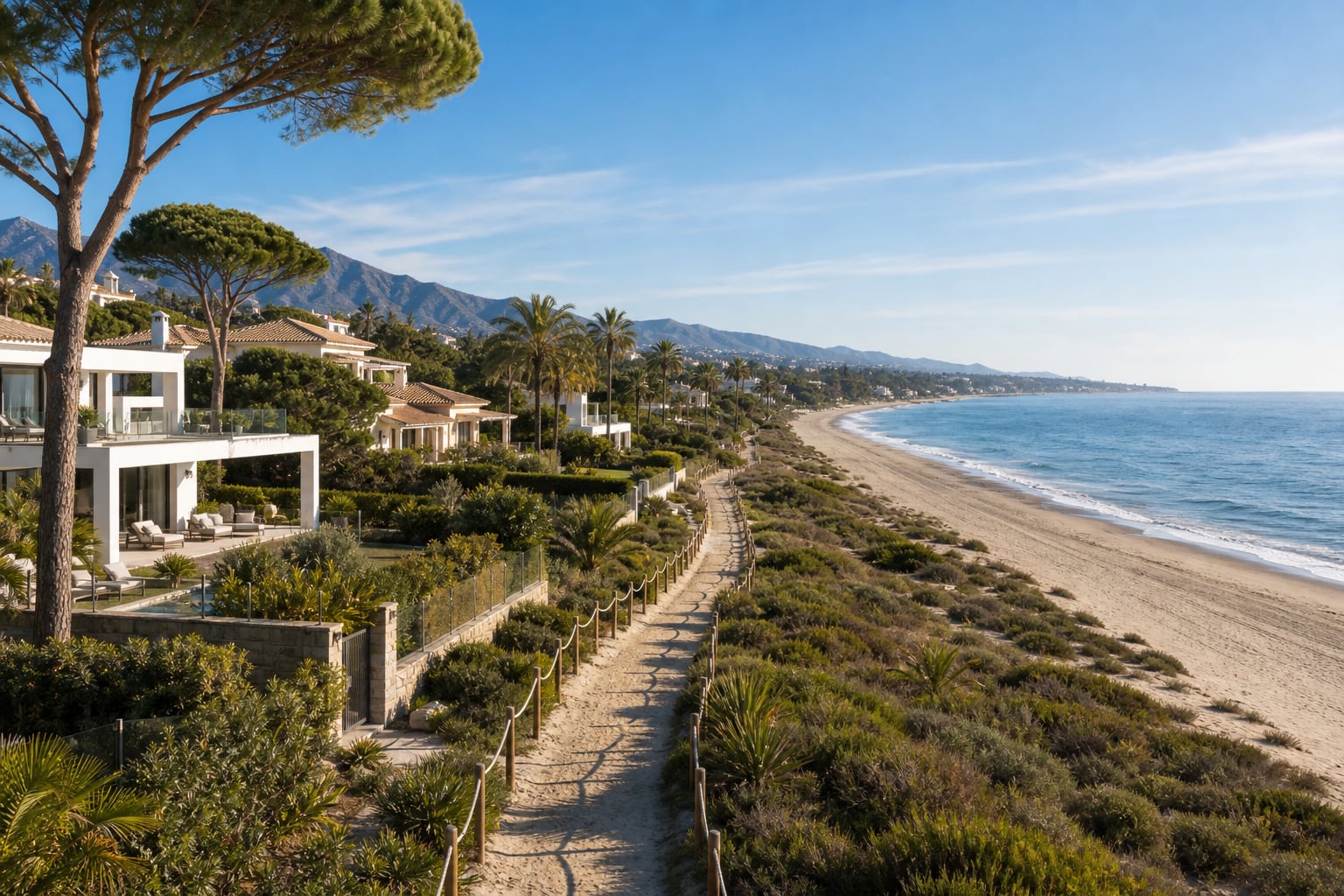
The road west from Marbella runs flat along the Costa del Sol for forty minutes before the Sotogrande exit materialises off the AP-7 — a slip road into Cádiz province that most property buyers exploring the coast between Marbella and Estepona never take. Those who do arrive at a landscape that bears almost no resemblance to the high-density development that lines the motorway on either side: wide, fenced paddocks of bright Bermuda grass, an atmosphere of unhurried money, and, between July and late August, the most concentrated gathering of serious polo players in Europe. Sotogrande's International Polo Tournament is not incidental to the property market here — it is the event around which the entire social and commercial calendar of the western Costa del Sol organises itself.
A Club, a Family and Sixty Years of Polo
Santa María Polo Club was founded in 1965 by Enrique Zóbel, a Filipino-Spanish industrialist who had spent the preceding decade developing Sotogrande from an undivided Andalucían estate into one of the first master-planned residential communities in Spain. Zóbel chose polo not merely as recreation but as social architecture: a sport that required sustained investment in horses, training and international travel, and which therefore attracted a specific, self-selecting community of buyers. The scale of the land he controlled made possible a polo infrastructure that would have been impossible within fifty kilometres of any major Spanish city.
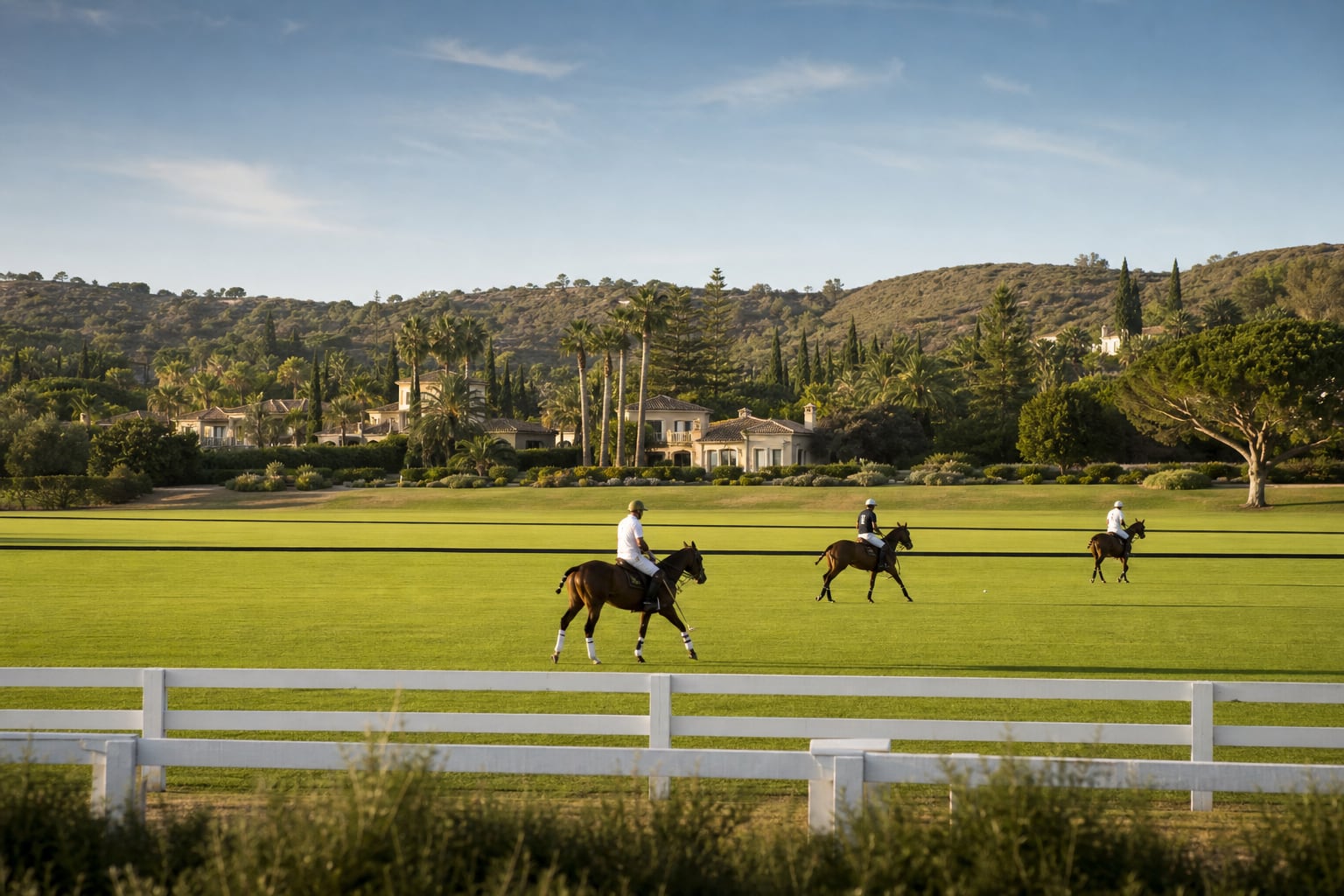
Santa María Polo Club now maintains seventeen grass polo fields, a grandstand and restaurant overlooking the principal pitch, and paddock and stabling facilities capable of accommodating several hundred horses during the peak summer season. It ranks among the largest polo venues in the world by field count and is the only venue in continental Europe that regularly hosts 20-goal competition — the highest standard of open polo played outside Argentina. This infrastructure took decades to build and cannot be quickly replicated. That, in a single sentence, is the enduring sporting case for Sotogrande.
The club's history has a dynastic second chapter. Enrique Zóbel's son Iñigo founded a second club, Ayala Polo Club, in 1970, and both institutions operated in parallel for decades. Since 2021 the major tournament programme has been consolidated under Ayala Polo Club, which holds a lease on the Los Pinos fields — now officially designated Ayala Polo Club Sede Los Pinos — while maintaining its own grounds at San Enrique de Guadiaro, a few kilometres to the east. Both clubs share the Zóbel lineage and are currently managed by Paula Zóbel, Iñigo's daughter, who brings the international tournament to its 55th edition in 2026.
What distinguishes the Sotogrande polo scene from most European luxury sporting events is its continuity. There is no modern relaunch, no private equity pivot and no rebranding exercise. The same families have been coming for two and three generations. New arrivals at the upper end of the property market tend to learn this quickly: buying near the polo fields is not simply acquiring proximity to a summer event. It is entering a social network with sixty uninterrupted years of membership — and that, for a certain kind of buyer, is precisely the point.
Eleven Tournaments: The Season in Full
The 2026 season at Ayala Polo Club runs from 19 May to 13 September across eleven tournaments on the Los Pinos and Ayala fields, covering Low, Medium and High handicap categories. The spring programme begins with the Copa Bienvenida (19–24 May) and builds through the Copa Joseph McMicking (4–14 June) and the Open de España (18–28 June) before a brief break ahead of the main event. These early tournaments are attended closely by the committed polo community rather than the wider international crowd that arrives in August — which makes them, paradoxically, the most instructive time to visit for a buyer considering property in the area. You see the fields at half-pressure and the residential streets at their most ordinary, both of which are more revealing than any agent tour.
The centrepiece of the season is the 55th International Polo Tournament, which runs in three successive stages. The Bronze Cup (27 July–1 August) opens the high-handicap competition with three simultaneous divisions: 6–8, 10–12 and 20–22 goals. The Silver Cup follows from 3 to 15 August across the same divisions. The Gold Cup — the event for which Sotogrande is known across the international polo circuit — runs from 17 to 29 August 2026, with the final weekend drawing the largest spectator attendance of any sporting fixture on the Costa del Sol. These dates anchor the short-let market, the restaurant booking calendar and the social itinerary of the entire western coast in a way that no other single event comes close to matching.
The Gold Cup final weekend at Los Pinos has, over decades, become the social summit of the Sotogrande summer in a way that is almost impossible to manufacture from scratch. Several thousand spectators gather on the grass beside the principal pitch — hospitality marquees alongside open lawn, families on picnic rugs, broadcast coverage for an international audience, and the peculiar electricity of watching polo at 20-goal standard. It is a sport entirely illegible for the first three minutes and immediately compelling for every minute thereafter. The atmosphere is louder than a Michelin-starred dining room and quieter than a Puerto Banús beach club — which is, for the buyers it attracts, exactly correct.
What the Gold Cup Does to Rents and Property Interest
Sotogrande's rental market operates on a logic distinct from the rest of the Costa del Sol. Elsewhere on the coast, short-let demand is driven by beach proximity, marina access and nightlife. In Sotogrande, the polo season is the primary commercial driver for the six weeks straddling the International Tournament. Villas on the residential lanes closest to the Los Pinos fields — in Sotogrande Costa and the private roads immediately adjacent to the club — command rates during the Gold Cup period significantly above their off-season equivalents, in part because international polo teams and their owners typically require properties large enough for a sustained stay of two to four weeks rather than a standard holiday let.
The buyer profile drawn to Sotogrande through the polo circuit is specific: Northern European families — British, Scandinavian, Benelux, Swiss — who play polo at medium handicap, sponsor teams at the upper levels, or simply follow the social circuit from a base in the clubhouse. Current market analysis from long-established Sotogrande agencies identifies American buyers as a clearly growing segment in 2026, consistent with the trend observed across the broader Costa del Sol. A meaningful proportion of first-time visitors arrive to rent a villa during the polo and leave with the name of a local agent. Sotogrande has always worked this way — as a self-renewing demonstration of its own appeal.
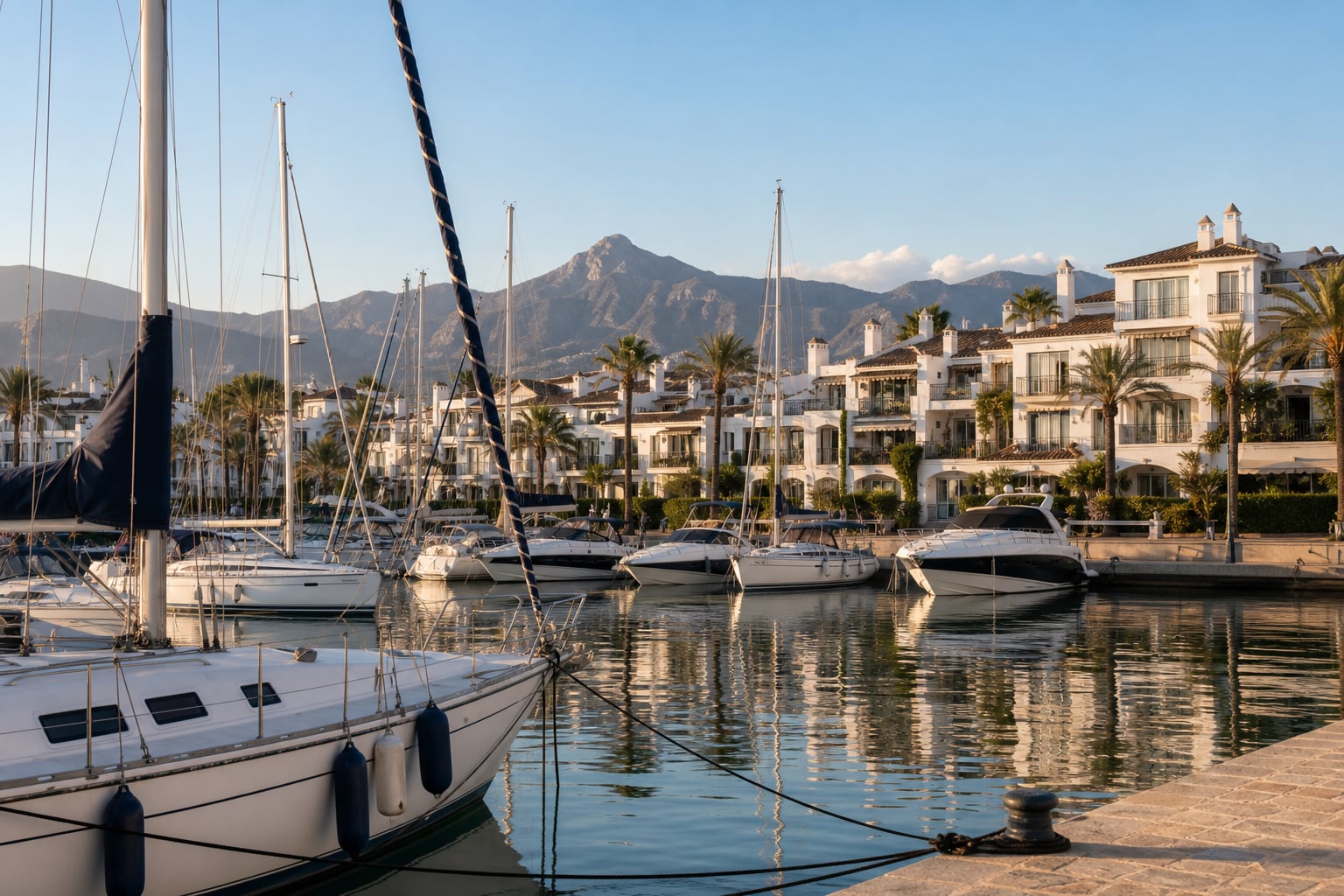
The commercial effect runs through the local economy well beyond the polo fields themselves. The marina restaurants, the club hospitality, and the shops around the Paseo del Parque record their highest footfall in July and August. The marina apartment sector — smaller, more liquid and more accessible than the large villas in Sotogrande Costa — has seen consistently strong year-on-year price gains in recent years, reflecting demand from lifestyle buyers who come for the polo and choose the marina as a practical entry into the broader Sotogrande ecosystem. Marina apartments in Sotogrande represent the most actively traded segment of the market precisely because they sit at the intersection of polo-season appeal and a price point accessible to a wider buyer base.
What Sotogrande Asks of Buyers: The Price Data
According to Engel & Völkers' June 2026 price data, the current average asking price for houses in Sotogrande stands at €3,246 per square metre, a 3.44% year-on-year increase and a cumulative rise of 28% from the €2,534/m² recorded in 2022. Apartments average €3,537/m², with a year-on-year gain of 6.05% and a four-year increase from €2,442/m² — an uplift of approximately 45% across that period. Both segments show consistent structural appreciation driven by supply restriction rather than speculative demand. New inventory in Sotogrande cannot be created at meaningful scale: the estate is effectively fully released, planning controls protect its low-density character, and protected green zones prevent the coastal expansion that has driven supply — and price volatility — elsewhere on the coast.
Within Sotogrande, the premium zone remains Sotogrande Costa — the original residential parcels laid out by Enrique Zóbel in the 1960s, characterised by plots of one hectare or more, mature umbrella pines and palms, and proximity to the Real Club de Golf de Sotogrande and the Atlantic-facing beach. Prices here lead the market at around €3,938/m². Sotogrande Alto, developed on higher ground above the original zone and closely associated with Sotogrande International School, draws family buyers for whom the school is the primary deciding factor; it runs at approximately €3,849/m². At those levels, a four-bedroom villa of 350 square metres in Sotogrande Costa is priced in the range of €1.4–1.8 million before premium location or exceptional condition is factored in.
Comparing these figures to Marbella's Golden Mile — where prime new-build apartments currently reach €10,000–15,000/m² in the best-positioned schemes — the Sotogrande numbers suggest genuine relative value. The distinction, however, is typological rather than simply numerical: Sotogrande buyers are purchasing into a low-density community of large private plots, established sporting infrastructure and a multigenerational social network, not into a hospitality corridor serviced by restaurants and beach clubs. Neither is objectively superior. They are different products for different buyers. The polo season is the clearest single demonstration of which buyer Sotogrande is built for.
Twenty Minutes North-East: Casares, Manilva and the Value Corridor
Buyers introduced to Sotogrande through the polo circuit but unable to absorb Sotogrande Costa pricing often find their way to a corridor of alternatives stretching approximately 20 kilometres north-east along the coast — through Manilva into Casares Costa, in Málaga province. The provincial border matters practically: buyers crossing from Cádiz into Málaga enter a different fiscal and planning jurisdiction, and should take independent legal advice on how those differences apply to their transaction. What does not change is the driving distance: this corridor sits within approximately 20 minutes of the Los Pinos polo fields on the A-7, which means the Gold Cup final weekend is as accessible from a property here as it is from central Estepona.
The western anchor of the Casares market is Finca Cortesin, a private estate containing a five-star hotel and spa, an 18-hole golf course designed by Cabell B. Robinson, and a residential community of freehold villas and apartments. Finca Cortesin has hosted European Tour events and ranks consistently among the finest golf destinations in southern Spain, at a level that draws comparison with Valderrama in adjacent San Roque. Property within the urbanisation ranges from apartment listings on Idealista beginning at around €479,000 to multi-million-euro fairway villas. The resort's international profile anchors the super-prime end of the Casares market while placing serious golf and private beach access within fifteen minutes of the AP-7.
The broader Casares property market along the coast offers new-build apartments from the low €400,000s through developments such as Skye Casares Golf and Alura Living — golf-fronted projects built to current Spanish energy-efficiency standards, with community pools and padel courts, at prices that represent a genuine entry to the western Costa del Sol prime market. A two-bedroom apartment priced at €449,000–€542,000 in this corridor, within 20 minutes of the Gold Cup, 30 minutes of Marbella and under an hour of Málaga Airport, occupies a market position where equivalent budgets in the established Marbella micro-markets buy considerably less space and far less quiet.
Manilva, the municipality immediately adjacent to Sotogrande on the Málaga side, adds another dimension in the form of Puerto de la Duquesa — a working marina at a scale smaller than Puerto Banús but more genuinely local in character, with fish restaurants along the quayside that have operated for decades rather than seasons. The hillsides above Manilva carry a newer generation of villa and townhouse development benefiting from views across the Strait of Gibraltar toward the Rif Mountains of Morocco. For buyers drawn to the western end of the coast by the polo season, Manilva is often the unexpected discovery that makes the corridor worth exploring seriously. See also our guide to Costa del Sol marinas and the property markets they anchor for more on Puerto de la Duquesa and its neighbours to the east.
The Buying Case for the Western End
The polo season is an annual demonstration of something that property price data alone does not fully capture: the western end of the Costa del Sol possesses a social infrastructure — old, tested, self-sustaining — that draws serious international buyers back to the same forty kilometres of coast year after year, generation after generation. The Zóbel family did not invent Sotogrande as a marketing concept; they built it piece by piece across six decades, and the result is visible in the condition of the roads, the scale of the plots, the age of the trees and the depth of the sporting offer. The Real Club de Golf de Sotogrande and Valderrama in adjacent San Roque. The polo fields at Los Pinos across seventeen weeks each summer. The Finca Cortesin course above Casares, twenty minutes north-east. Three of the most rigorous sporting addresses in southern Europe, connected by a single motorway corridor and accessible to Málaga Airport in under an hour.
For a buyer whose reference points are the Marbella Golden Mile or Sierra Blanca, this western corner requires a genuine reorientation — not a compromise but a reconfiguration of what a Costa del Sol life can look like. Marbella's Michelin-starred restaurants, including Skina in the Old Town and El Lago in Nueva Andalucía, remain within forty minutes. Gibraltar is forty minutes to the west. What changes is the surrounding texture: silence at scale, the kind of natural privacy that large plots and mature vegetation provide, and a sporting infrastructure that has no equivalent at this price level anywhere in southern Spain. The polo season exists because people came for it sixty years ago and kept coming back. That sustained return, more than any market forecast, is the honest case for the western end of the Costa del Sol.
Whether the polo season is your first serious reason to look at property in this part of the coast, or simply a confirmation of what you already suspected, the practical next step is time on the ground with clear criteria and a realistic picture of what each part of this corridor currently offers. Browse current properties across the western Costa del Sol — from Estepona through Casares and Manilva — or speak directly with the Domosmar team about which part of this corridor best fits your timing, criteria and budget. We have been working both ends of it for a long time.