- Estepona’s first full marathon takes place on 11 October 2026 over the official 42.195 km distance. The event is capped at 2,000 runners and had already passed 1,000 entries from more than 50 nationalities by early September.
- The race works because Estepona now has a coastal corridor built around roughly 23 km of municipal shoreline. Much of the route uses that seafront infrastructure rather than treating the Mediterranean as scenery seen only from a car.
- The wider Málaga Senda Litoral project is designed to connect about 180 km of coast across 14 municipalities from Manilva to Nerja. Official Marbella tourism information says around 80% is already transitable and the project is divided into 167 sections.
- Estepona’s August 2026 asking price reached €4,961/m², up 17.4% year on year. That is an advertised market average, not a completed sale price, but it shows how quickly the town has moved up the Costa del Sol price ladder.
- Domosmar’s live catalogue contains 83 available Estepona developments, with a median advertised development entry price of about €569,000. This is a current Domosmar stock snapshot rather than a census of the whole market.
- Bottom line: the coastal path is becoming a genuine residential amenity because it changes how often owners can use the sea edge in ordinary life — for a morning walk, school-day run, coffee, beach access or an evening out — rather than merely improving the view from a terrace.
Three days ago, Estepona announced that more than 1,000 runners from over 50 nationalities had already entered the town’s first full marathon. On 11 October they will cover 42 kilometres and 195 metres, with much of the route following the Mediterranean before turning back through the urban fabric of a town that has spent the past decade making its coastline easier to reach and easier to use.
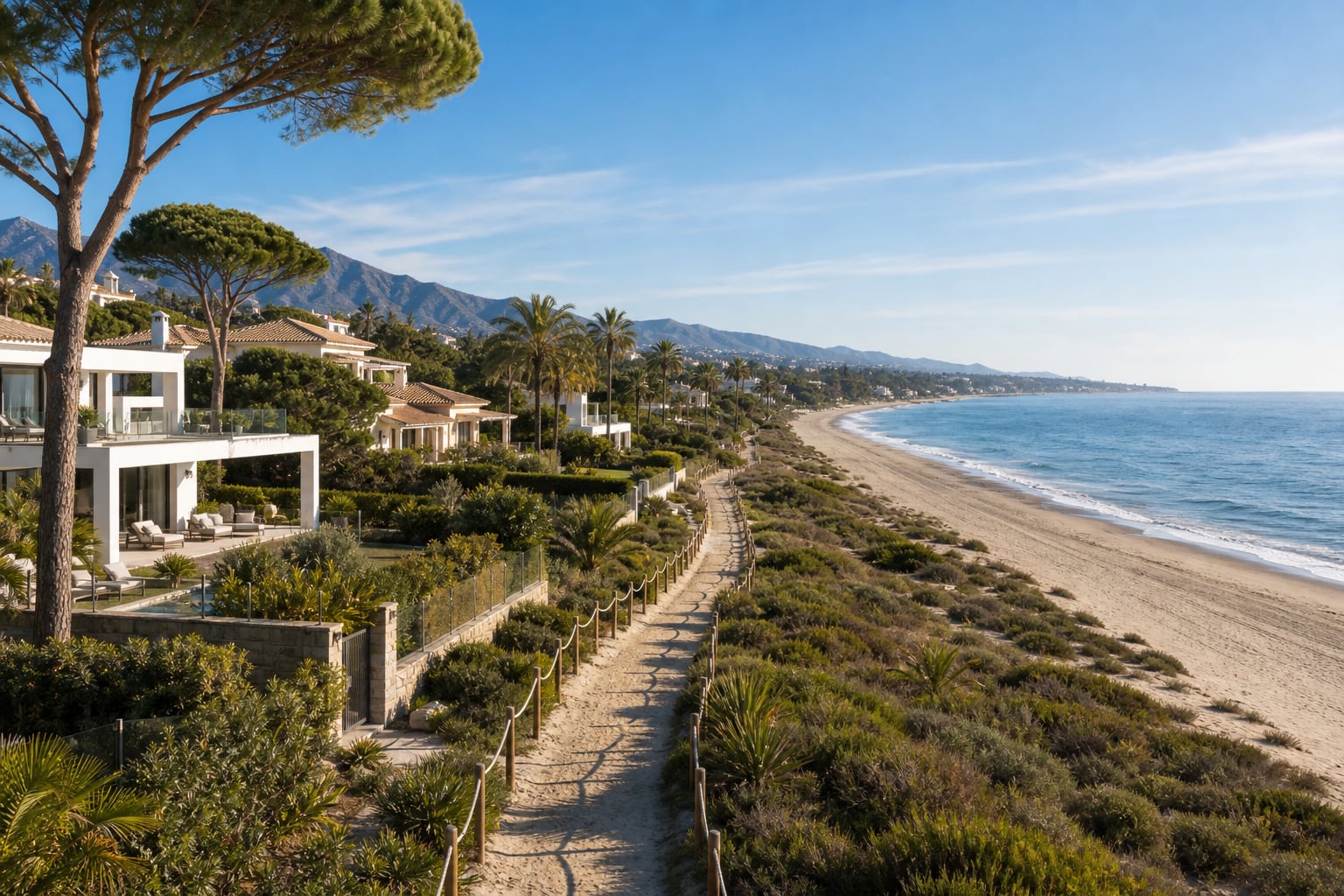
The race is a sporting event, but it also happens to be a revealing property story. Estepona can stage a marathon beside the sea because the seafront is no longer a sequence of disconnected beaches, hotel plots and dead ends. Its roughly 23 km coastline has been progressively stitched together with promenades, bridges, boardwalks and public access points. The result is becoming something closer to a linear public park — a front garden shared by apartments, villas, hotels, old neighbourhoods and new developments.
That distinction matters because coastal property is often sold with a surprisingly static vocabulary: sea view, south-facing terrace, first line, walking distance to the beach. The Senda Litoral changes the question. A buyer is not only asking how close the Mediterranean is. They are asking what they can actually do once they reach it. In Estepona, the answer increasingly includes walking for kilometres, running before breakfast, reaching restaurants on foot and using the shoreline as part of everyday life rather than as a backdrop.
A Marathon Built on Everyday Infrastructure
The Estepona town hall launch in April set the first marathon for 11 October 2026, with both marathon and half-marathon distances and a maximum of 2,000 participants. The limitation is deliberate: parts of the coastal route are narrower than a conventional city boulevard, so the organisers are pitching the event as a smaller-scale race rather than trying to force tens of thousands of runners through a promenade designed first for daily life.
By early September, the municipal sports department reported more than 1,000 entries from over 50 nationalities, with especially strong participation from Britain, the Netherlands, Belgium, Norway and Ireland. Of Spanish participants, 21% were coming from outside Andalucía, while 60% of the national contingent came from Málaga province. That mix is unusually close to the way Estepona’s property market behaves: local use and international demand occupying the same geography rather than two separate towns that happen to share a postcode.
The useful point for buyers is not that marathon runners raise house prices. They do not. It is that the event exposes the kind of infrastructure people notice only once they live somewhere. A seafront path wide and coherent enough to support a 42.195 km event is also the path that makes a 30-minute morning run simple in January, gives grandparents a level walking route, or lets a second-home owner leave the car parked after arriving on Friday evening.
The 180km Idea Is Bigger Than Estepona
Estepona’s corridor sits inside the much larger Senda Litoral de Málaga project. The provincial plan is to connect approximately 180 km of shoreline across 14 coastal municipalities, from Manilva in the west to Nerja in the east. Marbella’s official tourism information describes the project as 167 sections and says roughly 80% of the coast is already transitable.
The physical detail is worth more than the headline distance. The same official information says 56% of the planned route is wider than four metres, another 21% measures between 2.5 and four metres, 22% is narrower than 2.5 metres, and about 1% still has no passage. Only around 6% currently has a dedicated cycle lane. In other words, the Senda Litoral is not one uniform 180 km promenade. It is a network built from existing promenades, footpaths, bridges and new connections, and the user experience changes from one municipality — and sometimes one beach — to the next.
That is important for property comparisons. “Near the Senda Litoral” can mean a broad urban promenade outside Estepona old town, a wooden boardwalk beside dunes, a quiet beach path beside a residential community, or a section that still requires a detour. The useful buyer test is therefore not the logo on the map but the actual route from the building entrance: how quickly you reach the path, whether the route is comfortable after dark, what services sit along it and whether it leads somewhere you will genuinely use.
Why a Coastal Path Changes the Property Brief
The easiest way to understand the value of the corridor is to compare two homes with similar sea proximity. One has a beach 300 metres away but requires crossing a busy road, walking down an unlit access street and returning the same way. The other reaches a continuous promenade in five minutes and gives the owner several kilometres of flat walking in either direction. Both can honestly be marketed as “close to the beach”. They do not offer the same ownership experience.
For a second home, that difference affects frequency of use. The more friction there is around a property, the more every outing becomes a small expedition: keys, car, parking, traffic, then the same process in reverse. A usable seafront path turns exercise, lunch or a beach walk into something spontaneous. That sounds minor until a home is occupied six or eight times a year. Then the easy things are often the things owners do most.
For permanent residents, the case is stronger. Walkability is not only about restaurants. It is about whether a couple can live with one car rather than two, whether an older parent can go out independently, whether a teenager can reach the beach or town safely, and whether a dog walk means pavement beside traffic or a level path by the sea. Those are ordinary details, but ordinary details are precisely what separate a property that photographs well from one that works well.
This is why our earlier guide to living in Estepona’s walkable town centre is only part of the story. The coastal corridor extends the idea of walkability beyond the old town. A home can sit outside the historic centre and still connect into a long linear route that gives access to beaches, restaurants and neighbouring residential districts without making every movement car-dependent.
The Market Is Already Paying More for Estepona
No credible price index can isolate the value of the coastal path from everything else Estepona has changed: public realm, old-town restoration, new housing, restaurants, beach facilities, landscaping and the wider New Golden Mile. But the market direction is clear. Idealista’s August 2026 asking-price index put Estepona at €4,961/m², up 17.4% year on year. Twelve months earlier the same series stood at €4,227/m².
That growth should not be credited to one promenade project, and asking prices are not achieved sale prices. What it does show is that buyers are accepting materially higher values in a town that increasingly offers a more complete everyday proposition. Our latest supply analysis also found 3,475 completed home transactions in Estepona during 2025, up 9.9%, alongside 1,278 new-home permits. Demand and new construction are both operating at meaningful scale.
| Market | Aug 2026 asking €/m² | 2025 home sales | 2025 new-home permits | Domosmar live developments* |
|---|---|---|---|---|
| Estepona | €4,961 | 3,475 | 1,278 | 83 |
| Mijas | €3,711 | 3,197 | 1,670 | 29 |
| Marbella | €5,956 | 4,407 | 449 | 31 |
Domosmar currently has 83 available Estepona developments, with a median advertised development entry price of about €569,000. That is nearly three times the number of current Marbella developments in the catalogue. For a buyer who values the seafront lifestyle but does not need a Marbella postcode, Estepona therefore offers something commercially useful: a deep supply of modern stock across several coastal and inland micro-markets.
The Best Amenity May Be Outside the Gate
New-build marketing on the Costa del Sol has become increasingly sophisticated. Pools have been joined by gyms, spas, coworking rooms, cinemas, golf simulators and social clubs. We recently looked at this in the new-build amenity race. Those facilities can be excellent, but they also sit inside the community budget and are available only to the owners behind the gate.
A good public seafront does something different. It adds amenity without belonging to a single development. The buyer can choose a simpler community with lower common-area complexity and still have a compelling place to exercise and spend time outside. Alternatively, a high-service resort-style scheme becomes more attractive when the owner can step beyond the pool and immediately connect into a broader public landscape.
This is particularly relevant on the New Golden Mile, where developments can look close together on a map but feel isolated once the A-7 and local access roads are taken into account. Buyers considering this corridor should inspect the pedestrian route with the same seriousness as the kitchen specification. A five-minute walk to a useful stretch of the Senda Litoral can be more valuable in daily life than another rarely used communal room.
Accessibility Is Becoming Physical, Not Promotional
A useful sign of where Estepona is taking the coastline came in August. The town hall put out contracts to install 1,250 linear metres of permanent concrete beach walkways, each 1.80 metres wide, across public beach accesses. The walkway contract has a base tender value of €457,259 including IVA and is designed to replace timber structures that had to be removed seasonally and were more vulnerable to wear and storm damage.
The same programme includes 42 draining platforms for showers and foot-wash points and another 40 platforms for beach modules. A separate contract adds six lifeguard modules, nine toilet modules and one storage unit. The town had already installed 17 new lifeguard towers across La Rada, El Cristo, El Padrón, El Saladillo and Arroyo Vaquero.
This is mundane infrastructure, which is exactly why it matters. A second-home buyer may not mention beach-access gradients during a first viewing, but somebody using a pushchair, wheelchair, walking aid or simply carrying children’s beach equipment notices them immediately. Accessibility works best when it disappears into the daily experience rather than being presented as a special feature.
A Coastal Path Still Has to Survive the Coast
There is one obvious trade-off to building infrastructure beside the Mediterranean: the sea is not an obedient neighbour. Winter storms repeatedly test boardwalks, retaining walls and beaches. In Mijas this year, a 160-metre section of the Senda Litoral at Las Mimosas required a €300,000 repair after storms brought waves of around four metres and undermined the structure. The rebuilt section reopened in July at its original three-metre width.
Environmental constraints matter too. A planned Estepona section around the protected Matas Verdes dunes was halted in 2025 after concerns about works affecting a protected habitat. The sensible conclusion is not that coastal paths are a problem. It is that the better projects need to balance access with dune protection, erosion and the physical reality of a changing shoreline.
Marbella is facing the same engineering question as it expands the route east. In August 2026 the town announced a new Los Monteros section costing just over €1 million, with a four-month construction period and works designed around the La Adelfa dune environment. The broader lesson for buyers is reassuring rather than alarming: the coastal corridor is not a finished ornament. It is public infrastructure that municipalities are still extending, repairing and adapting.
Buy the Route You Will Actually Use
For an Estepona buyer, the practical exercise is simple: after viewing the property, walk out of the development and keep walking. Do not stop at the communal pool. Test the route to the beach. Turn left and see where the path takes you; turn right and do the same. Look for lighting, gradients, road crossings, cafés, shade, places to sit and whether the path remains pleasant after the postcard section ends.
Then ask whether that route fits the way the home will be used. A runner may value uninterrupted kilometres. A retired couple may care more about a level 20-minute walk with somewhere to stop for coffee. A family may want safe beach access and room for a pushchair. A lock-up-and-leave owner may simply want the freedom to arrive without planning every outing around the car.
This is what makes Estepona’s first marathon interesting beyond sport. The 42.195 km race is possible because the town has spent years turning the coast from a boundary into a route. Property buyers benefit from exactly the same change. The beach remains an attraction, but the stronger amenity is now movement along it.
At €4,961/m², Estepona is no longer the inexpensive western alternative it once was. Buyers are paying more, and the town needs to keep giving them reasons to do so. The coastal path is one of the better reasons because it is useful every day, available all year and shared by the whole city. A sea view is something you look at. A good coastline is something you live on.
Sources & Data Notes
Marathon participation figures use Estepona’s municipal sports update published on 3 September 2026. Senda Litoral dimensions and route characteristics use official provincial/municipal tourism information. Estepona asking prices are Idealista indices for August 2026 and are advertised prices, not completed transaction prices. Domosmar stock figures are a live catalogue snapshot on 6 September 2026 and are included to show current buyer choice on Domosmar rather than total market supply.
- Estepona municipal sports department — marathon participation update, 3 September 2026
- Málaga Hoy reporting Tinsa by Accumin / Vivienda en Costa 2026 — 2025 Costa del Sol transactions and new-home permits, 31 August 2026
- Marbella Tourism / Senda Litoral — route dimensions and project characteristics
- Estepona Town Hall — permanent beach-access programme, August 2026
- Idealista — Estepona asking-price history, August 2026
- SUR in English — Mijas coastal-path storm repairs, 3 July 2026
If the ability to walk to the sea matters as much as the sea view, browse current Estepona properties, compare the New Golden Mile, or explore the wider Costa del Sol new-build collection. For a shortlist built around true walking distance, beach access and how you plan to use the home week to week, contact Domosmar and we will compare the route outside the gate as carefully as the property inside it.