- The 13 September Benahavís wildfire spread across an estimated 378-hectare perimeter, although the whole area did not burn. More than 200 personnel and up to 22 aircraft were deployed; about 50 people from roughly 20 Montemayor homes were moved as a precaution, and residents later returned as the fire was stabilised. A 78-year-old man who remained at his home despite evacuation efforts later died from burns sustained during the fire.
- Andalucía treats isolated homes, scattered housing and urbanisations beside forest or natural vegetation as an urban-forest interface. Relevant homes and communities must have a Plan de Autoprotección setting out prevention and emergency measures.
- Where buildings covered by the rules sit on forest land or within a Forest Influence Zone, the plan includes an exterior protection strip at least 15 metres wide. It must be free of waste, scrub and herbaceous vegetation, while thinned trees and shrubs may remain.
- Access is part of resilience. Applicable plans require private roads and ditches to be kept free of dry vegetation for 1 metre and hydrants to be accessible, signed and connected to the water network; Junta guidance recommends at least two access and evacuation routes for an urbanisation.
- The house itself has a smaller defensive zone too. Junta guidance recommends avoiding vegetation and other combustible material within 3 metres of the home and keeping fuel tanks or firewood more than 10 metres away.
- Bottom line: wildfire resilience is not an argument against the Costa del Sol hills. It is a reason to value well-managed urbanisations, sensible landscaping, clear access and documented prevention alongside the view, privacy and architecture.
A 378-hectare fire perimeter is a dramatic neighbour for a property market averaging €5,553/m². On 13 September, a wildfire near the Rosario chapel in Benahavís moved quickly enough for the regional authorities to confine the town, restrict access to several residential areas and move about 50 people from roughly 20 homes in Montemayor. More than 200 personnel and as many as 22 aircraft were deployed. By the following evening the fire was stabilised, residents could return, and the emergency status was downgraded.
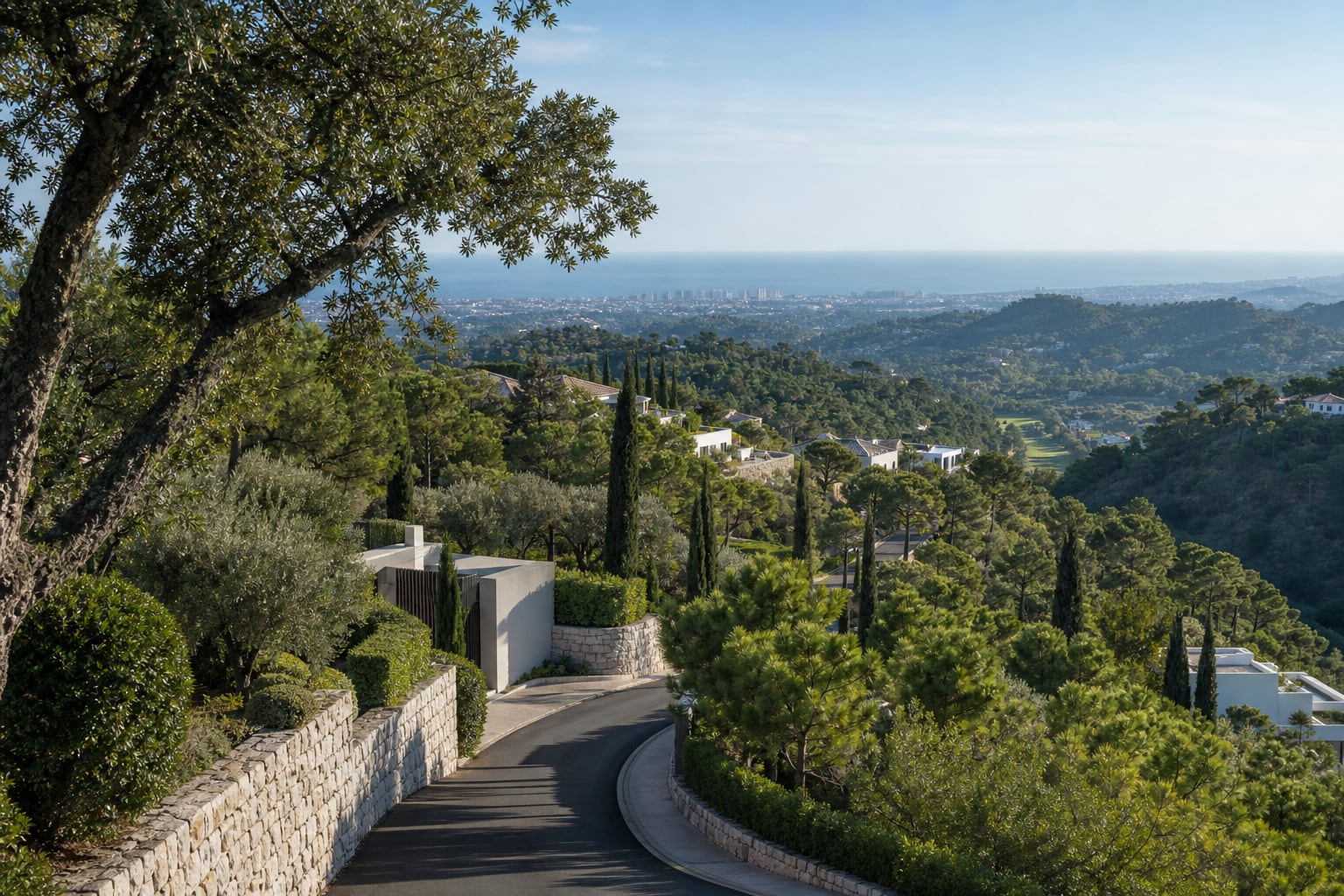
The useful property lesson is not that buyers should retreat from the hills. Benahavís, La Quinta, Los Arqueros, El Madroñal and the estates above the coast are desirable precisely because they combine landscape, privacy, golf, larger plots and elevated views. The lesson is that a hillside home is partly a landscape-management purchase. The quality of the estate around the house — its vegetation, access roads, hydrants and emergency planning — matters alongside the pool, terrace and floor plan.
Andalucía already has a framework for this. It calls the meeting point between housing and forest or natural vegetation the interfaz urbano-forestal, the urban-forest interface. For buyers, that rather technical phrase becomes surprisingly practical. A well-run hillside urbanisation should not merely look green. It should be organised so that the same landscape can be maintained, accessed and defended when summer conditions turn difficult.
The Hillside Premium Comes With an Interface
Benahavís, in Málaga province in Andalucía, Spain, is a useful place to understand the issue because its property appeal and its topography are inseparable. The municipality runs inland from the coast into steep, heavily vegetated terrain. Some homes sit in compact urbanisations; others occupy large plots beside open land. The Junta de Andalucía explicitly includes isolated houses, dispersed housing, urbanisations, rural settlements and the edges of larger towns within its definition of urban-forest interface where buildings meet forest or natural vegetation.
That does not make every Benahavís address equivalent. A low-rise apartment in a managed golf community, a villa on a wooded one-hectare plot and a townhouse close to the village can have very different exposure, access and maintenance responsibilities. The right unit of analysis is therefore the individual property and the urbanisation around it, not the municipal name on the sales brochure.
The market is not treating the hills as a marginal location. Idealista’s August 2026 advertised asking-price index puts Benahavís at €5,553/m², up 7.1% year on year. El Madroñal was at €7,876/m², La Quinta €6,126/m², La Zagaleta €8,040/m² and Los Arqueros–Puerto del Almendro €4,831/m². These are asking prices rather than completed transactions, and Idealista changed its methodology in July, but they show how much capital is concentrated in the hillside market.
Domosmar’s current catalogue tells a similar story from the new-build side. On 24 September it contained 18 available developments indexed to Benahavís, with a median advertised development entry price of approximately €1.6 million. Sixteen of those 18 are flagged with terraces and 12 with swimming pools. The catalogue is not a census of the municipality, but it illustrates the product buyers are choosing: homes designed to open towards the landscape. Wildfire resilience should help preserve that relationship with the landscape, not erase it.
A 15-Metre Strip Is Not Cosmetic Landscaping
The clearest number in the Andalusian rules is 15 metres. For covered buildings and installations located on forest land or within a Forest Influence Zone, the Plan de Autoprotección must include an exterior protection strip at least 15 metres wide. The strip has to be free of waste, scrub and herbaceous vegetation. Importantly, the rule does not demand a scorched-earth garden: thinned tree and shrub cover can remain.
That distinction matters aesthetically and commercially. Buyers come to the Benahavís hills because they want mature vegetation and a sense of landscape, not a villa marooned in a bare gravel field. Good prevention is closer to disciplined gardening than deforestation: remove dry fuel, control dense undergrowth, keep crowns from creating continuous pathways, manage abandoned plots and ravines, and make the transition from house to woodland deliberate.
The rule also reaches the road. Private internal and access roads, together with their ditches, must be kept free of dry vegetation across a width of 1 metre. Hydrants must meet the relevant technical specifications, connect to the water network, be accessible to fire engines and be properly signed. Those are not features buyers normally photograph during a viewing, yet in a forest-edge community they say a great deal about how professionally the estate is managed.
The same logic applies to new development. A buyer looking at a modern hillside scheme can reasonably ask how perimeter vegetation will be maintained after completion, who is responsible for the protection strip, whether the hydrant network forms part of the infrastructure and how emergency access works once residents’ cars, gates and landscaping are in place. The answers are mundane, which is exactly why they are useful.
The Best Urbanisation Is Designed for a Fire Engine Too
A hillside estate is often sold by its gatehouse, quiet roads and separation from through traffic. Emergency planning looks at the same layout from the opposite direction: can residents leave efficiently, and can fire crews enter with heavy vehicles while everybody else is trying to move?
Junta guidance recommends that an urbanisation have at least two access and evacuation routes, that streets and dead ends be clearly marked, and that internal roads remain passable and free of obstacles. It also recommends a network of hydrants and water points for firefighting vehicles and at least one pre-summer meeting each year to explain the community’s Autoprotection Plan and prevention measures.
| Buyer check | Andalusian benchmark | Useful question on a viewing |
|---|---|---|
| Perimeter vegetation | 15 m minimum protective strip in the applicable Autoprotection Plan; scrub and herbaceous fuel removed, trees/shrubs may remain thinned | Who maintains the strip, and when was it last cleared? |
| Private roads | 1 m width kept free of dry vegetation on private roads and ditches | Can a large emergency vehicle pass parked cars and bends easily? |
| Access / evacuation | Junta guidance recommends at least two routes | Is there a genuine second exit, or only a second gate to the same bottleneck? |
| Hydrants | Accessible, signed and connected to the water network under the applicable rules | Where are the nearest hydrants and who checks them? |
| Immediate house zone | Junta guidance advises no vegetation or other combustible material within 3 m | Are dry planters, timber storage or dense hedges pressed against the façade? |
| Fuel / firewood | Junta guidance recommends more than 10 m from the home | Where are gas tanks, stored fuel and firewood located? |
The distinction between a legal requirement and a practical recommendation matters. A buyer should not turn a guidance checklist into a homemade compliance certificate. What it can do is reveal whether the community appears to understand the issue. The strongest sign is not a perfect answer to one question; it is evidence that somebody is clearly responsible for the whole system.
What the September Fire Actually Demonstrated
The September fire is useful precisely because the response was large and the outcome for housing was comparatively contained. The Junta deployed more than 200 personnel and 22 aircraft at peak. Around 50 people from about 20 Montemayor homes were moved as a precaution, while the roughly 9,500 residents of Benahavís town were temporarily asked to remain indoors. Montemayor, La Coja and Benahavís Hills remained subject to restrictions for longer.
By the evening of 14 September, authorities declared the fire stabilised and residents were able to return. SUR reported that the fire had spread across a 378-hectare area but had not burned all of it. SUR later reported damage to private property but no homes affected by the fire itself. The incident nevertheless had a serious human consequence: a 78-year-old man who remained at his home despite evacuation efforts later died from burns sustained during the fire. Two other people were reported injured. That does not alter the distinction between a 378-hectare perimeter and 378 hectares of destroyed property, but it is an important part of the event itself.
The broader Andalusian response system also deserves context. During the 2025 high-risk campaign, INFOCA recorded 876 forest-fire interventions: 182 classified as fires and 694 as conatos, incidents held below one hectare. That means almost 79.2% were contained at the smaller category, while 6,327 hectares were affected across the region during that campaign. Prevention at the property level matters, but it sits inside a substantial public detection and firefighting system.
For owners, the sensible conclusion is neither complacency nor panic. Wildfire is a real Mediterranean land-management issue, particularly where homes meet natural vegetation. At the same time, a modern luxury urbanisation is not simply a house dropped into unmanaged forest. Its roads, landscaped areas, water infrastructure, maintenance contracts and community organisation can materially change how that interface behaves.
Landscaping Is Part of the Building Performance
Costa del Sol architecture has spent the past decade making the boundary between house and garden more permeable. Sliding glass walls, deep terraces, pergolas, pools and planted courtyards are part of the appeal. Our recent analysis of shade and summer comfort in new-build design made the same point from a heat perspective: outdoor space works best when architecture and climate are treated as one system.
Wildfire resilience adds another layer. Junta guidance advises avoiding combustible vegetation and other flammable elements within 3 metres of the house, keeping fuel tanks and firewood more than 10 metres away, avoiding highly flammable perimeter hedges such as cypress or other conifers, keeping roofs free of dry vegetation and ensuring water is available across the plot. Double glazing, shutters or well-closing external openings also form part of its household guidance.
None of that means a Mediterranean garden should become sterile. It means the vegetation closest to the house should be selected and maintained with intent. A shaded terrace can still be shaded. Mature trees can remain. A planted slope can still look natural. The difference is whether dry fuel is allowed to accumulate continuously from open land to façade, roof and outdoor furniture.
This is also a reason to look beyond the private plot. In apartment and townhouse communities, the most consequential vegetation may belong to the community rather than the owner. In villa estates, responsibility can be split between private plots, communal verges and adjoining undeveloped land. A buyer who understands who maintains each piece of that landscape is doing the same kind of due diligence as checking a pool budget or lift contract — just on a more seasonal issue.
The Buyer Questions That Reveal a Well-Run Community
The most useful wildfire questions are operational rather than theoretical. Ask whether the property or urbanisation falls within the relevant forest or Forest Influence Zone, whether a Plan de Autoprotección applies, who holds it, when it was last reviewed and which parts of the maintenance sit with the community, the individual owner or the municipality. If buying in a community, minutes and budgets can be as revealing as the brochure: recurring vegetation clearance is more reassuring than a one-off tidy-up immediately before a viewing.
Then walk the route. Is there a second practical way out? Are cul-de-sacs marked? Can two large vehicles pass? Are verges clear enough to remain usable? Are hydrants obvious and reachable? If the house sits behind a long private drive, is the turning space realistic for an emergency vehicle? These are not questions designed to disqualify a beautiful property. They distinguish an estate that merely looks private from one that is professionally managed.
Insurance belongs in the same conversation. Policy terms vary by property, construction, location, insurer and declared use, so there is no sensible coast-wide premium to quote. A buyer should obtain an insurance indication for the actual address before completion and make sure rebuilding values, outbuildings, landscaping and any special conditions are understood. That is ordinary ownership planning, not an admission that a house is unusually dangerous.
The calendar matters too. Andalucía normally treats 1 June to 15 October as the high-danger period for forest fires, with permanent restrictions on fire use and motor-vehicle circulation in forest areas subject to the applicable exceptions and authorisations. For a second-home owner who spends much of the summer abroad, that is precisely when a reliable gardener, community administrator or estate-maintenance team can be most valuable.
A View Is Still a View — Buy the Management Behind It
There is a temptation after any wildfire to treat the entire hillside market as one risk category. That is no more useful than treating every beachfront apartment as identical because storms exist. Exposure varies by vegetation, slope, access, plot design, surrounding land and the quality of community management. So does the quality of the home.
Benahavís remains one of the Costa del Sol’s strongest high-end residential markets because its geography offers things the coast itself cannot: privacy, scale, golf, open views and a sense of retreat while remaining close to Marbella and Puerto Banús. Our comparison of La Quinta, Los Arqueros and El Madroñal shows how differently even neighbouring hillside communities work. The wildfire question should be added to that micro-location analysis, not replace it.
The strongest properties will increasingly be the ones where resilience feels integrated rather than improvised: managed landscape instead of neglected scrub, two credible exits instead of one narrow road, maintained hydrants instead of a box nobody can locate, and clear responsibility rather than an annual argument about whose verge needs cutting.
That is not a gloomy way to buy in the hills. It is the opposite. The point of good prevention is to let owners enjoy the setting with fewer unknowns. A sea view tells you why you want the property. A well-managed urbanisation tells you something about how well that property is likely to work when the landscape is under pressure.
Sources & Data Notes
- Junta de Andalucía — Benahavís wildfire response, 13 September 2026. Primary source for the deployment of more than 200 personnel and 22 aircraft, the precautionary confinement and the movement of about 50 people from around 20 Montemayor homes.
- SUR in English — Benahavís fire stabilised, 14 September 2026. Used for the 378-hectare spread/perimeter estimate, return of residents and the distinction that the whole 378-hectare area did not burn. A 15 September follow-up reported damage to private property but no homes affected by the fire itself. A 22 September follow-up reported that a 78-year-old man who remained at his home despite evacuation efforts later died from burns sustained during the fire, while two other people had been injured.
- BOJA — Decreto-ley 2/2023 and Junta de Andalucía urban-forest interface guidance. Primary sources for the 15 m protection strip, 1 m road/ditch clearance, hydrant requirements and guidance on access, vegetation and household prevention.
- Junta de Andalucía — urban-forest interface typology. Source for the definition covering isolated homes, dispersed housing and urbanisations and the Plan de Autoprotección requirement.
- Junta de Andalucía — INFOCA 2025 high-risk-season balance. Source for 876 forest interventions, 182 fires, 694 conatos and 6,327 hectares affected; 79.2% is Domosmar’s calculation from those figures.
- Idealista — Benahavís asking-price index, August 2026. Figures are advertised asking prices, not completed transactions; Idealista notes a methodology improvement from July 2026. Domosmar catalogue figures are a 24 September 2026 snapshot and are not a census of total market supply.
Browse the current Benahavís property selection, read our Benahavís luxury-market analysis, or compare the wider Costa del Sol new-build collection. If you want a shortlist that takes access, estate management, landscaping and the actual setting into account as well as the view, contact Domosmar.