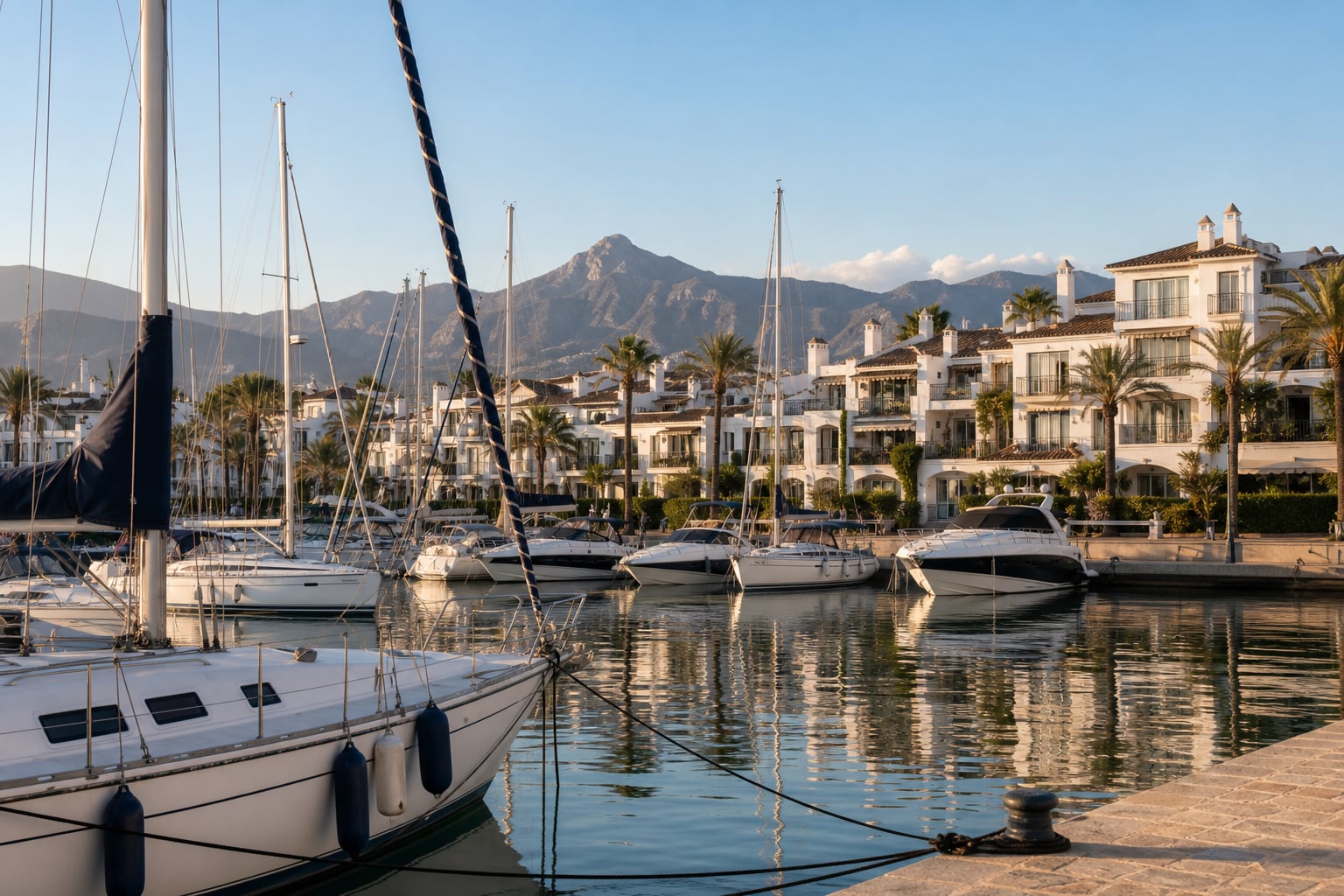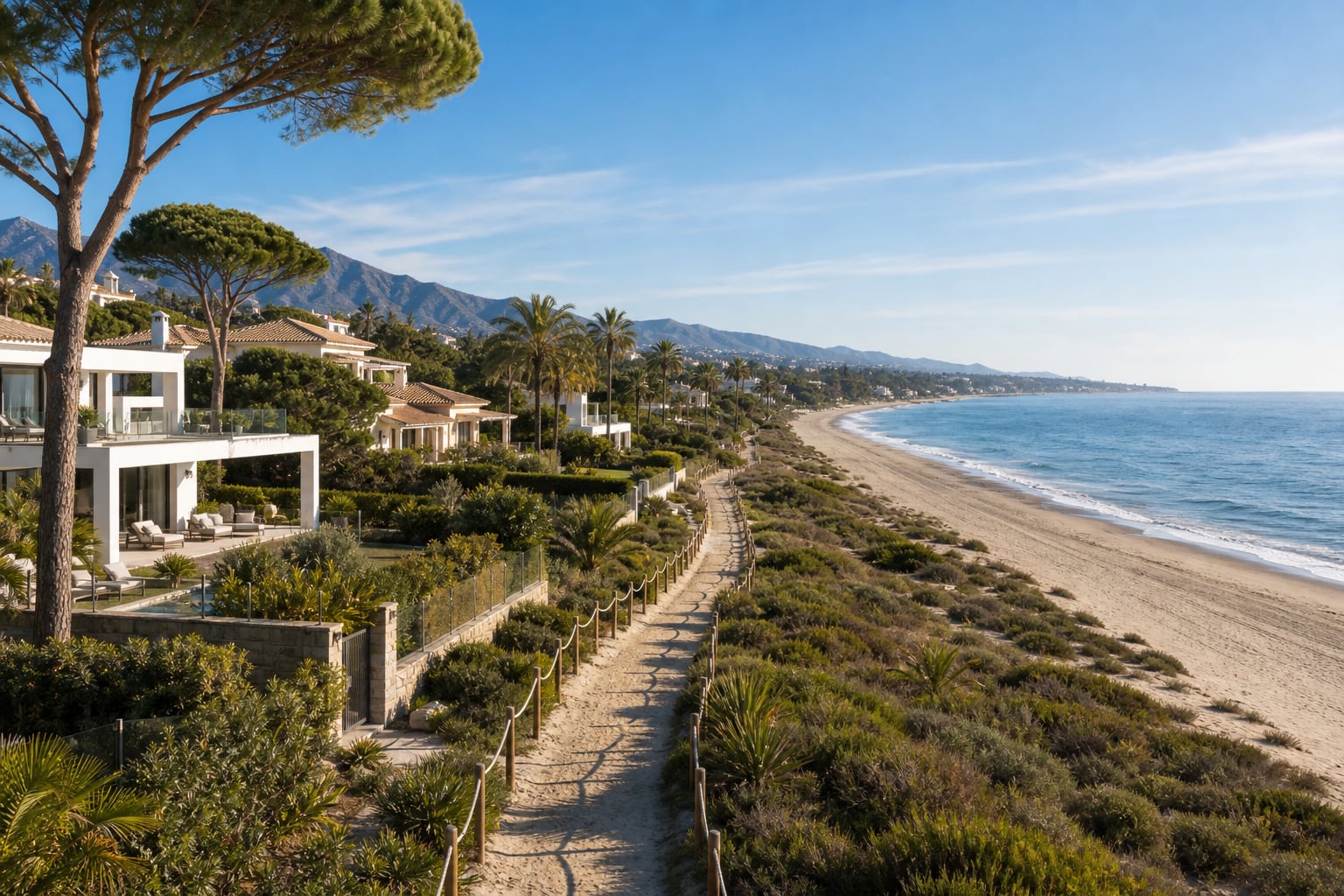
- From Manilva to Torremolinos, 27 beaches hold a Blue Flag in the 2026 award lists. The count is Manilva 2, Casares 1, Estepona 0, Marbella 8, Mijas 5, Fuengirola 4, Benalmádena 3 and Torremolinos 4.
- Málaga province has 45 Blue Flag beaches in 2026, the joint-leading total in Andalucía; Andalucía has 143 and Spain 677. The eight western Costa del Sol municipalities above therefore account for 60% of Málaga province’s beach awards.
- A Blue Flag is primarily an operational and environmental standard, not a property ranking. The criteria include excellent bathing-water quality, environmental education and management, safety, services and accessibility.
- The property-price map does not follow the flag count neatly. Marbella has eight Blue Flag beaches and an August 2026 asking-price index of €5,956/m²; Mijas has five at €3,711/m²; Fuengirola has four at €4,451/m².
- Estepona is the useful exception. No Estepona beach appears in the 2026 Blue Flag award list, yet its August asking-price index reached €4,961/m², up 17.4% year on year. Its marina retains a Blue Flag for the 32nd year.
- Bottom line: for a beach-oriented buyer, a Blue Flag is a useful signal that a specific stretch of coast is being tested and managed to a recognised standard. It should sit beside — not replace — the more important property questions of exact walking route, micro-location, beach character, year-round usability and the home itself.
Twenty-seven Blue Flags fly on the western Costa del Sol between Manilva and Torremolinos in 2026. That sounds like a clean league table for anyone buying a home beside the Mediterranean. It is not. Marbella has eight Blue Flag beaches, Mijas five and Fuengirola four. Estepona has none in the current beach award list — yet Estepona’s advertised asking-price index has risen to €4,961/m², 17.4% above August 2025.
That contradiction is exactly why the Blue Flag map is useful to a property buyer. The flag tells you something specific and worthwhile about the beach: bathing-water quality, environmental management, safety, services, information and accessibility. It does not tell you whether the apartment behind it has a good terrace, whether the road between the home and the sand is pleasant to cross, whether the promenade works in January, or whether the local property market is good value.
Used properly, the certification is one layer of due diligence on the lifestyle outside the front door. Used lazily, it becomes a badge that is asked to do far more than it was designed for. The more interesting buyer question is therefore not “Which town has the most flags?” but what does a Blue Flag genuinely tell you about living near the beach — and what still has to be checked for yourself?
What the Blue Flag Actually Measures
Spain remains the world leader in Blue Flag beaches. ADEAC, the organisation administering the programme in Spain, awarded 677 beach flags in 2026 across 253 municipalities, alongside 111 marinas and six tourist vessels — 794 distinctions in total. Andalucía received 143 beach flags and Málaga province 45.
The strongest part of the scheme is that the word “quality” is not left entirely to marketing language. ADEAC says the assessment includes excellent bathing-water quality, environmental education and information, environmental management, compliance with applicable law, accessibility and safety. In 2026, 713 beaches applied nationally and 677 received the award, a 95% success rate. Among Spain’s 1,737 bathing zones in the official water-quality census, 93% achieve the top “excellent” classification and are therefore potentially eligible for Blue Flag status.
The services behind the flag also matter. Across the 712 beaches that were candidates during the 2025 bathing season, ADEAC recorded 155,399 lifeguard interventions, including 148,068 first-aid cases, 7,331 rescues and 743,679 preventive actions. An average of 2,874 lifeguards — about four per beach — supported the candidate beaches. Those are national figures, not Costa del Sol figures, but they explain why the certification is more than a photograph of clean sand.
There is a current technical wrinkle worth knowing. For the 2026 awards, the international programme has introduced a temporary two-year certification period while accreditation requirements change. ADEAC is explicit that this does not mean a beach can win a flag and forget about it for two summers: continued compliance and annual verification still apply. Mijas, for example, has been awarded its five current flags for 2026 and 2027, subject to that ongoing monitoring.
Twenty-Seven Flags, Eight Very Different Property Markets
The coast becomes more revealing when beach awards and property asking prices are placed next to each other. From west to east, the eight municipalities between Manilva and Torremolinos contain 27 of Málaga province’s 45 Blue Flag beaches — exactly 60% of the provincial total. Yet the property markets range from around €3,000/m² to almost €6,000/m².
| Municipality | 2026 Blue Flag beaches | Aug 2026 asking price | YoY | Buyer reading |
|---|---|---|---|---|
| Manilva | 2 | €3,035/m² | +11.3% | Sabinillas and Las Gaviotas add managed-beach quality to a lower-entry western market |
| Casares | 1 | €3,197/m² | −3.7% | A small coastline where Playa Ancha carries the flag; micro-location matters more than municipal scale |
| Estepona | 0 | €4,961/m² | +17.4% | The clearest reminder that absence from the award list is not a property-market verdict |
| Marbella | 8 | €5,956/m² | +4.0% | The deepest mix of recognised beaches, from central Marbella to Cabopino and San Pedro |
| Mijas | 5 | €3,711/m² | +8.9% | Five flags across a 12 km coastline give buyers several recognised beach environments rather than one focal point |
| Fuengirola | 4 | €4,451/m² | +3.0% | All four municipal beaches are flagged, making certification part of the citywide beach proposition |
| Benalmádena | 3 | €4,183/m² | +6.1% | Carvajal, Fuente de la Salud and Torrebermeja-Santa Ana combine with a Blue Flag marina |
| Torremolinos | 4 | €4,229/m² | +9.9% | Four recognised beaches sit inside a highly urban, walkable coastal market with rail access |
The table is useful precisely because there is no neat correlation. Marbella combines the largest beach-flag count with the highest municipal asking-price index, but it would be absurd to attribute a €5,956/m² market to eight flags. The Golden Mile, Nueva Andalucía, international schools, prime villas, scarce land and global buyer demand all matter far more to Marbella pricing. At the other extreme, Manilva has only two flagged beaches but its current asking-price growth is in double digits.
The buyer implication is simpler: a Blue Flag can help narrow the lifestyle question at beach level. It cannot replace the property-market analysis at municipality, neighbourhood and building level.
Why Marbella’s Eight Flags Matter — Without Becoming a Price Formula
Marbella is eighth in ADEAC’s national municipal ranking in 2026, with ten Blue Flag distinctions: eight beaches and two marinas. Its beach list stretches across very different parts of the municipality: Cabopino, El Cable, El Faro, La Fontanilla, Nagüeles-Casablanca, Los Monteros, San Pedro de Alcántara and Venus-Bajadilla.
For a buyer, that geographic spread matters more than the raw total. A home near Cabopino sits beside dunes, a marina and the eastern edge of Marbella; Los Monteros is a low-density residential environment; La Fontanilla and Venus-Bajadilla are urban beaches connected to town life; San Pedro combines the paseo with a functioning year-round town. “Blue Flag Marbella” is therefore not one lifestyle product.
Our guide to the beach-side east from Los Monteros to Cabopino makes the same point from the property side: a few kilometres of coastline can contain very different road access, housing density, beach character and everyday services. Certification tells you the beach has met a standard. The address still determines what owning beside it feels like.
That distinction is especially important in a market where asking prices now average €5,956/m² and reach much higher in prime districts. A buyer paying a large premium for “beach proximity” should not stop at the name of the nearest beach. Walk the route. Check whether there is a footbridge or a dual carriageway between home and sand. See how the area feels at 8am in February as well as 2pm in August. A flag is reassuring; the ten-minute walk is what you will actually own.
Fuengirola and Mijas: When Beach Management Becomes Everyday Infrastructure
Fuengirola is perhaps the clearest example of Blue Flag status becoming part of the everyday urban proposition rather than a trophy attached to one prestige beach. In 2026 all four municipal beaches — Boliches-Gaviotas, Carvajal, Castillo-Ejido and Fuengirola — hold the flag. The town hall says this is the seventh consecutive year in which 100% of its beaches have been awarded Blue Flags, and the eleventh time overall that the entire municipal coastline has achieved the distinction.
More interestingly for owners who actually use the beach, ADEAC gave Fuengirola one of Spain’s three 2026 special mentions for accessibility and support for people with disabilities, and another of the new “Soludable” mentions for managing risks related to heat and sun. Torremolinos also received an accessibility special mention, while Mijas shared the Soludable recognition. Those awards point towards the practical side of a coastal town: shade, access, assistance, lifeguarding and day-to-day management.
Mijas offers a different pattern. Its five Blue Flag beaches — La Luna-Royal Beach, Riviera, El Bombo, El Chaparral and La Cala — are spread along a 12 km coastline. The municipality also reports nine Q quality distinctions, nine S sustainability distinctions and universal-accessibility certification at several beaches. For someone choosing between a new build above La Cala, a more established apartment in Riviera or a lower-density home around El Chaparral, the beach award is a useful common denominator while the property propositions remain quite different.
This is where the lifestyle case becomes commercially relevant without needing to invent a “Blue Flag premium”. A second-home owner may spend far more time walking the promenade, swimming, taking children to the beach or meeting friends at a chiringuito than using a residents’ lounge marketed in the brochure. Public beach infrastructure is effectively an amenity you do not have to maintain through the community fee.
The Estepona Exception Is the Most Useful Lesson
Estepona is the place that stops the entire argument becoming too neat. No Estepona beach appears in the published 2026 Blue Flag beach list for Málaga province. It would be easy — and wrong — to turn that absence into a conclusion that Estepona has inferior beaches or weaker coastal demand.
Blue Flag is an application-based certification. A beach that is not on the list has not necessarily “failed” the water-quality test; there can be different application histories and administrative choices, and the award is made to specific beach stretches rather than entire municipalities. What can be said confidently is that Estepona’s marina retains a 2026 Blue Flag, its 32nd year with the distinction, and that the marina has 447 berths for boats of up to 35 metres.
Meanwhile, Estepona’s property market is hardly being penalised. Idealista’s August 2026 asking-price index reached €4,961/m², up 17.4% year on year — the strongest annual increase of the eight municipalities in our comparison. The town’s appeal is being built through a wider package: its old town, beach promenade, new-build pipeline and an increasingly continuous coastal walking environment. Our recent analysis of Estepona’s 23 km coastal path is a better illustration of how public-realm investment can affect the daily usefulness of a beach-oriented home.
For buyers, this is a helpful correction. Do not downgrade an excellent property because the nearest beach lacks a particular badge. Equally, do not upgrade a mediocre property simply because a flag is visible from the promenade. The right question is why the badge is there, what services sit behind it and whether those services matter to the way you plan to use the home.
What a Buyer Should Test Beyond the Flag
The easiest mistake in coastal property is to measure beach proximity in metres and ignore the journey. Two apartments can both be advertised as “500 metres from the beach” while one has a flat pavement to a staffed urban beach and the other requires crossing a busy road, descending a steep hill and finding a way back in 35°C heat. For a family with a pushchair, an older owner, a wheelchair user or simply somebody carrying towels and shopping, those are different assets.
The beach itself also needs to match the ownership pattern. Some buyers want a lively urban paseo with cafés, restaurants and people year-round. Others want wider sand, dunes or a quieter edge-of-town setting. A protected cove may be excellent for children but feel crowded in August. A long open beach can be ideal for walking and winter sun but more exposed on windy days. None of those characteristics is graded by a simple flag count.
Then there is the seasonal question. A second home should be judged on the months in which you will use it. The Costa del Sol increasingly works as a short-break and winter-sun market, particularly with Málaga Airport expanding and international flight capacity deepening. If the home will be used in November, January and March, inspect the promenade, restaurants, supermarkets and transport outside the main bathing season. A staffed summer beach is valuable; a functioning neighbourhood in winter is what turns it into a genuine second-home base.
For new-build buyers, the floor plan and site plan add another layer. Which gate leads towards the beach? Is that exit step-free? Does the community have a pedestrian route or only a vehicle entrance? Where will guests park? Is the terrace oriented towards the sea but exposed to prevailing wind? Does the building have secure storage for paddleboards, bicycles or beach equipment? These are small questions individually, but together they determine whether “close to the beach” becomes a habit or merely a line in the sales particulars.
A Beach Home Is a Use Pattern, Not a Badge
There is a reason Blue Flags work well as a public signal. They compress a large amount of beach management into one recognisable symbol. Spain’s 677 beach flags represent water testing, safety infrastructure, environmental work and municipal effort that most owners would never investigate individually. On the Costa del Sol, the 27 flags between Manilva and Torremolinos give buyers an unusually broad choice of managed beaches across very different price bands.
The opportunity is to use that information intelligently. A buyer with a €400,000–€500,000 budget might compare Manilva, Casares, Mijas and parts of Fuengirola very differently from someone looking at a €1 million-plus Marbella home, yet both can include recognised beaches in the ownership equation. The flag is not reserved for the expensive end of the coast, which is precisely why it is useful.
The more valuable conclusion is that coastal quality on the Costa del Sol is increasingly about systems rather than scenery alone: water monitoring, lifeguarding, access, shade, promenades, parking, public space and year-round services. A sea view can be sold from a render. A well-run stretch of coast has to work every day.
That is the right way to read the 2026 Blue Flag map. It is not a ranking of where to buy. It is a shortlist of beaches where a recognised management standard has been met — and a prompt to go one step further before choosing the home behind them.
Sources & Data Notes
- ADEAC — Blue Flag 2026 national press note, 5 May 2026. Primary source for Spain and Andalucía totals, criteria, application success rate, special mentions, lifeguard data and Marbella’s eight beach/two-marina total.
- Europa Press — Andalucía Blue Flag beach list, 5 May 2026. Used to cross-check the 45 Málaga province beach awards and named municipal lists; Fuengirola’s fourth beach is additionally confirmed by its town hall.
- Fuengirola Town Hall — 2026 Blue Flags, 6 May 2026, and Mijas Town Hall — five Blue Flags, 6 May 2026. Primary municipal sources for full-coast Fuengirola coverage and the five Mijas beaches.
- Idealista — Málaga province asking-price index, August 2026, with individual municipal pages used for the comparison table. These figures are advertised asking prices, not completed sales; Idealista notes a methodology improvement from July 2026.
- Marinas de Andalucía — Estepona Marina Blue Flag 2026. Source for the marina’s 32-year distinction and its 447 berths.
- The 27-beach western Costa del Sol total is a Domosmar calculation from the published 2026 award lists for Manilva, Casares, Estepona, Marbella, Mijas, Fuengirola, Benalmádena and Torremolinos. A beach absent from the award list should not be assumed to have failed water-quality standards because Blue Flag is an application-based certification.
Browse the current Costa del Sol new-build collection, compare Marbella, Mijas, Estepona and Manilva, or contact Domosmar if you want a shortlist built around the kind of beach life you will actually use — not simply the distance to the sea on a brochure.