- Domosmar's live Costa del Sol new-build catalogue contained 320 available developments on 24 August 2026. Of those, 221 were tagged with a spa or wellness facility, 160 with a gym or fitness room and 61 with coworking.
- Outdoor space is close to standard: 278 of the 320 developments — 87% — were tagged with a terrace or balcony, while 215 — 67% — included a swimming pool.
- Resort-style amenities are no longer confined to Marbella's multi-million-euro tier. In the same live catalogue, the median advertised starting price was about €425,000 in Mijas, €435,000 in Manilva and €569,000 in Estepona.
- A new 139-home Marbella West scheme has pushed the amenity list as far as a dedicated pet spa, alongside four saltwater pools, wellness, gym, coworking and social areas.
- The wider trend is global: the Global Wellness Institute valued wellness real estate at $876 billion in 2025 and forecasts $1.8 trillion by 2030.
- Bottom line: the best amenity package is not the longest one. It is the one that improves how often you use the home, while keeping service quality and annual community costs in proportion.
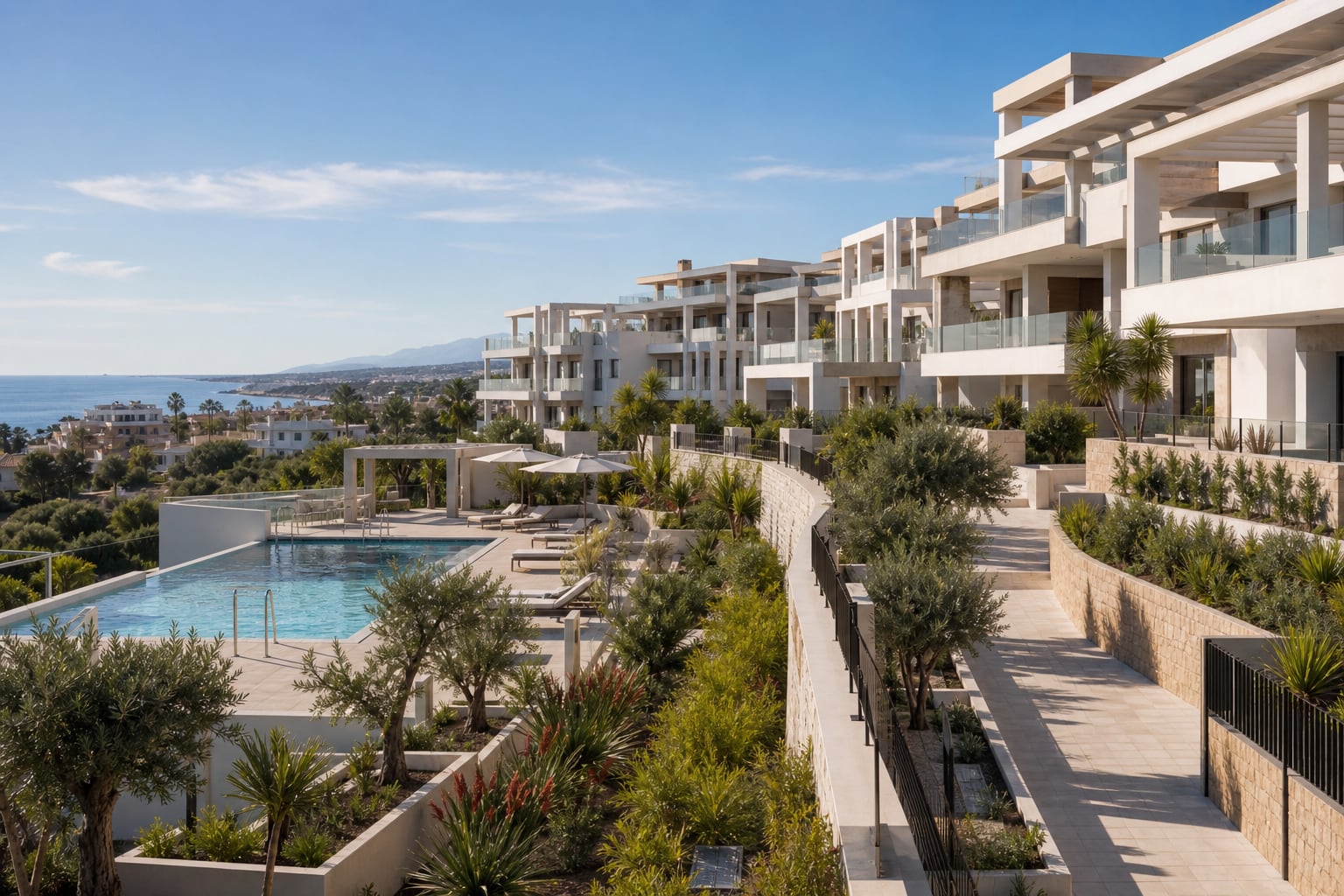
The newest status symbol in Marbella residential property is not an infinity pool, a private cinema or even a cold-plunge room. It is a place to wash the dog. In August 2026, idealista reported that a new 139-home development in Marbella West would include what it described as the first dedicated pet spa inside a residential urbanisation in the area. The same project offers four saltwater swimming pools, a wellness centre, gym, coworking space, Pilates and stretching room, children's areas, social spaces and a rooftop terrace.
It sounds extravagant until you look at the rest of the market. The pool, once the defining promise of a Costa del Sol apartment complex, has become only the first line of the specification. New residential projects now compete on how convincingly they can replace the gym membership, the hotel spa, the occasional office, the children's club and part of the social life that used to happen somewhere else. The apartment is still the product; increasingly, the building around it is part of what the buyer is paying for.
That shift matters because it is happening at the same time as Costa del Sol prices continue to rise. Idealista's July 2026 asking-price index put Marbella at €5,950/m², Estepona at €4,902/m², Mijas at €3,684/m², Manilva at €3,029/m² and Benahavís at €5,496/m². Buyers are paying more for the square metres inside the front door. Developers, in response, are trying to make the square metres outside it work harder.
The Pool Has Become the Starting Point
A snapshot of Domosmar's live new-build catalogue on 24 August 2026 makes the change unusually visible. Across 320 available Costa del Sol developments, 215 were tagged with a swimming pool, 221 with a spa, 160 with a gym or fitness room, 61 with coworking, 79 with a restaurant on site, and 278 with a terrace or balcony. Put into percentages, that is about 67% with a pool, 69% with spa facilities, 50% with fitness facilities, 19% with coworking and 87% with private outdoor space.
These figures come from listing metadata rather than a planning census, so they are best read as a catalogue snapshot: an untagged amenity may still exist. The important point is the scale. A gym or spa is no longer a rare badge reserved for a handful of branded projects on the Golden Mile. It appears across hundreds of schemes from Mijas to Manilva, and coworking — a concept that barely appeared in residential brochures a decade ago — is now explicit in almost one in five developments in the current catalogue.
| Area | Live sample | Median advertised starting price | Pool | Gym / fitness | Spa | Coworking |
|---|---|---|---|---|---|---|
| Estepona | 83 | €569,000 | 71% | 57% | 75% | 22% |
| Marbella | 31 | €1.466m | 81% | 65% | 55% | 29% |
| Mijas | 29 | €425,000 | 69% | 55% | 79% | 21% |
| Casares | 20 | €506,000 | 65% | 50% | 75% | 5% |
| Manilva | 19 | €435,000 | 79% | 58% | 63% | 32% |
| Benahavís | 16 | €1.725m | 62% | 38% | 56% | 6% |
Domosmar live new-build catalogue, 24 August 2026. Percentages show developments tagged with each amenity. Median starting price is the median of each development's advertised entry price, not a completed transaction price.
The table also kills one lingering assumption: this is not only a super-prime Marbella phenomenon. In Domosmar's current catalogue, the median advertised entry point across Mijas developments is about €425,000, and more than half of that sample is tagged with a gym while almost four in five are tagged with a spa. Manilva's median development entry point is around €435,000, with 58% tagged for fitness and 63% for spa facilities. The amenity race has moved down the coast and down the price ladder.
Wellness Has Moved From Extra to Infrastructure
The Costa del Sol is following a much larger property trend. The Global Wellness Institute estimated the worldwide wellness real-estate market at $876 billion in 2025, up from $151 billion in 2017, and forecasts it reaching $1.8 trillion by 2030. Its May 2026 data also identified Spain among the fastest-growing national wellness-property markets over the 2019–2025 period.
The direction is visible at the very top of residential property too. Knight Frank's Global Branded Residence Survey 2025, which reviewed more than 1,000 live and pipeline schemes across 83 countries, describes a move beyond the conventional spa-and-gym formula towards dedicated wellness hubs, longevity programmes and health-focused living. Marbella's branded-residence boom is the high-end expression of that same change, but the underlying idea has spread much further: buyers increasingly judge the entire residential environment, not simply the apartment plan.
One of the clearest Costa del Sol examples opened in July 2026 in the Marbella–Benahavís hills. El Lago Club at Real de La Quinta combines a navigable lake and beach with water sports, golf, tennis and padel, an indoor pool, children's area, wellness centre and restaurant. The wider residential resort reports more than 400 homes already built and roughly 50% of the masterplan completed. That is no longer a communal swimming pool with a few sun loungers. It is neighbourhood-scale leisure infrastructure.
Coworking Tells the More Interesting Story
A spa is easy to understand on the Costa del Sol. Coworking is more revealing. Sixty-one of the 320 live developments in Domosmar's current catalogue are explicitly tagged with a coworking area. Marbella stands at 29% in the six-location sample above; Manilva is slightly higher at 32%, though on a much smaller sample. Estepona stands at 22% and Mijas at 21%.
That does not prove everyone is taking Zoom calls beside the pool. It does reveal what the buildings are being designed for. The classic Costa del Sol second home assumed a clean separation between holiday and ordinary life: arrive for two weeks, leave again, repeat. A residential development that devotes real floor area to desks, meeting rooms and shared work lounges assumes something different — owners staying longer, combining work and leisure, or using the home throughout more of the year.
For buyers, that is generally a positive evolution. A well-designed coworking room can free an apartment from needing a dedicated office that sits empty most of the weekend. A proper residents' gym can remove another recurring journey. A social room gives people who own a lock-up-and-leave apartment somewhere to entertain without buying an extra twenty square metres of private living room. The best communal amenities are not baubles; they are a way of borrowing space only when you need it.
The Amenities Have Spread Down the Price Ladder
Marbella still sets the tone at the premium end. The 31 Marbella developments in Domosmar's current sample have a median advertised starting price of about €1.466 million; 81% are tagged with a pool, 65% with fitness facilities and 29% with coworking. Benahavís sits higher again on entry price, at a median of roughly €1.725 million across a smaller 16-development sample.
But the more interesting story is further west and east. Estepona's sample is much larger — 83 current developments — and has a median starting price of roughly €569,000, while 75% are tagged with spa facilities and 57% with a gym or fitness room. Mijas shows similar amenity depth around a €425,000 median entry point. This helps explain the appeal of the Estepona new-build market and the wider Mijas market to buyers who like Marbella's contemporary specification but do not need a Marbella postcode.
The wider asking-price map reinforces that choice. Idealista's July 2026 figures put Marbella at €5,950/m², Benahavís at €5,496/m², Estepona at €4,902/m², Mijas at €3,684/m² and Manilva at €3,029/m². Those are whole-market asking averages — resale and new build together — rather than prices for the developments in our sample. But they show why amenity-rich schemes have spread so quickly: a buyer can move along the coast and keep much of the resort-style specification while changing the underlying land and property price materially.
What Is Actually Worth Paying For?
A longer amenity list does not automatically make a better development. The useful test is frequency. A heated indoor pool can be genuinely valuable to a winter owner. A good gym may be used four times a week. Coworking can transform a two-bedroom apartment for somebody who works remotely. Secure bicycle storage matters enormously to a cyclist and not at all to somebody who regards Lycra as a warning sign.
Quality matters more than the brochure noun. A small room containing two treadmills technically qualifies as a gym. A proper training space with natural light, free weights, ventilation and changing rooms is something different. The same applies to spas, children's rooms and coworking. When viewing off-plan, ask for the square metres, the floorplan, whether facilities are indoor or seasonal, how many homes share them and who will maintain them. Renderings are very good at making six loungers look like the Aman.
Running costs deserve the same proportionate attention. Pools, lifts, staffed reception, landscaped gardens and wellness facilities have to be maintained, so a highly serviced scheme will usually carry higher community fees than a simple block. That is not inherently a negative: if you use the facilities, the fee can be excellent value compared with buying and maintaining equivalent private space. The buyer's job is simply to match the service level to the way the home will actually be used. Our guide to annual Costa del Sol ownership costs explains the wider budget.
The New Apartment Is Part Home, Part Club
The pet spa makes the headlines because it is amusingly specific. The more important change is what sits behind it. Costa del Sol developers are no longer designing purely for a fortnight in August. They are designing for owners who exercise in the morning, work for part of the day, stay through winter, bring children or dogs, invite friends and expect the development itself to carry some of the load.
That is particularly relevant to new-build buyers. Older Costa del Sol urbanisations can have wonderful gardens, generous plots and mature character, but adding an underground wellness floor or properly ventilated coworking suite after the event is difficult. New construction can integrate these uses from the first architectural drawings. The result is a genuine point of difference between new build and resale — not simply newer kitchens and better insulation, but a different idea of what the property includes.
For a buyer, the opportunity is choice. If the full resort model appeals, Marbella and Benahavís continue to push the ceiling, while Estepona, Mijas, Casares and Manilva now offer surprisingly sophisticated communal facilities at much lower entry points. If you prefer a simpler community and lower fixed costs, there is no shortage of those either. The Costa del Sol market is now broad enough to let buyers choose the lifestyle package as carefully as they choose the floorplan.
Questions Buyers Ask About New-Build Amenities
Are pools, gyms and spas now standard in Costa del Sol new builds?
Pools are very common, but no amenity is universal. In Domosmar's 320-development live catalogue snapshot on 24 August 2026, 67% were tagged with a pool, 69% with a spa and 50% with a gym or fitness room. Treat those as catalogue indicators rather than a census, because an untagged amenity may still exist.
Do better amenities always mean higher community fees?
Usually, more facilities mean more equipment, staff and maintenance, so community costs tend to rise. The useful comparison is not simply the fee but what you receive for it: a gym, indoor pool or concierge that you use regularly can replace services you would otherwise pay for separately.
Is coworking useful in a second-home development?
It can be, especially for owners who extend holidays by working remotely for a few days. A good shared workspace can also mean you do not need to dedicate one bedroom permanently to an office, which is valuable in a two- or three-bedroom apartment.
Are resort-style amenities only available in expensive Marbella developments?
No. Domosmar's current catalogue shows high incidences of spa and fitness facilities in Mijas, Estepona, Casares and Manilva as well. The median advertised starting price in the sampled Mijas developments was about €425,000 and in Manilva about €435,000, well below the Marbella sample.
What should I check before buying an amenity-rich development off-plan?
Ask for the communal-area plans, sizes and specifications, the projected community budget, whether facilities are heated or seasonal, how many homes will share them and who will manage them. The name of an amenity matters less than its scale, quality and likely availability when you actually use the property.
Which Costa del Sol area offers the best value for new-build amenities?
There is no single winner, but the current catalogue shows why buyers compare Mijas, Estepona and Manilva with Marbella. They offer many of the same contemporary communal features at lower median development entry prices, while Marbella and Benahavís retain the deepest choice at the premium end.
Domosmar tracks new-build opportunities across the Costa del Sol, from amenity-rich resort developments to smaller, quieter communities. Browse our current Costa del Sol properties, compare Marbella, Estepona and Mijas, or contact the team. Tell us which facilities you would genuinely use and which you would rather not pay for, and we can narrow the market accordingly.
Domosmar amenity figures are a snapshot of 320 available Costa del Sol developments in the site's live catalogue on 24 August 2026; amenity tags may undercount facilities that were not coded in the listing metadata. Development entry prices are median advertised starting prices, not completed sale prices. Wider market asking prices use Idealista's July 2026 Marbella index and the corresponding July 2026 reports for Estepona, Mijas, Manilva and Benahavís; Idealista introduced an updated methodology in July 2026. The Marbella pet-spa example comes from Idealista, 20 August 2026. Global wellness-market figures are from the Global Wellness Institute, May 2026; branded-residence context is from Knight Frank's 2025 survey; the El Lago Club facts are from the resort's 1 July 2026 opening announcement.