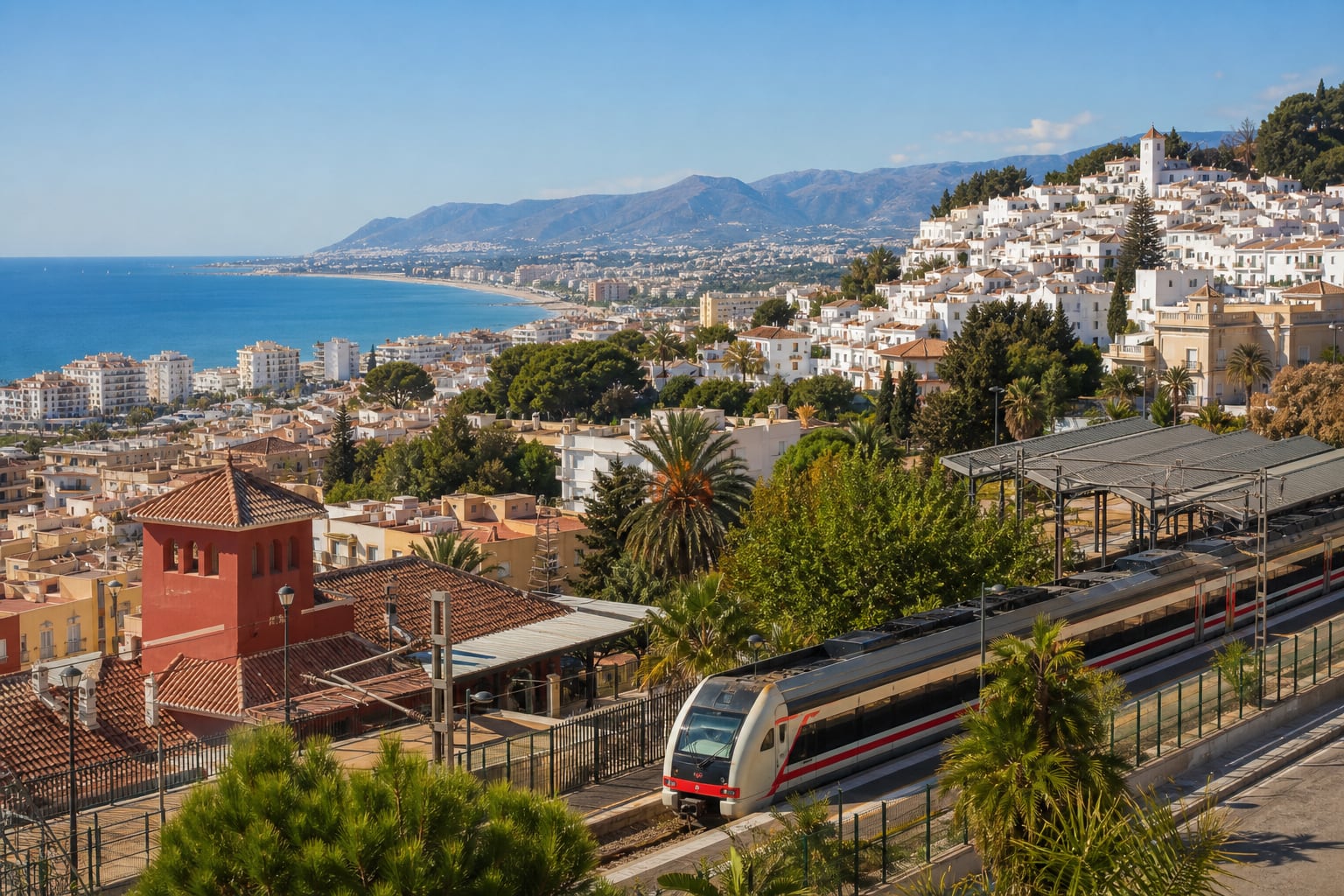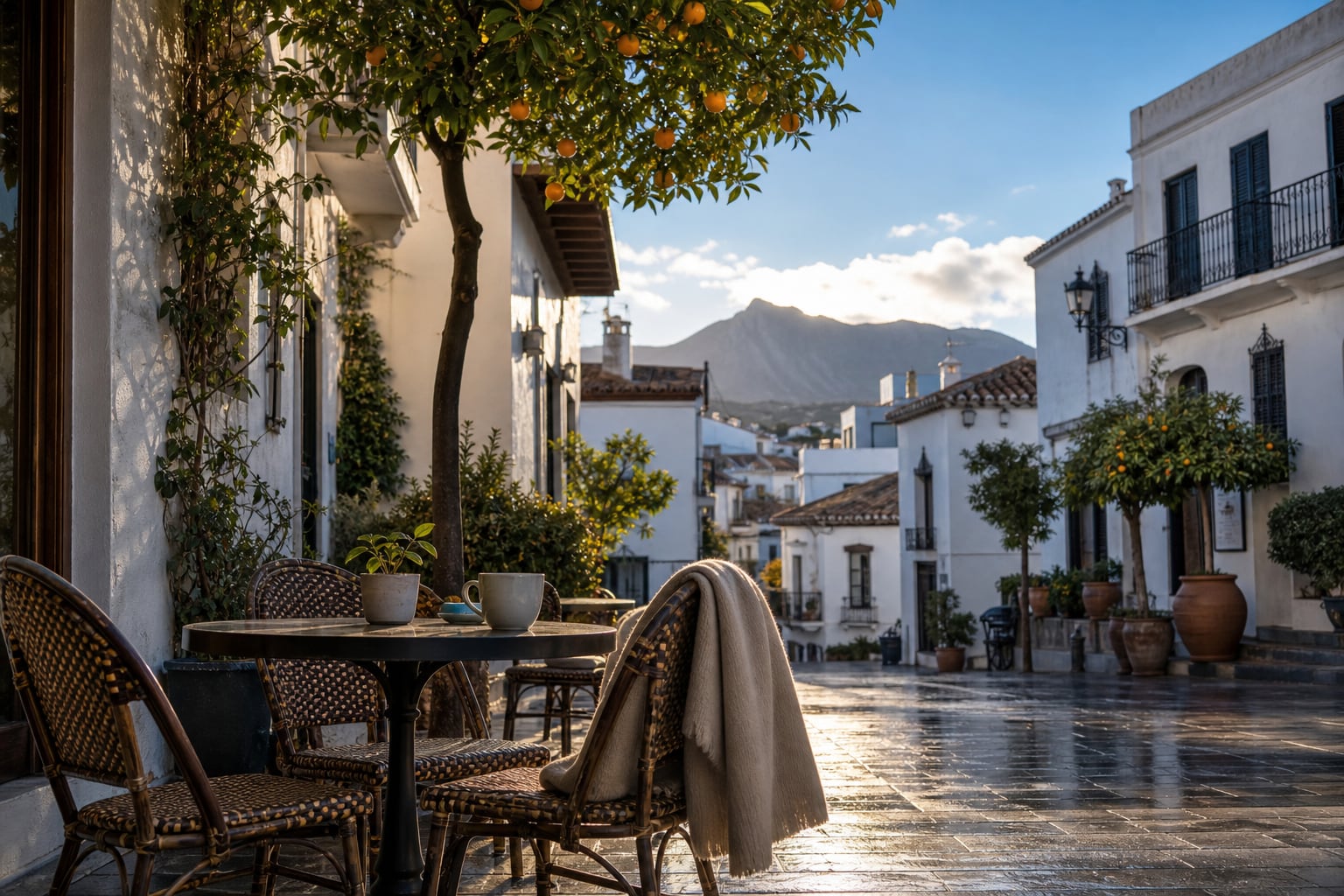
Un après-midi de janvier à Marbella atteint un maximum diurne moyen de 17.2°C, la mer tient à 16°C, et le soleil brille environ six heures par jour – tandis que les villes du nord de l'Europe d'où viennent la plupart des résidents hivernaux de la ville sont bloquées à un chiffre sous un ciel gris et plat. Cet écart est le fondement même de la Costa del Sol en tant que lieu de vie plutôt que de simple visite. Marbella en août se vend ; La question la plus difficile et la plus utile, pour quiconque envisage de déménager toute l’année, est de savoir à quoi ressemblent réellement les dix autres mois.
Il est préférable de répondre à cette question par des chiffres plutôt que par des brochures, car la version honnête est plus intéressante que le discours de l'office du tourisme ou le licenciement cynique. L'hiver sur cette côte est véritablement doux et véritablement ensoleillé - sans aucun doute le plus ensoleillé d'Europe continentale - mais ce n'est pas un été ininterrompu, et l'expérience de vivre ici de novembre à mars change énormément d'un quartier à l'autre. Bien comprendre cette image fait la différence entre une maison que vous utilisez pendant deux semaines et une maison que vous utilisez pendant douze mois.
Le chiffre qui en décide : 2 910 heures de soleil
Commencez par le climat, car c’est la raison pour laquelle tout le monde vient. Les normales climatiques de Malaga entre 1991 et 2020 — la période de référence publiée par l'agence météorologique espagnole, AEMET — enregistrent un total annuel d'environ 2 910 heures d'ensoleillement, et le détail révélateur est la répartition saisonnière : même en janvier, le soleil brille en moyenne six heures par jour, et comme le montrent les données compilées Record climatique de Malaga Remarques, l'ensoleillement hivernal atteint ici les niveaux les plus élevés de toute l'Europe. Ce seul fait distingue la Costa del Sol des marchés rivaux du soleil d’hiver qui peuvent égaler son mois de juillet mais jamais son janvier.
Les températures derrière le marketing sont réelles, mais méritent d’être précisées. Janvier, le mois le plus froid, en moyenne 12.4°C, avec des températures diurnes typiques proches de 17°C et des pointes ensoleillées l'après-midi de 18 à 20°C lorsque le vent vient d'Afrique. Décembre et février sont à nouveau un peu plus doux, avec une moyenne d'environ 13°C dans les deux cas. La mer, alimentée par l'Atlantique à travers le détroit de Gibraltar, descend jusqu'à 15–16°C en hiver – trop frais pour que la plupart des gens puissent nager, assez chaud pour les plus robustes – et même la journée la plus courte de décembre offre encore près de dix heures entre l'aube et le crépuscule. La comparaison que font les locaux avec la côte sud de la Californie n’est pas loin de la réalité.
Ce que les brochures oublient est tout aussi utile, et un résident de Marbella vous le dira sans qu'on vous le demande. L'hiver est la saison des pluies : novembre et décembre apportent chacun 100 mm de pluie, généralement sous la forme d'une poignée de fortes périodes de l'Atlantique plutôt que d'une bruine constante, et janvier ajoute 70 mm supplémentaires sur environ six jours. Les nuits sont fraîches – les nuits les plus froides de janvier tombent à environ 2°C – bien que les fortes gelées soient très rares et la neige sur la côte effectivement inconnue. Le fait n’est pas que l’hiver soit froid ; Selon les normes du Nord, ce n’est clairement pas le cas. Le fait est qu’il s’agit d’une vraie saison, avec des jours gris et des averses entre les jours clairs, et qu’il est préférable de choisir une maison pour cette réalité plutôt que pour un fantasme permanent du mois d’août.
Qu'est-ce qui ferme pour l'hiver – et qu'est-ce qui ne ferme pas
La plus grande variable dans la sensation hivernale n'est pas la météo mais le quartier, car la Costa del Sol est en réalité deux endroits différents superposés. Le premier est la côte balnéaire : les clubs de plage de renom – Nikki Beach, Ocean Club, les transats le long de la bande de Puerto Banús – sont en grande partie fermés de novembre jusqu'au printemps environ, et les urbanisations purement saisonnières, où la plupart des propriétaires n'apparaissent qu'en juillet et août, peuvent sembler étrangement calmes en février, avec des magasins fermés et un seul café ouvert.
La deuxième Costa del Sol ne change pratiquement pas. Le Casco Antiguo de Marbella garde son rythme toute l'année : le Marché municipal sur l'Avenida del Mercado, les commerces se déroulent tout l'hiver, les bars à tapas autour de la Plaza de los Naranjos restent ouverts et les orangers de la place portent leurs fruits en janvier. Le marché de rue du samedi de Nueva Andalucía, près des arènes, se déroule par tous les temps ; San Pedro de Alcántara, une ville ouvrière plutôt qu'une station balnéaire, ne se vide jamais ; et le vieux quartier d'Estepona est sans doute à son meilleur hors saison, lorsque ses restaurants appartiennent à nouveau aux résidents. Les agents locaux répètent le même argument à plusieurs reprises : la communauté internationale se contracte en hiver, mais dans le bon quartier, elle ne disparaît pas, et trouver la vie toute l’année est une question de choisir la bonne rue plutôt que d’en espérer une.
C’est aussi là que réside le conseil d’achat le moins glamour et le plus important : le chauffage. Un grand nombre de maisons de la Costa del Sol ont été construites pour l'été, avec des sols en pierre ou en carrelage, du simple vitrage et des unités de climatisation mises en service en hiver à contrecœur. Une villa conçue pour rester fraîche en août peut sembler vraiment froide par une soirée de janvier à 12°C, et l'écart entre une maison d'hiver confortable et une maison froide se résume à l'isolation, au vitrage, à l'orientation et à un système de chauffage approprié - et non au prix demandé. C'est la première chose à vérifier sur toute propriété destinée à être utilisée pendant les mois les plus froids, et la chose la plus facile à manquer lors d'une visite printanière ensoleillée.
La saison pour laquelle la côte a été construite
Si l’hiver a un argument rédempteur au-delà de la carte des températures, c’est que les activités autour desquelles la Costa del Sol est construite sont précisément celles qui se déroulent le mieux pendant les mois les plus froids. Le golf est le cas le plus clair. Avec plus de 70 cours entre Málaga et Sotogrande – ce qui a valu à la région le surnom de Costa del Golf – c'est la ceinture de tourisme de golf la plus fréquentée d'Europe continentale, et sa haute saison n'est pas l'été mais la partie tempérée de l'automne, de l'hiver et du printemps. L'économie le prouve : à Los Naranjos à Nueva Andalucía, un parcours de dix-huit trous avec un buggy coûte €139 dans la fenêtre basse saison du 16 novembre au 31 décembre, contre €177 rien que pour la ronde, au plus fort de la fin septembre, le golf d'hiver est non seulement disponible mais, aux bonnes dates, moins cher.
La même logique se retrouve dans le reste du calendrier extérieur. La région scène de padel, qui est effectivement né sur le Golden Mile de Marbella, se joue tout l’hiver sous les projecteurs et, de plus en plus, à l’intérieur. La randonnée dans le parc national de la Sierra de las Nieves, à une demi-heure à l'intérieur des terres, est bien plus agréable en janvier que sous la chaleur du mois d'août. Les cyclistes parcourent la route côtière et les montées au-dessus d'Estepona et de Benahavís tout l'hiver, et les paseos d'Estepona et de San Pedro se remplissent de marcheurs en manches de chemise par un beau dimanche. Rien de tout cela n’est une consolation pour un été manqué : c’est l’événement principal, qui se déroule dans de meilleures conditions.
Pour un acheteur, c’est le véritable argument en faveur d’une propriété toute l’année plutôt que d’un trou de boulon uniquement en été. Une maison à proximité d’un terrain de golf, d’un club de padel, d’un front de mer accessible à pied et d’une ville qui reste ouverte est une maison qui gagne sa place tout au long du calendrier – que le propriétaire y soit à plein temps, qu’il hiverne pendant quelques mois ou qu’il la loue pendant les saisons intermédiaires lorsque le temps est toujours au rendez-vous.
À combien coûte la vie toute l’année
Le prix à payer pour acheter tout cela est bien documenté, car la Costa del Sol est l'un des marchés immobiliers les plus suivis d'Espagne. Indice Idealista d'avril 2026 mettre le prix moyen demandé à Marbella à 5 596 € le mètre carré, en hausse de 9,0 % sur un an – un titre qui cache un large écart entre les quartiers. Le tronçon Nagüeles du Golden Mile menait à 6 872 € le mètre carré; Nueva Andalucía, la vallée du golf, s'élevait à 5 978 € ; La vieille ville de Marbella à 5 689 € ; et, à l'extrémité la plus accessible, San Pedro de Alcántara à 4 660 € le mètre carré et Elviria-Cabopino à l'est à 4 514 €.
Si l’on examine ces chiffres à travers le prisme de la vie hivernale, un schéma utile se dégage : les quartiers avec le plus de substance toute l’année ne sont pas nécessairement les plus chers. San Pedro, l'un des quartiers de Marbella les moins chers au mètre carré, est également l'une des villes les plus authentiques de la côte. Nueva Andalucía, à un prix intermédiaire de 5 978 €, associe une communauté résidentielle sédentaire au golf et au padel qui ancrent la vie hivernale. Les codes postaux haut de gamme – le front de mer et les domaines fermés des collines – achètent l'isolement et le prestige, mais un acheteur qui privilégie un mois de février animé plutôt qu'un mois d'août étincelant peut trouver à la fois un meilleur rapport qualité-prix et une meilleure vie quotidienne légèrement à l'intérieur des terres ou dans une ville active.
La répartition saisonnière détermine également le revenu, pour quiconque achète en partie pour louer. Comme indiqué dans notre analyse de Rendements locatifs à Marbella en 2026, le taux d'occupation le plus élevé provient d'un parc immobilier capable de remplir les mois intermédiaires du printemps et de l'automne – accessibles à pied, à proximité d'une plage ou d'une marina, dans une ville avec une vie hors saison – plutôt que d'urbanisations purement saisonnières qui affichent un taux d'été élevé sur un calendrier hivernal à moitié vide. Les qualités qui rendent une maison agréable à vivre en hiver sont, commodément, les mêmes qui la rendent plus facile à louer pour le reste de l’année.
Acheter pour douze mois, pas deux
Assemblez les pièces et le dossier pour une maison sur la Costa del Sol toute l’année s’écrit presque tout seul. Privilégiez une orientation sud ou sud-ouest, qui transforme le faible soleil d'hiver en une chaleur d'après-midi libre sur une terrasse. Scrutez le chauffage, les vitrages et l’isolation avec autant de sérieux que la vue mer. Choisissez un quartier avec une véritable vie hivernale à distance de marche – un marché ouvert, un ou deux restaurants ouverts toute l'année, un club ou un parcours que vous utiliseriez réellement en janvier – plutôt qu'une belle adresse qui s'éteint en octobre. Rien de tout cela n’est exotique, et tout cela est systématiquement négligé par les acheteurs qui visitent le mois de mai et n’imaginent que l’été.
La récompense pour avoir bien fait les choses est ce que la Costa del Sol offre véritablement et que la plupart de ses concurrents ne peuvent pas : un endroit où la vie en plein air, la vie sociale et la propriété continuent de fonctionner lorsque le reste de l'Europe est rentré à l'intérieur. Ici, l’hiver n’est pas une saison à supporter pour l’été. Pour les acheteurs qui choisissent bien, c’est l’argument le plus fort en faveur de vivre sur cette côte — 2 910 heures de soleil par an, et une part surprenante des meilleurs d’entre eux répartis sur les mois auxquels on s’attendrait le moins.
Pour évaluer les quartiers en pensant à la vie toute l'année, parcourez les maisons neuves et en revente actuelles sur notre Pages de propriétés sur la Costa del Sol, ou dites-nous comment vous envisagez réellement d'utiliser une maison - à temps plein, pour l'hivernage, en famille ou en location - et nous le ferons vous dresser une liste restreinte ça correspond. Pour en savoir plus sur la vie et l'achat à Marbella et sur la côte au sens large, explorez le Blog Domosmar.