There are more than 70 golf courses between Málaga and Gibraltar, strung along a coastline you can drive end to end in roughly ninety minutes. It is the densest concentration of golf anywhere in the world, and it earned this strip of the Costa del Sol a second name decades ago: the Costa del Golf. Within a fifteen-minute radius of Puerto Banús alone there are around twenty courses, and that figure does not begin to capture the spread once you push west toward Estepona, Casares and Sotogrande.
For someone choosing where to buy, this density is not trivia. It is the difference between a course you visit twice a year and one you can play before lunch on a Wednesday. It also explains a pattern that surprises first-time buyers: the busiest, most expensive golf months here are not summer. They are the depths of the northern winter, when a retired couple in Surrey or Stockholm is scraping frost off a windscreen and a fairway in Nueva Andalucía is sitting at eighteen degrees. Understanding that calendar — and the green fees attached to it — tells you a great deal about how the property around these courses is actually used.
The coast that plays golf in January
The Costa del Sol averages more than 300 days of sunshine a year, and the winter is the proof of it rather than the exception. December and January deliver typical daytime highs around 17–18°C on AEMET-referenced averages, with afternoons that regularly nudge into the low twenties. That is the same window when courses in Britain, the Netherlands and Scandinavia are waterlogged or closed, and it is precisely why this coast built its golf economy around the off-season. The comparison with Southern California — same latitude band, same dry winter light — is one we make often, and one we have looked at in detail elsewhere.
Practically, this inverts the green-fee calendar you might expect. At most clubs the highest rates fall across the spring and autumn golf seasons and the deep-winter resort window, while the genuine bargains sit in the searing heat of July and August, when only the early-morning tee times move. A buyer who plays through the winter is paying peak rates — but is also playing in the conditions the whole region is built to deliver, on courses that for the rest of Europe are simply unavailable that month.
It is worth being honest about the weather too: winter here is mild, not tropical. Cold snaps and rain do arrive, usually in short bursts between long sunny spells, and an exposed coastal course can catch a stiff wind off the Mediterranean. But the run of playable days from November to March is long enough that thousands of northern European owners structure their year around it, arriving when their home clubs shut and leaving when they reopen.
Inside the Golf Valley: Nueva Andalucía's clustered courses
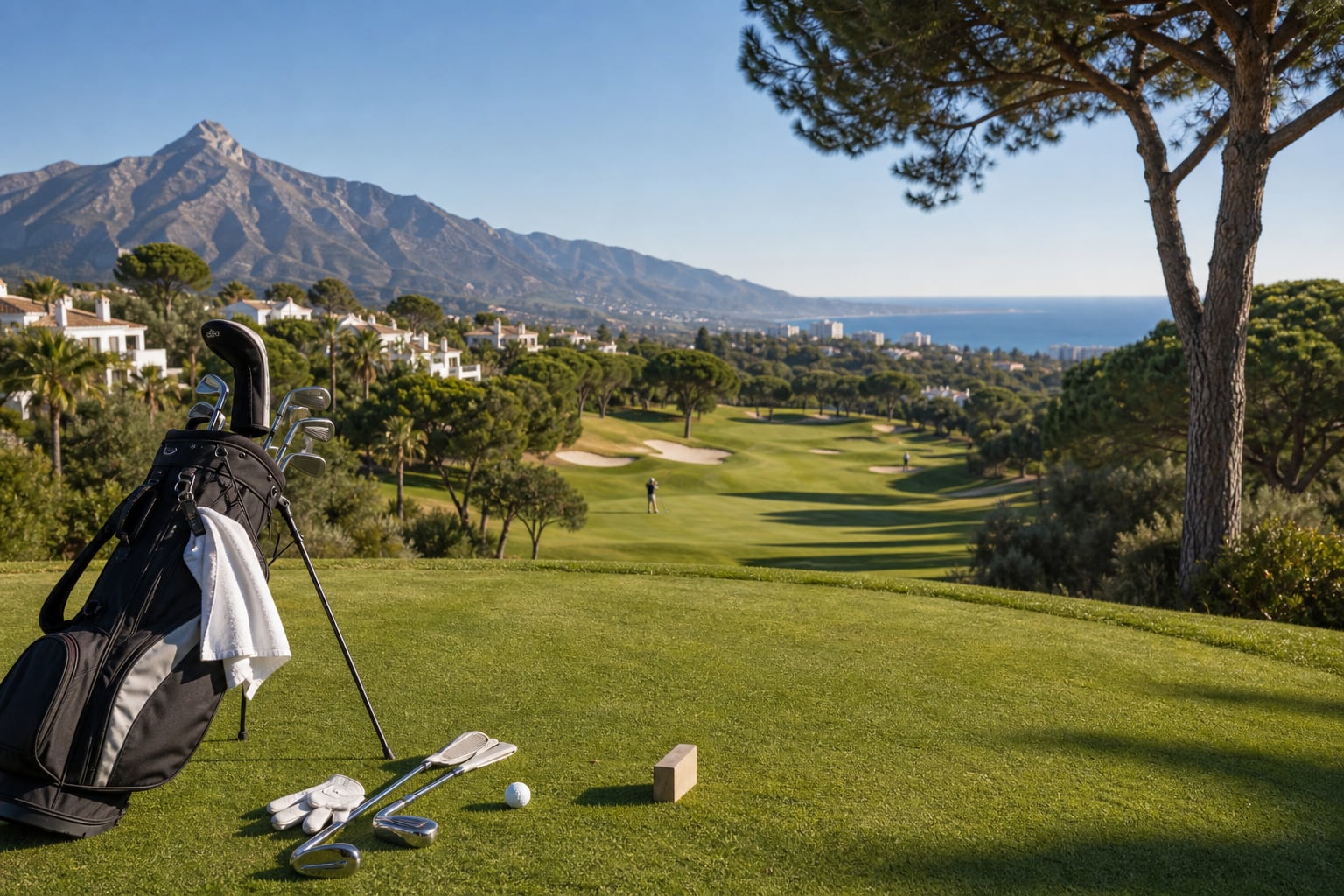
The tightest knot of courses sits just behind Puerto Banús, in the bowl of Nueva Andalucía that everyone here calls the Golf Valley. Aloha Golf Club, Los Naranjos and the Real Club de Golf Las Brisas share the same valley floor, their fairways separated by little more than a road and a line of villas. Aloha, a long-standing members'' club, typically prices visitor green fees in the €180–€250 band depending on season; Los Naranjos, a Robert Trent Jones design from 1977, and Las Brisas sit in a broadly comparable range. These are not casual pitch-and-putts — they are championship layouts that have hosted professional and elite amateur golf for decades.
A short drive up into Benahavís adds La Quinta Golf & Country Club, whose 27 holes wrap the Westin resort and where visitor rates run from roughly €114 to €152 across the year — among the better value of the prime courses for the quality on offer. Together with Los Arqueros and the courses of La Zagaleta and El Madroñal above them, this is the part of the coast where a homeowner can genuinely play a different course every day of the week without ever joining a motorway.
That concentration is exactly why the Golf Valley commands the prices it does. The neighbourhood is also where much of Domosmar''s new-build stock in West Marbella sits — villas and apartments built deliberately to look out over fairways rather than away from them. It is not only golfers who buy here, either; the valley has quietly become a daytime social hub, anchored by spots like Keki Café and the clubhouses that double as restaurants long after the last group has come in.
The trophy courses: Valderrama and Finca Cortesín
Two names sit above the rest, and both are within an easy drive west of Marbella. Real Club Valderrama, in Sotogrande roughly forty minutes down the AP-7, is the course that hosted the 1997 Ryder Cup — the first held in continental Europe — and remains, by most rankings, the finest course in Spain. It is a private members'' club that admits visitors in a narrow window, Monday to Thursday, between noon and one. The 2026 visitor green fee is €600 for eighteen holes, with a mandatory forecaddie at €70 per group and a buggy at €70; the full visitor rate card is published openly. It is, deliberately, not an everyday round — but it is on the doorstep of anyone who buys between Marbella and Sotogrande.
Closer in, above Casares, Finca Cortesín has become the coast''s other headline course. In September 2023 it hosted the Solheim Cup, the first ever staged in Spain, where Team Europe retained the trophy in a 14–14 tie sealed by Spain''s own Carlota Ciganda on the 17th green. Its visitor green fee sits around €375, rising at peak — expensive by any measure, but a fraction of what a comparable championship test costs to play in the United States or the Gulf.
What these two courses do for the wider area is less obvious than their green fees. They anchor the prestige of the whole coast, draw professional events and the global attention that comes with them, and give the resale market a story that travels. A home marketed as twenty minutes from Finca Cortesín or half an hour from Valderrama carries a weight that a course nobody outside Spain has heard of simply does not.
What the courses do to the property around them
Front-line golf is to the inland buyer what front-line beach is to the coastal one: a fixed, finite frontage that cannot be manufactured. A villa whose garden runs onto a fairway, or an apartment whose terrace frames a green and the mountains beyond, occupies a position no developer can replicate once the course is built. That scarcity is precisely why golf-frontage homes in Nueva Andalucía, La Quinta and around Los Arqueros hold their premium through soft and strong markets alike.
There is a rental dimension too. The same winter calendar that fills the tee sheets fills the holiday lets, and a well-placed golf property can earn through the November-to-March window when standard beach rentals go quiet. For an owner who does not live here year-round, a course on the doorstep turns the off-season from a dead period into the most lettable months of the year — a quiet but real argument for buying where the golf is, rather than simply where the sea is.
None of this requires you to be a single-figure handicapper. Plenty of buyers here barely play, and value a golf address purely for the open green space, the maintained views and the absence of anything ever being built across the fairway. But for those who do play, the proposition is hard to match anywhere in Europe: dozens of championship courses inside half an hour, open and dry in the months your home club is shut, with a home of your own a few minutes from the first tee.
If you are weighing a purchase with golf at the centre of it, the smartest first step is to match the course calendar to how you actually intend to use the home. Browse our West Marbella and Golf Valley properties to see what frontage and fairway views currently cost, or get in touch with the Domosmar team to talk through which of the coast''s courses should shape where you buy.