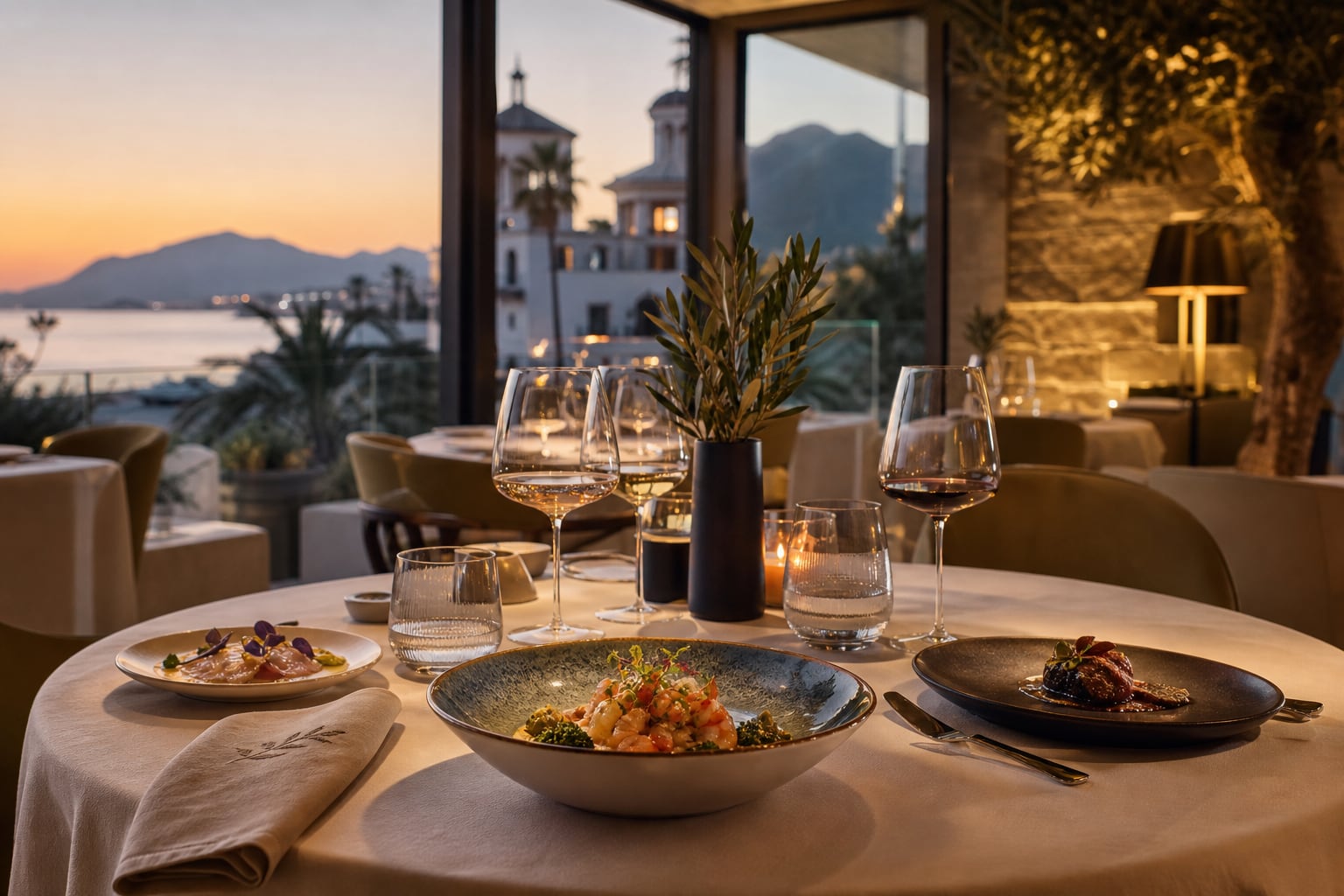
Cinq restaurants. Cinq quartiers. Six étoiles Michelin entre eux – et une carte étonnamment claire de l’endroit où se trouve réellement la principale propriété de Marbella.
L'édition 2026 du Guide Michelin répertorie cinq cuisines étoilées à l’intérieur des limites municipales de Marbella : Peau (deux étoiles) dans une ruelle étroite du Casco Antiguo ; Messine (une étoile) sur l'Avenida Severo Ochoa, juste à l'ouest du centre ; Nintaï (une étoile) dans un quartier calme entre la ville et Puerto Banús ; Dos (une étoile) dans la rue Pablo Casals, à l’est de la ville ; et Le Lac (une étoile), une valeur aberrante située à l'intérieur du club-house du Greenlife Golf à Elviria. Ils diffèrent sur presque tous les points – haute cuisine andalouse, méditerranéenne contemporaine, japonaise omakase, espagnole moderne, terroir au bord d’un lac – mais épinglés sur une carte de la ville, ils reflètent presque parfaitement la façon dont l’immobilier de premier ordre s’est organisé à Marbella.
Rien de tout cela n’est accidentel. Un restaurant étoilé Michelin, en particulier un restaurant deux étoiles, a besoin d'un type particulier de client : quelqu'un qui réserve six semaines, mange un menu dégustation de deux heures deux fois par saison et revient trois fois par an. Ce client habite à proximité ou possède une maison à proximité. Lorsque cinq de ces cuisines se regroupent à environ quinze minutes de route les unes des autres à Marbella, elles décrivent – discrètement, avec précision et en grande partie sans marketing – où se trouve réellement cet argent. Ce n’est pas la seule façon de lire le plan foncier de la ville, mais c’est l’une des plus honnêtes.
Skina, deux étoiles, et le Casco Antiguo
Peau est la star senior de la ville. Niché dans une maison de ville étroite de couleur sable au cœur de la vieille ville de Marbella, il deux étoiles dans l'actuel Guide Michelin España — la seule cuisine deux étoiles de toute la Costa del Sol et l'une des rares en Andalousie. La salle à manger peut accueillir une vingtaine de personnes. Il est largement rapporté que la cave peut contenir plus de 6 000 références. Gérée au sein du groupe du sommelier-restaurateur Marcos Granda, la cuisine élabore des menus de dégustation de saison autour de matières premières andalouses manipulées avec une précision française et japonaise : carte courte, service long et prix plafond qui signale une ambition trois étoiles.
Ce qui est intéressant pour un acheteur immobilier, c'est l'adresse. L'ensemble du Casco Antiguo mesure à peine six cents mètres de large : un réseau de ruelles piétonnes, de cours couvertes de jasmin et de petites places centrées sur la Plaza de los Naranjos, avec l'église de Santa María de la Encarnación à un pâté de maisons et les vieux murs maures qui tracent toujours le périmètre du quartier. C'est le seul quartier de la ville où l'on peut quitter le dîner à minuit, rentrer chez soi à pied en cinq minutes et ne pas voir de voiture pendant tout le trajet.
Le micro-marché reflète tout cela. Selon Données d’Idealista de mars 2026, le centre historique de Marbella s'étendait en moyenne autour 7 131 € le mètre carré, ce qui le place au premier rang des prix urbains de la ville située le long du Golden Mile. L'offre nouvelle est quasiment inexistante : le Casco est un quartier patrimonial, et presque tout ce qui s'échange est une maison de ville rénovée, un duplex creusé dans un bâtiment historique ou un petit appartement derrière une porte discrète dans l'une des ruelles intérieures. Pour un acheteur qui souhaite un accès piéton à la vieille ville, une échelle de joyau d'art et le dîner le plus sérieux de la Costa del Sol à trois minutes de la porte d'entrée, l'adresse Skina est, presque littéralement, le centre de la carte pertinente.
Messine et le couloir entre le centre et le Mile
A deux kilomètres à l'ouest de la vieille ville, Messine a conservé son étoile Michelin en continu depuis 2016 — plus longtemps que toute autre cuisine gastronomique indépendante à Marbella. Fondée en 2003 par le chef argentin Mauricio Giovanini et son associé, maître d'Pía Ninci, la salle à manger de l'Avenida Severo Ochoa est l'une des plus calmes de la ville : faible luminosité, bois sombre, table du chef dressée pour quatre convives face au col et menu dégustation que Giovanini reconstruit deux fois par an autour de ce qu'il appelle "l'essence liquide" des ingrédients - concentrés, réductions, jus et bouillons utilisés à la place des plus lourds. sauces. Les critiques et les inspecteurs Michelin le décrivent systématiquement comme une cuisine sobre et minimaliste sur un châssis technique très sérieux.
L'adresse se trouve à l'extrémité est du couloir qui relie le Casco Antiguo au Golden Mile proprement dit. L’Avenida Severo Ochoa est parallèle au front de mer, à quelques centaines de mètres à l’intérieur des terres, et de chaque côté, les principales propriétés de Marbella s’épaississent rapidement. Marchez vers l'est et les ruelles mènent à la vieille ville. Marchez vers l'ouest et en moins d'un kilomètre, vous vous trouvez dans le cours inférieur de la Milla de Oro, la bande de domaines en bord de mer et de jardins qui s'étend jusqu'à Puerto Banús.
Les chiffres d’Idealista de mars 2026 placent ce corridor tout en haut du marché urbain. La bande plus large de Nagüeles – Milla de Oro avait en moyenne 6 789 € le mètre carré début 2026, en hausse d'environ 6,9% sur un an, tandis que le prime Milla lui-même dépassait les 7 000 €. En d’autres termes, Messine ancre tranquillement depuis deux décennies le corridor le plus cher de la ville de Marbella. Pour un acheteur qui compare un appartement du Golden Mile à une maison de ville de Casco Antiguo, la question pratique est souvent de savoir à quoi ressembleront les dîners à distance de marche - et dans ce couloir, Messine est l'une des réponses qui ne change pas.
Nintai and Back : des étoiles entre le centre et Banús
Les deux restaurants étoilés suivants se situent dans la même bande urbaine mais s’adressent à un type d’acheteur différent. Nintaï, dans la rue Ramón Gómez de la Serna, entre le centre-ville et Puerto Banús, est un comptoir omakase à douze places construit autour d'un seul itamae travaillant devant vous pendant deux heures : des ingrédients japonais de saison de première qualité aux côtés de poissons espagnols débarqués ce matin-là, une courte carte de sakés et de vins réfléchie et un menu de dégustation reconstruit tous les soirs. Il a ouvert ses portes en 2019 et a obtenu sa première étoile Michelin quelques années plus tard, ce qui en fait le seul restaurant japonais de la Costa del Sol à remporter cette distinction. Le même groupe Marcos Granda qui dirige Skina est derrière le projet.
À quelques minutes en voiture vers l'est, dans la Calle Pablo Casals, le chef David Olivas dirige Dos. Originaire d'Úbeda à Jaén, Olivas élabore un menu de dégustation andalou moderne qui distingue les plats régionaux classiques - gaspachuelo, ajoblanco, agneau mijoté - et les réassemble avec la retenue et l'acidité qui lui ont valu une étoile au Guide Michelin. La salle à manger est petite et confiante, la cave s'appuie sur des producteurs andalous et le personnel est particulièrement calme sur ce qui est, techniquement, une cuisine très précise.
Nintai et Back servent ensemble, en pratique, le même triangle immobilier : les collines de Sierra Blanca et Nagüeles au-dessus du Golden Mile, les appartements et maisons de ville derrière Puerto Banús, et les villas familiales du Lomas de Marbella Club et du Upper Mile. Ce sont les quartiers que les données d'Idealista considèrent comme le principal noyau urbain de la ville, avec une moyenne plus large de Marbella grimpant à 6 260 € le mètre carré d'ici mars 2026, soit une hausse de 8,6 % sur l'année, et les principaux sous-marchés bien au-dessus. Un acheteur dans ces rues obtient deux des cinq restaurants étoilés de la ville à dix minutes de route, et un troisième à l’intérieur des murs de la vieille ville. Peu de poches immobilières de premier ordre en Espagne peuvent égaler cette densité.
El Lago et le cas de l’est de Marbella
L’étoile la plus surprenante de la carte est aussi la plus ancienne. Le Lac ouvert en 2000 à l'intérieur du club-house de Greenlife Golf, un petit parcours de neuf trous situé au milieu des lacs d'Elviria, à environ quinze minutes à l'est du centre de Marbella. Il a obtenu sa première étoile Michelin en 2005 sous la direction du chef Diego del Río, qui participe au projet depuis le jour de son ouverture et le tient sans interruption depuis – plus de deux décennies de reconnaissance continue des étoiles, plus longtemps que n'importe quel autre restaurant de la province de Málaga. La cuisine est résolument andalouse : chevreau de la Sierra de las Nieves, fromages artisanaux des montagnes de Malaga, poulpes débarqués à Estepona, crevettes ramenées du port de Marbella, huile d'olive pressée à Álora, à quelques kilomètres de l'intérieur des terres.
Ce qui rend l’adresse stratégiquement intéressante, c’est sa distance avec les autres cuisines étoilées de la ville. Conduisez de Skina à Messine et vous vous êtes déplacé d’environ deux kilomètres vers l’ouest. Conduisez de Messine à Nintai, encore trois. Conduisez de Nintai à El Lago, quinze – devant le Casco Antiguo, après Rio Real, en passant par La Mairena et sur le côté vallonné et à faible densité de l’est de Marbella, où vivent réellement la ceinture de golf de la ville et le marché résidentiel familial.
Cette distance est le point. El Lago ancre l'est de Marbella comme Skina ancre la vieille ville. Les micro-marchés se nourrissent ainsi : L’Est de Marbella a enregistré la plus forte croissance annuelle des prix de tous les principaux sous-marchés de Marbella en 2025, avec une hausse d’environ 14,1 % selon Idealista., et Elviria elle-même a été désignée par les analystes comme l'une des principales zones d'investissement de la région pour 2026. Les acheteurs qui considèrent la vieille ville trop étroite, le Golden Mile trop exposé et Puerto Banús trop bruyant finissent souvent par regarder vers l'est : vers Greenlife lui-même, à Elviria Hills, à Cabopino, vers les urbanisations plus anciennes autour de l'Hacienda Las Chapas. Savoir qu'une cuisine andalouse une étoile avec un record de vingt ans se trouve dans l'une de ces urbanisations est, pour ce type d'acheteur, plus rassurant que n'importe quelle étude de marché.
Ce que dit la carte à un acheteur
Placez les cinq restaurants sur une carte des prix actuelle de Marbella et un modèle unique et utile apparaît. La carte Michelin se concentre étroitement à l'intérieur du principal corridor urbain – de la vieille ville au Golden Mile et derrière Puerto Banús – avec une exception délibérée à l'est, à Elviria. C’est presque exactement la forme du marché immobilier haut de gamme de la ville, et globalement la forme qu’il a occupée au cours des deux dernières décennies.
La lecture ne veut pas dire que la seule bonne nourriture de Marbella est celle des étoiles. Ce n’est clairement pas le cas : Benahavís, à quinze minutes en amont de la vallée, abrite plus de quarante restaurants sérieux., et Estepona, Casares et Mijas ont chacune leurs propres scènes. Ce n'est pas non plus la lecture selon laquelle Michelin vous indique à lui seul où acheter. Le projet municipal, les modifications des règles de location, le boom des résidences de marque et vingt autres facteurs méritent leur propre poids dans toute décision.
Mais une infrastructure alimentaire de ce calibre, soutenue depuis deux décennies et continuant à ajouter des étoiles, est l'un des indicateurs les plus fiables qu'un marché immobilier de premier ordre puisse offrir. Il vous indique que les clients sérieux dépensent beaucoup d’argent dans un quartier semaine après semaine – et y restent assez longtemps pour subvenir aux besoins d’une cuisine qui réserve quatre mois. Cela vous indique que le marché locatif environnant présente une demande de haute qualité tout au long de l’année qui résiste en octobre comme en août. Et cela vous dit, plus important que tout, que quelqu’un de compétent s’intéresse à la réputation du quartier depuis très longtemps.
Si vous cherchez où acheter à Marbella, la carte Michelin est l'un des éléments de diligence raisonnable les moins chers que vous puissiez exécuter. Parcourez-le, mangez-le et vous en saurez plus sur les principaux couloirs de la ville que n’importe quelle brochure ne peut vous le montrer. Lorsque vous êtes prêt à traduire la carte en recherche de propriété, Le portefeuille de Domosmar sur la Costa del Sol couvre les cinq quartiers où ces restaurants sont ancrés – et notre équipe mange dans les mêmes salles à manger, semaine après semaine. Parcourez notre Maisons à vendre à Marbella, lisez plus d'articles sur la zone sur le Blog Domosmar, ou entrer en contact lorsque vous êtes prêt à comparer côte à côte une maison de ville de Casco Antiguo, un appartement du Golden Mile et une villa de l'est de Marbella.