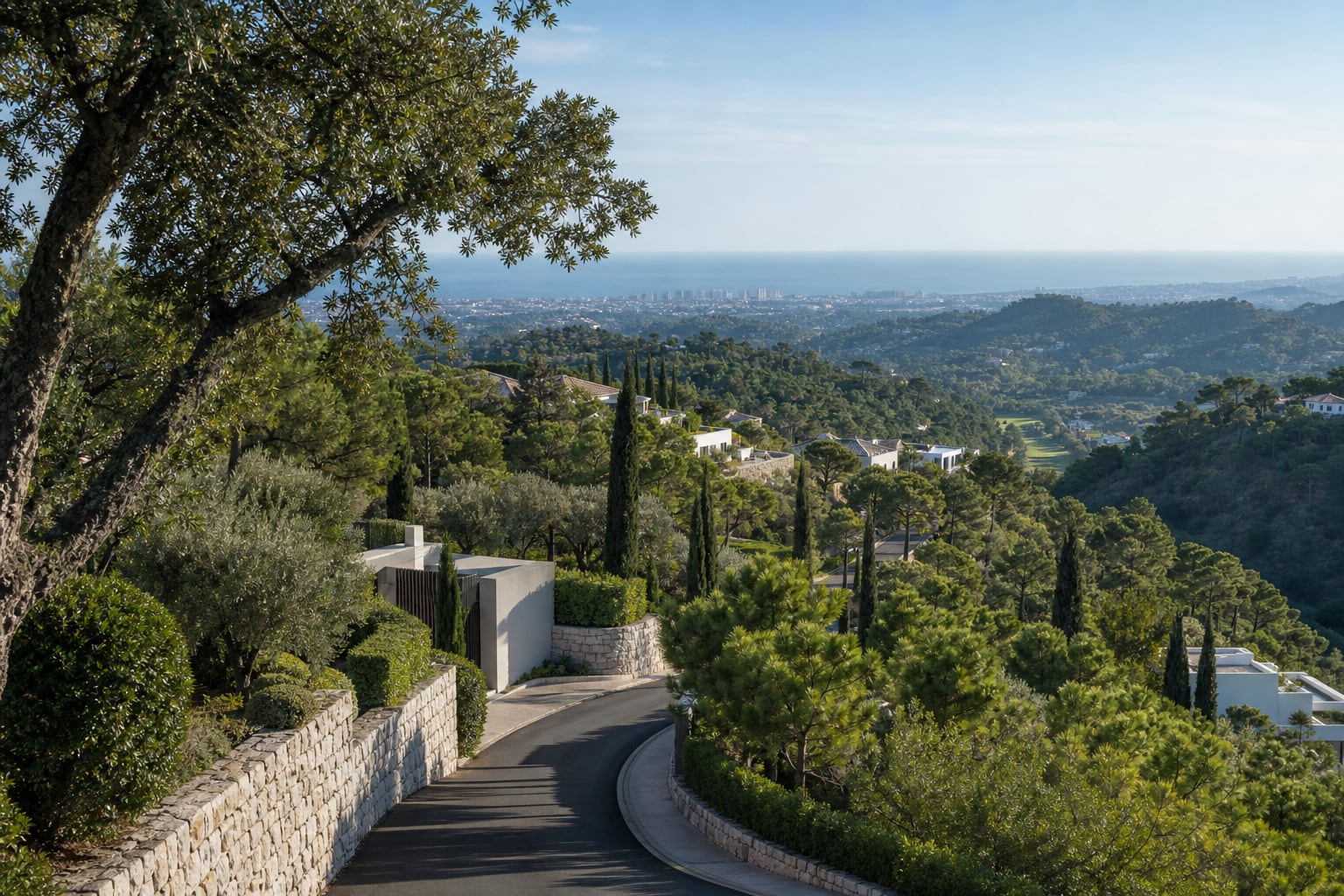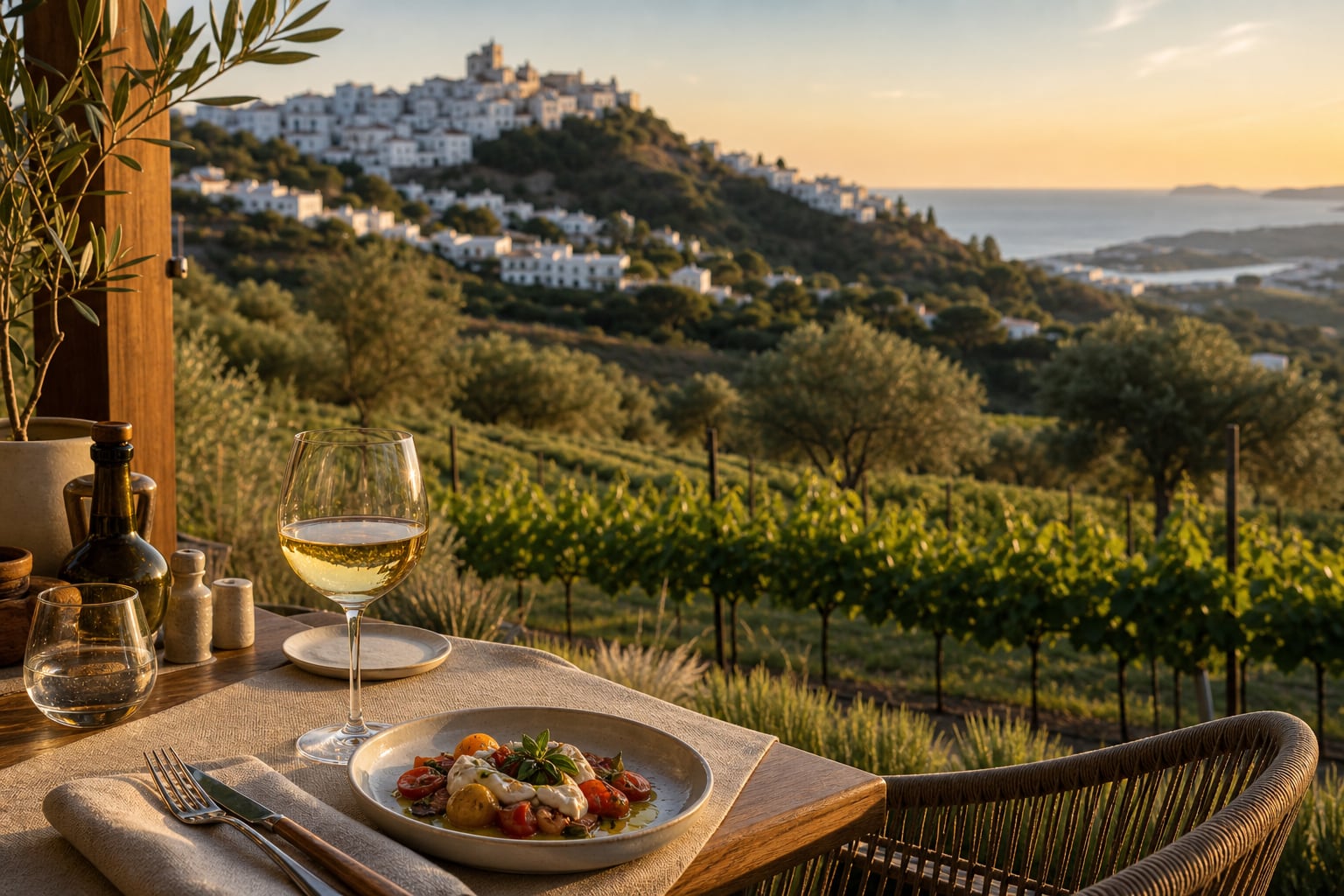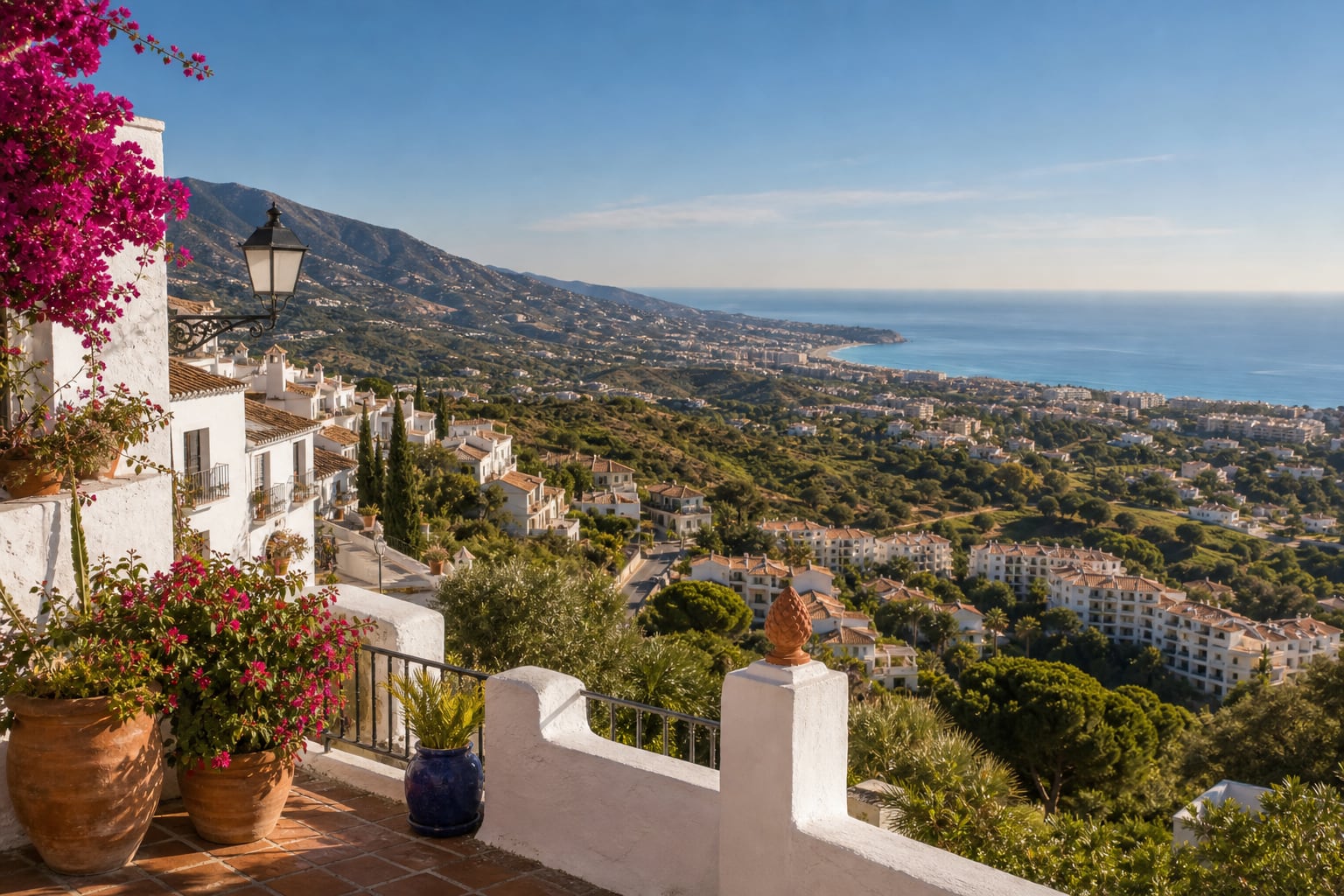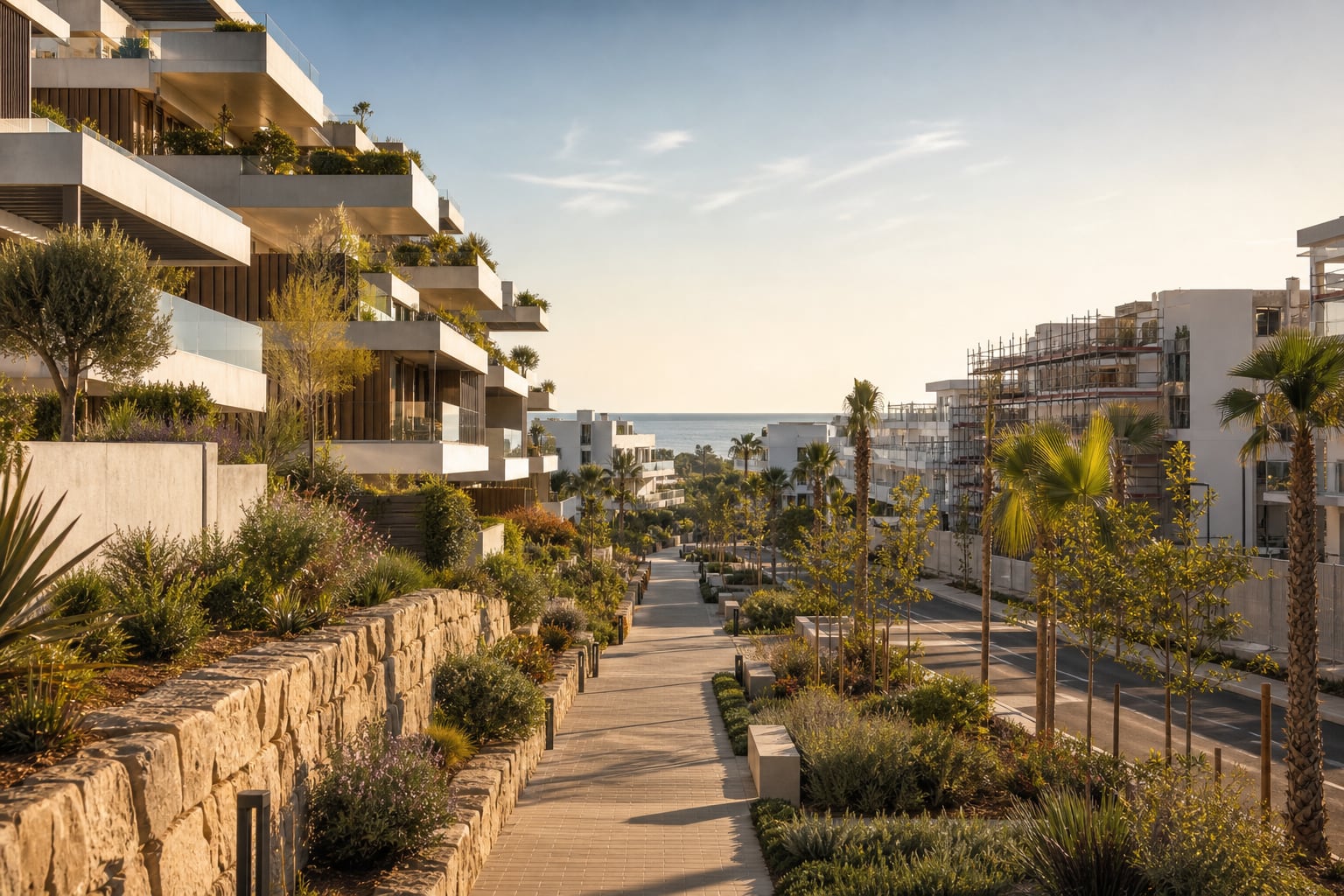
Le tronçon de la route côtière A-7 entre Guadalmina et l'ancienne station balnéaire de Kempinski à Playa El Padrón s'étend sur environ douze kilomètres, à l'ouest de la ligne municipale de Marbella jusqu'à Estepona. À l’intérieur de ce ruban se trouvent au moins sept urbanisations nommées, quatre terrains de golf de 18 trous, trois écoles internationales, un parc conçu par Gary Player et le pipeline de nouvelle construction le plus fréquenté d’Andalousie. C'est ce que les agents locaux, les brochures et le bureau de recherche d'Idealista ont passé la dernière décennie à appeler Le nouveau Golden Mile d'Espagne - un nom emprunté, de manière semi-effrontée, à l'original Milla de Oro, à l'est du centre de Marbella, et désormais fermement son propre marché.
Pour un acheteur qui envisage la Costa del Sol en 2026, le New Golden Mile est l'un des micro-marchés les plus importants à comprendre rue par rue. Les prix moyens à Estepona se situent à 4 234 € le mètre carré en février 2026 selon les données d'Idealista, mais le tronçon principal de ce corridor côtier atteint 6 000 à 8 000 € par m² pour les nouvelles constructions – un niveau qui s'est fortement réduit par rapport à la moyenne du Golden Mile de Marbella de 6 789 € par m². Si le Golden Mile d’origine est mature et visible, le New Golden Mile est l’endroit où l’offre se construit actuellement, où le bassin d’écoles internationales est le plus dense et où les stocks de nouvelles constructions changent de mains à grande échelle.
Où commence et se termine réellement le New Golden Mile
Il n'y a pas de panneau routier, pas de démarcation municipale officielle, et pourtant chaque agent local trace la limite à peu près au même endroit. La limite orientale est la rivière Guadalmina, qui forme la frontière entre la municipalité de Marbella (Guadalmina Baja et Guadalmina Alta) et Estepona. La limite ouest est plus floue : la plupart des agents arrêtent le New Golden Mile à l'entrée de la ville d'Estepona proprement dite, quelque part autour des plages de Bahía Dorada ou de Costa Natura. Entre les deux se trouvent Atalaya, Atalaya Alta, Bel-Air, Benavista, El Paraíso, La Cancelada, Saladillo, Benamara, Selwo et Guadalmansa – chacune avec sa propre fourchette de prix et sa propre atmosphère.
Deux routes définissent ici la vie quotidienne. La route côtière A-7 – l'ancienne N-340, aujourd'hui déclassée – passe au niveau de la mer et transporte le trafic local entre les lotissements, les clubs de plage et les supermarchés. L'autoroute à péage AP-7 s'étend à l'intérieur des terres, parallèlement et à un kilomètre ou deux en amont, et c'est celle que les résidents utilisent pour se rendre à Marbella, Puerto Banús, l'aéroport de Malaga (environ 55 à 65 minutes selon l'heure de la journée) ou vers Sotogrande et Gibraltar. La répartition est importante : les propriétés du côté mer de l'A-7 sont en bord de mer et plus calmes la nuit mais plus exposées à la route ; les propriétés situées entre l'A-7 et l'AP-7 sont généralement des lotissements à l'intérieur des terres avec vue sur la mer et un accès plus facile dans les deux sens.
L'autre élément déterminant de la géographie est la Sentier Litoral, le sentier côtier d'Estepona. Depuis 2026, il couvre plus de 20 kilomètres de front de mer, avec des travaux en cours le poussant à travers les brèches de Benamara, Bahía Dorada et Atalaya. Une fois terminé, vous pourrez marcher sur une promenade continue depuis Costa Natura, juste après Estepona, jusqu'à la ligne municipale de Marbella. Cela change la perception de la propriété en bord de mer le long du New Golden Mile, en particulier pour les acheteurs habitués à le comparer avec le tronçon plus développé à l'est de Puerto Banús.
L'échelle des prix, de 3 900 € à 8 650 € le mètre carré
Les données d'Idealista au niveau des quartiers, actualisées début 2026, révèlent à quel point la pente est abrupte sur ce qui ressemble sur une carte à une seule bande côtière. Au sommet, Guadalmansa se situe à 8 651 € le m² — en bord de mer, fermé et dominé par des développements de style complexe. Punta Plata coûte environ 6 890 € le m². Seghers, légèrement à l'intérieur des terres, imprime à 4 888 € le m². Selwo, gravir la colline derrière le parc safari, coûte environ 4 365 € le m². Altos de Estepona, la bande intérieure la plus résidentielle, tombe à 3 895 € le m². La même série de données évalue le Golden Mile classique de Marbella (Nagüeles-Milla de Oro) à 6 789 € par m² en moyenne, ce qui signifie que les meilleures poches en bord de mer du New Golden Mile se négocient désormais. au-dessus de la référence de Marbella.
C’est dans la nouvelle construction que se situent les gros titres. Le bureau de luxe Idealista a rapporté en février 2026 que Les prix des nouvelles constructions à Estepona atteignent désormais 7 000 € par m², avec la tranche New Golden Mile allant de 6 000 à 8 000 € par m² pour les développements premium. Pour un appartement typique de trois chambres d'une superficie construite de 100 m² dans un projet en bord de mer, cela se traduit par environ 600 000 € en bas de fourchette et 800 000 € en haut avant taxes, frais et toute prime de résidence de marque. Un appartement en revente de 100 m² situé à un pâté de maisons de la plage dans une urbanisation légèrement plus ancienne se situera toujours dans la fourchette de 423 000 à 500 000 € selon les mêmes données, ce qui rend le marché de la revente intéressant pour les acheteurs qui n'ont pas besoin de tout ce qui est neuf.
Les rendements et les prévisions sont tous deux fermes. Les rendements locatifs bruts des locations courtes sur le New Golden Mile sont cités par plusieurs agents locaux et la plateforme Idealista dans le 5.5–7.5% fourchette à l'achat pour les actifs à caractère touristique, avant frais de gestion, IBI, frais communautaires et impôt sur le revenu des non-résidents (19 % pour les résidents de l'UE/EEE, 24 % pour les non-EEE). Les rendements nets d’un bien locatif de luxe se situent généralement entre 3 et 4,5 % une fois qu’ils sont honnêtement modélisés – directionnels et non prometteurs. Du côté des capitaux, plusieurs notes de recherche locales indiquent une croissance attendue des prix de 4 à 6 % par an jusqu'en 2026, ralentissant à mesure que de nouveaux approvisionnements arrivent.
Les quartiers, par ordre de caractère
Atalaya et Atalaya Haute se trouve à l'extrémité est, immédiatement à l'ouest de Guadalmina. L’institution déterminante ici est Atalaya Golf & Country Club, un complexe de 36 trous avec un Old Course conçu à l'origine par le Dr Bernhard von Limburger en 1968 et un New Course plus moderne ouvert en 1990. Les green fees commencent à environ 29 € par partie en basse saison et le club dispose d'une base de membres fortement internationaux et résidents à temps plein. L'immobilier ici est un mélange de villas établies sur des terrains donnant sur le golf, de complexes d'appartements de faible hauteur datant des années 1990 et d'un flux constant de nouvelles constructions contemporaines remplaçant les anciennes. Les acheteurs sont généralement des familles avec des enfants d'âge scolaire et des retraités d'Europe du Nord qui jouent quatre fois par semaine.
El Paraíso est la prochaine urbanisation à l’ouest et sans doute la plus emblématique des domaines de villas de l’intérieur des terres. Le El Paraíso Golf Club est un parcours de 18 trous dans un parc conçu par Gary Player et aménagé en 1973 - toujours ouvert quotidiennement aux joueurs green-fee et l'un des rares originaux Player en Europe. L'urbanisation environnante d'El Paraíso est une grille de grandes villas individuelles, une école primaire (The International School Estepona, English National Curriculum), le marché du samedi matin près de la station-service et un groupe restreint de restaurants et de courts de padel. Le prix des villas neuves ici est actuellement indiqué à 1,35 M€ à 1,78 M€ pour un produit contemporain 4 chambres, avec des villas contemporaines sur plan haut de gamme à partir de 1,53 M€. Les reventes de rénovations des années 1980 se négocient encore bien en dessous de ce chiffre.
Benamara, Benavista et Bel-Air asseyez-vous au bord de la plage, avec des jardins arborés, des immeubles d'appartements à faible densité et un accès direct à la promenade du front de mer. Le caractère est résidentiel plutôt que touristique : les résidents à temps plein se rendent à pied à la boulangerie, les cours d'école sont courts et la plage de Saladillo-Benamara est l'une des étendues pavillon bleu les plus calmes entre Marbella et Estepona. Cancelada, légèrement à l'intérieur des terres et centré sur une place de village espagnole en activité, est devenu le cœur opérationnel du New Golden Mile - les supermarchés, les quincailleries, les vétérinaires et le genre de café où le constructeur, le jardinier et l'avocat prennent tous leur café du matin. C’est la partie du couloir qui ressemble le moins à une campagne de marketing.
Selwo and Guadalmansa fermer l'extrémité ouest. Selwo gravit la colline derrière le parc safari éponyme et offre certaines des meilleures vues à long terme sur la côte. Les projets d'appartements modernes ici représentent souvent le meilleur rapport qualité-prix du New Golden Mile par mètre carré. Guadalmansa, en revanche, se situe au sommet de l'échelle des prix : en bord de mer, fermée et abritant plusieurs des développements de marque et de style complexe qui ont généré les impressions de plus de 8 000 €/m² dans les données récentes.
Les écoles, le golf et les infrastructures qui attirent les familles
Le bassin scolaire est le moteur discret d’une grande partie de la population à temps plein du New Golden Mile. À moins de quinze minutes en voiture, asseyez-vous Collège international Laude San Pedro (fondée en 2004, English National Curriculum 3-18, classée par El Mundo comme l'une des 100 meilleures écoles internationales d'Espagne), École Internationale Atalaya en Atalaya Alta (bilingue anglais-espagnol avec un programme de baccalauréat international), et L'École Internationale d'Estepona au cœur d'El Paraíso (programme national anglais, primaire et infantile). Les familles britanniques, irlandaises et scandinaves qui déménagent en milieu de carrière ont tendance à choisir le New Golden Mile précisément parce que le trajet entre l'école et la maison se mesure en minutes plutôt qu'en une demi-heure de route depuis les collines derrière Marbella.
La concentration du golf est inhabituelle, même selon les normes de la Costa del Sol. À l'intérieur de cette bande de douze kilomètres, les résidents ont accès à Atalaya ancien et nouveau, El Paraíso, Real Club de Golf Guadalmina, Los Flamingos, La Resina et El Campanario – sept aménagements dans à peu près la superficie d’un petit quartier de Londres. La plupart des familles détenant une propriété ici appartiennent à un club pour devenir membre à part entière et jouent le reste selon la rotation des green-fees. Pour un retraité pratiquant quotidiennement le golf, cette densité est la seule raison de choisir le New Golden Mile plutôt que, par exemple, la Golf Valley plus étroite de Nueva Andalucía, où les parcours sont plus denses mais la propriété est uniformément plus ancienne.
Les infrastructures ont été la priorité la plus claire de la mairie d'Estepona pour le deuxième mandat. Le budget municipal 2025 — 132 millions d'euros, le plus important de l'histoire de la ville — a prévu 35 millions d'euros pour l'entretien et les travaux urbains. Le sentier Senda Litoral est désormais achevé à plus de 90 % sur toute la côte et comble ses dernières lacunes le long du New Golden Mile. Estepona has also reduced the IBI property tax by an average of 20% via a €6.6 million fiscal incentive, which is a small but real ongoing cost saving for owners. Rien de tout cela ne change l’attrait de la côte, mais cela change suffisamment la texture de la vie quotidienne pour que les acheteurs devraient le remarquer.
Que demander avant de signer en 2026
La première question pratique est de savoir de quel côté de l’A-7 se trouve une propriété donnée. Beachfront — sea side of the road — is quieter at night but adds a barrier to walking inland, and most schemes resolve this with underpasses and dedicated crossings. Inland — between the A-7 and AP-7 — typically gets bigger plots, longer driveways and clearer views, but requires a car for absolutely everything, including the beach. Neither is better; the trade is real.
La deuxième question concerne la date de livraison et les antécédents du développeur. The New Golden Mile is the most active off-plan corridor in Andalusia and a meaningful share of stock currently being marketed is in projects that will not deliver until late 2026 or 2027. That is workable if your timeline matches, painful if not. The standard Andalusian sequence is around 10% on reservation plus a staged 20–30% during construction (with bank guarantees per Spanish law) and the balance on notary completion. L'impôt espagnol sur les mutations immobilières (ITP) sur les reventes en Andalousie est actuellement de 7 % ; les nouvelles constructions comportent 10 % d'IVA plus 1,2 % d'AJD. Confirmez toujours les derniers chiffres auprès d'un abogado ou d'un gestor espagnol qualifié avant de vous engager, car les tarifs changent.
La troisième question concerne l'utilisation prévue. If the property will rent on short-let between visits, the New Golden Mile's 5.5–7.5% gross yield band is real but assumes a tourist-spec finish, professional management and a community that permits short rentals — not all do, and Andalusia's rental regime has tightened around licensing. If it will be a primary residence with the family schooled locally, the maths is about lifestyle and cost-of-ownership rather than yield, and the right comparison is not Marbella but Sotogrande, Mijas Costa or the more residential parts of Estepona.
The fourth question — easy to forget under pressure from showroom marketing — is whether the buyer actually prefers the calmer, more residential rhythm of Estepona's coast to the louder, more international energy of Marbella proper. For some, the New Golden Mile feels like a relief: less August traffic, fewer paparazzi-grade beach clubs, more children in the playgrounds, real local life in Cancelada square. Pour d’autres, c’est trop calme. Le test honnête est d'y rester en février ainsi qu'en août. Quiconque ne visite qu’en été verra une version du lieu, et non celle dans laquelle il vivra dix mois par an. Pour le contraste de style et de prix, le Guide du Mille d'Or de Marbella est la prochaine lecture évidente.
The New Golden Mile is what happens when a coast with three hundred sunny days, four golf courses per square kilometre and three international schools attracts a decade of disciplined, well-capitalised new development. Ce n'est plus l'alternative bon marché à Marbella ; pour le groupe privilégié en bord de mer, il se négocie désormais au-dessus de la moyenne de Marbella. But it remains the most coherent stretch of new-build inventory on the Costa del Sol — and the most useful one to walk before deciding where on this coast to actually live.
To see current Domosmar listings along this stretch — new-build apartments and villas in Atalaya, El Paraíso, Benamara, Cancelada and Selwo — browse the live property collection, ou entrer en contact d'organiser une visite guidée du couloir avec quelqu'un qui habite à dix minutes.