Est-ce que c'est encore une fois 2007 ? C'est la question que les acheteurs sérieux se posent plus que toute autre en 2026 – généralement entre la deuxième visite et la première offre, et presque toujours de la part de quelqu'un qui se souvient exactement de ce qui est arrivé aux propriétés côtières espagnoles entre 2008 et 2013. Les chiffres qui la motivent sont réels : l'Espagne a enregistré 714 237 ventes de logements en 2025, le chiffre le plus élevé depuis dix-huit ans et la première fois que le marché a compensé 700 000 transactions depuis le pic d'avant-crise de 775 300 en 2007, selon l'Instituto Nacional de Estadística (INE). Les prix ont suivi le volume à la hausse et les principaux quartiers de Marbella affichent des chiffres records au mètre carré. La question est donc légitime et mérite une réponse sérieuse.
Cette réponse ne réside pas dans le volume des ventes, mais dans trois endroits rarement abordés par les gros titres : comment les achats sont financés, ce qui est construit et qui achète. D'après chacune de ces mesures, 2026 ne ressemble presque en rien à 2007. Pour quiconque envisage un achat à Marbella, Estepona ou Benahavís cette année, comprendre pourquoi est plus utile que n'importe quel simple tableau de prix, car il détermine si les prix d'aujourd'hui sont un avertissement ou simplement la conséquence d'un marché qui, structurellement, ne peut pas fournir ce que veulent ses acheteurs.
Le chiffre derrière la question
Commencez par les chiffres bruts. Les données de fin d'année de l'INE, rapporté par Olive Press en février 2026, montre 714 237 transferts de logements à travers l'Espagne en 2025 — un chiffre Augmentation de 11,5% par rapport à 2024 et plus du double du volume d’il y a dix ans. L'activité a augmenté de plus de 22 % depuis 2023. Environ 78 % de ces transactions concernaient des maisons d'occasion, même si les achats de nouvelles constructions ont augmenté plus rapidement, en hausse de 16,1 % sur l'année.
La répartition régionale importe davantage pour les lecteurs de ce blog. Andalousie enregistrée 143 794 ventes en 2025 — plus que toute autre région espagnole, devant la Catalogne (112 585) et Madrid (81 681). En Andalousie, la province de Malaga a longtemps été le moteur : elle représente la plus grande part des achats étrangers de la région et contient, dans le triangle Marbella-Estepona-Benahavís, le marché résidentiel le plus international du sud de l'Espagne. Lorsque des records nationaux de transactions sont établis, ce littoral occupe une place disproportionnée là où ils sont établis.
Les commentateurs du marché cités parallèlement au communiqué de l'INE se sont montrés particulièrement sereins. Ferran Font, directeur de recherche du portail Pisos.com, a souligné "des critères de prêt hypothécaire beaucoup plus prudents et un profil d'acheteur plus solvable" qu'avant 2008. C’est une affirmation qui mérite d’être testée, car si elle est vraie, la ressemblance avec 2007 est superficielle. Si c’est faux, aucun optimisme méditerranéen ne changera l’arithmétique.
Suivez le crédit, pas les gros titres
Le krach de 2008 était, à l’origine, un événement de crédit. Les banques espagnoles avaient prêté de manière extravagante aux promoteurs et aux ménages, et lorsque les marchés de financement se sont gelés, les deux côtés de la balance se sont effondrés ensemble. La comparaison publique la plus rigoureuse d’hier et d’aujourd’hui vient de Rapport sectoriel de CaixaBank Research sur le marché du logement, et ses données de crédit sont frappantes. Les prêts hypothécaires aux ménages s'élèvent à 30,6% du PIB, contre 63,6% en 2006. La dette totale des ménages s’élève à 42,5 % du PIB, contre un peu plus de 80 % en 2010. Le crédit aux promoteurs et aux constructeurs – le carburant de la dernière bulle – se situe aujourd’hui autour de 5 % du PIB, contre des ratios supérieurs à 40 % à la fin des années 2000.
La structure des prêts a changé autant que leur volume. Dans les années 2000, à peine 2 % des prêts hypothécaires espagnols étaient à taux fixe ; depuis 2022, plus de la moitié de tous les nouveaux prêts hypothécaires sont fixes, protégeant les emprunteurs des chocs de taux d’intérêt qui ont écrasé les ménages à taux variable après 2008. Le ratio prêts hypothécaires/ventes raconte la même histoire : environ 68 % au premier semestre 2025, soit un achat sur trois réalisé sans aucun financement. Et les normes de prêt n’ont pas baissé : les prêts hypothécaires supérieurs à 80 % de la valeur d’expertise ne représentaient que 10,9 % des nouveaux prêts début 2025, une grande partie étant imputable aux programmes gouvernementaux aidant les jeunes primo-accédants plutôt qu’à l’effet de levier spéculatif.
Sur cette côte, la part non financée est encore plus élevée. Les acheteurs internationaux du segment premium – le Golden Mile, la Sierra Blanca, La Zagaleta, les meilleures rues de Nueva Andalucía – ont tendance à conclure en fonds propres, le financement étant utilisé de manière sélective pour la planification fiscale plutôt que pour la nécessité. Les non-résidents qui empruntent sont soumis à des conditions prudentes, généralement un rapport prêt/valeur de 60 à 70 %, une discipline que nous avons abordée en détail dans notre guide des prêts hypothécaires espagnols pour les non-résidents. Un marché dans lequel l’acheteur marginal dépense ses économies plutôt que l’argent emprunté ne se déroule tout simplement pas comme en 2008.
2007 Trop construit. 2026 construit trop peu.
La deuxième différence structurelle est l’offre, et ici les deux époques sont des images miroir. Dans les années 2000, l'Espagne a approuvé environ 550 000 nouveaux logements par an tout en créant environ 400 000 ménages – un excédent qui, multiplié sur une décennie, a laissé le pays recouvert de stocks invendus lorsque la demande a disparu. Depuis 2021, la relation s’est inversée : les approbations se sont élevées en moyenne à environ 118 000 logements par an contre 226 000 nouveaux ménages, laissant un déficit accumulé que CaixaBank Research estime à plus de 500 000 logements et en croissance.
La composition des ventes le confirme. En 2007, les logements neufs représentaient 42,1 % de toutes les transactions – signature d'un boom de la construction. Au premier semestre 2025, cette part était de 22,2 %. L’investissement dans la construction résidentielle s’élève aujourd’hui à environ 6 % du PIB, soit la moitié de son niveau de l’époque de la bulle. Même le nombre record de transactions semble différent une fois la population prise en compte : l'Espagne compte 4,3 millions de personnes et 3,2 millions de ménages de plus qu'en 2007, donc le volume de 2025 équivaut à environ 14,3 ventes pour 1 000 habitants contre 17,3 au pic de 2007. Par habitant, le marché est encore bien en deçà de ses anciens sommets.
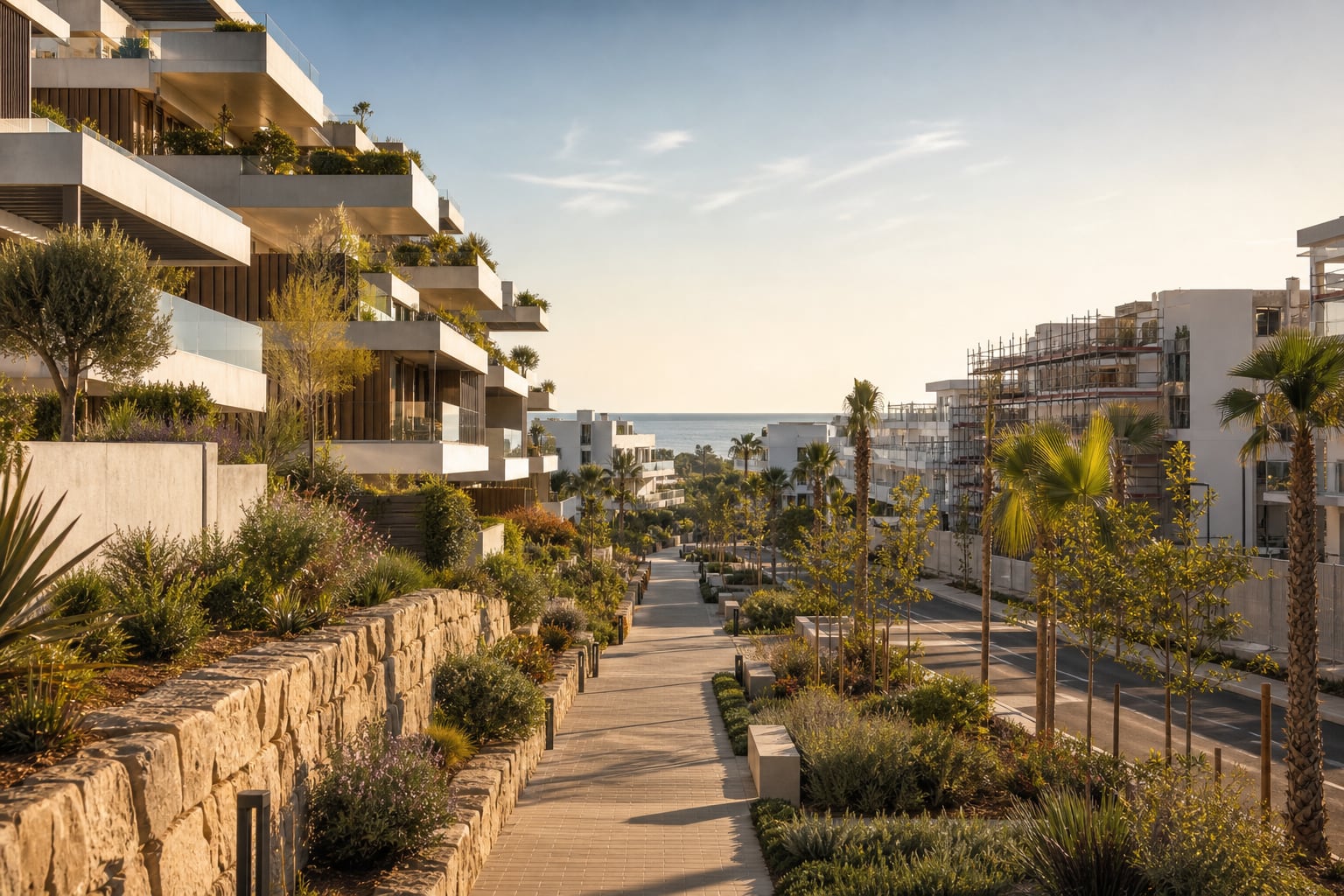
Marbella ajoute sa propre couche de pénurie au tableau national. La municipalité a passé plus d’une décennie dans les limbes de la planification sans plan directeur urbain valide, limitant la libération de terrains aménageables précisément au moment où la demande internationale s’accélérait. La conséquence est visible dans chaque vitrine d'agence, de San Pedro à Los Monteros : les nouveaux produits bien situés sont absorbés presque aussi vite qu'ils sont commercialisés, et les propriétaires existants dans les urbanisations établies ne sont soumis à aucune pression pour rabaisser. Les prix sur ce marché augmentent parce que presque tout ce qui arrive sur le marché se vend – et non parce que le crédit chasse les actions spéculatives.
À quoi ressemble le cycle depuis Marbella
Zoomez sur les données nationales sur cette partie de la côte et les chiffres portent la même signature : forts, mais inégaux et motivés par la rareté plutôt qu’uniformes et motivés par le crédit. Selon Rapports de prix d'idéalista pour février 2026, Los Monteros, sur la plage est de Marbella, atteint 8 772 €/m², en hausse de 11,9% sur un an; le corridor Nagüeles–Milla de Oro s'élève à 6 789 €/m², en hausse de 6,9 % ; et Nueva Andalucía ont imprimé un maximum historique de 5 654 €/m², en hausse de 6,6%. Trois micro-marchés voisins, trois taux de croissance sensiblement différents – la dispersion elle-même est la preuve que les acheteurs fixent des prix sur des emplacements et une qualité de produit spécifiques, et n'enchérissent pas sans discernement sur quoi que ce soit ayant un code postal.
La demande étrangère reste la variable distinctive du littoral. À l'échelle nationale, les étrangers ont acheté environ 50 000 logements au premier semestre 2025 — 14,1% de toutes les ventes espagnoles, contre une moyenne 2006-2024 de 10,5 %, selon les données du Colegio de Registradores citées par CaixaBank. Dans la province de Malaga, la part est bien plus élevée et s'est montrée résiliente même après que l'Espagne a fermé le Golden Visa aux investisseurs immobiliers en avril 2025 — un épisode que nous avons analysé dans notre bilan de la première année de Marbella sans le Golden Visa. Les acheteurs qui soutiennent ce marché sont majoritairement des utilisateurs finaux et des propriétaires à long terme originaires d’Europe du Nord, du Royaume-Uni, des Amériques et du Golfe, qui achètent pour leur style de vie et leur déménagement plutôt que pour des privilèges de visa ou une revente rapide.
Ce profil d’acheteur change la façon dont un ralentissement se transmettrait. Le vendeur marginal en 2008 était un spéculateur espagnol à effet de levier ou un promoteur insolvable ; la vente forcée fixait le prix. Le propriétaire représentatif du segment principal en 2026 détient l’actif, l’utilise et peut attendre une période de ralentissement. Les marchés dominés par des détenteurs de titres discrétionnaires peuvent certes rester calmes – les volumes de transactions sont la première victime lorsque la confiance se refroidit – mais ils réévaluent rarement de manière violente, car personne n’est obligé de vendre.
Les mises en garde qui méritent une facturation égale
Rien de tout cela n’autorise la complaisance, et la version honnête de cet article inclut les avertissements. La Banque d'Espagne a estimé fin 2024 que les prix nationaux de l'immobilier étaient restés stables. entre 1,1% et 8,5% au-dessus de leur équilibre de long terme; les modèles de la Banque centrale européenne rapprochent la surévaluation de 10 %. Les deux chiffres sont modestes par rapport aux normes de la bulle et tous deux sont des agrégats qui en disent peu sur une rue spécifique de Marbella – mais la direction du déplacement est clairement ascendante et les ratios d’accessibilité dans les régions à forte demande sont tendus. Les prix nominaux à l'échelle nationale ont désormais dépassé leur sommet de 2007, même si, corrigés de l'inflation, la plupart des segments restent en dessous de ce niveau.
La voie à suivre réaliste est la modération plutôt que le renversement. CaixaBank Research prévoit que la demande se maintiendra 720 000 ventes par an jusqu’en 2026 la croissance des prix ralentit à environ 6,3 %, contre environ 10 % en 2025. Pour un acheteur, la traduction pratique est que la phase facile – où presque tout achat bien situé s'apprécie – cède la place à une phase qui récompense la sélectivité : l'orientation, la qualité de la construction, les frais de communauté, la légalité de la location et le rendement réaliste comptent à nouveau, une discipline que nous avons définie dans notre analyse de ce que la propriété de Marbella rapporte réellement. Bien acheter en 2026 signifie garantir l’actif spécifique, et non l’humeur nationale.
Alors : est-ce encore 2007 ? Le tableau des volumes indique peut-être ; tout ce qui est en dessous dit non. Le dernier boom s’est construit sur de l’argent emprunté pour chasser une offre surconstruite. Celui-ci est construit sur l'équité pour chasser une offre sous-construite, dans un pays qui compte trois millions de ménages supplémentaires, sur un littoral où la contrainte est la terre et la planification plutôt que le crédit. Les cycles existent toujours et les prix n’augmenteront pas de manière linéaire – mais le mécanisme qui a transformé 2007 en 2008 n’est tout simplement pas assemblé en 2026.
Pour les acheteurs, l’année record doit être interprétée comme une confirmation que la région de Marbella reste l’un des marchés résidentiels les plus profonds et les plus liquides d’Europe – et qu’attendre une réinitialisation à la manière de 2008 signifiera probablement attendre indéfiniment pendant que la pénurie s’aggrave. Parcourez notre sélection actuelle de propriétés de nouvelle construction et de revente à Marbella, Estepona, Benahavís et sur la Costa del Sol au sens large, ou parlez à l'équipe Domosmar sur la façon dont les données de 2026 s’appliquent aux zones et fourchettes de prix spécifiques que vous envisagez.