On 13 and 14 September 2025, Spain played Denmark in a Davis Cup qualifier on the clay of the Puente Romano Tennis Club on Marbella''s Golden Mile. It was the fifth time the city has staged the competition, after ties in 1989, 2009, 2018 and 2022. For two days the club''s central stadium — usually seating around 2,500 — was extended with temporary stands to hold roughly 5,000 spectators, according to idealista, with two-day passes priced between €90 and €250 and single-day tickets from €50.
It is easy, in 2026, to assume the racquet sport that defines this coast is padel. The percussive pop of rubber on glass really is the morning soundtrack of Nueva Andalucía. But tennis came first, and it never left. The clubs that the Royal Spanish Tennis Federation keeps choosing for national ties are woven into the most valuable residential corridor in Andalusia — and for a certain kind of buyer, the courts are not a footnote to a property search but the reason for it.
Marbella was a tennis town first
The Puente Romano club opened in 1979, in the early years run under the name of Björn Borg, the Swede who was then winning Wimbledon every summer. Management later passed to Manolo Santana, Spain''s first global tennis star and the 1966 Wimbledon champion, who lived and taught in Marbella for the rest of his life. The list of players who have hit balls on these courts — Boris Becker, John McEnroe, Novak Djokovic, Andy Murray — reads like a who''s who of the modern game.
That pedigree is the reason the federation keeps coming back. When Spain needs a clay-court home tie in autumn, Marbella offers something almost nowhere else in Europe can: championship clay, a stadium that can be dressed up for television, and a near-guarantee of dry, warm weather in September, with Málaga''s international airport only about 40 minutes east. The 2025 tie against Holger Rune''s Denmark decided a place in the Final 8 in Bologna — the kind of event that, for one weekend, turns a residential resort into a sporting capital.
None of this is incidental to the property market. A buyer comparing Marbella with the South of France or the Algarve is weighing intangibles, and a club that hosts Davis Cup ties is a tangible expression of an intangible: that this is a place where serious sport, and serious money, choose to be.
Four clubs within a few kilometres
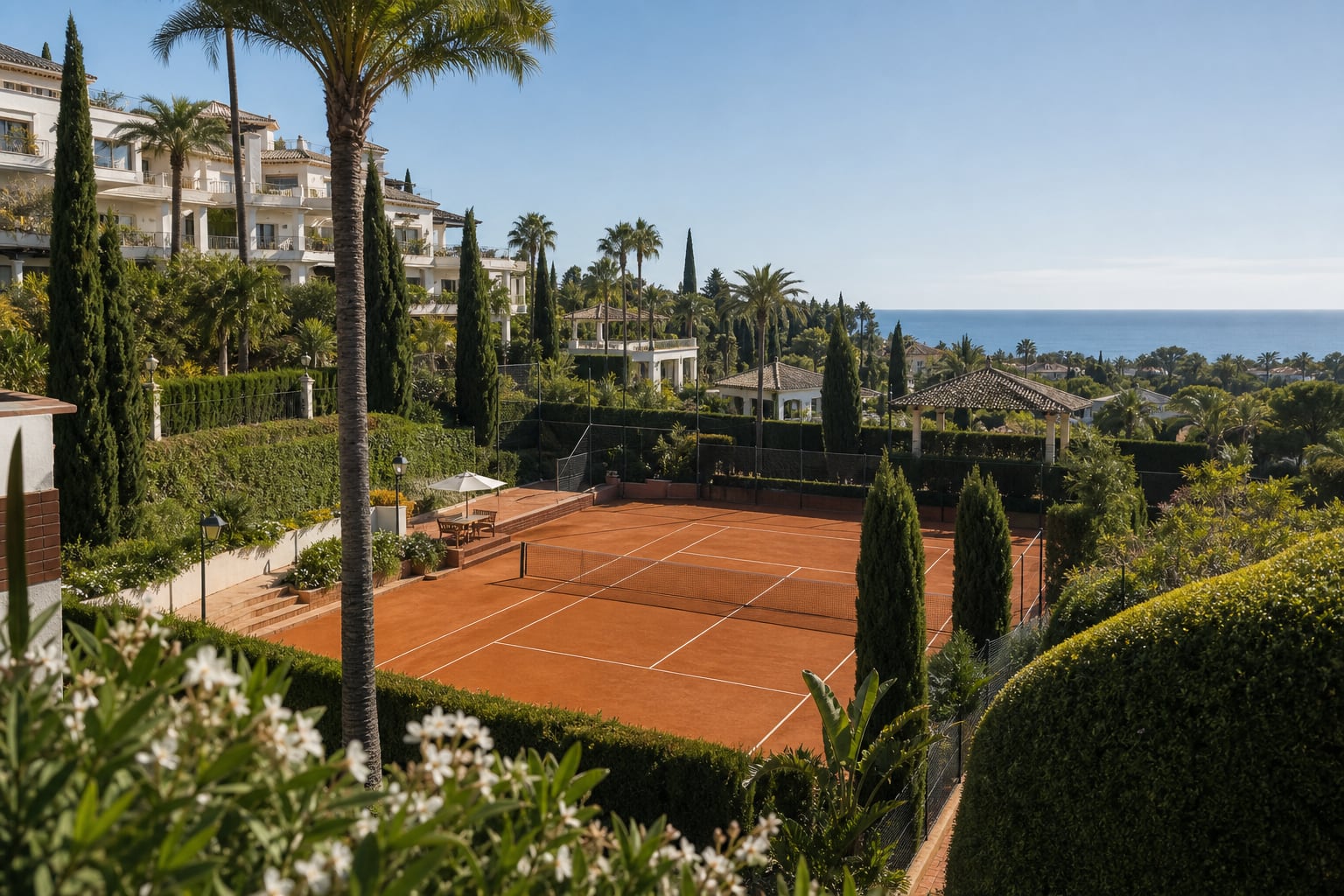
The Puente Romano Tennis Club itself, on the Bulevar Príncipe Alfonso von Hohenlohe at the heart of the Golden Mile, is the anchor. Its neighbouring sister resort, the Marbella Club, describes the shared complex as offering 14 courts in total — a mix of clay, hard (plexipave) and padel. The Puente Romano club lists eight floodlit clay courts among them, open daily from 8am to 9pm, with a full academy running after-school junior programmes and adult coaching year-round. You do not need to own a villa behind the barrier to play; courts are bookable by the hour.
A short distance away sits the Manolo Santana Racquets Club, the members'' club that carries the great champion''s name. It is smaller and more private — six courts — but unusual in covering all three Grand Slam surfaces, including a rare grass court, a surface almost unheard of on the Mediterranean. Alongside the tennis there are padel courts, a pool, a gym and a restaurant, all floodlit for evening play. For residents who want the feel of a private club rather than a resort, it is the natural home.
East of the town, in the leafy El Rosario urbanisation just off the old Cádiz road at kilometre 188, the Royal Tennis Club Marbella offers a different proposition again: eight clay courts and one hard court, roughly 800 metres from the beach and a five-minute drive from the centre, wrapped around a small hotel, restaurant and gym. It is less glossy than the Golden Mile clubs and all the more popular with year-round residents for it. Between these clubs and the academies attached to them, the stretch of coast from El Rosario to San Pedro probably has a higher concentration of quality clay courts than anywhere else in the country.
What the courts do to the Golden Mile
The clubs sit on, or beside, the most expensive residential land in southern Spain. The Nagüeles–Milla de Oro stretch of the Golden Mile reached an average of €6,789/m² in February 2026, up 6.9% year on year and close to its historical maximum, according to idealista''s price report. At the trophy end, a frontline-beach duplex penthouse within the Puente Romano resort — the same resort that houses the tennis club — was listed at €19,900,000.
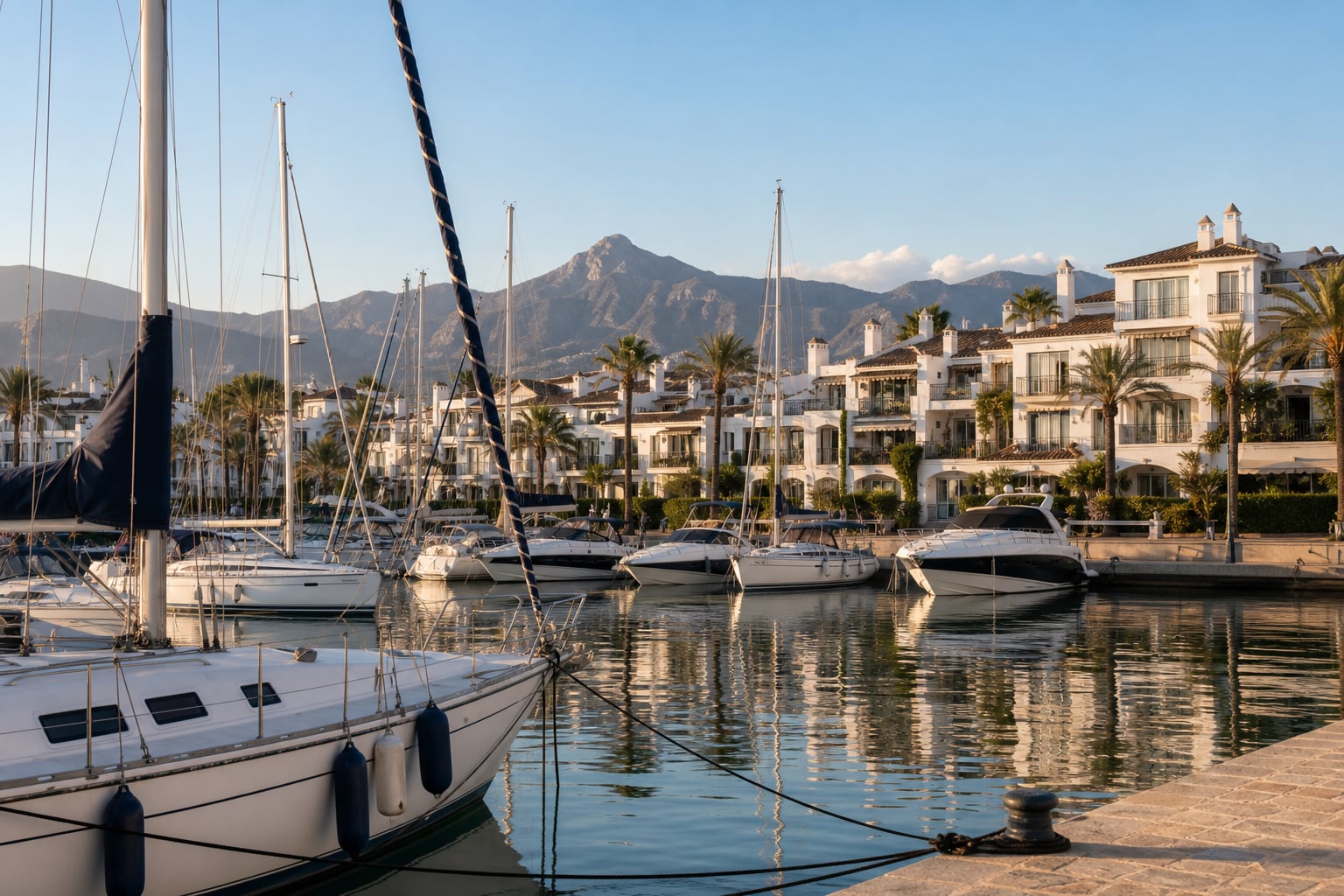
What the buyer is paying for, beyond the square metres, is walkability to a particular kind of life: Michelin-starred dining, beach clubs, designer boutiques and, a few minutes on foot, a Davis Cup court. For owners who let their homes when they are not in residence, weekends like the September tie sharpen short-term rental demand — a point idealista makes explicitly when it argues that hosting events of this scale reinforces Marbella''s property values. A home you can play out of in the morning and rent at a premium during a sporting weekend is doing two jobs at once.
It is worth keeping the figure in perspective against the wider east of town: beachfront Los Monteros reached €8,772/m² in the same report, a reminder that proximity to the sand still outranks proximity to a baseline. But on the Golden Mile the two overlap, and that overlap is rare. Buyers weighing the corridor can browse current Marbella listings to see how the premium plays out building by building.
Nueva Andalucía and the courts behind the golf
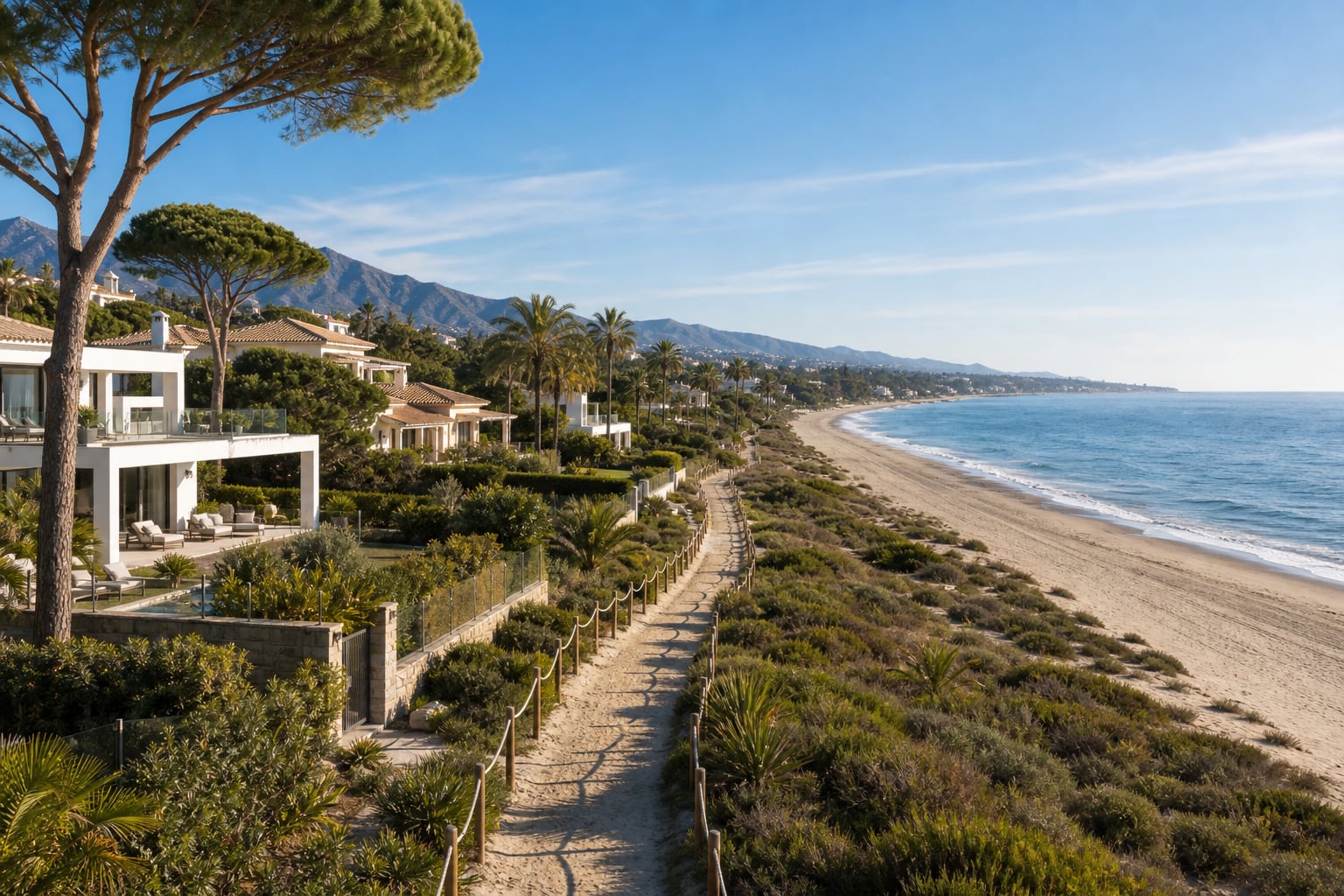
Inland and west, behind Puerto Banús, Nueva Andalucía is best known as Marbella''s Golf Valley — but it is also the heart of the racquet-sport boom. The area reached an average of €5,654/m² in February 2026, its historical maximum, up 6.6% year on year. That is a meaningful discount to the Golden Mile for a buyer who values space, golf frontage and a quieter family rhythm over beachfront cachet, and who is happy to drive ten minutes for the sea.
It is here that tennis and padel blur into a single lifestyle. The clubs around Avenida Valle Inclán hum from early morning, and a private court — tennis, padel, or both — has become as common a brief from buyers as a pool once was. For the active household, the appeal of this quarter is not one sport but the density of them within a short radius: golf, padel, tennis, and the mountains behind for those who want to swap the baseline for a trail, as covered in our guide to hiking La Concha and the Sierra de las Nieves.
The practical buyer''s point is this: in Nueva Andalucía the sporting infrastructure is a genuine value driver rather than a luxury veneer. Demand here is consistent, international and increasingly year-round, and the steady climb in price reflects it. Those tracking the segment can follow new-build and resale homes across Nueva Andalucía as projects come to market.
Playing as a resident, not a professional
For all the Davis Cup glamour, the everyday reality of tennis here is unfussy. At the Puente Romano club, courts are bookable by the hour through the club''s online system, and you do not need to be a hotel guest or a member to reserve one. The same is true at the Royal Tennis Club in El Rosario, which runs an open booking platform alongside its leagues, mix-in sessions and a summer children''s camp. The Manolo Santana Racquets Club is the exception — a members'' club first — though its padel classes are open more widely.
The academies are the part that matters most to relocating families. Puente Romano''s Junior Training Academy runs after-school programmes Monday to Friday from 5pm to 7pm and Saturday mornings from 10am to 1pm, with coaches certified by the Spanish professional registry. For a household weighing a move with school-age children, a serious tennis programme within ten minutes of the front door is the kind of detail that tips a decision — and it pairs naturally with the cluster of British and international schools between San Pedro and east Marbella.
It is also worth being honest about the calendar. Marbella''s tennis is a year-round affair precisely because the weather allows it: outdoor clay is playable in January here in a way it simply is not in northern Europe. That is the quiet engine behind every figure in this article — the same climate that fills the courts in winter is what underwrites the +6.9% annual price growth on the Golden Mile and keeps demand from cooling. Sport and property, on this coast, run on the same sunshine.
Buying near the baseline
Tennis is not the loudest story on the Costa del Sol — padel and golf both shout louder — but it is one of the oldest and most durable, and it sits on the most valuable ground. Five Davis Cup ties, a grass court that has no business existing on the Mediterranean, eight floodlit clay courts within walking distance of €6,789/m² apartments: this is infrastructure that does not get built quickly and does not move. For a buyer choosing between coasts, that permanence is part of the case for Marbella over its rivals.
If a home within a few minutes of championship courts is on your list — whether on the Golden Mile, in Nueva Andalucía or further east near El Rosario — explore our current Marbella and Costa del Sol properties, and talk to the Domosmar team about matching a search to the clubs and neighbourhoods that suit how you actually want to live.