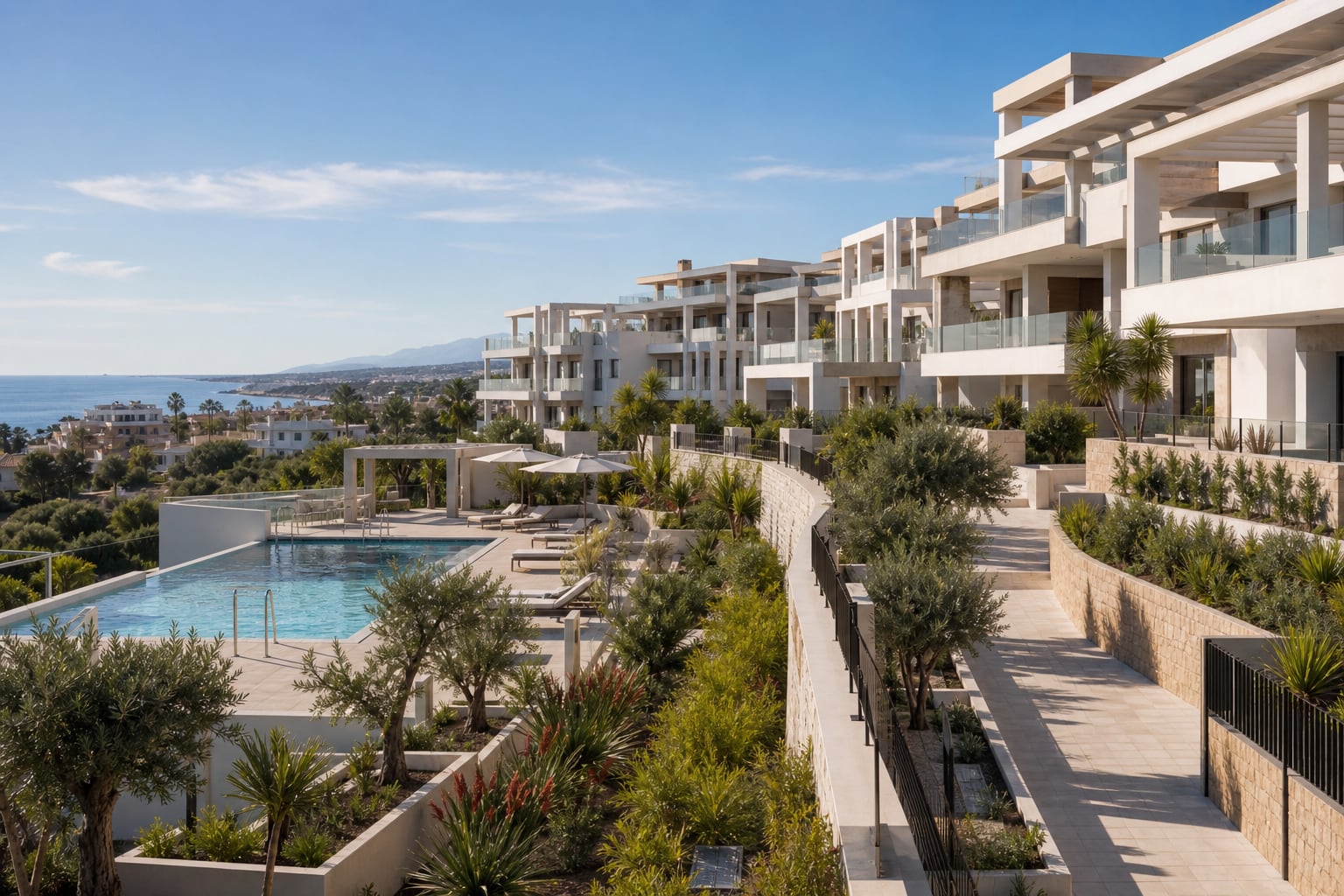
Sur un Villa de 5 millions d'euros à La Zagaleta détenue au nom d'un non-résident, la facture annuelle de l'impôt sur la fortune en 2026 s'élève à environ €22,000 — versé à la Junta de Andalucía de Séville plutôt qu'à l'État de Madrid. Ce chiffre surprend la plupart des acheteurs internationaux, car la phrase qu’ils lisent le plus souvent est que l’Andalousie a aboli son impôt sur la fortune en 2022 et que les résidents – et par extension, les propriétaires étrangers de maisons de vacances – ne paient rien en plus de leurs impôts fonciers quotidiens. C'était vrai, brièvement. Il ne s’agit plus d’une description complète du fonctionnement du système.
La réalité de la Costa del Sol en 2026 est plus nuancée et nettement plus intéressante. Les acheteurs dont les actifs en Espagne sont inférieurs à environ 3,7 millions d’euros ne paient toujours rien d’impôt sur la fortune – exactement comme le suggère le titre. Les acheteurs au-dessus de ce seuil paient, mais ils paient un montant calibré sur l'impôt national de solidarité sur les grandes fortunes plutôt que sur l'ancienne échelle régionale ; et les revenus vont au trésor régional plutôt qu’à l’État central. Comprendre les mécanismes est important car ils déterminent la façon dont un achat sérieux à Marbella, La Zagaleta, Sierra Blanca ou sur le front de mer d'Estepona est structuré, valorisé et détenu. Ce guide présente le régime tel qu'il existe en mai 2026, avec des exemples concrets tirés du segment supérieur du marché que Domosmar dessert chaque semaine.
D’où est née l’idée de « pas d’impôt sur la fortune en Andalousie »
L'Impuesto sobre el Patrimonio espagnol – l'impôt sur la fortune – est un impôt national dont les recettes sont entièrement affectées aux régions depuis les années 1990, chaque communauté autonome ayant le pouvoir de fixer ses propres exonérations, barèmes et réductions. Pendant la majeure partie de la dernière décennie, l'Andalousie a imposé la richesse selon une échelle progressive allant de 0,22 pour cent à 2,76 pour cent, avec une exonération personnelle de 700 000 €. Cela a changé 20 septembre 2022, lorsque la Junta de Andalucía a introduit un Bonification 100 pour cent régionale sur l'impôt sur la fortune, réduisant ainsi à zéro la facture des actifs de situation andalouse. Madrid, Murcie, Cantabrie, La Rioja et Estrémadure ont pris des mesures similaires, et une concurrence délibérée entre les régions pour attirer les résidents fortunés bat son plein.
Le gouvernement central a répondu en quelques mois. La loi 38/2022, votée le 27 décembre de la même année, a créé le Impuesto Temporal de Solidaridad de las Grandes Fortunas (ITSGF) — un nouvel impôt de solidarité au niveau national sur la fortune nette supérieure à 3 millions d'euros, à l'image des tranches supérieures de l'ancienne échelle régionale. Le texte juridique et les crochets sont dans le domaine public à la Portail ITSGF de l'Agencia Tributaria. La Cour constitutionnelle espagnole a confirmé la taxe en novembre 2023, et ce qui était initialement conçu comme une mesure temporaire de deux ans a été prolongé indéfiniment ; pour les années fiscales 2024 et 2025 (déclarations déposées à l’été 2025 et 2026), l’ITSGF reste en vigueur.
Pour l’Andalousie, l’introduction d’un impôt national parallèle était un problème que le gouvernement régional a dû résoudre. Si la bonification régionale restait à 100 pour cent, la même richesse serait toujours imposée – mais les revenus iraient à Madrid plutôt qu'à Séville. Ne rien faire signifiait perdre les recettes d’un impôt auquel la région avait volontairement renoncé. La solution est ce qui façonne le tableau de 2026, et la plupart des couvertures en langues étrangères sur le sujet ne l’ont pas rattrapé.
La réforme de 2024 - comment l'Andalousie a discrètement réabsorbé l'impôt
Le mécanisme est exposé en détail sur le Directives officielles de la Junta de Andalucía sur l'Impuesto sobre el Patrimonio. À partir de l’année fiscale 2024, alors que l’impôt national de solidarité reste en vigueur, deux choses se produisent. Le barème des tarifs andalou 2022 est suspendu; et le titre de remise régionale de 100 pour cent est remplacé par un abattement partiel calculé comme la différence, le cas échéant, entre l'impôt régional sur la fortune autrement dû et ce qui serait dû au titre de l'ITSGF national. L’effet net est symétrique et élégant du point de vue du trésor régional : un contribuable andalou – ou un non-résident possédant une propriété andalouse – paie le même montant que celui qu’il devrait au titre de l’impôt national de solidarité, mais les recettes restent en Andalousie plutôt que d’être collectées par Madrid.
Pour le contribuable, les conséquences pratiques sont précises. Toute personne dont la richesse espagnole imposable se situe en dessous du seuil de l’ITSGF continue de ne rien devoir, exactement comme pendant les années de réduction de 100 pour cent. Toute personne dépassant le seuil paie, mais le chèque est établi à l'ordre du trésor régional, le dépôt est l'Impuesto sobre el Patrimonio régional (Modelo 714) plutôt que le Modelo national 718, et les exonérations personnelles utilisées dans le calcul suivent les règles de l'impôt régional. Comme le dit le propre bulletin de la Junte, « nadie va a pagar más que en 2023 » — aucun contribuable ne paiera plus qu'en 2023. La réforme est fiscalement neutre pour les déclarants très riches ; il s’agit simplement d’une redistribution du niveau de gouvernement qui conserve l’argent.
C’est pourquoi répéter en 2026 la formule selon laquelle « l’Andalousie n’a pas d’impôt sur la fortune » est plutôt trompeur que erroné. Pour un acheteur belge qui projette d’acquérir un appartement d’une valeur de 1,6 million d’euros sur le New Golden Mile, le slogan est essentiellement exact : il ne paiera rien. Pour une famille norvégienne pesant une villa de 7 millions d’euros dans la Sierra Blanca, le slogan sous-estime considérablement ce qu’elle devra chaque année. Le seuil compte plus que le titre.
Les parenthèses qui décident de la facture
L’impôt de solidarité – et donc, en pratique, l’Impuesto sobre el Patrimonio andalou pour les déclarants dépassant le seuil – s’applique sur trois tranches progressives. Comme résumé dans Résumés fiscaux mondiaux de PwC pour l'Espagne, les tarifs sont 1,7 pour cent sur la tranche de 3 millions d'euros à 5,347 millions d'euros, 2,1 pour cent de 5,347 millions d’euros à 10,696 millions d’euros, et 3,5 pour cent sur chaque euro supérieur à 10,696 millions d’euros. Fondamentalement, ces bandes s'appliquent au base liquidable — la base nette imposable — après déduction de l'exonération personnelle de 700 000 € de la fortune nette brute. Les résidents ajoutent une allocation de résidence principale de 300 000 € supplémentaires, mais la grande majorité des propriétaires étrangers sur la Costa del Sol sont des non-résidents détenant la propriété comme résidence secondaire et n'ont pas droit à cette allocation.
Deux points de cadrage échappent souvent aux primo-accédants. Premièrement, les non-résidents sont imposés selon obligation réelle — uniquement sur les actifs situés en Espagne. Un acheteur britannique possédant une villa de 4 millions d’euros à Marbella et 30 millions d’euros de patrimoine indépendant à Londres n’est imposé que sur la villa espagnole ; le portefeuille de Londres n’a aucun rapport avec l’Espagne. Deuxièmement, l’évaluation pertinente d’un bien est la le plus élevé de trois chiffres: la valeur cadastrale, le prix déclaré dans l'escritura lors de l'acquisition, ou toute valeur fixée ultérieurement par l'administration fiscale lors du contrôle. Pour les logements achetés à partir de janvier 2022, le cadastre valeur de référence - le chiffre de référence mis à jour de Catastro - sert de plancher pour ces calculs et est l'une des raisons pour lesquelles les acheteurs ne devraient pas être surpris lorsque l'assiette de l'impôt sur la fortune est plus proche de la valeur marchande que l'ancien numéro cadastral endormi dont ils se souvenaient il y a dix ans.
En Andalousie, l’obligation de déclarer démarre à partir de 2 millions d’euros de patrimoine brut, même lorsqu’aucun impôt n’est dû – un seuil procédural qu’il convient de connaître car les déclarants qui se situent au-dessus doivent soumettre le Modelo 714 chaque été, que la bonification ramène ou non leur facture à zéro. Les résidents espagnols en Andalousie dont les actifs sont inférieurs à 2 millions d'euros ne sont pas du tout obligés de déposer une déclaration.
Ce que ça coûte réellement – trois exemples de Marbella
L’arithmétique concrète est le moyen le plus rapide de comprendre le régime. Prenons trois exemples d'achats par des non-résidents dans la région de Marbella, chacun détenu au nom de l'acheteur, la propriété étant son seul actif en situation espagnole.
Un appartement de 1,6 million d'euros sur le New Golden Mile d'Estepona. Richesse nette espagnole de 1,6 M€ ; moins l'exonération personnelle de 700 000 €, on obtient une base liquidable de 900 000 €. Ce chiffre se situe en dessous du seuil ITSGF de 3 millions d'euros, la taxe calculée est donc zéro. La bonification régionale en Andalousie s'applique, la facture est nulle et aucun paiement n'est dû – bien que si d'autres actifs espagnols poussent la richesse brute au-dessus de 2 millions d'euros, l'acheteur doit toujours déposer le Modelo 714 chaque été.
Une villa de 5 millions d'euros à La Zagaleta. Richesse nette espagnole 5 millions d'euros ; moins 700 000 € donne 4,3 millions d'euros de base liquidable. Les premiers 3 millions d’euros se situent dans la tranche de taux zéro ; les 1,3 millions d’euros restants se situent dans la fourchette de 1,7 pour cent, ce qui produit environ 22 100 € de taxe annuelle. En raison de la réforme de 2024, cette somme est versée à la Junta de Andalucía en tant qu'Impuesto sobre el Patrimonio plutôt qu'à l'État en tant qu'ITSGF – mais elle est versée dans les deux sens. En guise de contexte, Lecture d'Idealista de février 2026 évaluent les valeurs moyennes à La Zagaleta entre 6 580 et 7 000 € par mètre carré, ce qui signifie qu'un budget de 5 millions d'euros tend à acquérir environ 700 à 750 mètres carrés de villa construite sur un terrain généreux.
Une villa ultra-prime de 15 millions d'euros sur le Golden Mile. Richesse nette espagnole 15 millions d'euros ; moins 700 000 € donne 14,3 millions d'euros de base liquidable. Les 3 premiers millions d'euros sont imposés à zéro ; 2,347 millions d'euros dans la tranche de 1,7 pour cent rapportent environ 39 900 euros ; 5,348 millions d'euros dans la tranche de 2,1 pour cent rapportent environ 112 300 euros ; et les 3,605 millions d'euros restants dans la tranche de 3,5 pour cent produisent environ 126 200 euros. Taxe annuelle totale d'environ €278,000 – significatif en termes absolus, et l’une des raisons pour lesquelles le marché supérieur de Marbella utilise régulièrement des structures d’entreprise ou des assurances pour gérer la facture dans les limites légales. Aucune de ces planifications n’est imprudente ou agressive ; il s’agit simplement d’une gestion d’actifs professionnelle à grande échelle, et il est préférable de la modéliser avant la signature plutôt qu’après.
Points de planification que les acheteurs devraient soulever avant de signer
La première conversation qui vaut la peine d’avoir lieu est avec l’évaluation devant vous. L'impôt sur la fortune en 2026 est essentiellement isolé des prix d'écriture déclarés qui tombent bien en dessous de la valeur de référence du Catastro ; l’assiette fiscale flottera malgré tout jusqu’au chiffre le plus élevé. Il est peu probable qu’un acheteur acceptant un prix enregistré bas pour économiser une partie des droits de mutation économise quoi que ce soit sur l’impôt sur la fortune annuel et pourrait faire l’objet d’un examen minutieux sur les deux fronts. La position pragmatique consiste à enregistrer la véritable considération et à planifier en conséquence.
Le deuxième est la structure de propriété. Détenir la propriété dans une Sociedad Limitada espagnole supprime l'actif du bilan personnel du contribuable aux fins de l'impôt sur la fortune, mais cela introduit des obligations fiscales sur les sociétés, un traitement réputé de location pour un usage personnel et des exigences de substance plus strictes qu'il y a dix ans. Pour l’acheteur d’une villa individuelle destinée à un usage véritablement personnel, la propriété en son propre nom est presque toujours la voie la plus simple ; pour un acheteur constituant un portefeuille andalou multi-propriétés, ou dont la situation implique une planification successorale et fiduciaire dans plusieurs juridictions, une SL ou une structure non-résidente peut avoir du sens. Rien de tout cela n’est un conseil unique : c’est exactement l’endroit où un Espagnol qualifié avocat et un conseiller fiscal du pays d'origine de l'acheteur doivent tous deux être présents dans la pièce.
Le troisième point est le timing. L'événement imposable est patrimoine net au 31 décembre; la déclaration tombe l'été suivant. Les acquisitions tardives dans l'année civile héritent immédiatement de la situation fiscale du nouveau propriétaire pour cette année-là, tandis qu'un achat réalisé début janvier donne à l'acheteur la majeure partie de douze mois avant le déclenchement de la première déclaration. L’interaction avec la dette hypothécaire est également importante : la dette garantie sur la propriété espagnole réduit l’assiette de l’impôt sur la fortune, ce qui explique en partie pourquoi une hypothèque pour non-résident n’est pas toujours uniquement une question d’accès au capital. Et rien de tout cela ne change les taxes transactionnelles sous-jacentes que tout acheteur de Marbella aurait déjà dû modéliser ; notre guide complet sur les impôts et les coûts des non-résidents reste le bon point de départ du côté des droits de mutation et de l’IVA.
Comme toujours, rien dans cet article ne constitue un conseil juridique ou fiscal personnalisé ; un article ne peut pas remplacer un avocat espagnol engagé travaillant à partir de vos faits spécifiques. Le but de l'écriture est plus simple : s'assurer que lorsqu'un acheteur se présente à cette réunion, le cadre "L'Andalousie n'a pas d'impôt sur la fortune" n'est pas l'hypothèse qu'il apporte avec lui.
L'attrait de la Costa del Sol pour les acheteurs internationaux fortunés n'a pas faibli, loin de là. De solides pipelines d'approvisionnement à Estepona, une demande persistante sur le Golden Mile et l'ampleur du stock de revente à Sierra Blanca et Nueva Andalucía continuent de faire du marché l'un des plus actifs d'Europe. Ce que la réforme de 2024 a changé, c’est la partie de la feuille de calcul qui s’exécute après l’achèvement, et non celle qui s’exécute avant ; et pour les acheteurs qui modélisent avec précision les deux moitiés dès le départ, Marbella reste exactement la destination qu’elle prétend être depuis longtemps.
Si vous envisagez un achat à Marbella, Estepona, Benahavís, Casares ou n'importe où le long de la côte et que vous souhaitez obtenir de l'aide pour cartographier l'image après l'achèvement d'une propriété spécifique, l'équipe Domosmar se fera un plaisir de parcourir les chiffres avec vous et de vous mettre en contact avec des conseillers juridiques et fiscaux espagnols expérimentés. Parcourez la sélection actuelle sur notre Collection de propriétés sur la Costa del Sol, lisez le texte plus large Journal Domosmar, et lorsque vous êtes prêt à parler de votre situation, prendre contact avec l'équipe pour des conseils dirigés par l'acheteur, de la première visualisation à la signature finale.