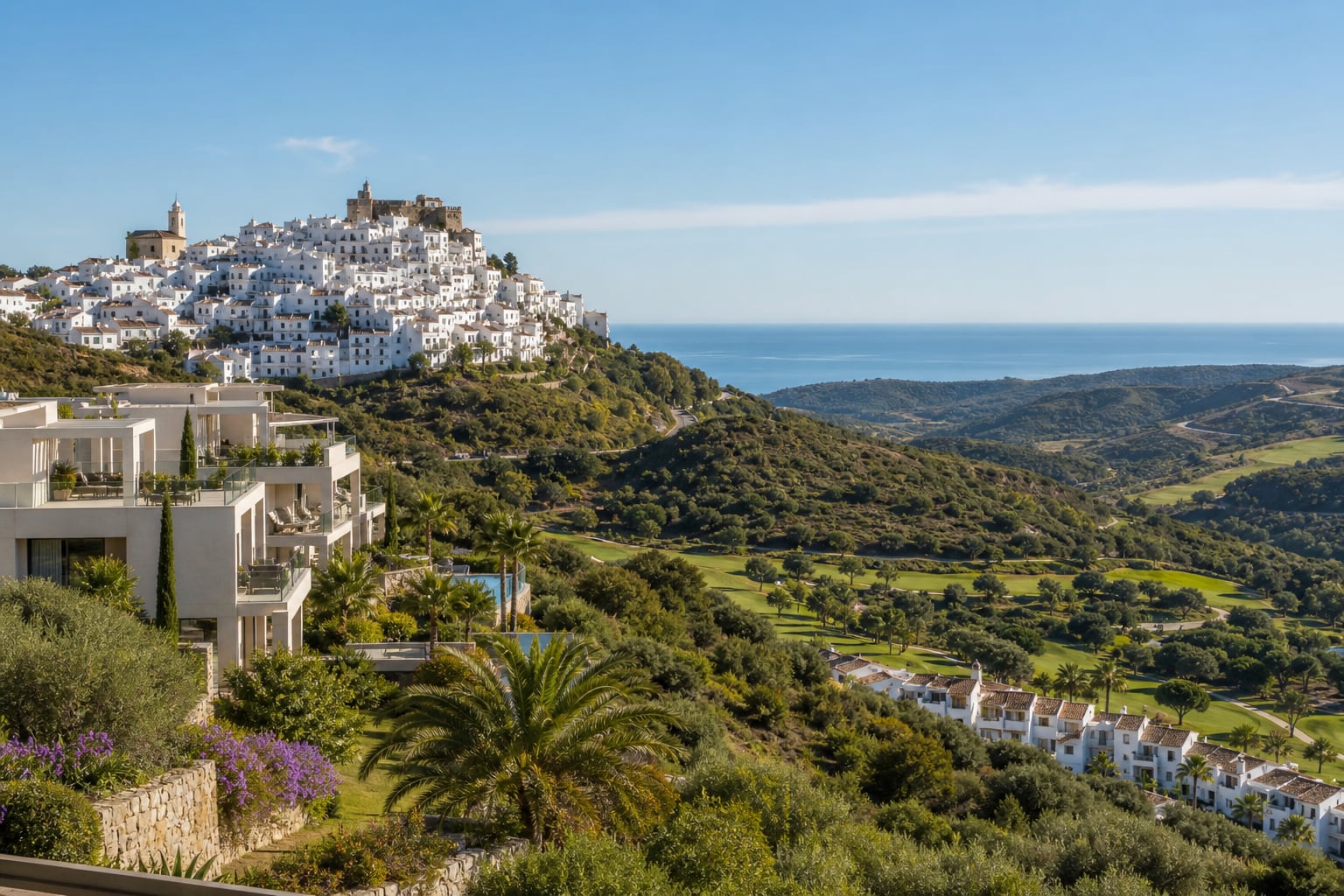
Casares n'est pas un lieu mais trois. Il y a le village blanc lui-même – un empilement de maisons blanchies à la chaux épinglées à flanc de colline sous un château maure en ruine, à quinze kilomètres à l’intérieur des terres. Il y a Casares Costa, la bande de plage, de golf et d'appartements neufs le long de l'ancienne N-340. Et entre les deux se trouve le pays de la station balnéaire, dont le pilier est Finca Cortesin, le domaine cinq étoiles qui a accueilli la Solheim Cup 2023. Pour un acheteur hors du centre de Marbella et regardant Estepona grimper, ces trois Casares constituent la question de valeur la plus intéressante sur la Costa del Sol occidentale.
La plupart des acheteurs qui recherchent la région de Marbella commencent par le centre et se déplacent vers l'ouest uniquement lorsque le nombre les y oblige. Au moment où la recherche atteint Estepona, le prix moyen demandé se situe déjà à 3 910 € le mètre carré à la mi-2025, selon Données idéalistes — plus cher que la moyenne andalouse, et toujours en hausse. Continuez encore vingt minutes le long de la côte et la carte manque de noms célèbres. Ce qui ne manque pas, c’est l’offre, le littoral, le golf ou – et c’est la partie qui mérite d’être regardée de plus près – un niveau de prix qui n’a pas encore rattrapé la qualité de ce qui est construit. Cet endroit est Casares.
Un nom, trois marchés différents
La première chose à comprendre à propos de Casares est que le nom couvre une municipalité d'environ 160 kilomètres carrés, et non un seul quartier. Elle borde Estepona à l'est, Manilva à l'ouest et le village de montagne de Gaucín à l'intérieur des terres. Sur ce territoire, il y a trois endroits distincts, et un acheteur qui les traite comme interchangeables finira par comparer les mauvaises choses.
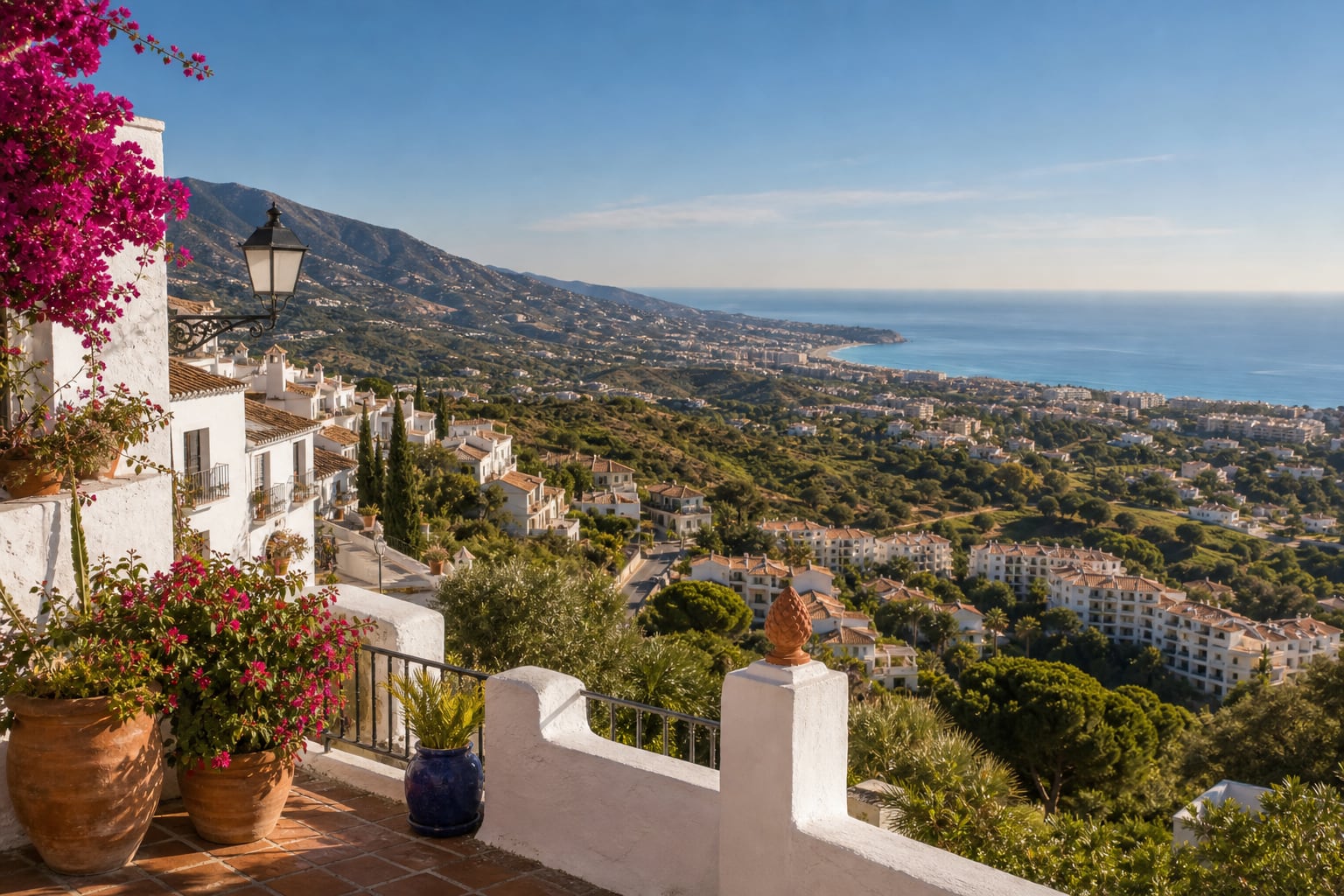
Le village blanc – Casares pueblo – est l’image qui vend les cartes postales : des maisons blanchies à la chaux empilées sous un château en ruine du XIIe siècle, accessible en tournant vers l’intérieur des terres depuis l’ancienne N-340 et en gravissant environ quinze kilomètres de route en lacets. C'est véritablement à l'intérieur des terres, véritablement un village andalou actif, et une proposition totalement différente de la côte.
Casares Costa — également indiqué comme Casares Playa — est à l'opposé : une bande côtière plate composée de plages, de golfs et d'immeubles d'appartements qui longe la mer entre Estepona et la frontière de Manilva. C’est là que se concentre l’essentiel de l’activité de construction neuve et que se retrouvent la plupart des acheteurs internationaux. D'ici c'est autour 27 minutes d'Estepona, à environ une demi-heure de Sotogrande dans la province de Cadix et à environ 40 minutes de Gibraltar — l'aéroport de Málaga est à un peu plus d'une heure à l'est.
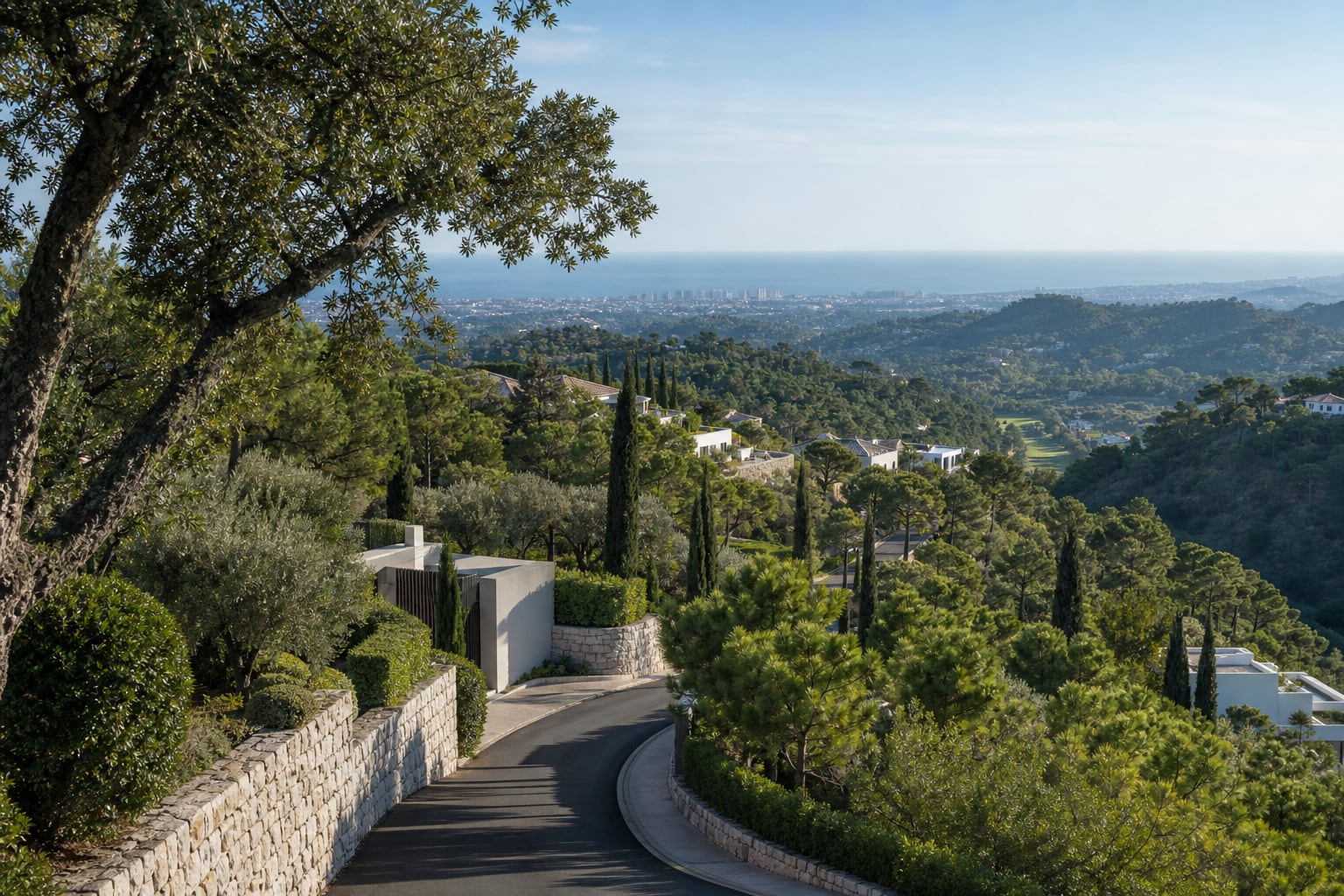
Entre les deux se trouve la ceinture de villégiature – le pays vallonné où se trouvent la Finca Cortesin et le parcours de golf Doña Julia. C'est la partie de Casares qui a le plus contribué à changer la réputation de la municipalité au cours des deux dernières décennies, et c'est là que se situe le sommet du marché local. Trois implantations, trois profils d'acheteurs, une mairie : telle est la structure à garder à l'esprit avant toute comparaison de prix.
L'écart de prix qui définit Casares
L’attrait central de Casares est, franchement, l’arithmétique. Les données du marché placent la moyenne municipale à environ 3 400 € le mètre carré en 2025 — en dessous des 3 910 € d'Estepona, et bien en dessous des adresses premium de Marbella où la revente en bord de mer atteint régulièrement cinq chiffres au mètre carré. Pour un acheteur dont la présélection a commencé sur le Golden Mile de Marbella, cet écart n'est pas une erreur d'arrondi. C'est la différence entre un compromis et un achat confortable.
Ce qui vaut la peine d’être examiné à nouveau, c’est sa direction de déplacement. Casares a été un marché tranquille pendant des années ; les prix sont restés essentiellement stables jusqu’en 2023. Puis une vague de nouveaux développements est arrivée et la municipalité a enregistré l’une des hausses annuelles les plus fortes de la province de Malaga – près de 21% en 2024, avec une croissance approchant les 30 % sur un an à la fin de l’été 2025. C’est la signature d’un marché en réévaluation plutôt que d’un marché en légère hausse.
Le contexte plus large compte ici. Comme notre analyse du Données du Triangle d’Or 2025 Comme le prévoit la demande sur la Costa del Sol occidentale, elle pousse inexorablement vers l'ouest : les acheteurs qui ne peuvent pas atteindre le plafond de Marbella se redistribuent vers Estepona, et les acheteurs qui trouvent Estepona au meilleur prix cherchent encore une ville plus loin. Casares est le prochain arrêt sur cette ligne. L’expression utilisée aujourd’hui par les agents – selon laquelle La Duquesa et Casares sont en train de devenir une extension naturelle d’Estepona – n’est pas du marketing ; c'est ce que décrivent les données de transaction.
Rien de tout cela ne rend Casares bon marché en termes absolus, et un acheteur ne doit pas s’attendre à ce qu’il se comporte comme une poubelle à bonnes affaires. Ce qu'il offre est une valeur relation: à peu près le même littoral, le même climat et le même accès au golf qu'Estepona, avec une remise qui s'est réduite – ce qui est précisément la fenêtre que les acheteurs à long terme ont tendance à rechercher.
Casares Costa : les plages, Doña Julia et la nouvelle locomotive
Pour la plupart des acheteurs internationaux, Casares signifie Casares Costa. La bande côtière dispose d'un ensemble fonctionnel de plages - Playa de la Sal, Playa de Piedra Paloma et la plage près de l'ancienne tour de guet de Torre de la Sal - adossées au parcours de golf Doña Julia, un parcours de 18 trous qui donne à la région son agrément principal et une grande partie de sa façade de propriété.
L’offre de nouvelles constructions ici est ce qui a réinitialisé les moyennes municipales. Développements actuels à Casares illustrent clairement la gamme : au point d'entrée, les appartements de deux chambres dans des programmes tels que Alcazaba Lagoon commencent à partir d'environ €335,000; les projets mixtes d'appartements et de maisons de ville coûtent environ 395 000 € à 585 000 € ; et les projets contemporains plus importants atteignent plus de 1,5 million d'euros pour les meilleurs logements de trois et quatre chambres. Les appartements de trois chambres situés dans la zone du golf de Doña Julia se négocient généralement entre 300 000 et 400 000 €.
Cette propagation est le point. Il est véritablement difficile d'acheter un appartement flambant neuf et bien spécifié de deux chambres à distance de marche d'un terrain de golf et à quelques minutes en voiture de la mer n'importe où dans le centre de Marbella pour 335 000 €. À Casares Costa, c'est un prix d'entrée normal. Le profil des acheteurs reflète cela : un mélange d'acheteurs britanniques et d'Europe du Nord, dont beaucoup achètent une base de vacances fermée et libérée ou une maison de relocalisation, qui ont fait le calcul de Marbella et ont décidé que la côte ouest offre plus de logements pour leur argent sans renoncer aux choses pour lesquelles ils sont venus.
Les compromis sont réels et méritent d’être clairement indiqués. Casares Costa n'a pas de centre-ville comme Estepona ou La Cala de Mijas - l'infrastructure sociale et commerciale est plus mince et la bande continue de se remplir. Les acheteurs qui veulent une ville espagnole accessible à pied autour d'eux devraient peser cela avec soin. Les acheteurs qui recherchent une base tranquille au bord du golf et de la plage, avec tout le reste à quelques minutes en voiture, ont tendance à trouver que l'équation joue en leur faveur.
Finca Cortesin : l'adresse qui a fixé le plafond
Si Casares Costa explique l'histoire de la valeur, Finca Cortesin explique l'ambition. Situé à travers 532 acres Situé dans un pays vallonné entre la côte et les montagnes de Casares, le domaine a ouvert ses portes en 2006 et a depuis passé des années à rassembler le genre de références qui font la réputation de toute une municipalité. Son parcours de championnat de 18 trous, conçu par Cabell Robinson, a accueilli Coupe Solheim 2023 — le plus grand événement par équipe féminine de golf — après avoir déjà organisé le Volvo World Match Play.
La station elle-même en est le point d'ancrage : l'hôtel Cortesin de 67 suites, un club de plage de 6 000 mètres carrés sur la mer et un spa qui contient ce qui est réputé être la seule grotte de neige d'Espagne. Pour un acheteur immobilier, l'importance n'est pas le nombre d'étoiles de l'hôtel mais l'impact d'une opération cinq étoiles permanente sur le terrain qui l'entoure. Il garantit la qualité des services, entretient le paysage et confère aux villas environnantes une adresse de marque qui conserve sa valeur à travers les cycles.
Les prix des villas au sein de Finca Cortesin varient généralement d'environ 3,8 M€ à près de 9 M€, selon la parcelle, la position et si la propriété fait face au golf ou offre une vue sur la mer. C'est un chiffre sérieux, mais comparez-le à La Zagaleta, le domaine fermé au-dessus de Marbella présenté dans notre Guide Benahavís et La Zagaleta, où les moyennes se situent à près de 7 000 € par mètre carré et le plafond dépasse 30 millions d'euros, et Finca Cortesin se présente comme le moyen le plus accessible d'accéder au même niveau de vie en station.
C’est la logique tranquille de Casares dans son ensemble. La municipalité dispose d'un véritable point d'ancrage de luxe au sommet - qui garantit la confiance et renforce la qualité de tout ce qui se trouve en dessous - sans les prix haut de gamme que ce point d'ancrage offrirait à vingt minutes à l'est. Un acheteur n'a pas besoin de dépenser au niveau de la Finca Cortesin pour bénéficier du fait qu'elle existe.
Le Village Blanc : histoire, restaurants et achats plus lents
À l’intérieur des terres, Casares pueblo est un achat complètement différent – et pour certains acheteurs, le plus convaincant. Le village est l'un des plus photographiés d'Andalousie villages blancs, ses maisons si étroitement empilées sous le château que l'ensemble du village apparaît comme une seule masse blanche depuis la route d'accès. C'est un site historique et artistique protégé depuis 1978 et c'est le berceau de Blas Infante, écrivain et avocat considéré comme le père du nationalisme andalou, né ici en 1885.
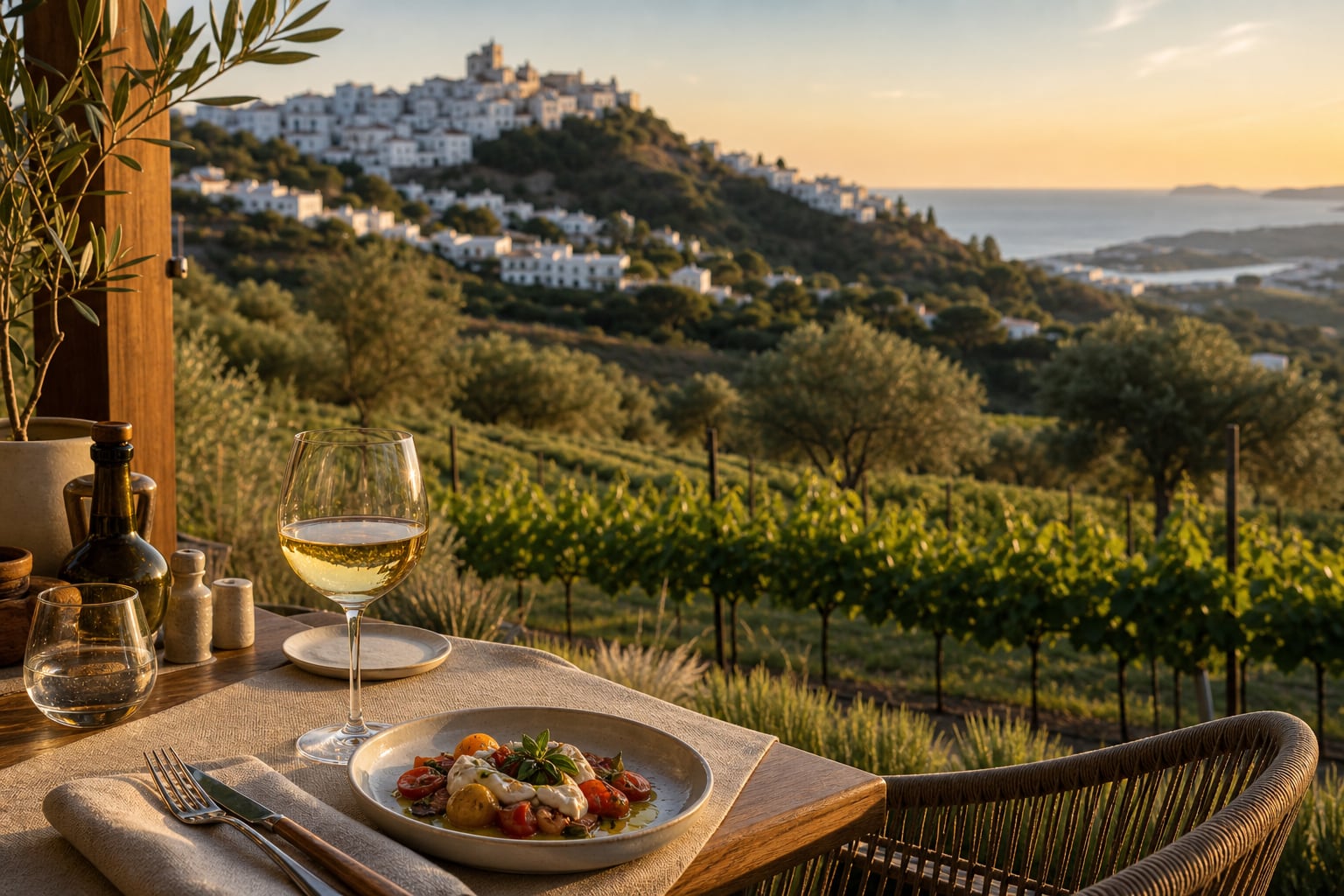
La municipalité dans son ensemble s'est considérablement développée : sa population enregistrée a dépassé 9 000 d'ici 2025, selon l'INE espagnole — mais le noyau historique lui-même ne compte encore qu'environ trois mille habitants, et cette ampleur fait partie de l'attrait. La vie du pueblo s'organise autour de la Plaza de España, où les terrasses des cafés ont remplacé ce qui n'était autrefois qu'une simple voie de passage, et autour de petits rendez-vous comme le marché du vendredi matin dans la Calle Copera. Le scène gastronomique du village est modeste et authentique plutôt que cosmopolite – les cuisines en terrasse telles que Venta El Mirador et El Cortijo privilégient la vue sur la vallée et la cuisine andalouse traditionnelle plutôt que l'ambition.
Acheter au village, c'est acheter une maison de village espagnole, de caractère, souvent étroite, parfois à rénover, et achetée à un prix plus proche des bandes basses de la commune que des nouvelles constructions côtières. Cela convient à un acheteur particulier : quelqu'un qui recherche l'authenticité et un rythme plus lent autour d'une terrasse de piscine et d'un abonnement au golf, et qui n'hésite pas à parcourir quinze kilomètres en voiture jusqu'à la plage la plus proche. Ce n'est pas une machine à louer pour les vacances. C’est un tout autre rapport au lieu.
Les deux versions de Casares partagent le climat qui attire les acheteurs sur cette côte : plus de 300 jours de soleil par an, avec des températures hivernales diurnes qui descendent rarement en dessous de 15°C. La vallée en contrebas du village abrite encore les bains de soufre de La Hedionda, datant de l'époque romaine, qui rappellent que les gens viennent ici depuis très longtemps pour le climat et l'eau.
Pourquoi Casares fait partie de la liste restreinte de 2026
Casares ne conviendra pas à tous les acheteurs et il ne faut pas prétendre le faire. Il n'a pas la reconnaissance de Marbella, le centre-ville rénové d'Estepona ou l'agitation toute l'année que certains acheteurs souhaitent spécifiquement. Ce qu'il présente, c'est un argument de valeur cohérent : un littoral et un climat impossibles à distinguer de ceux de ses voisins plus chers, un point d'ancrage de luxe crédible dans Finca Cortesin, un nouveau pipeline de construction qui démarre à des prix que Marbella ne peut tout simplement pas égaler, et une tendance des prix qui a réduit l'écart plutôt que de l'élargir.
Le conseil pratique est le conseil qui s'applique à toute ville à trois parties : décidez quel Casares vous achetez réellement avant de comparer les prix. Un appartement neuf à Casares Costa, une villa de villégiature à Finca Cortesin et un projet de rénovation dans le village blanc sont trois décisions différentes avec trois acheteurs différents – et le pire résultat est d'en choisir un tout en en achetant un autre.
Domosmar travaille sur les trois, des appartements côtiers neufs aux villas de villégiature. Parcourez le courant Annonces Casares et le plus large Portefeuille Costa del Sol pour voir ce que chaque budget garantit, et contactez l'équipe Domosmar pour une liste restreinte construite autour de comment – et où à Casares – vous souhaitez réellement devenir propriétaire.