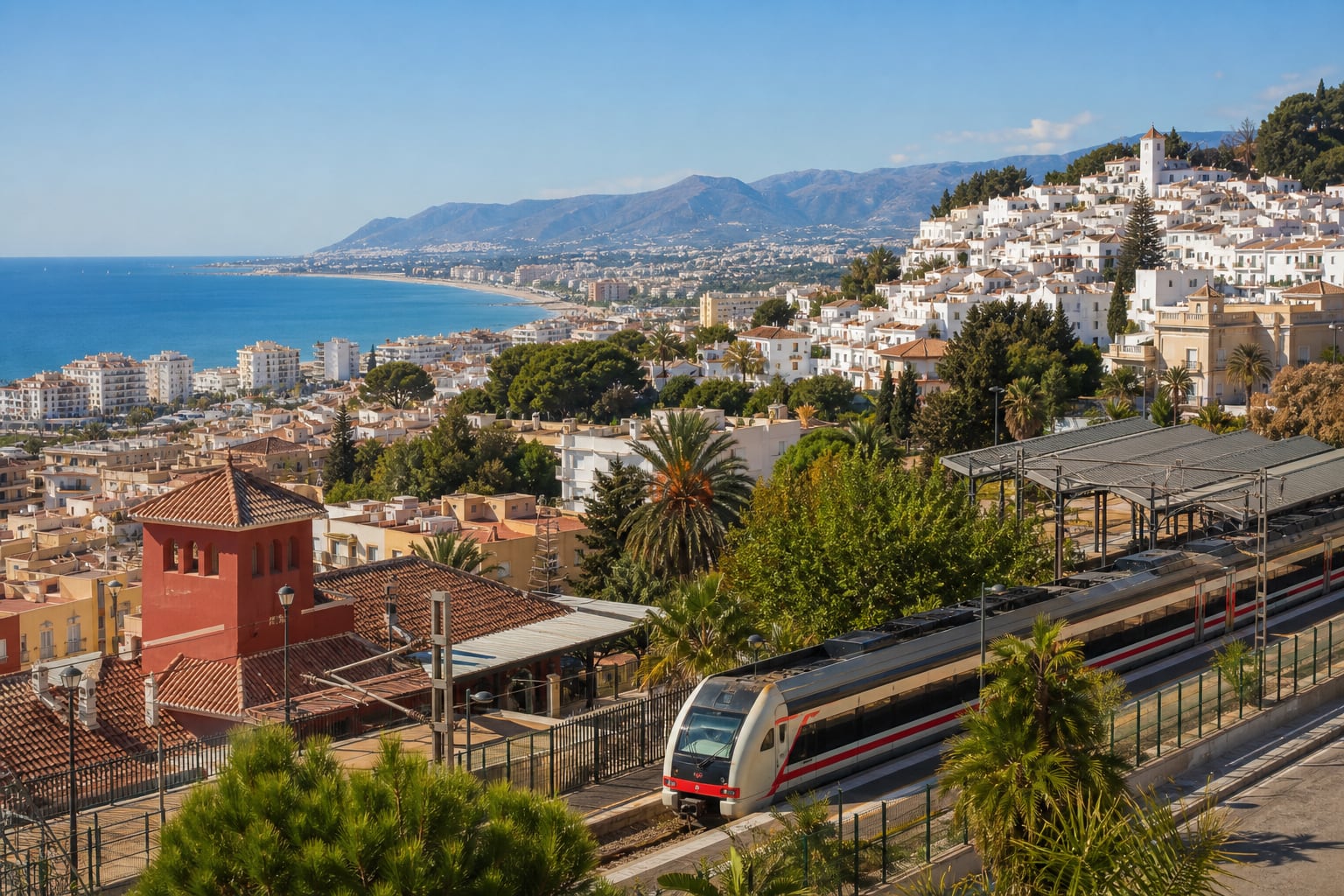
- The western Costa del Sol has a €348 million water-infrastructure investment plan. In July 2026 the European Investment Bank approved €175 million of financing, with the first €75 million tranche already signed.
- The system is built for a population that changes dramatically with the seasons. The 11 municipalities served have about 1 million residents, rising to more than 1.4 million people in summer.
- Marbella's desalination plant is back at its full 20 hm³ annual capacity after €8 million of emergency upgrading completed in 2025.
- The investment is not only about creating more water. More than 30 km of drinking-water pipelines and more than 20 km of sewer collectors are due for rehabilitation, while reclaimed-water networks are being expanded.
- The hydrological starting point is much stronger in 2026. In March, Andalucía reported every monitored system back above the threshold for normality; Mediterranean-basin reservoirs held 880.38 hm³, or 76.9% of capacity.
- Bottom line: the Costa del Sol's water story has shifted from short-term drought management towards long-term resilience — useful infrastructure for a region that continues to add residents, visitors and new homes.
The most important number behind a Marbella swimming pool this summer is not its length. It is €348 million. That is the scale of the water-infrastructure investment plan now being rolled out across the western Costa del Sol: a programme covering desalination, drinking-water pipes, sewer collectors, treatment plants, reclaimed water, storage and the connections that allow supply to move more efficiently along the coast.
The timing is significant. On 4 August 2026, in the middle of the busiest month of the year, the public water operator put another €14.52 million of projects out to tender: new sections of the bulk-water network around Marbella, almost 8 km of sewer rehabilitation between Marbella and Estepona, and planning work for a major wastewater-treatment upgrade serving Fuengirola and Mijas. A month earlier, the European Investment Bank approved €175 million of long-term financing for the wider programme.
For property buyers, this is a more interesting story than another drought headline. The Costa del Sol has come through several dry years, but in March 2026 Andalucía's drought-management committees reported every monitored system back above the threshold for normality. The response has not been to forget the problem when the rain returns. It has been to use the better conditions to build a system that is less dependent on any single source of water. In a market where Domosmar's live catalogue currently contains 305 available developments across the same 11 western Costa del Sol municipalities, that quiet investment beneath the roads matters almost as much as the cranes above them.
A €348 Million System Behind an Ordinary Tap
The western Costa del Sol water system serves a geography that is unusually demanding. Its 11 municipalities — Benahavís, Benalmádena, Casares, Estepona, Fuengirola, Istán, Manilva, Marbella, Mijas, Ojén and Torremolinos — have a combined resident population of around 1 million, according to the EIB. In summer that rises beyond 1.4 million. The infrastructure therefore has to cope not simply with population growth, but with a seasonal swing of more than 400,000 people arriving at roughly the same time that gardens, pools and public spaces are under their greatest pressure.
The investment plan approved in 2024 is designed around that reality. The EIB's €175 million loan covers roughly half of the €348 million programme, and the first €75 million tranche was signed in July. The work list is deliberately unglamorous: rehabilitate production, transport and storage systems; renew electromechanical equipment; improve wastewater plants; replace leaking or infiltrated collectors; lay reclaimed-water networks; renew more than 30 km of drinking-water pipelines; and add new storage at the Río Verde drinking-water treatment plant.
That breadth is the point. Water resilience is rarely created by one heroic project. A larger desalination plant is useful, but much less useful if the pipes carrying the water lose pressure or fail. A full reservoir helps, but only if water can be moved to where it is needed. Reclaimed water reduces pressure on drinking-water supplies, but only where the treatment and distribution network exists. The Costa del Sol is increasingly being treated as one interconnected system rather than eleven separate municipal problems.
| Infrastructure | Current scale / status | Why it matters |
|---|---|---|
| Regional investment plan | €348m; EIB financing approved for €175m | Funds a multi-year upgrade across supply, sewerage, treatment, reuse and storage |
| Marbella desalination plant | 20 hm³/year full capacity after €8m upgrade | Adds a rainfall-independent source of drinking water |
| Benalmádena–Torremolinos water highway | Approx. 6 km; €13.67m; over 50% complete by June 2026 | Improves bulk transfer and adds a parallel reclaimed-water connection |
| Pipe and collector renewal | 30+ km drinking-water pipes and 20+ km sewer collectors in the EIB programme | Reduces losses, failures and seawater infiltration |
| Río Verde storage | New head reservoir planned at minimum 100,000 m³ | Adds operational buffer to the treatment and distribution system |
Marbella's Desalination Plant Is Back at Full Capacity
The most visible insurance policy sits on Marbella's eastern side. In July 2025, the Marbella seawater desalination plant returned to its full design capacity of 20 hm³ a year after two emergency phases of work costing €8 million. One cubic hectometre is one million cubic metres, so the plant's annual nameplate capacity is 20 million m³ — arithmetically equivalent to about 54,800 m³ a day if spread evenly across a year. That is a capacity calculation, not a claim that the plant produces that amount every day.
The importance is strategic rather than theatrical. Reservoir levels can change sharply with rainfall; seawater does not disappear during a dry winter. Desalination therefore gives the western Costa del Sol a source that can be increased when conventional supplies are under stress. It is not intended to make reservoirs irrelevant. It makes the mix more resilient.
The next stage is about making that insurance policy cheaper to run. A €7.59 million energy-efficiency programme is upgrading pumps, high-pressure lines, controls and electrical systems. The target is to bring energy consumption towards 1.40 kWh per cubic metre, with the works described as reducing consumption by around 30%. The wider EIB programme also includes renewable self-generation at the plant. For a technology whose principal operating cost is energy, that is as important as adding nominal capacity.
The 'Water Highway' Is Really About Flexibility
The other big idea has an unnecessarily dramatic name: the Autovía del Agua, or water highway. It is not a new motorway. It is a high-capacity bulk-water network designed to improve the movement of supply along the coast and make individual municipalities less dependent on a single local route.
Between Benalmádena and Torremolinos, a section of approximately 6 km is being replaced with an 800 mm main pipe and additional municipal connections. The contract value is €13.67 million. In March, more than 1.2 km had been executed; by 2 June 2026 the works were reported as more than 50% complete. A reclaimed-water pipe is being installed alongside it, so the same civil works improve both potable-water security and the future ability to use treated water for appropriate non-drinking purposes.
The August tender takes the same principle further west. The published project documentation covers three new Marbella-area sections totalling approximately 11.8 km. This is the kind of infrastructure that rarely appears in a property brochure because nobody can photograph a buried pipe attractively. Yet redundancy is precisely what mature destinations pay for: if one route is interrupted, the network has more options to move water around it.
Reclaimed Water Is the Quiet Multiplier
Creating drinking water is only half the equation. The smarter question is how many jobs actually require drinking-quality water in the first place. Landscaping, some forms of public cleaning and golf-course irrigation can use appropriately treated reclaimed water instead, leaving higher-quality supplies for homes and businesses.
That is why the EIB programme explicitly includes wastewater recycling and new reclaimed-water networks. Acosol has worked with reclaimed water for more than two decades, including irrigation supply, and in April 2026 began a dedicated plan to maximise its future use. The study itself is modest — about €15,750 — but its job is to identify where treatment quality and distribution networks need to expand to unlock more reuse.
For the Costa del Sol's property market, this is particularly relevant because private outdoor space is no longer a niche feature. Domosmar's recent analysis of new-build amenities found terraces, landscaped communal areas, pools and wellness facilities spread far down the price ladder. A more developed reclaimed-water network does not give owners licence to waste water; it gives the region more ways to support the landscape and leisure infrastructure buyers value without asking the drinking-water system to do every job.
The Pipes Under the Road Matter as Much as the Reservoir
The least glamorous part of the programme may have the most immediate effect on efficiency. The EIB financing includes replacement of more than 20 km of sewer collectors affected by leaks and seawater infiltration, plus rehabilitation of more than 30 km of drinking-water pipelines. In a coastal network, keeping seawater out of sewer infrastructure matters because unnecessary infiltration increases the volume and salinity reaching treatment plants, making treatment and subsequent reuse harder.
The newest tender gives a concrete example. Nearly 8 km of sewer between Marbella and Estepona is due for rehabilitation using a lining technique that renews the inside of the existing pipe. The three packages are valued at just over €12.09 million and cover sections between Marbesa and Cabopino, San Pedro and Guadalmina, and stretches further west around Guadalmansa and El Velerín. The objective is not simply to avoid leaks; a more watertight sewer network also improves the system's ability to treat and regenerate water efficiently.
Storage is being addressed too. A project launched for the Río Verde drinking-water treatment plant specifies a new head reservoir with a minimum capacity of 100,000 m³, split into two chambers. The design contract was budgeted at €665,500. Again, this is planning-stage infrastructure rather than a completed tank, but it shows how the programme is being assembled: source, treatment, storage, transfer, distribution and reuse rather than one oversized answer to every problem.
2026 Starts From a Much Stronger Water Position
Infrastructure investment is easier to understand against the hydrological backdrop. On 13 March 2026, the Junta de Andalucía reported that every monitored exploitation system had moved above the thresholds for normality. Across the Mediterranean river basins of Andalucía, reservoirs held 880.38 hm³, equivalent to 76.9% of total capacity and almost double the volume recorded at the same point in 2025. The Costa del Sol Occidental was among the systems specifically listed as normal.
That does not make drought a historical curiosity. Southern Spain will continue to have wet and dry cycles, and the regional government itself stressed the need for responsible consumption even as restrictions eased. But there is a meaningful difference between facing the next dry period with the same infrastructure and facing it with more desalination capacity, more interconnection, better storage, lower leakage and a larger reclaimed-water network.
This is why the 2026 story is more optimistic than the drought years that preceded it. The coast is not waiting for the next emergency before spending. The works are proceeding while the system is in a healthier state, which is exactly when long-term infrastructure should be built.
What the Water Upgrade Means for Property Buyers
No sensible buyer should pay more for an apartment because a new water main is being laid ten kilometres away. There is no clean equation between a €13 million pipe contract and next year's price per square metre. Property values on the Costa del Sol are still driven far more directly by location, views, supply, international demand, build quality and the everyday appeal of the town or urbanisation.
What infrastructure does is support the platform on which those values sit. The EIB-funded system serves the same 11 municipalities in which Domosmar counted 305 available developments on 28 August 2026. Estepona alone accounted for 95 of them, Marbella and Mijas 54 each. These are live catalogue figures, not an official census of every project under construction, but they illustrate the scale of residential choice being asked to coexist with a large permanent population and an even larger summer one.
For a buyer comparing Marbella, Estepona or Mijas, the useful takeaway is therefore not "buy because of the water plan". It is that one of the region's less visible growth constraints is receiving serious capital, European financing and multi-year planning. The same logic applies to transport, electricity, schools and healthcare: a mature second-home market eventually has to invest like a permanent city, because increasingly that is what it has become.
At development level, there are still sensible questions to ask. Large landscaped schemes should be able to explain how irrigation is managed, whether reclaimed water is or can be used, and what pool and garden maintenance means for community fees. Those are ordinary ownership questions, not warning signs. The encouraging part is that the regional system behind them is becoming more diversified, better connected and more efficient.
The Costa del Sol has always sold the visible things well: sea views, terraces, golf courses, marinas and winter sun. The €348 million water programme is a reminder that the invisible things count too. A desalination plant running at full capacity, a pipe that can transfer water from one system to another, a sewer that no longer admits seawater and a reclaimed-water network that frees drinking water for higher-value uses are not glamorous property features. They are the infrastructure of a coast planning to remain attractive while accommodating more people.
For buyers, that is a constructive signal. The strongest property markets do not avoid growth pressures; they invest to manage them. The western Costa del Sol is now doing that at a scale large enough to matter.
Sources & Data Notes
Infrastructure figures are drawn principally from the European Investment Bank's 6 July 2026 financing announcement; Acosol's 4 August 2026 tender update; the July 2025 desalination-capacity update; and the Junta de Andalucía's 13 March 2026 drought-status report. Domosmar's development count is a live internal catalogue snapshot taken on 28 August 2026 and should not be read as an official census of all construction on the Costa del Sol.
Domosmar tracks new-build and resale opportunities from Benalmádena through Mijas, Marbella and Estepona to the western end of the Costa del Sol. Browse our current Costa del Sol properties or contact the team for a shortlist matched to your budget, preferred area and the way you intend to use the home.