Vers sept heures trente un mardi matin de mai, les terrains de padel de Club de Padel Los Naranjos sur l'Avenida Valle Inclán à Nueva Andalucía sont déjà pleins. Trois courts sont occupés avant que le restaurant du club n'ouvre sa terrasse à 8h30, et la file d'attente au comptoir du café est un échantillon assez fiable du quartier : des retraités britanniques et scandinaves, des familles plus jeunes dont les enfants sont à l'Aloha College à quelques minutes en voiture et des résidents espagnols de longue date qui vivent dans la Golf Valley assez longtemps pour se souvenir de l'époque où il y avait plus d'orangers que de villas. Ce n’est pas une scène du pic de l’été. C’est un mardi ordinaire du mois de mai – et c’est à cela que ressemble la routine lorsque l’on possède une propriété à Nueva Andalucía.
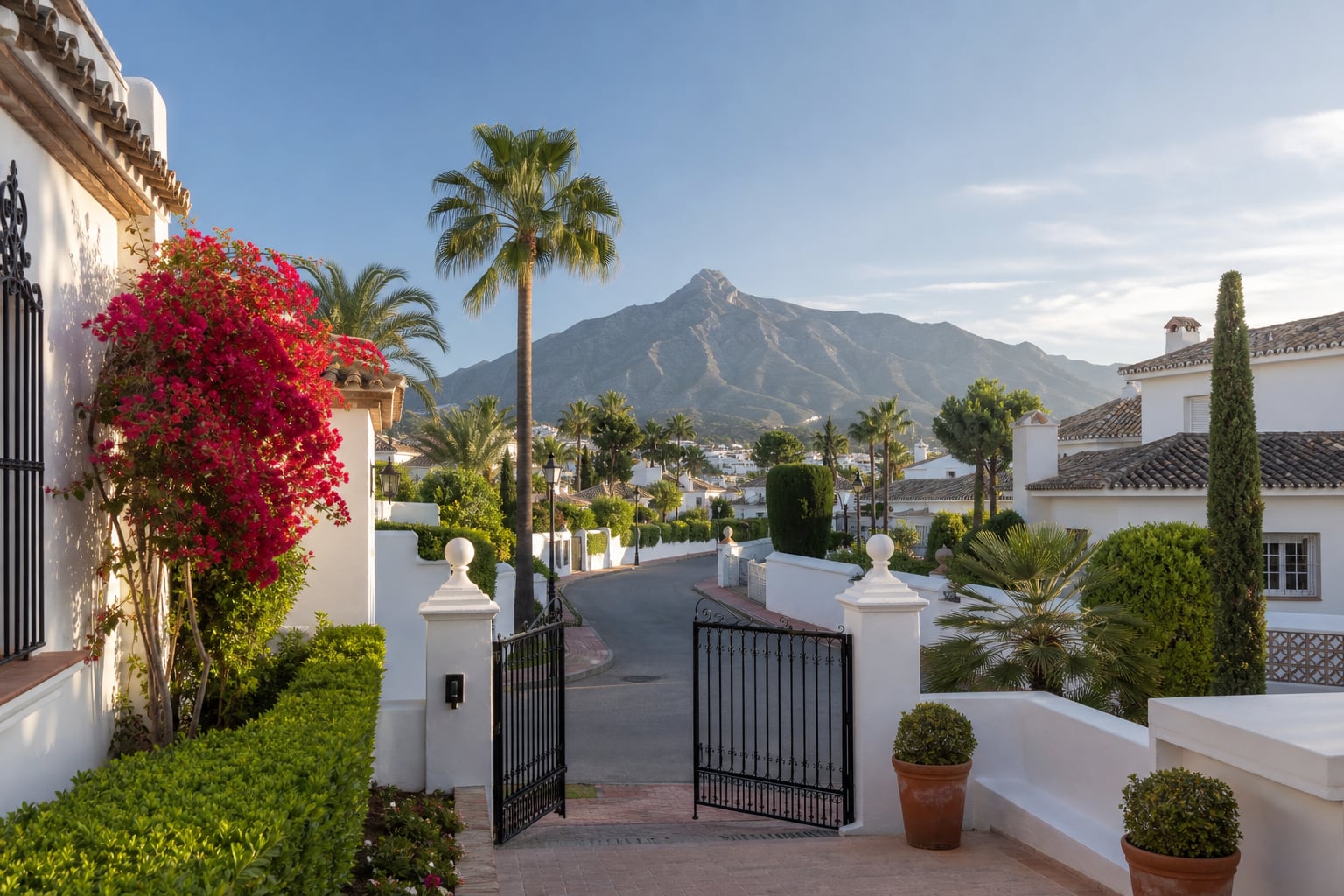
Nueva Andalucía se trouve immédiatement à l'ouest du centre-ville de Marbella, entourée par les fairways de trois des clubs de golf les plus établis de la Costa del Sol : Real Club de Golf Las Brisas, le club de golf Aloha et le club de golf Los Naranjos. La zone est commercialisée sous le label Golf Valley, une appellation géographiquement précise mais légèrement trompeuse en tant que résumé du style de vie. Le golf fait ici partie intégrante du tissu, mais il ne définit pas la semaine pour la plupart des résidents. Ce qui définit la semaine est une combinaison particulière d'autosuffisance et de proximité que le quartier a développée au cours de trente ans : son propre centre commercial, ses propres écoles internationales, ses propres installations médicales privées, ses propres restaurants et cafés – et un trajet en voiture jusqu'à Puerto Banús qui prend moins de dix minutes. Le résultat est un quartier qui fonctionne selon ses propres conditions sans se sentir éloigné de tout ce que Marbella a à offrir.
Le rythme quotidien de la Golf Valley
Le rythme matinal de Nueva Andalucía est façonné par le climat. La Costa del Sol a une moyenne d'environ 320 jours de soleil par an, et même janvier et février affichent des températures diurnes d'environ 14 à 15 °C – suffisamment fraîches pour faire de l'exercice en plein air confortablement, suffisamment chaudes pour que personne ne porte de manteau d'hiver. L'habitude d'organiser une activité physique tôt, avant que les engagements de la journée ne s'accumulent, est bien ancrée parmi les habitants de toutes nationalités, et les infrastructures du quartier se sont adaptées en conséquence. Club de Padel Los Naranjos, avec 18 courts dont quatre installations couvertes et un terrain de compétition, ouvre tôt et connaît sa plus forte fréquentation le matin. Les courts extérieurs pouvaient être réservés à partir d'environ 20 € de l'heure au cours de la saison 2025, avec des courts couverts à environ 32 € – des tarifs qui reflètent le sérieux des installations sans pour autant exclure une utilisation régulière. Le Manolo Santana Racquets Club sur l'Avenida Severo Ochoa ajoute une offre plus large : six courts de tennis sur surfaces dures, terre battue et gazon, quatre courts de padel et un centre de remise en forme complet avec piscine, se situant quelque part entre un club sportif et un centre social pour la communauté internationale.
Le golf joue un rôle plus calme mais constant tout au long de la semaine. Le Real Club de Golf Las Brisas, conçu par Robert Trent Jones et ouvert en 1968, fonctionne comme un club privé : l'accès pour les visiteurs se fait par invitation des membres ou par disponibilité limitée de temps de départ pendant des périodes spécifiques. L'Aloha Golf Club, également privé, ouvre aux clients des heures de départ sélectionnées l'après-midi entre mai et septembre. Pour les résidents membres de l'un ou l'autre club, une ronde en milieu de semaine est une affaire simple sur le plan logistique : le premier départ se trouve à moins de cinq minutes de la plupart des adresses de la Golf Valley, une ronde se termine avant le déjeuner et vous êtes de retour sur votre terrasse avec un café à une heure. Le golf, dans ce contexte, n’est pas une occasion spéciale. C’est ce que fait une partie importante du quartier le mercredi matin.
Le cœur commercial de Nueva Andalucía se concentre autour du Centro Plaza et des rues environnantes, à l'écart de la route d'accès principale. L'offre est plus pratique que glamour : supermarchés, pharmacies, agences immobilières, dentistes, banques, cafés et une concentration de restaurants qui attirent quotidiennement le commerce local plutôt que la fréquentation touristique. C'est là que l'on achète le café du matin, que l'on fait la course Mercadona le jeudi après-midi, que l'on récupère le pressing et qu'un rendez-vous avec le comptable occupe un créneau tranquille du lundi. La zone n'a pas le drame visuel de la vieille ville de Marbella ni le luxe ostentatoire de la marina de Puerto Banús, mais elle fonctionne efficacement - et le stationnement est simple, une qualité que les résidents ont tendance à apprécier plus qu'ils ne l'avaient prévu avant de s'installer ici.
Écoles, soins de santé et infrastructures pratiques
Pour les familles avec enfants, la proximité de Collège Aloha sur l'Avenida de las Palmeras est l'un des avantages pratiques les plus concrets du quartier. L'école propose un enseignement de style britannique depuis la petite enfance jusqu'au programme du diplôme du baccalauréat international et s'est bâtie une réputation bien établie au sein de la communauté internationale de Marbella pendant plusieurs décennies. Une part importante de son apport provient du bassin versant immédiat de Golf Valley, ce qui signifie que pour de nombreuses familles, l'école se trouve à cinq minutes en voiture ou à une promenade gérable par temps clair. Le calendrier scolaire façonne le rythme du quartier de manière reconnaissable : le groupe de dépôt du matin au café près de l'entrée, le calme du vendredi après-midi alors que les familles se dirigent vers la plage, le calme des juillet et août lorsque de nombreux ménages ferment leurs portes et partent pour l'été.
L'infrastructure de santé dans la région de Marbella est plus développée que ce à quoi de nombreux acheteurs s'attendent avant leur arrivée. Le secteur privé est ancré par Hôpital Quirónsalud de Marbella, situé sur le boulevard Príncipe Alfonso von Hohenlohe — à environ douze minutes du centre de Nueva Andalucía. L'hôpital dispose d'un service d'urgence 24 heures sur 24, y compris les urgences pédiatriques, avec 95 lits répartis dans six salles d'opération et une gamme complète de départements spécialisés. En 2025, Quirónsalud a considérablement agrandi son centre ambulatoire Singlehome, en ajoutant 6 500 mètres carrés d'espace de consultation spécialisée. Pour les rendez-vous de routine, la plupart des résidents utilisent le réseau de cliniques privées situées dans les zones commerciales de Nueva Andalucía, l'hôpital servant de filet de sécurité pour les situations plus urgentes. Le système de santé publique espagnol offre une option parallèle aux résidents cotisant à l'assurance maladie espagnole, l'établissement public le plus proche étant l'hôpital Costa del Sol, dans la ville de Marbella.
Que manger : du Daily Café aux étoiles Michelin
La scène des restaurants de Nueva Andalucía s'étend des bars à tapas de quartier fiables à de solides restaurants internationaux de milieu de gamme – le genre d'offre qui fait vivre une population résidentielle plutôt que touristique. Les restaurants autour du Centro Plaza et des urbanisations Golf Valley sont ouverts toute l'année, ils connaissent leurs habitués et fixent leurs prix en conséquence. Un déjeuner de trois plats avec du vin dans un restaurant du quartier de Golf Valley coûte généralement 30 à 45 € par personne — globalement comparable à un restaurant décent à Madrid ou à Barcelone, ce qui constitue en soi une donnée utile sur la normalisation des coûts quotidiens dans cette partie de Marbella. L’hypothèse selon laquelle la vie quotidienne ici comporte une prime de luxe constante ne tient pas la route une fois que vous êtes à l’intérieur du quartier plutôt que de l’observer de l’extérieur.
Lorsque la semaine exige quelque chose de plus réfléchi, les options en moins de vingt minutes sont véritablement exceptionnelles. Peau, sur l'Avenida Cánovas del Castillo dans la ville de Marbella, détient deux étoiles Michelin et est dirigé par le chef Marcos Granda. Le menu s'appuie sur des produits andalous de saison et s'accompagne d'une carte des vins de plus de 6 000 références ; la réservation est indispensable des semaines à l’avance. Au sein même de la Golf Valley, El Lago — une étoile Michelin — se trouve au bord d'un lac entouré par les collines de la région, offrant un menu créatif dans un cadre distinctif même selon les normes de Marbella. Les deux restaurants représentent un niveau de restauration auquel les résidents peuvent accéder un jeudi soir ordinaire sans concierge d’hôtel ni logistique complexe – juste une réservation effectuée suffisamment à l’avance.
La semaine alimentaire ordinaire, cependant, est ancrée dans des schémas beaucoup plus simples. La réservation Skina est le plan du vendredi. Le mardi padel est suivi d'un café à la terrasse du club. La course du supermarché du jeudi remplit le réfrigérateur pour la semaine. Certains résidents utilisent le marché bihebdomadaire situé le long de l'Avenida del Mar à Marbella pour acheter des fruits, des légumes et des produits locaux des collines de Malaga. La forme générale est celle d’une semaine ordonnée et agréablement occupée qui ne nécessite pas de planification constante – une vie qui s’écoule autour de l’infrastructure disponible plutôt que de se heurter à ses limites.
La plage et le quart de week-end
Nueva Andalucía n'est pas un quartier côtier : la plage la plus proche se trouve à environ six minutes en voiture en direction de Puerto Banús. C'est l'un des compromis envisagés par les acheteurs : le cadre de Golf Valley offre de l'espace, de l'intimité, une façade de golf et une enceinte verdoyante que les bandes côtières ne peuvent pas reproduire, mais la mer est à une courte distance en voiture plutôt qu'à pied jusqu'au bout de la route. La plupart des résidents considèrent cette distinction comme non pertinente sur le plan opérationnel. Six minutes ne constituent pas une distance significative. Les clubs de plage le long de la côte de Banús et de Marbella — Club Océan avec sa plage de 9 000 mètres carrés et sa piscine d'eau salée, Nikki Beach à l'est et une rotation de chiringuitos toute l'année le long de la Playa de la Fontanilla — se trouvent effectivement dans le rayon d'un déjeuner de quartier.
Le rythme du week-end s'écarte sensiblement de celui de la semaine. Le samedi, les résidents se dirigent vers Puerto Banús pour la promenade de la marina, le marché de producteurs qui apparaît de façon saisonnière près du port, ainsi que les terrasses des restaurants surplombant l'eau et les couchettes des superyachts. La séquence logique du week-end – padel ou golf le matin, plage à midi, long déjeuner tardif à la marina – est exécutée sans complexité de transport et sans les frais de planification que la même séquence nécessiterait pour une adresse plus éloignée à flanc de colline, plus loin dans les collines de Benahavís. En été, l'énergie nocturne de la marina se prolonge jusque tard dans la nuit, même si les résidents ayant des départs de golf précoces ou de jeunes enfants ont tendance à la considérer comme une ressource dans laquelle se plonger plutôt que comme une scène à vivre à plein temps.
Les chiffres derrière le style de vie
Comprendre le mode de vie est une chose ; comprendre le coût d’entrée en est une autre. Selon données publiées par Idealista en mars 2026, Nueva Andalucía a atteint un prix demandé moyen de 5 654 € le mètre carré en février 2026 — son maximum historique, reflétant une augmentation d'une année sur l'autre de +6.6%. Cette moyenne masque des écarts importants. Les appartements plus anciens situés dans des communautés fermées établies se négocient à des niveaux par mètre carré nettement inférieurs ; les villas de golf en première ligne de Las Brisas ou d'Aloha – les adresses les plus convoitées de la vallée – coûtent à partir de 5 millions d'euros, les constructions contemporaines récemment achevées sur ces parcelles coûtant bien plus. La propriété totale d'entrée de gamme pour un appartement en revente dans une communauté établie avec piscine commence entre 500 000 et 650 000 €, les stocks les plus récents commençant plus haut.
Le profil de l'acheteur a toujours été majoritairement international : les données des registres d'immatriculation locaux indiquent que plus de 80 % des résidents officiellement enregistrés de Nueva Andalucía sont des ressortissants étrangers, avec des communautés britanniques, suédoises, norvégiennes et belges particulièrement établies de longue date. Cela crée un environnement social anglophone que de nombreux acheteurs trouvent immédiatement accessible, réduisant ainsi la période d'adaptation culturelle qui peut compliquer une délocalisation vers d'autres régions d'Espagne. Cela explique également le développement du secteur des services locaux – avocats, comptables, gestionnaires immobiliers, spécialistes, entraîneurs personnels, architectes – qui s’est développé précisément parce qu’une base de propriété internationale l’exige. L'infrastructure suit la demande.
Les coûts de fonctionnement annuels suivent le modèle général de Marbella. L'IBI (taxe d'habitation) pour un appartement à Nueva Andalucía varie généralement de 800 € à 2 500 € par an en fonction de la valeur cadastrale. Les frais de communauté pour les complexes fermés avec piscines et jardins entretenus varient considérablement : d'environ 150 € par mois pour un petit appartement à 600 – 1 000 € par mois pour une plus grande communauté de villas avec une infrastructure partagée importante et une sécurité 24 heures sur 24. Ces coûts sont prévisibles et les services qu'ils financent – sécurité, aménagement paysager, gestion de la piscine, entretien commun – font directement partie de ce qui maintient les normes de présentation du quartier et la stabilité de la valeur des propriétés au fil du temps.
Pourquoi Nueva Andalucía fonctionne comme une décision d'achat
L’attrait de Nueva Andalucía pour les acheteurs sérieux n’est pas difficile à exprimer : c’est un quartier qui fonctionne. La Golf Valley tient sa promesse de style de vie d'une manière fondée sur la logistique plutôt que sur l'aspiration : les courts de padel sont pleins parce qu'ils sont bien gérés et accessibles, et non parce que le marketing est convaincant. Les écoles réussissent parce qu’elles le font depuis des décennies. Les restaurants restent ouverts car la population résidente les entretient toute l'année. Et la proximité de Puerto Banús et de la ville de Marbella signifie que l'accès à la côte plus large est inconditionnel, disponible à tout moment, sans le compromis de vivre à l'intérieur du noyau touristique.
Pour les acheteurs qui évaluent actuellement la région de Marbella, Nueva Andalucía représente un argument de poids en faveur du juste milieu envisagé : plus d'espace et d'intimité que le Golden Mile à un prix nettement inférieur, avec une infrastructure et un accès quotidien que des endroits plus éloignés - plus loin dans Benahavís ou vers la Sierra Blanca - ne peuvent pas reproduire à un coût comparable. Les données sur les prix racontent leur propre histoire : +6,6% sur un an jusqu'au plus haut historique de 5 654 €/m² en février 2026, soutenu par des acheteurs qui veulent comprendre à quoi ressemble la propriété à Marbella lorsqu'ils ne sont pas en vacances.
Domosmar répertorie actuellement Île Béla, un développement contemporain au cœur de Nueva Andalucía avec des appartements de deux à quatre chambres au prix de 825 000 €, dont la livraison est prévue au premier trimestre 2028. Pour les acheteurs explorant la Golf Valley plus largement, parcourir les annonces Domosmar actuelles ou parler directement avec l'équipe pour une conversation simple sur la région, le stock actuel et ce qui correspond à votre mission.