À 8 heures du matin, le premier bruit sur l'Avenida Valle Inclán à Nueva Andalucía n'est pas celui de la circulation. C’est le bruit plat et percutant d’une balle en caoutchouc contre une vitre – des dizaines d’entre elles se chevauchant – dérivant des courts du Los Naranjos Padel Club, où se déroulent les ligues matinales depuis sept heures. Couples de retraités, commerçants se pressant pour jouer avant un quart de travail, parents d'élèves qui seront de retour à leur bureau à neuf heures et demie : la Costa del Sol joue au padel comme ailleurs on boit du café, tôt et sans cérémonie.
Pour quiconque évalue une maison autour de Marbella, ce son mérite qu’on y prête attention. Le padel n’est pas un engouement passager importé d’un endroit à la mode. Il s’agit, dans un sens réel, d’une invention locale – le jeu moderne a pris racine en Europe ici, sur le Golden Mile, il y a un demi-siècle – et il est depuis devenu intégré à la façon dont vit la région, à la façon dont ses propriétés sont conçues et, de plus en plus, à la manière dont les acheteurs choisissent entre un développement et un autre. C'est l'histoire de la façon dont la curiosité d'un hôtel de Marbella est devenue un facteur mesurable sur un marché immobilier sérieux.
Le sport adopté par l’Espagne – et Marbella a commencé
Le padel n'a pas été inventé en Espagne. Le mérite revient à Enrique Corcuera, un homme d'affaires mexicain qui, à la fin des années 1960, souhaitait un court de tennis chez lui mais n'avait pas la place pour un tel. Il a muré un espace plus petit, a laissé la balle rebondir sur les murs arrière et latéraux et a remis à ses amis des battes courtes et sans fil. Le résultat était plus rapide, plus social et beaucoup plus facile à apprendre que le tennis – un jeu dans lequel vous pourriez vous impliquer avec compétence en un après-midi.
L'un des amis de Corcuera était Alfonso de Hohenlohe, l'aristocrate qui avait ouvert le Marbella Club en 1954 et, ce faisant, avait plus ou moins fait de Marbella une station balnéaire internationale. Hohenlohe a essayé le jeu, l'a adoré et a construit en 1974 Les premiers terrains de padel d'Europe dans son hôtel du Golden Mile, ajustant les règles pour les rendre un peu plus compétitives. C'est à partir de ces deux terrains que le sport s'est répandu, d'abord dans le circuit social de Marbella, puis dans toute l'Espagne.
Cela s’est répandu parce que les bonnes personnes jouaient. Le roi Juan Carlos s'en chargea ; l'ancien champion de Wimbledon, Manolo Santana, longtemps associé au tennis sur la côte, est devenu évangéliste. En une génération, le padel est passé d’une curiosité derrière un hôtel de la Costa del Sol à un passe-temps national. Cette origine compte aujourd’hui pour un acheteur dans un sens spécifique : le padel ici n’est pas un équipement complémentaire emprunté à une brochure sur papier glacé. Cela fait partie du mobilier culturel local et cela ne va nulle part.
Où joue Marbella aujourd’hui
La concentration la plus dense de tribunaux se trouve, à juste titre, dans Nouvelle Andalousie - le coin de terre derrière Puerto Banús, longtemps connu sous le nom de Golf Valley. Los Naranjos Padel Club sur l'Avenida Valle Inclán est le point d'ancrage : avec environ 18 terrains, intérieur et extérieur, ainsi qu'un terrain d'exposition panoramique, c'est l'un des plus grands sites de padel du pays et occupé dès les premières lueurs du jour. A quelques minutes, l'Aloha Gardens Padel Club attire une forte clientèle intermédiaire et avancée, avec une académie et un espace bien-être attenants.
Le jeu ne se limite pas à Nueva Andalucía. Le Real Club Padel Marbella et le Padel Center Banús couvrent la ville et la marina ; dans Estepona, le Club de Tenis y Pádel offre des courts aux résidents et aux visiteurs ; et dans les collines, Los Arqueros Racquet Club à Benahavís et le Villa Padierna Padel Club donnent aux communautés de l'intérieur leur propre scène. La plupart des clubs fonctionnent désormais sur la même application de réservation, Playtomic, qui met en relation des joueurs de niveau similaire – et a fait tout ce qui est en son pouvoir pour que se présenter seul, sans partenaire arrangé, soit tout à fait normal.
Le coût est rarement l’obstacle. Dans les clubs locaux, une heure sur le terrain dure généralement 20€ à 28€, réparti entre quatre joueurs, avec des raquettes disponibles à la location pour quelques euros si vous n'avez pas apporté les vôtres. Les adhésions existent – le Real Club Padel Marbella, par exemple, propose des options mensuelles à partir d'environ 80 € – mais la plupart des joueurs occasionnels paient simplement par partie. Pour un ménage qui pèse les coûts de fonctionnement d’une maison sur la Costa del Sol, c’est un contraste utile : un sport véritablement intégré à la vie quotidienne qui coûte à peu près le prix d’une tournée de café pour jouer.
La dimension sociale est la partie que les chiffres ne capturent jamais vraiment. Un match de padel, c'est quatre personnes ; un club est un endroit où vous finissez par connaître vos voisins. Pour les familles qui déménagent et pour les acheteurs qui n’utiliseront une maison qu’une partie de l’année, ce réseau prêt à l’emploi est l’une des raisons les plus calmes pour lesquelles il est facile de s’installer dans la région – et plus difficile de la quitter.
Un boom que vous pouvez réellement mesurer
Rien de tout cela n’est anecdotique. Le Rapport mondial FIP Padel 2025, publié par la Fédération Internationale de Padel, a compté plus de 35 millions de joueurs actifs dans le monde et un total mondial de 77 300 tribunaux – en hausse de 15,2 % en une seule année – répartie dans 150 pays. Les clubs ont progressé de 16,1% sur la même période. L'Espagne reste le centre de gravité de tout cela, avec plus de terrains que tout autre pays et une base de participation juste derrière le football.
Marbella se situe à l’extrémité de cette courbe, et le calendrier professionnel le prouve. En juin 2026, le Coupe de réserve revient au Puente Romano Tennis Club sur le Golden Mile, à partir de 18 au 20 juin et, pour la première fois à Marbella, organiser un tableau féminin aux côtés de celui des hommes. Quelques semaines plus tard, le Málaga P1 – une étape de la tournée Qatar Airways Premier Padel – remplit l'arène Martín Carpena de Málaga, à 45 minutes de route à l'est, comme c'est le cas chaque mois de juillet ces dernières saisons.
Pour un acheteur, un calendrier de tournois est plus qu’un simple divertissement. C’est un signal que l’entraînement, le parrainage, l’infrastructure et le public sont tous en place et s’approfondissent – le même genre de signal qu’envoie un circuit de golf mature. Le padel est passé, en à peine une décennie, d'un sport à vocation régionale à un sport ayant une place fixe dans le calendrier international, et Marbella est l'une des adresses de ce calendrier.
Cela explique également pourquoi les clubs de la région continuent de se développer. La demande a toujours dépassé l’offre de terrains, c’est pourquoi de nouvelles installations ouvrent désormais avec huit ou douze terrains au lieu de deux – et pourquoi le padel a commencé à migrer des clubs autonomes vers les endroits où les gens vivent réellement.
Pourquoi les promoteurs construisent désormais des courts, pas seulement des piscines
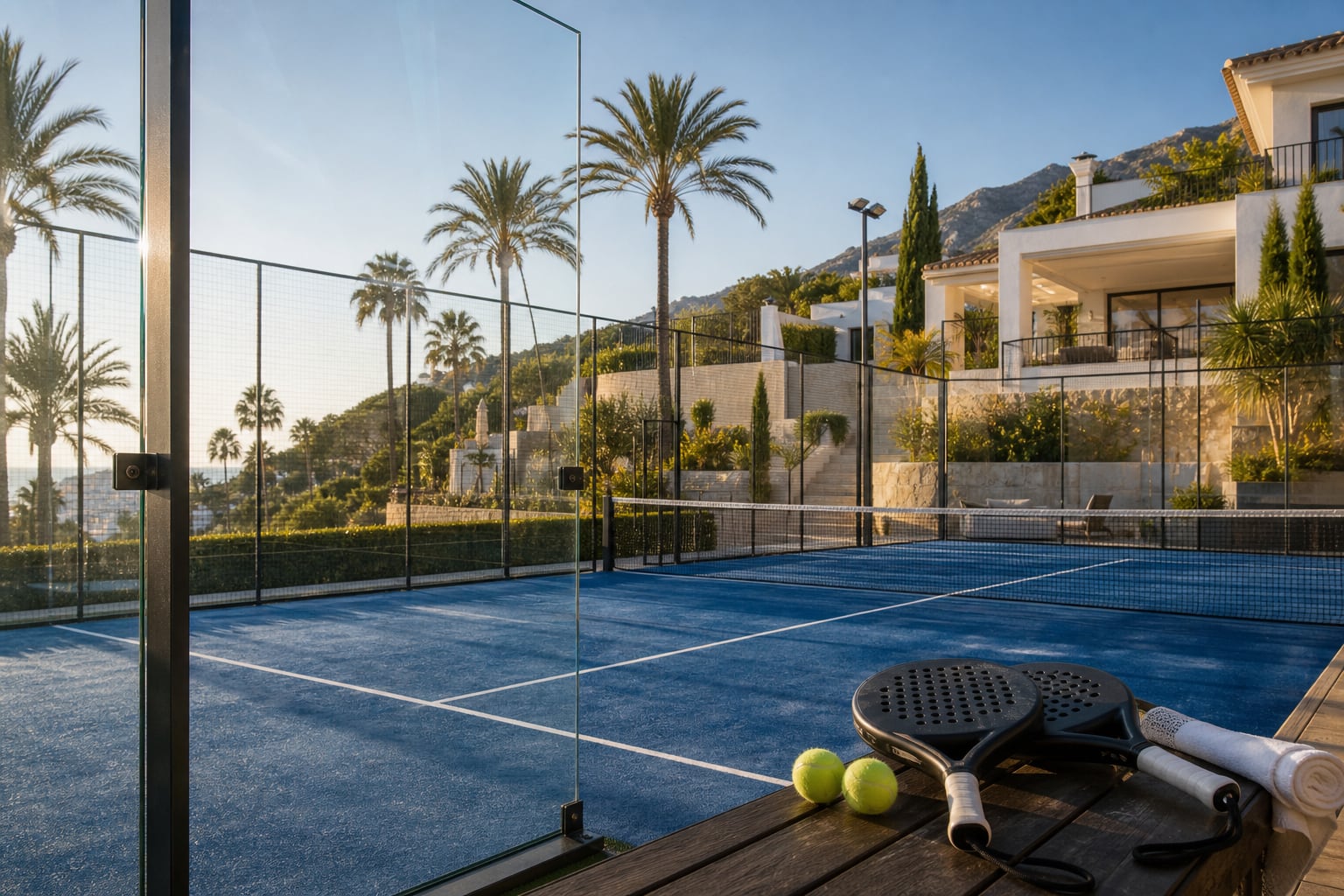
Parcourez presque tous les nouveaux projets de construction lancés sur la côte au cours des dernières années et vous trouverez un terrain de padel dans le plan directeur, assis à côté de la piscine et de la salle de sport, comme s'il y avait toujours sa place. À Estepona et le long du New Golden Mile en particulier, les développements de style complexe traitent de plus en plus un ou deux courts comme un standard plutôt que comme un fioriture - un changement évident par rapport à l'époque où une piscine commune et un carré de pelouse étaient considérés comme suffisants.
La logique est simple. Un tribunal est une ligne relativement modeste dans un budget de développement, et il fait un vrai travail : il donne aux habitants une raison de se rencontrer, il séduit les familles et les jeunes acheteurs que la côte attire de plus en plus, et il permet à une location de vacances de se démarquer sur un site de réservation. Les acheteurs ont remarqué cette tendance et beaucoup posent désormais directement la question : existe-t-il un tribunal et est-il bien entretenu ? en même temps qu'ils posent des questions sur le stationnement et l'orientation.
Cette demande s’ajoute à un marché immobilier déjà ferme. Selon données d'Idealista début 2026, Nueva Andalucía — la Vallée du Golf et le cœur de la scène padel — a atteint une moyenne de 5 654 € le mètre carré, un nouveau plus haut historique et en hausse de 6,6% sur l'année. Le Golden Mile attenant se trouvait à proximité 6 789 € le mètre carré, et le front de mer de Los Monteros, encore plus haut. Dans des zones où les prix sont élevés, un tribunal privé ou communal est rarement un tribunal à part entière qui fixe les prix ; c'est un facteur de départage - le détail qui décide entre deux maisons par ailleurs comparables.
Cela vaut la peine d’être lucide à ce sujet. Un terrain de padel ne permettra pas, à lui seul, d’effectuer un achat, et un terrain privé ajoute une ligne de maintenance que l’acheteur devrait prendre en compte honnêtement. Mais en tant que marqueur de la façon dont un développement a été conçu – pour qui il est construit, comment il attend que les gens vivent – c’est une lecture véritablement utile, et qui n’existait tout simplement pas sur la côte il y a dix ans.
Ce que cela signifie si vous achetez près de Marbella
Pour la plupart des acheteurs, la solution pratique ne consiste pas simplement à « trouver une maison avec un tribunal ». Il s’agit d’utiliser le padel comme objectif. Un projet qui a soigneusement réfléchi à un tribunal a généralement pensé au reste : à l'espace commun, à qui sont ses résidents, à ce que l'on ressent en février comme en août. Un quartier avec des clubs animés à proximité est un quartier avec une vie sociale toute l'année, ce qui est extrêmement important si la maison est destinée à un usage à temps partiel, ou à une éventuelle retraite, plutôt qu'à une seule quinzaine de jours en été.
C'est aussi un rappel de ce que la Costa del Sol offre réellement au-delà du temps et de la vue. Avec plus de 300 jours de soleil Chaque année, la région abrite une vie en plein air – padel, golf, randonnées dans la Sierra de las Nieves, navigation au départ de Puerto Banús et d'Estepona – qui s'étend sur tout le calendrier plutôt que de s'arrêter pour l'hiver. Padel est tout simplement l’ajout récent le plus visible à cette liste et celui qui a les racines les plus profondes à Marbella même.
Si vous cherchez où acheter autour de Marbella, Estepona ou Benahavís, cela vaut la peine de présélectionner en gardant cela à l'esprit. Vous pouvez parcourir les maisons neuves et en revente actuelles dans toute la région sur notre Pages de propriétés sur la Costa del Sol, ou dites-nous comment vous envisagez réellement d'utiliser la maison - à temps plein, à temps partiel, familial ou en location - et nous le ferons vous dresser une liste restreinte cela correspond à la vie que vous voulez ici, avec les tribunaux et tout.