Un mètre carré de Nueva Andalucía coûte €5,654. Sur le Golden Mile, il va jusqu'à €6,789, et le long du front de mer de Los Monteros, il a grimpé jusqu'à €8,772. Conduisez cinq kilomètres à l'ouest de Puerto Banús, traversez le Río Guadaiza, et le même mètre carré à San Pedro de Alcántara se négocie toujours à la modique somme de 5 000 €. Pour un acheteur qui souhaite une véritable ville espagnole – une rue principale en activité, une église paroissiale, un marché de rue le samedi – plutôt qu'un complexe hôtelier assemblé pour les visiteurs, cet écart de prix est l'argument principal en faveur d'un achat ici.
San Pedro n’est pas une banlieue de Marbella au sens strict du terme. C'est une ville à part entière — abritant des dizaines de milliers d'habitants toute l'année — qui se trouve à l'intérieur de la municipalité de Marbella, avec son propre centre, sa propre plage et un caractère plus proche de l'Andalousie quotidienne que du Golden Mile à quelques minutes à l'est. Au cours de la dernière décennie, elle est également devenue l'une des propositions de valeur les plus intéressantes de la Costa del Sol occidentale : suffisamment proche de Puerto Banús et Benahavís pour emprunter leurs commodités, suffisamment loin pour conserver sa propre identité et ses propres prix. Ceci est un guide de ce que cela signifie pour un acheteur en 2026 : les chiffres, les quartiers de la ville et le type de vie qu'elle soutient réellement.
L'écart de prix et ce qu'il achète
Les chiffres ci-dessus proviennent Données de prix d'idéalista pour février 2026, et ils décrivent un gradient net s'étendant d'est en ouest le long de cette partie de la côte. San Pedro de Alcántara se situe à l’extrémité abordable. L'indice Idealista place la ville à environ 5 200 € le mètre carré fin 2025, soit environ 450 € de moins que sa voisine Nueva Andalucía et près d'un quart en dessous du Golden Mile, pour une adresse qui partage les mêmes plages, les mêmes échangeurs d'autoroutes et le même parcours aéroportuaire.
Ce que cet écart permet, en pratique, c’est le choix. Le point d'entrée à San Pedro est vraiment bas pour la région : les appartements en centre-ville commencent dans la région de €200,000, un chiffre qui ne vous rapporte rien à distance de marche de Puerto Banús. Montez sur l'échelle et la répartition est large - les appartements neufs de trois chambres à quelques pas de la promenade sont répertoriés entre environ 890 000 € et 1,33 M€, tandis que les enclaves de villas à la limite ouest de la ville se comptent par millions. C'est l'un des rares endroits de la municipalité de Marbella où un premier acheteur de la Costa del Sol et un acheteur de villa avec un budget à huit chiffres font leurs achats dans le même code postal.
Pour un aperçu de ce à quoi ressemble le premium d'à côté, notre guide zone par zone du Golden Mile de Marbella cartographie un marché où les prix de revente en bord de mer ont dépassé les 15 000 € le mètre carré. San Pedro ne participe pas à cette ligue et n’essaie pas de le faire. Sa proposition est à l'opposé : une ville où le prix reflète toujours un endroit où les gens vivent toute l'année, et pas seulement un endroit qu'ils visitent en août.
Comment une autoroute enterrée a refait la ville
Pendant la majeure partie de son histoire moderne, San Pedro a été divisée en deux par la route côtière A-7, qui traversait directement le centre de la ville et séparait le centre de sa propre plage. Cela a changé lorsque l'autoroute a été transformée en un passage souterrain de deux kilomètres — des travaux qui ont débuté en 2006 et ont duré cinq ans — et un parc a été construit au sommet. Le Boulevard San Pierre ouvert en décembre 2014, couvrant quelque 55 000 mètres carrés avec six terrains de jeux, un amphithéâtre, des jardins et une piste cyclable, et couronné par une passerelle ondulante de 300 mètres - "Un Mar de Sensaciones" - par l'architecte local Juan Antonio Fernández.
L’effet était structurel et non cosmétique. La suppression du trafic de transit a permis de relier le côté plage de San Pedro au côté ville et de donner au centre une colonne vertébrale accessible à pied allant de l'église au sable. C’est la principale raison pour laquelle la ville est aujourd’hui considérée comme un lieu cohérent plutôt que comme un carrefour avec les maisons qui l’entourent – et c’est le type d’investissement public qui soutient discrètement les valeurs pendant des décennies après la coupure du ruban.
La prochaine intervention est désormais en cours sur le front de mer. UN Programme de régénération des plages de 7,4 millions d'euros, approuvé par le ministère national de l’Environnement début 2025 après un long processus de consultation publique, va remodeler 3,5 kilomètres de littoral entre les rivières Guadaiza et Guadalmina. Selon Actualités hebdomadaires de l'euro, le plan ajoute cinq nouveaux brise-lames, soit plus de 151 000 mètres cubes de sable et une promenade en bois de 2,1 kilomètres traversant les plages de San Pedro, Linda Vista et Guadalmina, sur un calendrier de construction de neuf mois. Pour tous ceux qui achètent près du front de mer, une plage plus large et mieux défendue n’est pas un agrément mineur – c’est la différence entre une bande saisonnière et une plage ouverte toute l’année.
Quatre San Pedro, quatre budgets
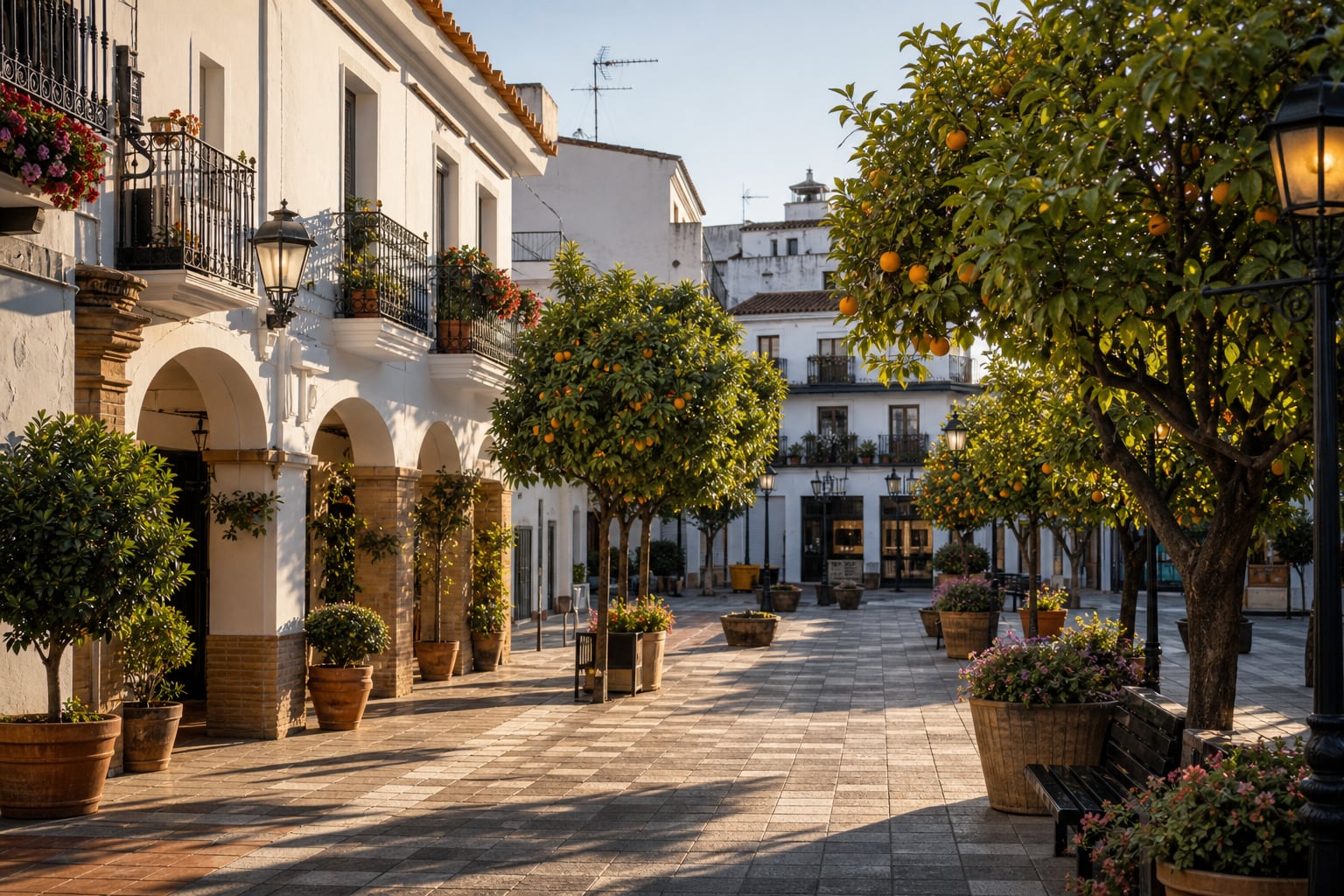
La ville est divisée en micro-marchés distincts, et le budget nécessaire varie fortement entre eux. Le centre historique, autour du Place de l'Église et son église paroissiale datant des années 1860, est la plus abordable et la plus authentiquement espagnole : un réseau étroit de rues piétonnes au large de l'Avenida Marqués del Duero — les rues principales appellent encore « Calle del Medio » — bordées de bars à tapas, de ferreterías et de cafés familiaux. C'est là que se trouvent les appartements à moins de 300 000 € et que la vie quotidienne se déroule à un rythme espagnol plutôt qu'à celui d'un complexe hôtelier.
Au sud du boulevard, le bande de plage c’est là que va la majeure partie de l’argent frais. Des projets d'appartements modernes se multiplient à quelques pas de la promenade, destinés directement aux acheteurs qui souhaitent pouvoir se verrouiller et quitter les lieux au bord de la mer. Annonce de Domosmar pour Salvia — appartements de trois chambres de 143 à 227 m² à partir de €920,000, à côté du front de mer bordé de palmiers et à quelques pas de la ville - est une bonne référence pour ce que coûte ici le produit contemporain en bord de mer.
À l'est, en direction de Puerto Banús, se trouve Nouvelle Alcántara, le quartier moderne le plus élégant de la ville – de larges avenues, des immeubles d'appartements et des maisons de ville plus récents et le campus du Laude San Pedro International College. À l'ouest, en direction d'Estepona, se trouve l'enclave prestigieuse de Guadalmina, divisé par la route côtière en deux moitiés. Guadalmina Baja, du côté de la plage, est l'une des adresses de villas de premier ordre de la région, avec des maisons individuelles typiquement de 2 millions d'euros et des maisons en première ligne de golf ou en bord de mer bien plus hautes ; Guadalmina Alta, à l'intérieur des terres, offre un espace comparable de plus près 1,2 million d'euros. Tous deux entourent le Real Club de Golf Guadalmina, dont les deux parcours de dix-huit trous, dont l'un descend jusqu'à la mer, sont le pilier du quartier depuis le début des années 1960.
Ce qu’il faut retenir en pratique, c’est que « acheter à San Pedro » peut signifier quatre transactions très différentes. Le même nom de ville couvre un appartement en centre-ville de 200 000 €, un appartement en bord de mer de 950 000 € et une villa de 4 millions d'euros derrière le golf – c'est précisément pourquoi la moyenne globale par mètre carré vous en dit moins ici que la rue spécifique.
Écoles, golf et géographie quotidienne
Pour les familles qui déménagent, l'atout le plus fort de San Pedro est l'éducation. Collège international Laude San Pedro, sur l'Avenida de la Coruña à Nueva Alcántara, est une école internationale britannique qui enseigne les programmes britannique et espagnol sur un seul campus, avec une communauté composée de plus de soixante nationalités et des parcours A-Level et Bachillerato jusqu'à l'âge de dix-huit ans. Une école de ce niveau à l’intérieur de la ville – plutôt qu’à quelques minutes en voiture – est exactement le genre de point d’ancrage qui transforme les acheteurs de vacances en résidents à l’année, et elle maintient un plancher stable sous les maisons de taille familiale à proximité.
La géographie est l’autre moitié de l’attrait. Puerto Banús est à peu près cinq kilomètres à l'est - dix minutes en voiture - mettant sa marina, ses restaurants et Golf Valley à portée de main sans payer les prix de Golf Valley pour y vivre. La vieille ville de Marbella est à environ quinze minutes ; Estepona à une distance similaire dans l'autre sens ; et le village blanchi à la chaux de Benahavís se trouve à une courte montée vers l'intérieur des terres par l'A-355. Aéroport de Malaga se trouve à environ soixante-dix kilomètres à l’est, soit confortablement moins d’une heure sur l’AP-7. Il s'agit d'une position centrale sur la côte, importante tant pour la revente que pour la demande de location.
Les golfeurs sont gâtés avant de quitter les limites de la ville — les deux parcours de Guadalmina sont à proximité — et les quatre parcours de championnat de la Golf Valley de Nueva Andalucía sont à quelques minutes, un marché que nous couvrons en détail dans notre Guide immobilier de Golf Valley. Ajoutez à cela plus de 300 jours de soleil par an sur la Costa del Sol et un centre plat et accessible à pied, et San Pedro offre la rare combinaison d'une véritable ville qui sert également de base de vacances.
Qui achète et qu'est-ce qui est construit
L'activité de construction est concentrée sur le bord de mer et à Nueva Alcántara, où les promoteurs ajoutent des programmes d'appartements contemporains destinés aux acheteurs internationaux – des projets tels que Salvia, son projet sœur Salvia 2 à partir d'environ 890 000 € et Breeze à partir d'environ 650 000 €. L'offre de nouvelles constructions ici est orientée vers les appartements et penthouses de deux et trois chambres plutôt que vers les villas trophées du Golden Mile, ce qui maintient la ville accessible à un bassin d'acheteurs plus large que la plupart des codes postaux de premier ordre de Marbella.
Le marché de la revente fonctionne en parallèle et comble les vides laissés par les nouveaux projets : des appartements plus anciens et plus grands dans le centre aux prix les plus intéressants de la ville, et des villas établies à Guadalmina et dans les rues résidentielles entre le centre et la mer. Les acheteurs qui souhaitent un état visible et un délai plus court ont tendance à se tourner vers la revente ; ceux qui veulent des normes énergétiques modernes et des paiements échelonnés pour les promoteurs se tournent vers les nouvelles constructions. Les deux sont bien représentés à quelques rues l’un de l’autre.
La composition des acheteurs constitue un différenciateur discret. San Pedro attire la même demande internationale que le reste de la côte – britannique, irlandaise, scandinave, belge et au-delà – mais elle conserve une importante population résidente espagnole qui manque aux zones de villégiature pure, ce qui donne à la ville un rythme toute l'année et un profil de location plus stable. Un centre accessible à pied, une école, une plage en cours de renouvellement actif et une occupation hivernale fiable constituent ensemble un argument de location plus solide qu'une villa qui se vide chaque mois d'octobre ; pour les chiffres sous-jacents sur ce que les propriétés de la région de Marbella rapportent réellement, notre Analyse des rendements locatifs 2026 présente l’image actuelle.
Le cas de San Pedro en 2026
Rassemblez les pièces et San Pedro de Alcántara se lit comme l'entrée financière raisonnable dans le premier triangle occidental de Marbella. Il offre une véritable ville plutôt qu'un complexe hôtelier, des prix nettement inférieurs à Nueva Andalucía et au Golden Mile, un front de mer au milieu d'une rénovation de plusieurs millions d'euros, une école internationale de premier plan et une offre constante d'appartements neufs à côté d'un marché de revente établi - le tout à cinq kilomètres de Puerto Banús. Pour les acheteurs qui ont regardé Banús ou le Golden Mile et ont hésité au calcul du mètre carré, c'est l'adresse où les chiffres recommencent à avoir un sens.
Pour voir ce qui est actuellement disponible à San Pedro et sur la Costa del Sol occidentale, parcourez notre annonces immobilières actuelles sur la Costa del Sol, ou contactez l'équipe Domosmar pour une comparaison dirigée par l'acheteur des options de construction neuve et de revente adaptées à votre budget et à votre calendrier.