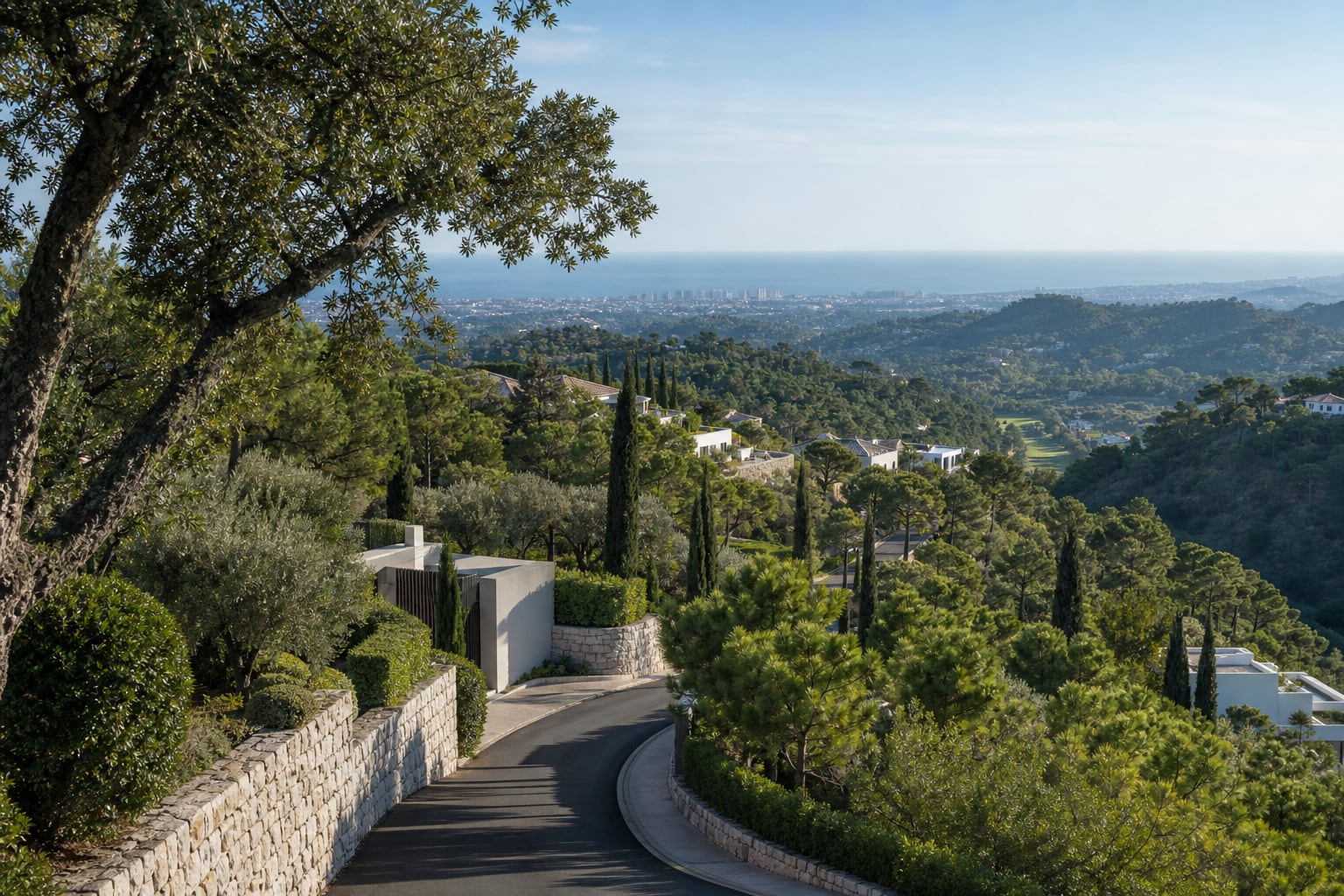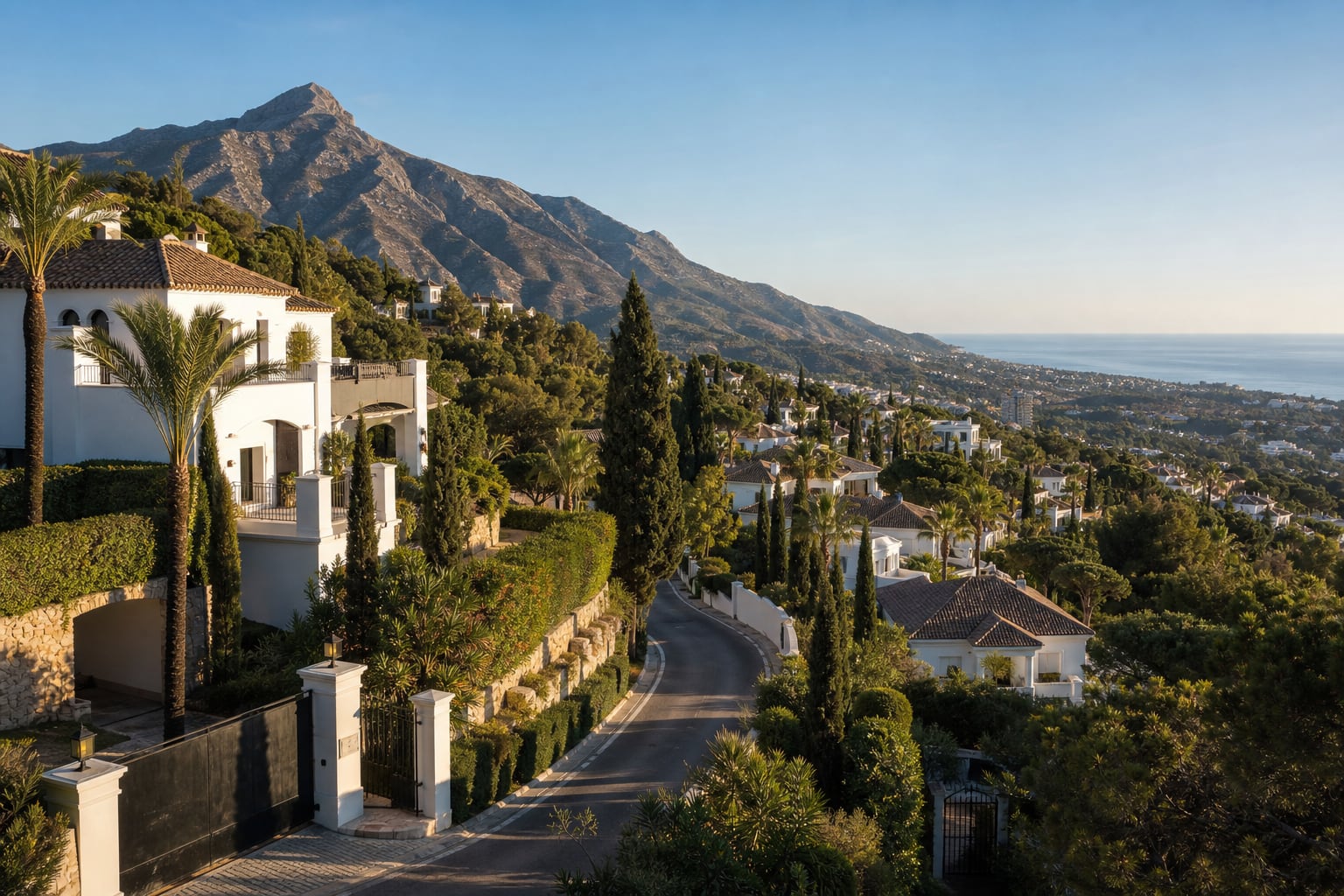
Il y a trois façons d'accéder à la Sierra Blanca et une barrière sur chacune d'elles. Les rues derrière elles portent le nom de compositeurs – Mozart, Bach, Chopin, Albinoni – et elles grimpent en un quadrillage serré sur la pente inférieure de La Concha, le pic calcaire qui donne sa toile de fond à Marbella. Il s'agit de l'adresse fermée la plus établie de la ville : environ 300 logements répartis sur 25,2 hectares, disposé sur 300 mètres d'altitude, suffisamment proche de la côte pour que presque toutes les maisons voient la Méditerranée et suffisamment haute pour s'en sentir séparées. Les agents locaux l'appellent le Beverly Hills de Marbella, et pour une fois, ce raccourci n'est pas du pur marketing.
Pour un acheteur, Sierra Blanca répond à une question spécifique : où aller à Marbella lorsque vous voulez de l'intimité, un jardin et un périmètre surveillé, mais que vous n'êtes pas prêt à renoncer aux huit minutes de route jusqu'à la plage ou à l'école du matin ? Il se trouve juste au-dessus du Golden Mile – la bande de quatre kilomètres d’hôtels, de clubs de plage et de restaurants entre la ville de Marbella et Puerto Banús – et se vend à un prix supérieur à celui de la bande située en dessous. L'agencement, les prix et le fonctionnement réel des portes méritent tous d'être examinés de plus près avant de les sélectionner.
Une grille de villas, à trois cents mètres de hauteur
La Sierra Blanca a été aménagée au début des années 1990, sous la mairie de Jesús Gil, et a pris sa forme actuelle à partir de 1995 environ sous la direction du promoteur Antonio Rodríguez, dont le quadrillage de rues la définit encore aujourd'hui. Le résultat est inhabituel pour Marbella : un quartier planifié et ordonné en interne plutôt qu'un patchwork d'urbanisations séparées que l'on trouve ailleurs sur la côte. Les maisons sont plus rapprochées que dans les grands domaines de Benahavís, mais les parcelles sont généreuses - la moyenne tourne autour 2 000 mètres carrés – et les hauts murs du jardin gardent chacun privé.
L’élévation est tout l’intérêt. À environ 300 mètres d'altitude, presque toutes les propriétés donnent sur le Golden Mile et la mer au-delà ; par temps clair, la vue atteint Gibraltar et les montagnes du Rif au Maroc. Sierra Blanca est l'une des rares parties de Marbella où vous avez une vue sur la mer depuis chaque étage de la maison. — dernier étage inclus — plutôt que seulement depuis un toit-terrasse. Le même repli de la montagne confère à la région un microclimat abrité, à l'abri des vents les plus violents et à l'abri des chaleurs estivales les plus rudes, un détail que les guides de l'agence signalent et que les résidents répètent.
Ce que vous n'abandonnez pas, c'est la commodité. Les plages du Golden Mile sont À 2,3 km, soit environ huit minutes en voiture; Le centre de Marbella est à neuf minutes ; Puerto Banús et la vieille ville sont tous deux entre dix et douze heures. Puente Romano et le Marbella Club – ainsi que les restaurants Nobu, Babette et Dani García qui leur sont rattachés – se trouvent à quatre kilomètres en bas de la colline. L'aéroport de Malaga se trouve à environ 40 minutes à l'est sur l'AP-7, tandis que Gibraltar est à environ une heure à l'ouest. L'architecture va des demeures andalouses classiques sur lesquelles la région a été construite aux modernes en verre et en béton qui se trouvent maintenant à côté ou les remplacent, mais la ligne directrice est constante : espace, intimité et orientation fixe vers l'eau.
Ce que coûte la Sierra Blanca en 2026
La Sierra Blanca se situe fermement dans un territoire à sept chiffres et souvent bien au-delà. Selon Rapport sur le marché en direct de Drumelia couvrant la période janvier 2024 à janvier 2026, le le prix de vente moyen dans la région était de 7 694 524 €, sur une superficie construite moyenne d'environ 903 mètres carrés - un en moyenne environ 7 350 € le mètre carré. Les ventes enregistrées sur cette période allaient de 1,35 million d'euros au bas de l'échelle à 17,9 millions d'euros au sommet, sur 21 transactions. La maison la plus chère jamais vendue là-bas a été évaluée par Forbes à 40 millions d'euros.
Placez-le à côté de la bande en dessous et la prime est claire. La zone Nagüeles – Milla de Oro (Golden Mile) a une moyenne 6 789 € le mètre carré en février 2026, en hausse de 6,9% sur un an, selon Données de prix d'Idealista; Nueva Andalucía était à 5 654 € et Los Monteros en bord de mer, l'actuel leader, à 8 772 €. Le chiffre mixte de Sierra Blanca se situe au-dessus de la moyenne du Golden Mile, et sa villa ultra-prime s'adresse au commerce confortablement au nord de 15 000 € le mètre carré. Vous payez pour l'élévation, le portail et le jardin, pas pour les mètres de première ligne de plage.
Les parcelles changent encore de mains, même s’il en reste peu. La terre commence à environ 1 000 € le mètre carré, et l'exemple concret de Drumelia estime le coût tout compris de la construction d'une villa de 1 200 m² sur un terrain de 2 000 m² – construction à environ 3 000 € par mètre carré, plus licences, frais et taxes – à près de 6,9 M€ avant mobilier. Pour la plupart des acheteurs, cette arithmétique plaide en faveur d'une villa existante ou d'une nouvelle construction clé en main plutôt que de partir d'un terrain brut et d'un permis de construire de deux ans.
Il existe cependant un moyen de passer en dessous des prix des villas. Un petit nombre de complexes d'appartements, parmi lesquels El Alfar, Lagos de Sierra Blanca et Balcones de Sierra Blanca, mettent le code postal à portée de main à un autre niveau : la revente de deux chambres est apparue partout €380,000, avec des unités plus grandes et des penthouses en duplex allant d'environ 800 000 € à 1,5 million d'euros. Elles constituent l'exception dans un quartier où la villa indépendante est l'unité par défaut, mais elles sont importantes pour les acheteurs qui recherchent l'adresse, la vue et la sécurité sans avoir à gérer une maison de 900 mètres carrés.
Pour mettre des visages sur ces chiffres, il est utile de voir ce que chaque budget achète. Au bas de l'échelle du marché des villas, une maison andalouse classique ayant besoin d'être rénovée a récemment été répertoriée à environ 5,5 millions d'euros; les logements modernes rénovés ou nouvellement construits avec une orientation complète vers la mer atteignent 11 à 16 millions d'euros, les annonces actuelles de Drumelia étant de 11,88 millions d'euros et 16 millions d'euros. La répartition reflète deux produits différents partageant un même code postal – les demeures originales des années 1990, dont beaucoup sont maintenant prêtes à être rénovées, et les reconstructions aux murs de verre qui fixent de plus en plus le haut de gamme de la région – et c'est la chose la plus importante à vérifier avant de visiter, car les prix demandés à eux seuls ne vous diront pas lequel des deux vous regardez.
Cascada de Camoján et la différence qu'un portail fait
Le nom « Sierra Blanca » est utilisé de manière vague, et il vaut la peine d'être précis. À proprement parler, les poches voisines telles que Nagüeles et Cascada de Camoján ne font pas partie du noyau de la communauté fermée, même si elles se trouvent juste à côté. Cascade de Camojan est une enclave distincte, encore plus discrète, située sur les pentes inférieures de La Concha, bordée par le ruisseau Arroyo Guadalpín — la « cascade » qui lui donne son nom — à environ cinq kilomètres du centre de Marbella. Quelques dizaines de grandes villas réparties sur un court trajet de rues numérotées en font l'une des adresses les plus privées de toute la municipalité, et les prix y se situent au sommet de la fourchette de la Sierra Blanca.
Il convient de comprendre en quoi tout cela diffère de l’autre nom recherché par les acheteurs, La Zagaleta. La Zagaleta se trouve sur les collines de Benahavís : un 900 hectares ancien domaine de chasse avec deux golfs privés, un héliport et un accès surveillé 24h/24 où les non-résidents s'inscrivent au portail. C'est l'option la plus exclusive et la plus isolée de la côte, et la plus éloignée de la vie quotidienne. Sierra Blanca offre le commerce inverse : un portail et une sécurité 24 heures sur 24, mais à l'intérieur de la propre municipalité de Marbella, à quelques minutes des écoles, des cliniques et de la plage plutôt qu'à une longue montée sur une route de montagne.
En pratique, les deux attirent des acheteurs qui se chevauchent mais qui sont distincts. La Zagaleta convient à ceux qui veulent un maximum de terrain, un maximum d'isolement et un domaine indépendant derrière une seule entrée gardée ; Sierra Blanca convient aux acheteurs qui veulent la porte sans l'isolement – des gens qui utiliseront en fait ces huit minutes de route jusqu'au Golden Mile plusieurs fois par semaine. Pour l'extrémité Benahavís de ce spectre, notre guide de Benahavís et de La Zagaleta le couvre en profondeur, tandis que le Guide du Mille d'Or cartographie la bande immédiatement en dessous de la Sierra Blanca.
Vivre sur la colline
Sierra Blanca est avant tout un quartier familial et les écoles en font partie. École internationale des cygnes, une école au programme britannique qui passe par le GCSE et le baccalauréat international, se trouve dans la zone elle-même ; la British International School de Marbella se trouve à quelques minutes et l'Aloha College et Laude San Pedro sont tous deux à quelques minutes en voiture à l'ouest. Pour les familles qui déménagent, ce groupe définit souvent le code postal avant qu'une seule villa n'ait été visitée : la maison suit l'école, et non l'inverse.
La sécurité est l’autre caractéristique déterminante, et c’est plus qu’une simple ligne de vente. La communauté dispose de trois entrées, chacune avec une barrière et un point de contrôle surveillé ; les déplacements sont ouverts le jour et contrôlés la nuit, avec des patrouilles 24 heures sur 24 et des systèmes de caméras qui utilisent désormais l'IA pour distinguer les résidents des visiteurs. Couché au-dessus des hauts murs et des portes des villas individuelles, c'est précisément ce que paient les familles internationales et les propriétaires à temps partiel ici. Des cliniques privées et un hôpital se trouvent à quelques minutes en voiture, et Puerto Banús — avec El Corte Inglés et les boutiques de créateurs — est à environ dix minutes en bas de la colline.
Au quotidien, la montagne est à nos portes. Le parc Nagüeles, avec ses aires de barbecue et ses sentiers forestiers, se trouve à dix minutes à pied et constitue le point de départ du sentier pour l'ascension. La Concha — le sommet de 1 215 mètres qui encadre chaque photographie de la région — est suffisamment proche pour que les résidents le considèrent comme une promenade locale plutôt que comme une expédition ; notre guide de randonnée à La Concha couvre le parcours. En bas de la colline, les clubs de plage et les restaurants du Golden Mile - La Milla, La Leña de Dani García, le centre Forum - sont à cinq minutes, et la réputation de la Costa del Sol pour environ 300 jours de soleil par an signifie que la terrasse et la piscine restent utilisables la plupart du temps.
Qui achète ici – et pourquoi cela a de la valeur
Les résidents sont internationaux par défaut – un mélange de familles européennes, moyen-orientales, scandinaves et britanniques, certaines à temps plein, d'autres à temps partiel – et cette diversité fait partie de la stabilité de la région. La demande est stable et l'offre est essentiellement fixe : avec environ 300 logements avec très peu de terrains aménageables, Sierra Blanca ne peut pas s'étendre vers l'extérieur. Le nouveau stock provient désormais presque entièrement de la démolition et de la reconstruction, ou de la rénovation lourde des demeures originales des années 1990, ce qui maintient le segment des villas modernes serré et bien enchère.
Pour un acheteur, cette combinaison – une empreinte fixe, un périmètre fermé, une vue permanente sur la mer et à huit minutes en voiture de la plage – est ce qui sous-tend les prix qui sont restés proches de leurs sommets même si certaines parties du marché au sens large se sont affaiblies. La Sierra Blanca n'est pas l'endroit où vous cherchez une bonne affaire ou un coup d'oeil rapide ; c'est là que vous achetez une maison familiale principale ou à long terme à Marbella et que vous vous attendez à ce qu'elle conserve sa valeur. Cela récompense bien plus un briefing clair et un peu de patience que la rapidité, car la bonne maison dans la bonne rue n'arrive pas souvent.
Si la Sierra Blanca ou les enclaves à flanc de colline qui l'entourent figurent sur votre liste restreinte, vous pouvez parcourir nos annonces actuelles à Marbella et sur la Costa del Sol ou parlez à l'équipe Domosmar pour une vue personnalisée de ce qui est disponible, sur et hors marché, dans ce coin de Marbella.