Charles de Gaulle finished part of his war memoirs in a stone hunting lodge in the Sierra Blanca, a fifteen-minute drive above the white village of Ojén. The building — El Refugio de Juanár — was raised in 1906 as the hunting lodge of the Marqueses de Larios, the family that built much of industrial Málaga, and it has fed monarchs, presidents and Spanish prime ministers in the decades since. It is still a working restaurant, reached by a five-kilometre tarmac road that climbs off the Ojén bypass into pine and holm-oak forest, and it is still where people in Marbella go when they want venison rather than turbot, mountain cool rather than beach heat, and a lunch that has nothing whatever to do with Puerto Banús.
This is the other Costa del Sol — the one that starts about ten minutes inland and almost no brochure mentions. Behind the seafront towers and the beach clubs, a string of white villages sits in the folds of the Sierra Blanca and the Sierra de las Nieves: Ojén, Istán, Monda, Tolox, Guaro. Each has its ventas — the roadside country restaurants where Andalusian families have eaten for generations — and increasingly each has buyers from the coast looking for something quieter, greener and a good deal cheaper per square metre than the Golden Mile. The food is the way in. Understand where Marbella actually eats on a Sunday, and you understand a property market that the seafront listings never quite explain.
A hunting lodge in the Sierra Blanca
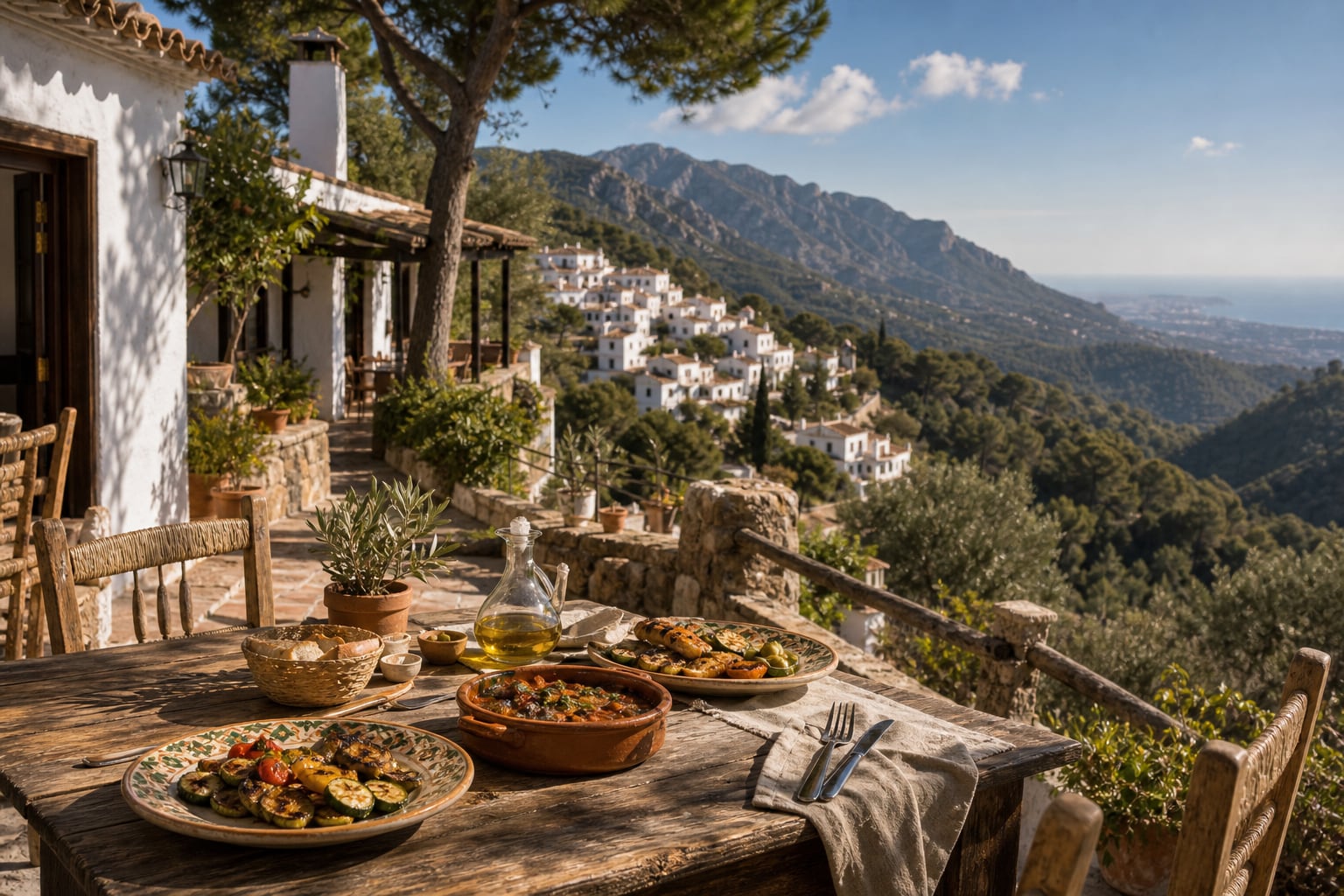
Juanár sits in a high bowl of forest between Ojén and Monda, at the foot of the limestone ridge that runs west from La Concha. The drive up is the point as much as the destination: the road leaves the village, switches back through cork oak and pine, and arrives at a low whitewashed building with a courtyard, a fireplace that runs through winter, and a dining room that has changed very little in decades. The Diputación de Málaga lists it among the province's distinguished establishments, which is the polite Spanish way of saying it is an institution.
The kitchen does one thing seriously: game. Partridge in escabeche, rabbit, quail a la cazadora, pheasant, and — the dish people drive up for — venison loin braised in sweet Málaga wine. In the autumn and winter hunting season the menu extends to wild goat from the surrounding sierra. None of this is fashionable cooking; it is the older Andalusian larder, the food of the mountains rather than the sea, and it is almost impossible to find on the seafront. A full meal here lands well below the prices of a Golden Mile beach club, and the setting — pine, silence, a terrace looking down the valley — is one no chiringuito can match.
From the lodge, a walking trail climbs in about half an hour to the mirador at the Cruz de Juanár, with the whole bay of Marbella laid out below and, on a clear day, the Rif mountains of Morocco across the Alboran Sea. The lodge is the trailhead for some of the best walking in the range, the same upland country covered in our guide to hiking La Concha and the Sierra de las Nieves. Lunch at altitude after a morning on the hill is, for a certain kind of resident, the entire argument for buying inland.
What a venta actually is
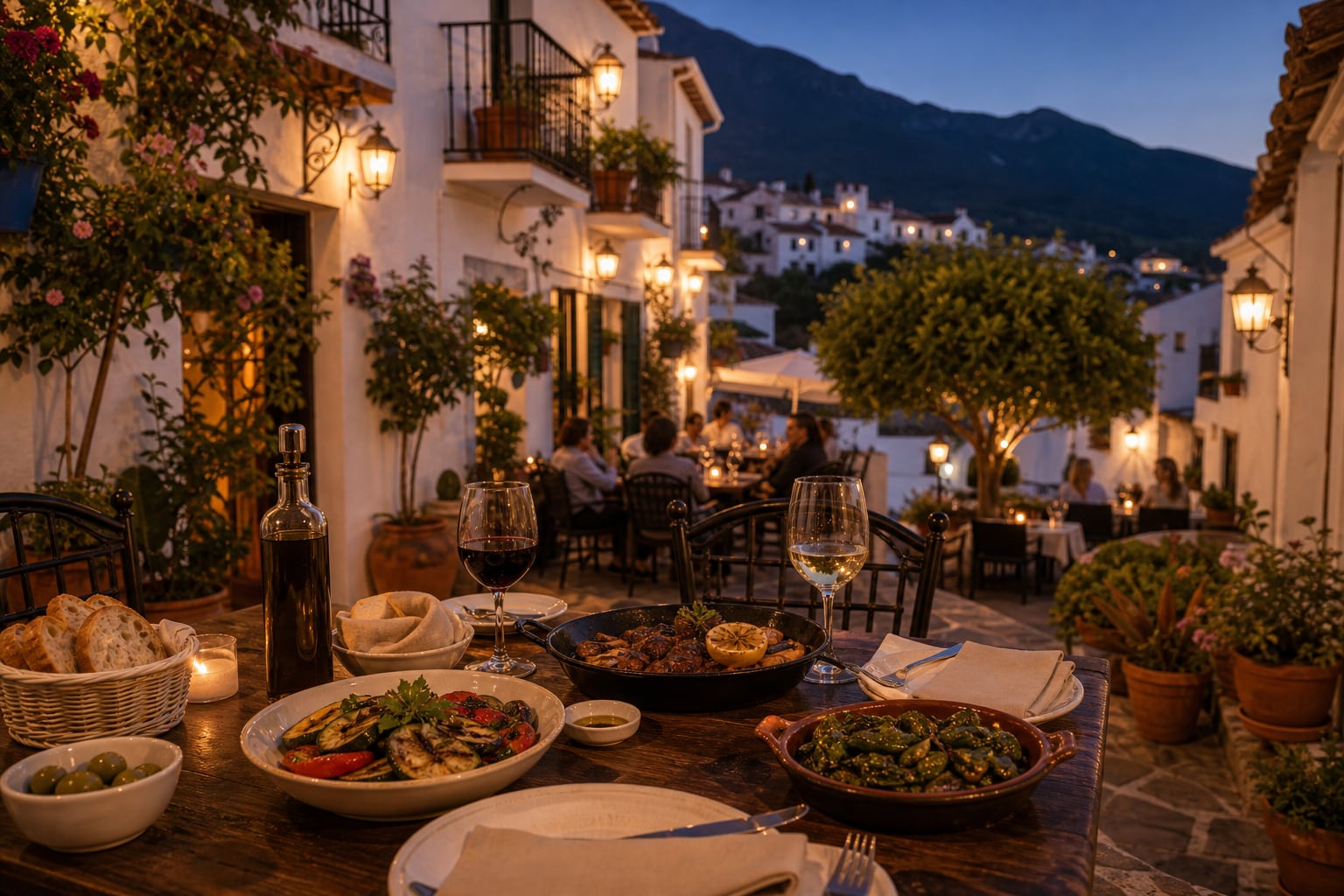
A venta is not a restaurant in the coastal sense. The word goes back to the roadside inns that fed muleteers and travellers on the old routes through the sierra, and the modern version keeps the spirit: generous, unpretentious, family-run, built around a menú del día rather than a tasting menu. You will not find a sommelier or a dress code. You will find paper tablecloths, a charcoal grill, a house wine measured by the jug, and portions sized for people who have done a day's physical work.
The clearest example sits just three and a half kilometres up the old Marbella–Ojén road. Venta El Barranco has been feeding builders, hikers and Marbella families for decades — a country house with a shaded terrace, a charcoal grill, and the kind of value that has long since vanished from the seafront. Its mixed grill for two is the stuff of local legend, and at weekends the place fills with a mix of Spanish, Colombian and international regulars, sometimes with live music. The menú del día is the test of any venta, and El Barranco passes it: three courses, bread, a drink, for the price of a single starter on the beach.
The economics are the real story. A grilled-fish lunch for two on the Golden Mile can run past €120 before wine; the same money buys a long, unhurried Sunday for a family of four at a sierra venta, with change for the drive home. For residents — as opposed to holidaymakers doing two weeks of beach clubs — this is where the week-to-week eating actually happens. It is also a reliable signal of where a place still has a living local community rather than a seasonal one, and that matters enormously when you are choosing where to own.
The villages behind the kitchens
Ojén is the closest of the inland villages to Marbella — roughly ten kilometres and twenty minutes from the seafront, set at about 200 metres of altitude where the air is noticeably cooler than the coast in August. It is a genuine working pueblo: a tight grid of white houses, a church, a couple of plazas, and a handful of bars where the village still eats. And it is dramatically cheaper than the coast. Asking prices in Ojén average around €4,000 per square metre in mid-2026 — set that against roughly €6,789/m² on the Marbella Golden Mile and €5,654/m² in Nueva Andalucía, and the inland discount is obvious. Village townhouses still trade well under half a million euros, while modern villas in the hills above Ojén reach into the millions with sea views the coast cannot offer.
Istán is the other essential name — about fifteen kilometres from Marbella, tucked into the Sierra de las Nieves above the Concepción reservoir, the body of water that supplies much of the western Costa del Sol. The village is built around its springs; locals call it the manantial, the spring, of the Costa del Sol, and water runs through fountains all over the old centre. Its Castaño Santo — the Holy Chestnut — is reckoned to be more than 800 years old, with a girth of some thirteen metres. The village has a small clutch of well-regarded local restaurants and tapas bars; the cooking is mountain Andalusian, built on olive oil, wild herbs, chestnut, goat and game.
Monda, a little further west beneath its restored hilltop castle, completes the trio. None of these villages is a resort, and that is precisely the appeal for the buyers who choose them: people who want a real Spanish setting, cooler summers, mountain walking from the doorstep, and the coast still close enough for the airport, the international schools and the beach. The catch is supply. Inland village stock is thin and turns over slowly, far less liquid than the new-build market in Marbella itself, so the right village house or hillside plot tends to need patience and quick decisions when it appears.
Game, sweet wine and the mountain larder
What the ventas cook is, in effect, a map of the sierra itself. The braising wine in Juanár's venison is no accident: the sweet wines of Málaga — Moscatel and Pedro Ximénez, protected under the Málaga and Sierras de Málaga denominations — are one of the oldest wine traditions in Spain, prized across Europe long before the coast had a single hotel. A spoonful of that dark, raisined wine reducing over game is the single most Andalusian thing on any of these menus, and it ties the kitchen directly to the hills it sits in.
The rest of the larder is just as local: olive oil from the mills around Casares and the Guadalhorce valley, chestnuts from Istán and the higher villages, goat's cheese, almonds, wild asparagus in spring, and the game that gives the whole tradition its backbone. This is seasonal, weather-driven cooking — partridge and venison in the cold months, grilled meats and salads when the heat comes — and it changes far more through the year than anything on the beach, where the menu is broadly the same in February and August. For a resident, that rhythm is part of the pleasure of living slightly inland: the table tells you what month it is.
It also reframes what proximity to Marbella is worth. A home in Ojén or Istán is twenty minutes from the Golden Mile's restaurants and beach clubs when you want them, and a world away when you don't — with a sierra venta, a charcoal grill and a jug of house red as the everyday alternative. With more than 300 days of sunshine a year across the province, the terrace season inland runs nearly as long as it does on the coast, just a few degrees cooler and a great deal quieter.
A different way to own the Costa del Sol
The inland villages are not a compromise on the Marbella lifestyle; they are a quieter, greener, more affordable version of it, with a food culture the seafront lost decades ago. Ojén, Istán and Monda put a buyer inside a working Andalusian community, at roughly €4,000 per square metre against the coast's €6,000–€8,000, with the beach, the airport and the international schools still within easy reach — and a hunting lodge serving venison in sweet Málaga wine fifteen minutes up the hill. For the right buyer, that combination is hard to beat anywhere on the western Costa del Sol.
If a quieter, mountain-side base near Marbella is the kind of home you have in mind, browse our current Costa del Sol properties or talk to the Domosmar team. We can compare inland villages against coastal alternatives, flag what little comes to market in Ojén and Istán, and help you weigh the trade-offs before you buy.