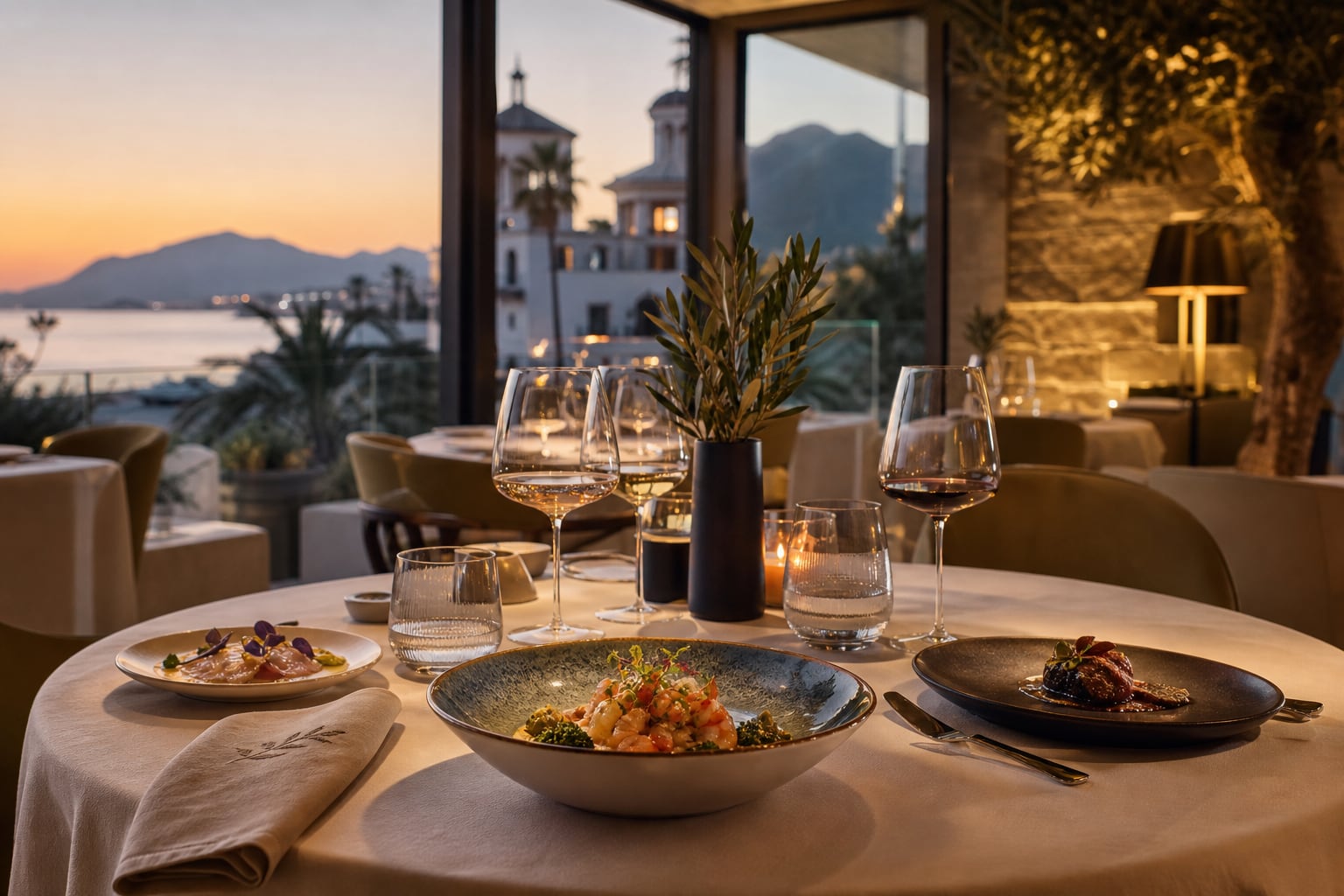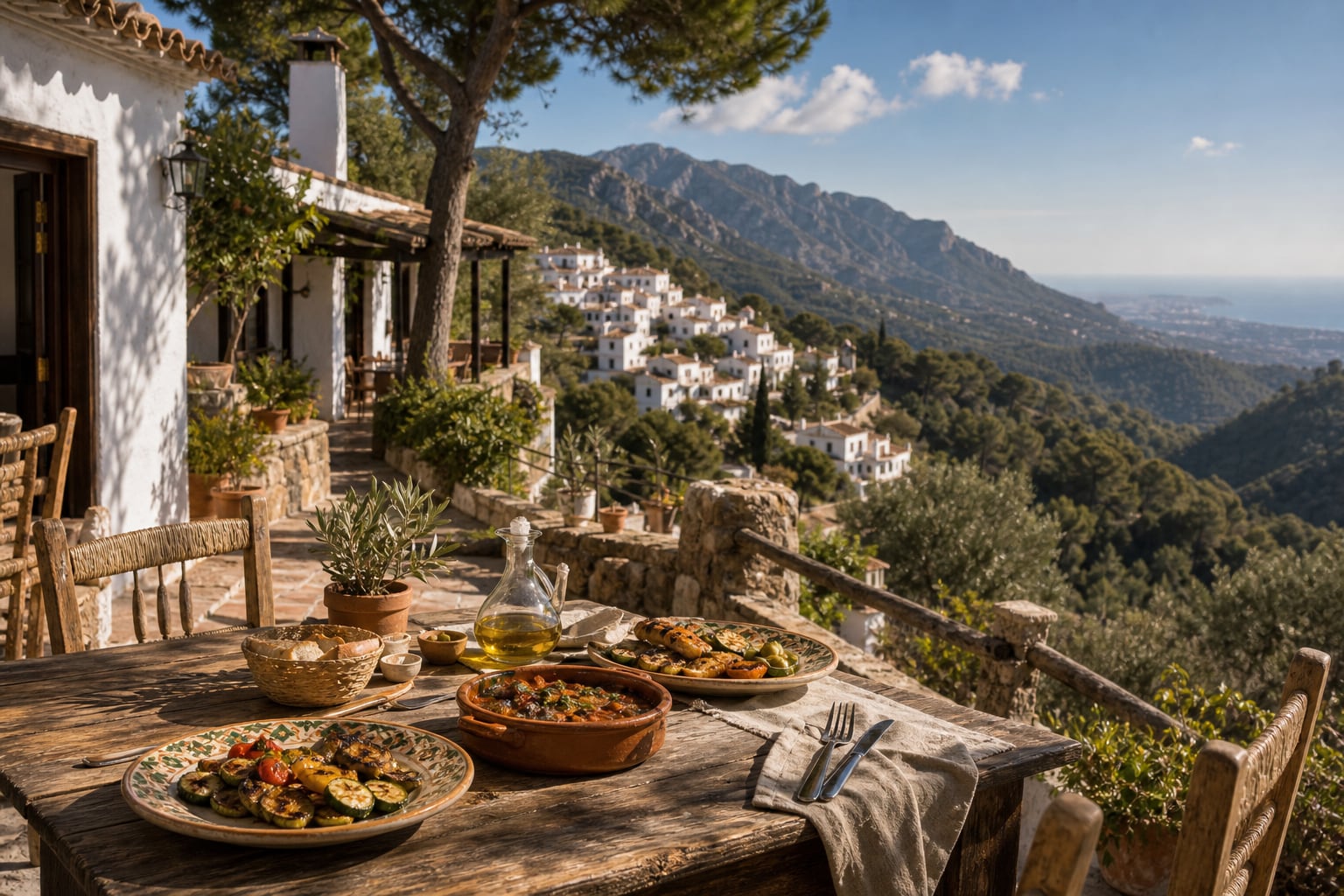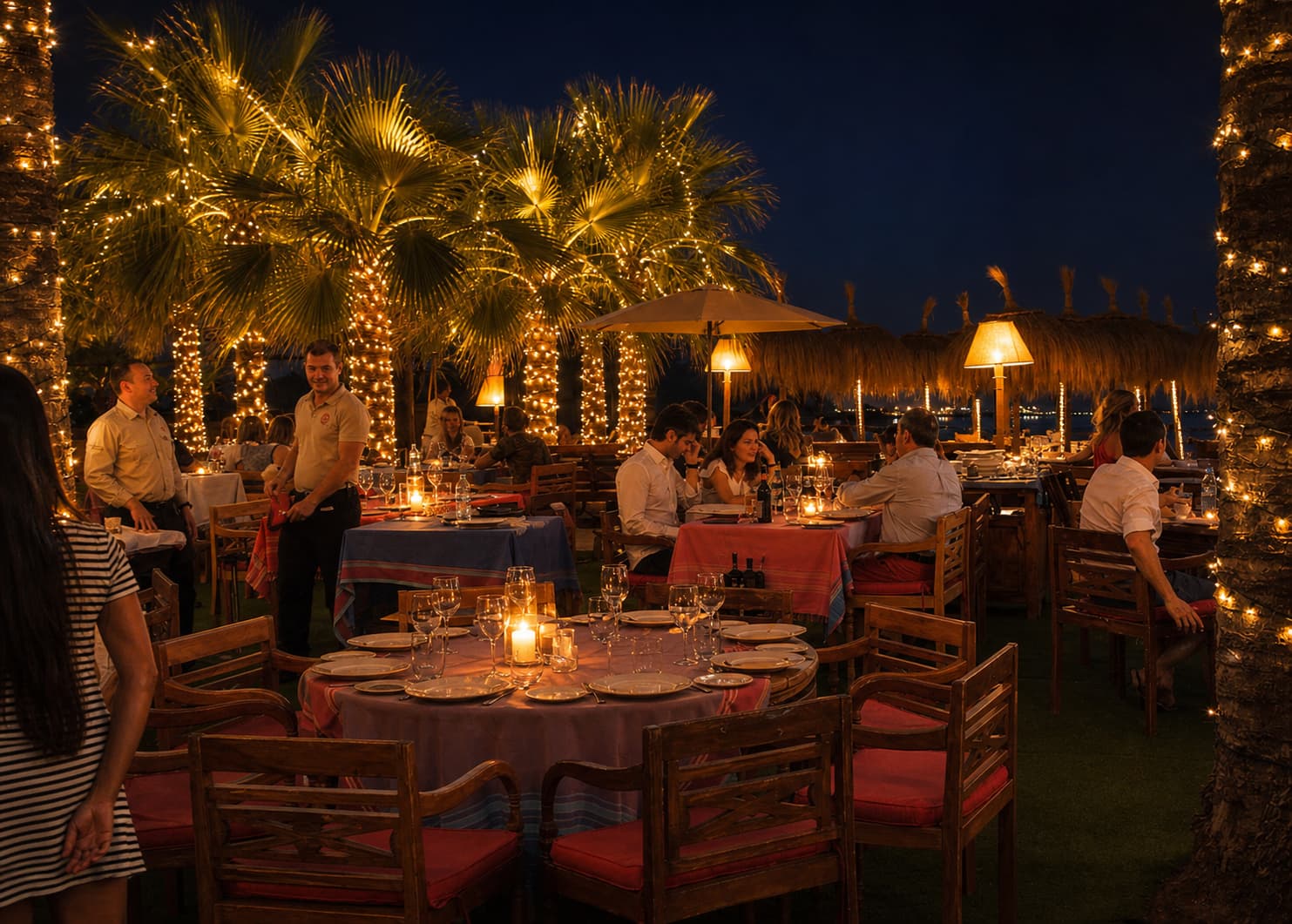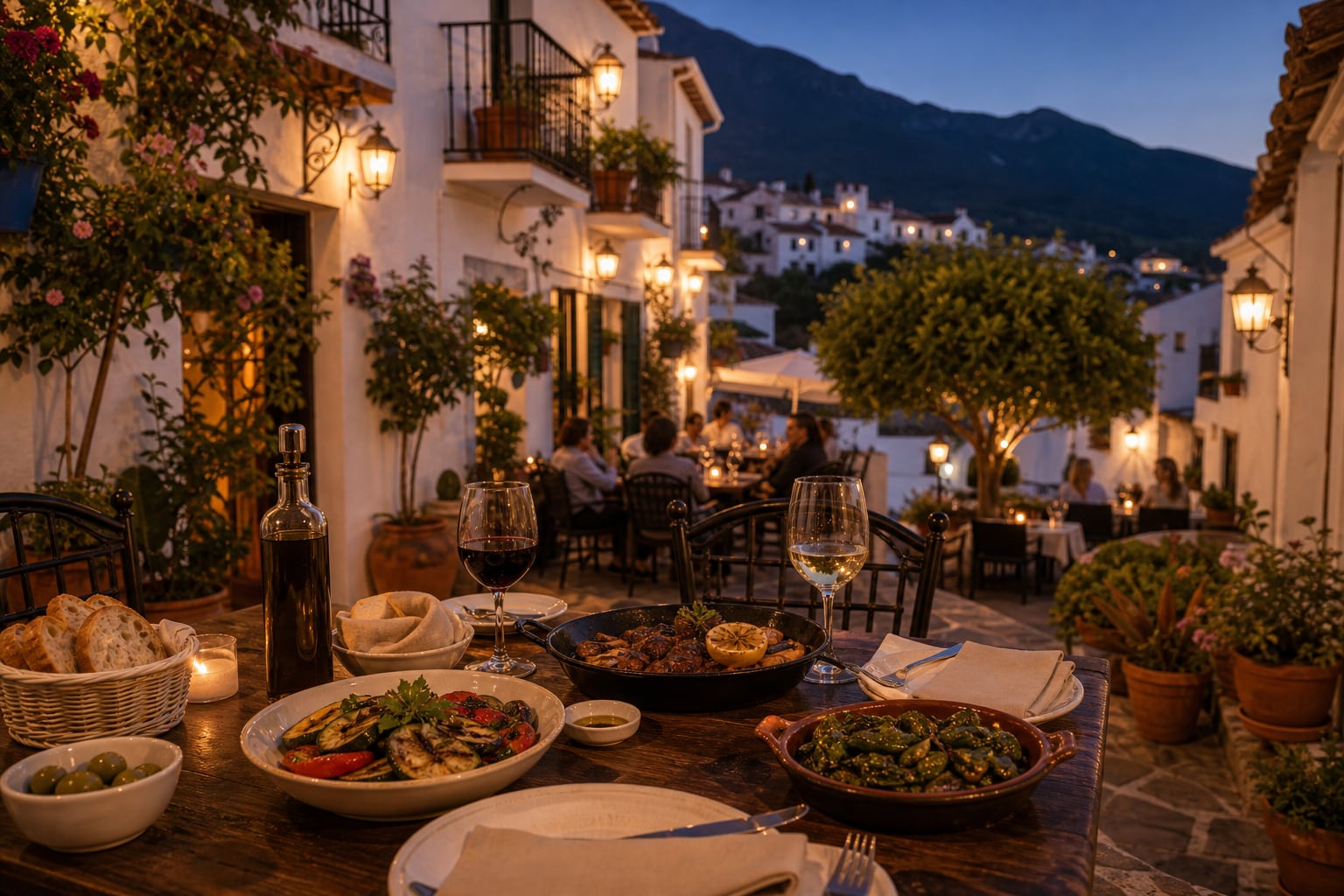
A municipality of fewer than 10,000 people keeps more than twenty well-known restaurants in business, twelve months a year, in a single mountain village reached by one road off the coast. That ratio — roughly one serious kitchen for every few hundred residents — has no real parallel anywhere else on the Costa del Sol, and it is why Andalusians who could eat anywhere between Málaga and Gibraltar so often point their cars uphill instead. Benahavís is not a beach town, a marina, or a golf resort with a good restaurant bolted on. It is a village that eats for a living.
The old centre sits at around 150 metres above the sea, folded into the lower slopes of the Serranía de Ronda, on a municipal territory larger than either Marbella or Estepona on its flanks. There is only one way up from the coast: the A-355, which leaves the motorway behind San Pedro de Alcántara and reaches the first restaurant terraces in about fifteen minutes. Málaga airport is roughly 79 kilometres and an hour''s drive to the east. That single-access geography is not a footnote. It has kept the village compact and walkable — a knot of white streets and small plazas where, unusually for this coast, the restaurants are the anchor tenants and everything else has arranged itself around them.
The village they call the frying pan of Andalucía
Drive into Benahavís and the road signs make the claim for you: this is the gastronomic corner of Andalucía. Locals have a shorter name for it — La Sartén de Andalucía, the frying pan of Andalusia — and the tourism guides tend to translate the reputation as the dining room of the Costa del Sol. The label is not marketing invention. As the long-running Andalucia.com restaurant guide puts it, the village is "renowned for its gastronomy," with a density and consistency of kitchens that a settlement this size has no obvious right to sustain.
There is a supply-and-demand explanation underneath the romance. Behind the pine ridge above the village sit some of the most expensive addresses in Spain — La Zagaleta, El Madroñal, Los Arqueros, La Quinta — along with five-star hotels such as the Westin La Quinta and the Villa Padierna Palace. That concentration of high-spending residents and guests, most of them within a ten-minute drive, has underwritten an unusually deep restaurant economy in the village below. Kitchens that would struggle for covers in a smaller town stay full here because the catchment is wealthy, year-round and hungry.
The cooking that resulted is not, for the most part, tweezered fine dining. It is generous, ingredient-led Andalusian food — much of it built on produce grown or reared within the province — served on terraces that spill into the streets on warm evenings, which on this coast means most of them. Benahavís runs to an annual mean temperature of around 17°C and shares the Costa del Sol''s tally of well over 300 days of sunshine a year, so the al fresco season is long and the village''s outdoor tables are rarely put away.
A walk down Calle Málaga
Most of the village''s kitchens sit within a few hundred metres of one another, and the densest stretch is Calle Málaga. The best-known name on it is Los Abanicos at numbers 15–17 — strings of garlic and dried peppers hanging from the beams, brightly coloured fans on the walls, and a kitchen that trades in baby squid, thick-cut steaks and slow-cooked suckling lamb rather than anything remotely haute. A few doors along, Los Faroles is one of the oldest restaurants in the village, still drawing regulars for its pepper chicken and ternera en salsa. Cross the street to Amigos at number 3, where the kitchen threads Argentinian, French and Japanese influences through a wine-focused menu.
The lanes open onto Plaza de España, where the terraces are shoulder to shoulder. Restaurante Eugenio Las Cañas at number 5 is the family house locals send you to for rabo de toro — oxtail braised until it falls off the bone — and cordero al horno, oven-roasted lamb. On the same square, Flor de Lis works a Galician seam: octopus, seafood and northern-style meat dishes on a terrace with a view down the valley. Away from the plaza, El Molino on Avenida de Andalucía keeps a short, ambitious card — Beef Wellington, fresh foie, steak tartare, and always a vegetarian dish of the day — open for dinner only, Tuesday to Sunday.
For something more informal there is La Torre, a bodega on Calle Castillo turning out tapas made to order beside a long wine list, and La Escalera de Balthazar on Calle El Almendro, which sends classic Mediterranean plates up to a rooftop terrace over the village. Rufinos, on Calle Montemayor, is the first restaurant you meet driving in and one of the busiest in summer — big portions, strong value, reserve ahead. Two of the most polished rooms are attached to hotels rather than the village streets: the restaurant at the boutique Hotel Amanhavís (no children under eight, by house rule) and La Veranda at the Villa Padierna Palace, reached through the Flamingos Golf estate to the south.
What actually lands on the plate
The through-line across the village is traditional Andalusian cooking treated seriously. Expect the braises the region is known for — oxtail, oven lamb, Iberian pork — alongside chilled soups in summer (gazpacho, and the thicker Cordoban salmorejo) and game in season, when partridge and venison come down off the surrounding sierra. Because the coast and its fish markets are barely fifteen minutes below, the seafood is genuinely fresh: prawns, clams and whatever the boats at Marbella and Estepona landed that morning turn up as the day''s specials.
The wine lists lean on the province''s own resurgent scene. Reds from the Sierras de Málaga DOP and the high vineyards above Ronda, an hour inland, now hold their own against the Riojas and Riberas, and the better village kitchens pour them by the glass. What Benahavís does not really do is gouge: at the traditional houses, two people can still eat three courses with a bottle for comfortably under €100, while the hotel dining rooms and the tasting-led places run higher. It is a rare thing on this coast — a food destination that has stayed largely unpretentious.
Part of the appeal is simply that you walk to all of it. In a region built around cars, gated urbanisations and resort strips, Benahavís offers the increasingly scarce experience of strolling out of your front door, choosing between twenty kitchens on foot, and walking home again. For a certain kind of resident, that alone is worth the drive up the hill.
The school that keeps the kitchens staffed
A restaurant culture this deep needs a supply of trained cooks and waiters, and Benahavís built its own. The Escuela de Hostelería de Benahavís — formally the Fundación Escuela Hispano-Árabe de la Dieta Mediterránea — was inaugurated on 5 June 2003, funded by the town hall together with the Diputación de Málaga, the Mancomunidad de Municipios de la Costa del Sol and the European Union''s INTERREG programme. From January 2006 it added a working restaurant open to the public, where students in cooking and front-of-house courses practise on real diners.
The school''s reason for being is written into the local economy. Benahavís is ringed by five-star hotels and championship golf resorts that demand skilled staff, and the foundation set out to train them locally rather than import them. In the two decades since, several hundred cooks and service staff have passed through, many going straight into kitchens in the village, the surrounding hotels or the wider province. It is the structural reason the Benahavís food scene reads as a genuine local institution rather than a tourist veneer: the talent is grown on site.
That civic investment in food is of a piece with how Benahavís presents itself more broadly — a small municipality that has consistently chosen quality of life over volume, and marketed its restaurants, its river gorges and its golf as the point of the place. For a buyer trying to read a town''s character before committing to it, a village that built and funds a catering college says something useful about its priorities.
What a dining village means for a buyer
Benahavís forms one corner of what agents and analysts call the Golden Triangle — the Marbella–Estepona–Benahavís cluster that idealista and others treat as the prime segment of the Costa del Sol. Within that triangle, Benahavís spans an enormous range. In the walkable old village, apartments typically trade in the region of €5,000 to €5,500 per square metre, putting a well-located two-bedroom home within a short stroll of every restaurant named above. Climb the ridge behind it and you reach La Zagaleta, where valuations are the highest in Spain — a spread we cover in detail in our Benahavís property guide.
The dining scene is not an incidental amenity in that calculation; for many buyers it is the amenity. A significant slice of Benahavís demand comes from people who want golf, gated privacy and mountain quiet without giving up the ability to walk to dinner — a combination the resort strips down on the coast cannot quite offer. New-build villas in the municipality on our books currently open at around €1.65 million and climb well beyond it, while the village apartments give lower-budget buyers a genuine foothold in the same postcode. In both cases, the twenty-restaurant walk is part of what the price buys.
If Benahavís is on your shortlist, the most useful next step is to spend an evening eating your way around the old centre and then look at what is for sale within walking distance of it. You can browse current homes across the municipality on our Benahavís property page or the wider Costa del Sol listings, and when you want a local read on which streets and developments actually suit the way you plan to live here, talk to the Domosmar team. We will point you toward the village, not just the view.