- Spain approved €830 million for Málaga-Costa del Sol Airport under the 2027–2031 DORA III programme on 15 September 2026; the wider expansion is expected to require roughly €1.5 billion across more than one investment cycle.
- The airport handled a record 26.76 million passengers in 2025, equivalent to about 89% of its current stated 30 million-passenger annual capacity.
- Planned annual capacity rises to 36 million passengers, while the terminal area is expected to expand from around 80,000 m² to 140,000 m².
- Traffic is still growing: 19.32 million passengers used the airport from January to August 2026, up 6.6% year on year; about 83.5% of commercial passengers on those flights were international.
- The design includes a new 987-metre non-Schengen pier with 12 boarding gates, more security and passport-control capacity, and more than 3,300 long-stay parking spaces.
- Bottom line: the expansion does not guarantee property-price growth, but it strengthens one of the Costa del Sol's most important practical advantages for international owners: frequent, scalable access to the rest of Europe and beyond.
On 15 September, Spain approved an €830 million investment programme for Málaga-Costa del Sol Airport. Two days later, the more revealing number is not the budget but the gap it is designed to close. The airport handled 26.76 million passengers last year against a stated annual capacity of roughly 30 million. In other words, one of southern Europe's most important leisure gateways was already operating at about 89% of that nominal ceiling before another record summer had finished.
That matters to property buyers because Málaga Airport is not an amenity in the usual sense. It is the piece of infrastructure that turns a home in Marbella, Estepona, Mijas, Fuengirola or Benalmádena from a distant holiday address into somewhere that can be used repeatedly through the year. The rise of the Costa del Sol weekend home has already been built on dense flight schedules. The new question is whether the airport can keep absorbing that demand without convenience being eroded by its own success.
The newly approved DORA III plan begins to answer that. It is not a promise of instant transformation, nor a reason to attach an arbitrary percentage premium to nearby property. It is something more useful: a funded, multi-year attempt to make the Costa del Sol's international gateway fit the scale of the market it now serves.
A Gateway Already Close to Its Design Envelope
The airport's recent growth has been unusually consistent. Aena recorded 26,760,549 passengers in 2025, up 7.4% from 2024, alongside 186,990 aircraft movements, up 6.9%. International traffic accounted for 22.25 million commercial passengers — just over 83% of the total commercial market. The United Kingdom alone generated 6.15 million passengers, making it by a considerable margin Málaga's largest international market.
The 2026 numbers show no obvious pause. From January through August, Málaga-Costa del Sol Airport handled 19,324,184 passengers, 6.6% more than in the same period of 2025, and 132,539 take-offs and landings. August alone brought 3.05 million passengers — an average of 98,414 people a day. International traffic grew 7.9% that month, faster than the domestic market, with 2.57 million passengers on foreign routes.
This is why the capacity figure deserves more attention than another record headline. The airport's present nominal capacity is around 30 million passengers a year. A 26.76 million result in 2025 left less than 3.25 million passengers of theoretical headroom, and traffic has continued to expand in 2026. Airports do not suddenly stop functioning when a published capacity figure is crossed, but queues, baggage systems, border control, gate availability and aircraft circulation become progressively more important. Capacity is therefore as much about preserving the quality of the journey as accommodating a larger number on a spreadsheet.
What €830 Million Is Actually Buying
DORA III covers the 2027–2031 investment period. Málaga's allocation is €830 million out of €1.267 billion earmarked for Andalusian airports — around 65.5% of the regional total. The full Málaga expansion has been put at roughly €1.5 billion, so part of the programme will extend beyond this five-year regulatory cycle. That distinction matters: the €830 million is real approved investment, but it is not the entire final cost of the finished airport.
The most visible change will be the terminal. Current terminal space of about 80,000 m² is planned to rise to roughly 140,000 m² — a 75% increase. Annual capacity is intended to move from around 30 million to 36 million passengers, a 20% uplift. Commercial space could increase by 41%, but the more important buyer-facing improvements sit in the unglamorous parts of an airport: security screening, passport control, baggage handling, aircraft stands and circulation between runway and apron.
| Measure | Today / recent level | Planned / approved direction | Why it matters |
|---|---|---|---|
| Annual passenger capacity | About 30m | 36m | More headroom for sustained route growth |
| Terminal area | About 80,000 m² | About 140,000 m² | More room for passenger processing and circulation |
| 2025 passengers | 26.76m | — | Already about 89% of current nominal capacity |
| Non-Schengen pier | Existing facilities | 987 m, 12 new gates | Supports long-haul and non-EU/Schengen flows |
| Long-stay parking | Existing provision | New building with 3,300+ spaces | Useful for frequent travellers and longer trips |
| DORA III investment | 2027 start | €830m through 2031 | Funded programme rather than a speculative concept |
The proposed new pier is particularly substantial: 987 metres long with 12 boarding gates, designed around non-Schengen traffic and larger aircraft. Outside the terminal, the plans also include a long-stay parking building with more than 3,300 spaces, while access and vehicle flows are being reorganised. The existing two runways are considered capable of meeting projected long-term flight demand, so the bottleneck is less about pouring more concrete for aircraft to land on and more about moving people, baggage and planes efficiently once they are on the ground.
Why the Non-Schengen Investment Is More Than an Airport Detail
For Costa del Sol property, the international mix is the strategic part of the story. In the first eight months of 2026, roughly 83.5% of commercial passengers at Málaga were travelling internationally. Aena currently lists 61 airlines operating at the airport. The route map now stretches well beyond the traditional northern-European leisure network, with direct services involving carriers from the Gulf, North America, North Africa and a widening range of European cities.
That is why a dedicated non-Schengen pier matters. British owners already pass through passport control after Brexit; buyers from the United States, the Middle East and other non-Schengen markets depend on the same processing infrastructure. A larger international area does not create demand by itself, but it removes one of the constraints on airlines adding or scaling routes when the commercial case exists.
For a British buyer in particular, the size of the UK market provides useful reassurance. More than 6.1 million passengers travelled between Málaga and the UK in 2025. In August 2026 alone, UK routes carried 747,501 passengers, ahead of Germany, Italy, France, the Netherlands and Ireland. Individual routes and airline schedules will always change, but a market of that depth tends to support frequency and competition in a way a single seasonal service cannot.
From Holiday Airport to Ownership Infrastructure
A generation ago, airport access was mostly discussed as a tourism statistic. For today's second-home owner it is part of the home's utility. The difference between using a property six weeks a year and fifteen or twenty weekends a year is often not the swimming pool or the view; it is whether travelling there feels easy enough to do almost on impulse.
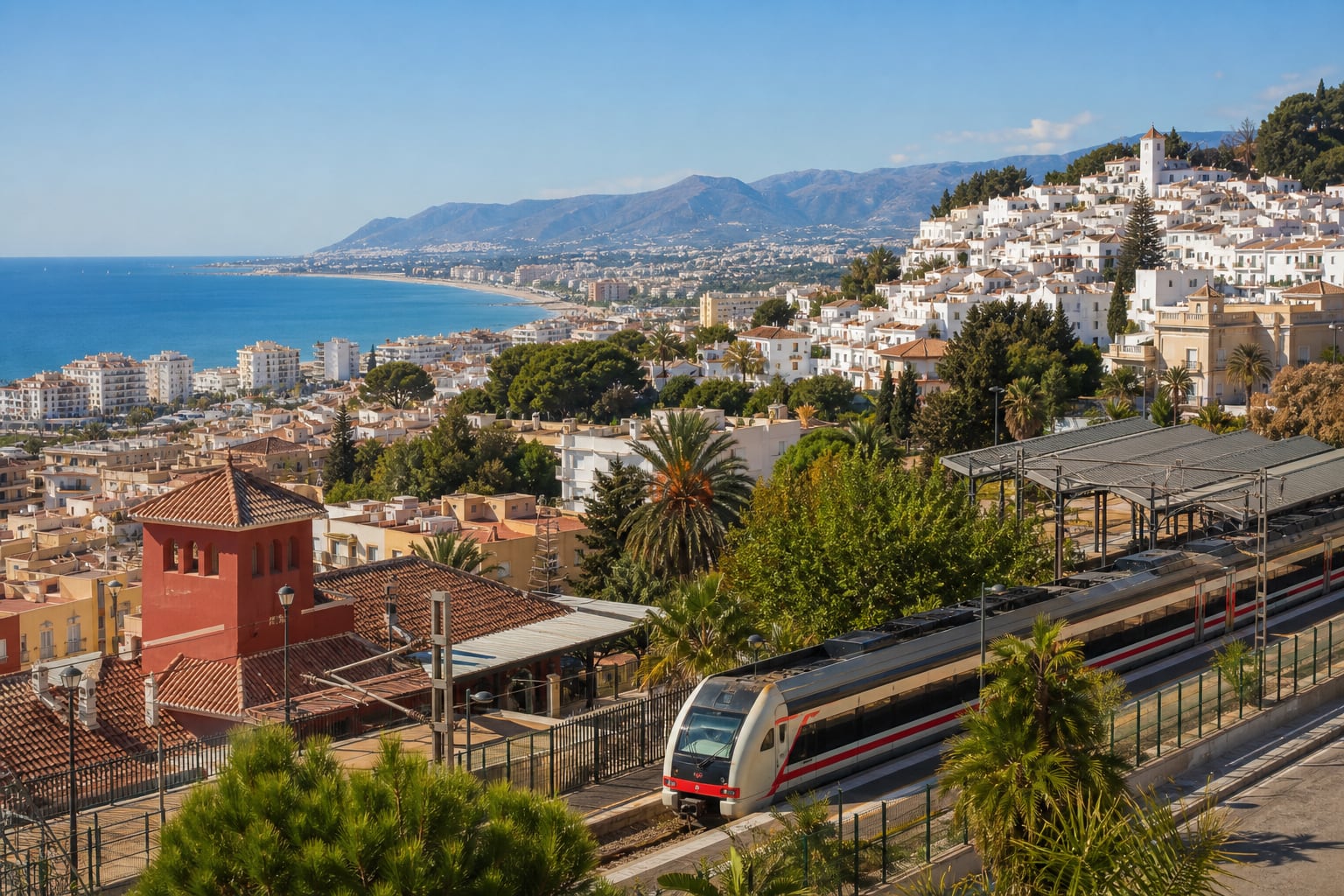
Málaga has an unusual structural advantage because the airport sits directly on the C1 Cercanías rail line serving Málaga city, Torremolinos, Benalmádena and Fuengirola. Those markets therefore combine air access with a rail option. West of Fuengirola, buyers in Mijas, Marbella, Benahavís and Estepona remain more road-dependent, which makes reliable terminal access and vehicle circulation particularly relevant. The airport expansion will not solve the Costa del Sol's missing westward rail link — a separate issue we examined in our Costa del Sol rail analysis — but it should make the aviation side of the journey more resilient.
That distinction is commercially important. A buyer looking at Benalmádena or Fuengirola may place unusually high value on train-to-terminal convenience. A buyer choosing Marbella or Estepona may accept a longer road transfer because the property, beach, golf, school or social environment matters more. The right conclusion is not that one location wins. It is that airport access is a real part of the ownership equation, and different parts of the coast convert that access into convenience in different ways.
The Expansion Protects an Advantage; It Does Not Create a Property Premium Overnight
It would be tempting to turn an €830 million infrastructure announcement into a neat property-price forecast. That would be difficult to defend. Marbella prices are not high because an airport terminal is getting larger, and a home in Estepona does not become worth a fixed percentage more because a new boarding pier has been approved. Property values on the coast are still determined first by location, scarcity, specification, orientation, walkability, views and the balance between supply and demand.
The airport works at a different level. It supports the size and geographic diversity of the buyer pool. A second-home market dominated by international purchasers needs a gateway capable of handling international passengers comfortably. When that gateway is already approaching its current design capacity, adding headroom is defensive infrastructure as much as growth infrastructure: it helps preserve the convenience that buyers already assume exists.
That is especially relevant as the Costa del Sol market broadens beyond the traditional summer holiday buyer. Families use homes around school calendars, hybrid workers travel repeatedly, retirees split time between countries, and owners increasingly make short stays outside July and August. The airport's job is not simply to deliver more tourists. It is to make that repeated pattern of ownership workable at scale.
Why the Timeline Needs to Be Read Properly
The approval is significant, but buyers should not read “€830 million approved” as “36-million-passenger airport next year”. DORA III runs from 2027 to 2031, and the wider €1.5 billion programme is expected to continue into a later investment period. The airport is being redesigned while it remains fully operational, which necessarily means phasing.
The design and technical-assistance contract alone is worth about €44.2 million and provides for 60 months of design work plus 48 months of supervision during construction. Some elements will arrive earlier than others. Security technology, terminal reconfiguration, apron works, parking and the larger pier do not all share one completion date.
There is also a useful distinction between forecast traffic and ultimate capacity. Current plans envisage the airport handling around 30.8 million passengers in 2031, while the completed infrastructure is designed for up to 36 million annually. That reserve is the point. Building only for the traffic already on the books would simply move the bottleneck a few years down the runway.
For Buyers, the Quiet Value Is Future Headroom
The strongest infrastructure stories are often the least dramatic ones. A larger passport hall does not photograph like a beach club. A better baggage system will never appear in a property brochure. Yet those are precisely the things that determine whether owning a home abroad remains easy after the novelty of the first summer has worn off.
Málaga-Costa del Sol Airport already has the demand: 26.76 million passengers in 2025, 19.32 million in the first eight months of 2026, 61 airlines on Aena's current list and an international share above 80%. The €830 million DORA III allocation is important because it is an attempt to ensure the physical airport catches up with that commercial reality.
For someone choosing a home on the Costa del Sol, that should sit alongside the more obvious questions about price, terrace, orientation and neighbourhood. It is not a reason to buy a particular apartment. It is one of the reasons the wider market can continue functioning as a genuinely international second-home and residential destination.
Sources & Data Notes
Aena, 15 September 2026 traffic data: August and January–August passenger and operations figures for Málaga-Costa del Sol Airport. Aena.
Aena, 13 January 2026: final 2025 traffic total, international/domestic split and annual operations. Aena.
Government approval / DORA III, 15–16 September 2026: €830 million Málaga allocation, 2027–2031 period, capacity and terminal-area plans. Europa Press.
Expansion specification: new pier, terminal, parking, access and phasing details, cross-checked against current reporting on the approved programme. SUR in English.
Technical expansion detail: pier dimensions, boarding gates, long-stay parking and design/supervision phasing were cross-checked against the approved-project reporting. El Español.
\n\nAena current airline directory: 61 airlines listed as operating at Málaga-Costa del Sol Airport at the time of publication. Aena. Percentages described as calculations are Domosmar calculations from the cited Aena totals.
If regular access is central to how you plan to use a home, browse our Costa del Sol properties or tell us how often you expect to travel. We can shortlist locations and new developments around the way you will actually use the property, not simply the postcode.