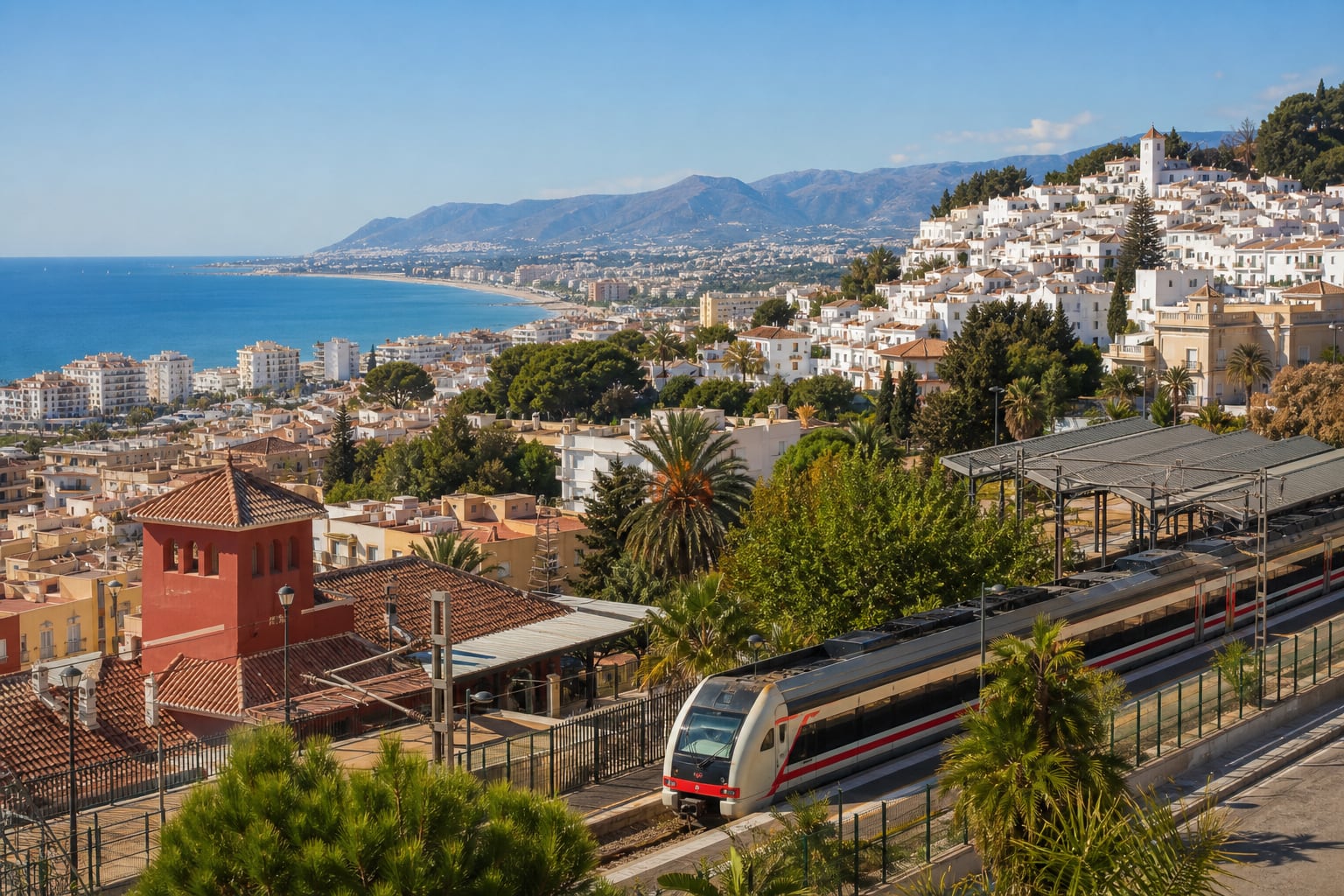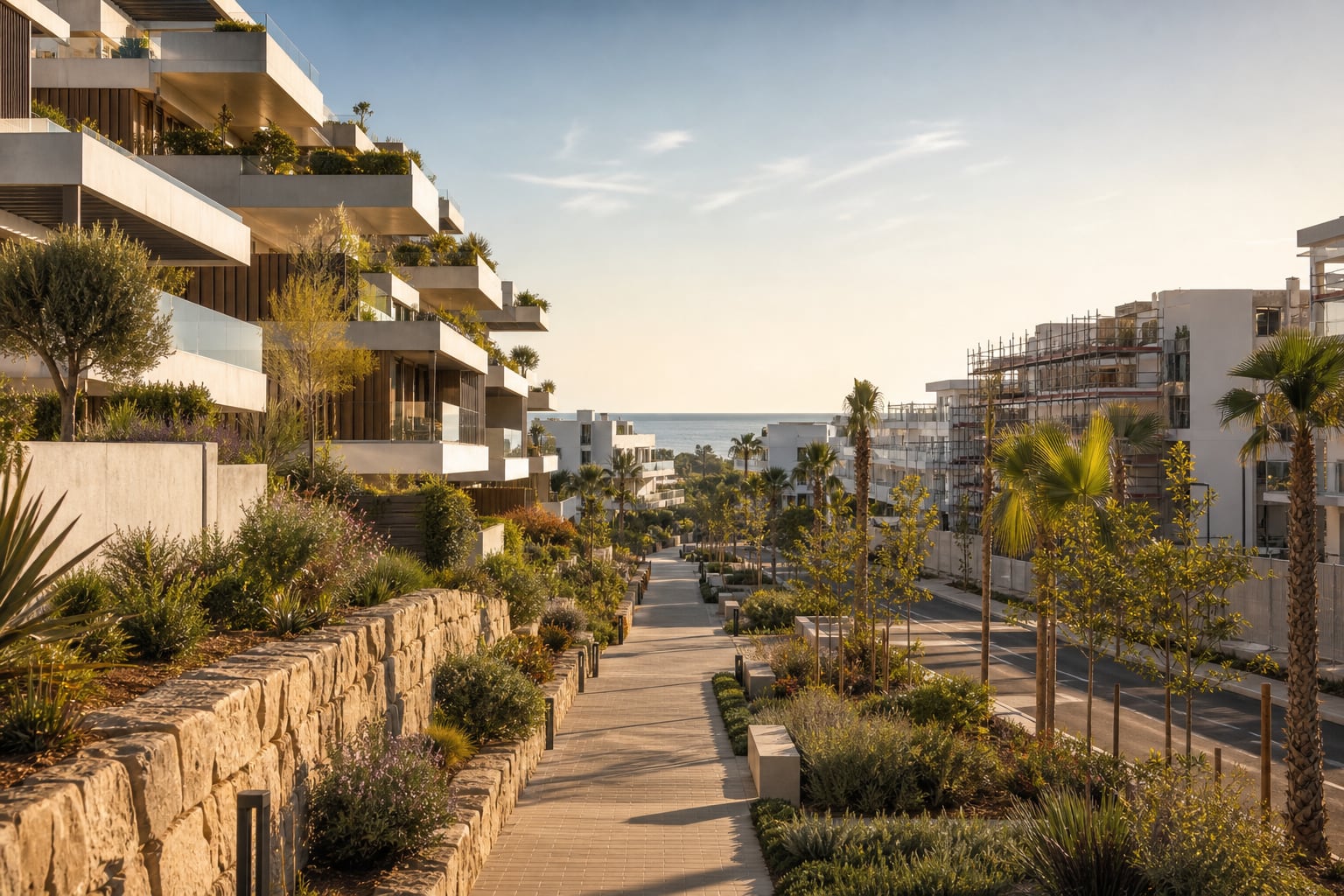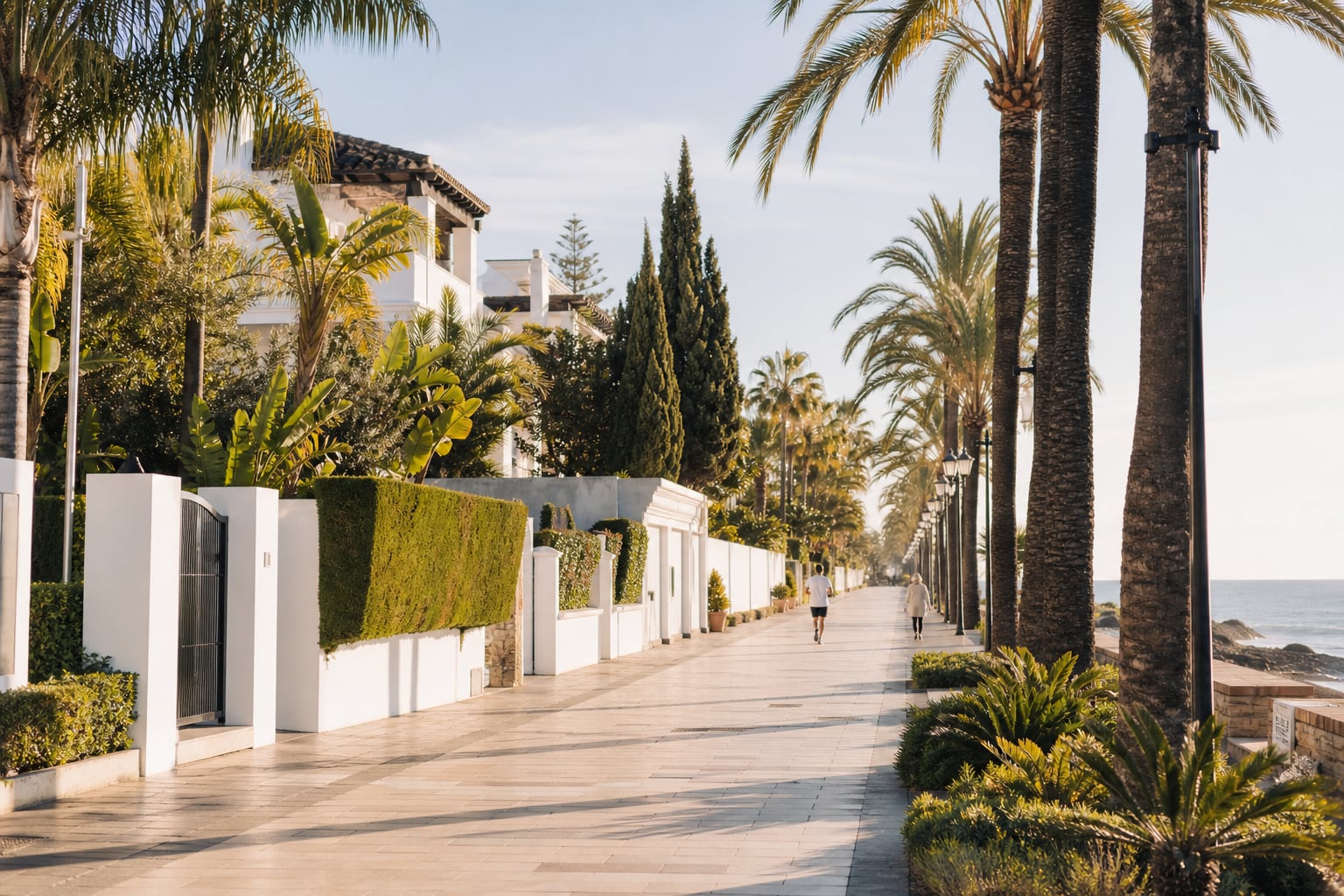
The address on the brass plaques says Bulevar Príncipe Alfonso von Hohenlohe. It runs for six and a half kilometres between the edge of Marbella town and the entrance to Puerto Banús, and the density of amenity it contains per linear metre is difficult to match anywhere on the Costa del Sol. Within this single corridor sit two of Spain's most celebrated hotel resorts, more than twenty named restaurants, an internationally recognised tennis and padel club, a spa that completed a full renovation in 2026, two private beach clubs, and a beachfront promenade that residents use as their daily running circuit — before breakfast.
These are not hotel facilities in the conventional sense. They are the infrastructure of daily life for a permanent residential community. For buyers who choose to own on the Golden Mile rather than merely visit it, the address delivers a concentration of resources per square kilometre that is largely invisible to the tourist traffic passing through on the N-340. Understanding what that actually means, week to week and month to month, is what this piece attempts to lay out.
Six Kilometres, Two Anchors
The Golden Mile has two institutional anchors, set roughly 700 metres apart as measured along the beach. The Marbella Club Hotel sits at the eastern end — opened in 1954 by Prince Alfonso of Hohenlohe, the property that placed Marbella on the European social map, and still operated today with the quiet restraint of a long-standing family institution. Its 130 rooms, suites and 15 private villas are arranged around a beach club, an adults-only pool, and garden grounds that supply the hotel's own kitchen from the Finca Ana María within the estate. El Olivar, a seasonal farm-to-table restaurant open May through September in the adults-only pool area, draws its daily menu directly from what those gardens produce that morning — Chef Andrés Ruiz writes the menu around more than 300 seasonal varieties grown on site.
Puente Romano Beach Resort occupies a position slightly to the west, its layout deliberately modelled on an Andalusian village: whitewashed archways, bougainvillea terraces, a central plaza that functions as the social gathering point of the complex, and buildings dispersed through subtropical gardens running down to the beach. More than twenty restaurants and bars are distributed across the resort, from an eight o'clock tennis-club café to late-night venues running until four in the morning. The resort's address is the same bulevar — named for the same founder — and the compound includes Nobu Hotel Marbella, giving it the character of a self-contained micro-district rather than a single hotel property.
Between the two institutions lies a strip of coastline that is technically public but functions in practice as the shared amenity of the residential community on both sides of the N-340. The promenade here is flat, consistent and well-lit; residents walk and run it in the mornings, cyclists use it at weekends, and the beach below — wider at this point than at the Marbella town seafront — fills with families from the international schools further inland on summer afternoons. The residential urbanisations of Nagüeles press against the hillside on the landward side, and the gated apartment complex of Las Terrazas sits within the Puente Romano perimeter itself.
The micro-geography matters because it determines what daily ownership actually delivers. A resident of Las Terrazas de Puente Romano — a gated beachside complex with 24-hour security inside the resort — has direct access to all Puente Romano amenities without a car. A villa owner in Nagüeles, on the hillside above the N-340, is a five-minute drive from the resort and a ten-minute walk to the beach. Both carry the same Golden Mile address; the practical daily experience differs between them in ways that prospective buyers should understand before choosing which part of the corridor to focus on.
How the Mornings Actually Work
Lagom! Café at the Puente Romano Tennis Club opens at 8 AM and has become one of the more quietly civilised breakfast spots on this stretch of the Golden Mile — good coffee, açai bowls and fresh pastries available before the first match begins on the clay. The club runs 14 courts in total: eight clay, four padel and two plexipave. For residents who structure a significant part of their week around tennis or padel, the proximity of that infrastructure — available without a car journey across town, at professional standard, across the full twelve months — is a meaningful part of the address's daily value.
Chiringuito, Puente Romano's beachfront club voted Spain's Best Beach Club by Condé Nast Traveler, opens for breakfast from 8:30 AM on the beach terrace, with a morning menu of plant-forward dishes, local juices and espeto-style preparations. In July, when Marbella's daytime high reaches around 30°C, the beach is occupied well before nine: walkers at the water's edge, early swimmers, the first delivery crates arriving at the open kitchen. The separate Chambao — a boutique Andalusian beach club five minutes from the resort along the Golden Mile — opens at midday and runs pool and beach service with tortillitas de camarones, orzo with carabineros and signature cocktails made with local Palo Cortado sherry.
The Six Senses Spa at Puente Romano completed a renovation in 2026, with the thermal area and treatment rooms updated and the layout redesigned to create more space and better flow. The beachfront facility includes a hammam, saunas, cold plunge and indoor pool. Morning wellness slots — yoga sessions, early thermal circuit appointments — are available to resident owners in Las Terrazas, and the programme runs year-round rather than seasonally. For owners who want spa and recovery infrastructure within walking distance on a weekday morning, rather than as a drive-across-town special occasion, this is a material advantage over most other residential areas on the Costa del Sol.
The Marbella Club's own mornings run quieter and more privately. The beach club opens to resident dining members and villa guests from early in the day. El Olivar operates lunch service from 12:30 PM, May to September, in the grounds of the estate — the space that became, under subsequent hotel ownership, one of the most serene lunch settings on the Golden Mile. The adults-only pool where El Olivar is situated is perceptibly quieter than the main Marbella Club pool: a distinction that regular visitors notice and permanent residents particularly value through the high summer months.
The Dining Depth of the Bulevar
Nobu Marbella — the first Nobu restaurant to open in Spain, located at Puente Romano — operates from 7 PM to 1 AM on weeknights and to 2 AM at weekends, with a separate beach-terrace lunch service from 1 PM to 6 PM. Executive Chef Eleni Manousou leads the kitchen; the black cod miso and yellowtail jalapeño appear on every service alongside seasonal Omakase menus and a curated sake and wine list. Cipriani, whose founder opened Harry's Bar in Venice in 1931 and whose Venetian menu has been served in that institution's format since its establishment, occupies another corner of the resort gardens: Carpaccio, the original Bellini, a blue-and-white nautical interior that has not attempted to modernise. La Petite Maison — the Nice-originated restaurant with more than three decades of Riviera following — brings its signature daurade entière au citron and Colonel lemon sorbet to a table overlooking Puente Romano's Mediterranean bay.
Sea Grill, Puente Romano's signature fine-dining room after a complete transformation, now writes its menu daily around what the sea provides, with fish prepared across six cooking styles. The wine list has received three consecutive Wine Spectator awards and draws from a cellar of over 900 references held at La Bodega. GAIA, by Chef Izu Ani, serves Greek-Mediterranean cooking with a daily ice market display of the catch at the entrance and a nature-framed terrace; Leña — the steakhouse by Dani García, who previously held three Michelin stars at his eponymous Marbella restaurant before deliberately converting to more accessible formats — anchors the meat offer with premium cuts over fire, including the Beef Tomahawk and aged selections. PurOsushi offers an immersive omakase experience at a fourteen-seat counter led by father-and-son chefs.
COYA operates across three formats within the resort: the main Peruvian-fusion restaurant open nightly, fusing traditional Peruvian dishes with Japanese, Chinese and Spanish techniques; COYA Club, a dining-to-dancing venue running Thursday to Saturday until 4 AM with live performance shows and DJs; and COYA Pool, a daytime adults-only Inca-inspired pool club with ceviches and Pisco cocktails. The NYX speakeasy — accessed through a discreet door at GAIA — adds another late-night dimension. El Pimpi brings a traditional Málaga bodega and flamenco evenings; Les Jardins du Liban covers authentic Lebanese cuisine. Residents who have spent more than one full season in the corridor consistently note that the range eliminates the need to drive elsewhere for dinner on most evenings of the week.
The Marbella Club's dining offer is more contained but concentrated at the upper end of its range. The Grill runs Easter through October and requires advance reservation of at least a week for Friday and Saturday evenings in July and August. El Patio provides Mediterranean all-day dining through the year. Dining memberships allow property owners nearby to access both restaurants and the beach club without hotel accommodation. For the Michelin-starred kitchens within a fifteen-minute drive across the wider municipality, see our guide to Marbella's Michelin restaurant scene.
The Community That Stays
The permanent residential layer on the Golden Mile is denser than the hotel traffic implies. Las Terrazas de Puente Romano holds beachside apartments within the resort's gated perimeter, sharing 24-hour security with the hotel and offering direct access to resort amenities. The ownership community is international and stable: British, Scandinavian and Dutch buyers have long been the core, and over the past two or three years buyers from the Gulf states and North America have joined in increasing numbers, choosing Marbella as a primary or extended-stay base. International demand from high-net-worth buyers held at historically high levels in early 2026, according to Pure Living Properties in an analysis published by Idealista in March 2026 — the closure of Spain's Golden Visa to property investors in April 2025 had not reduced the flow.
The tennis club functions as social infrastructure in its own right. Annual membership at Puente Romano Tennis Club is open to property owners in the surrounding area, and the padel courts run from early morning through the week with consistent demand. For owners who prioritise active daily sport within walking distance rather than as an occasional activity, the density of the sporting offer here — clay tennis, padel, swimming pool and beachfront running route, all within a few hundred metres — is difficult to find elsewhere in the Marbella area. The resort's social calendar runs alongside: COYA holds its La Noche Blanca party, a New Year's Eve event, and regular themed evenings through the summer; Chiringuito DJ sessions run through July and August; La Bodega opens each evening for private tastings from a cellar of over 900 references.
The corridor's walkability to Puerto Banús — roughly twenty minutes along the promenade, or five minutes by taxi — and to Marbella's historic centre in the opposite direction means that most daily requirements can be covered without a car. For the morning social routine: Cappuccino Grand Café on the Paseo Marítimo opens from 8:30 AM until midnight seven days a week and functions as a morning meeting point for permanent residents in a way that the hotel venues — which also serve transient guests — do not entirely replicate.
The beach-club question — which venue, how often, at what cost — tends to occupy more conversation among first-year Golden Mile residents than almost any other aspect of the address. In practice it resolves into a settled pattern within a single summer season: a regular morning club for weekday use, a different one for weekend entertaining, a third for special evenings. The range available within the corridor itself — Chiringuito, Chambao, the Marbella Club beach, and several independent clubs on the surrounding coastline — covers essentially every social register and price point. For a detailed breakdown of costs and formats, our guide to the Costa del Sol beach-club scene covers the options in depth.
Prices and What They Buy You in 2026
Idealista's February 2026 price data recorded an average asking price of €6,789 per square metre across the Nagüeles–Milla de Oro area, with an annual increase of +6.9% and a position close to the corridor's historical maximum. That average spans the full range of stock along the bulevar: upper-slope villas in Nagüeles with mountain and sea views, road-adjacent apartments on the N-340 side, and frontline beachside properties — where the premium over the corridor average is very substantial.
Frontline beach apartments within or adjacent to the Puente Romano complex trade well above the corridor average. A duplex penthouse within the resort complex offering 454 m² with unobstructed sea views was listed in early 2026 at €19,900,000, equivalent to approximately €43,800 per square metre. Entry-level two-bedroom apartments in comparable beachside complexes on this stretch start around the €2–3 million mark. Villas on the hillside above Nagüeles — three bedrooms on the upper residential streets — trade from around €3.5 million upward, with larger plot holdings on the ridgeline, where sea views are uninterrupted and La Concha is visible behind the town, commanding considerably more.
New-build supply on the Golden Mile is structurally constrained. The corridor has been largely built out for decades, and what development appears tends to be high-end refurbishment or boutique projects rather than large-scale new urbanisations. Constrained supply alongside deep and sustained international demand has historically supported capital values through broader Spanish market cycles: the Golden Mile does not produce the headline growth rates of the hottest peripheral markets in any given year, but it has also avoided their sharper corrections. The +6.9% recorded in the February 2026 data reflects measured, durable appreciation rather than speculative momentum — and for buyers seeking capital preservation over the medium term, this distinction matters.
On the running costs: IBI municipal rates apply across the Marbella municipality, and community fees in gated complexes on this corridor — covering 24-hour security, communal pool and garden maintenance, and in some cases resort amenity access — tend to be meaningfully higher than in less managed developments. Non-residents holding the property for personal use face Imputed Income Tax (IRNR) on deemed rental income, currently calculated at 1.1% of the cadastral value per annum for properties with a recently revised rateable figure. Tax obligations vary according to country of residence and ownership structure; a qualified Spanish abogado should be consulted on the specifics relevant to each buyer's situation before completing any purchase.
For buyers who ask what the Golden Mile gives them beyond a prestigious postcode and a sea view, the answer is in the density: twenty-plus named-chef restaurants within walking distance, a fourteen-court tennis and padel club, a renovated beachfront spa, two private beach clubs, a 6.5-kilometre promenade used as daily exercise infrastructure, and a ten-to-fifteen-minute drive to either Marbella's historic centre or the marina at Puerto Banús. No other corridor of comparable length on the Costa del Sol concentrates those resources in the same way. For whole-property ownership in a market where prime supply is genuinely limited and international demand has consistently held at high levels, the case here is among the most straightforward in the region.
Domosmar holds a curated selection of properties across the Golden Mile and the wider Marbella area. Browse our current listings to find available apartments and villas along this corridor, or get in touch with the team to discuss your requirements — we are based in Marbella and can arrange viewings, area tours and developer introductions at your convenience.