Mijas is the only municipality on the Costa del Sol where a donkey holds a working licence. The burro-taxis that climb the cobbled lanes of the white village have been a regulated trade since the 1960s, run today under a municipal bylaw covering more than sixty animals, at fixed published rates — €15 for a donkey ride, €20 for a two-person donkey cart, €25 for a horse carriage. It is the image the postcards sell. It is also, for anyone trying to buy here, the single most misleading thing about Mijas.
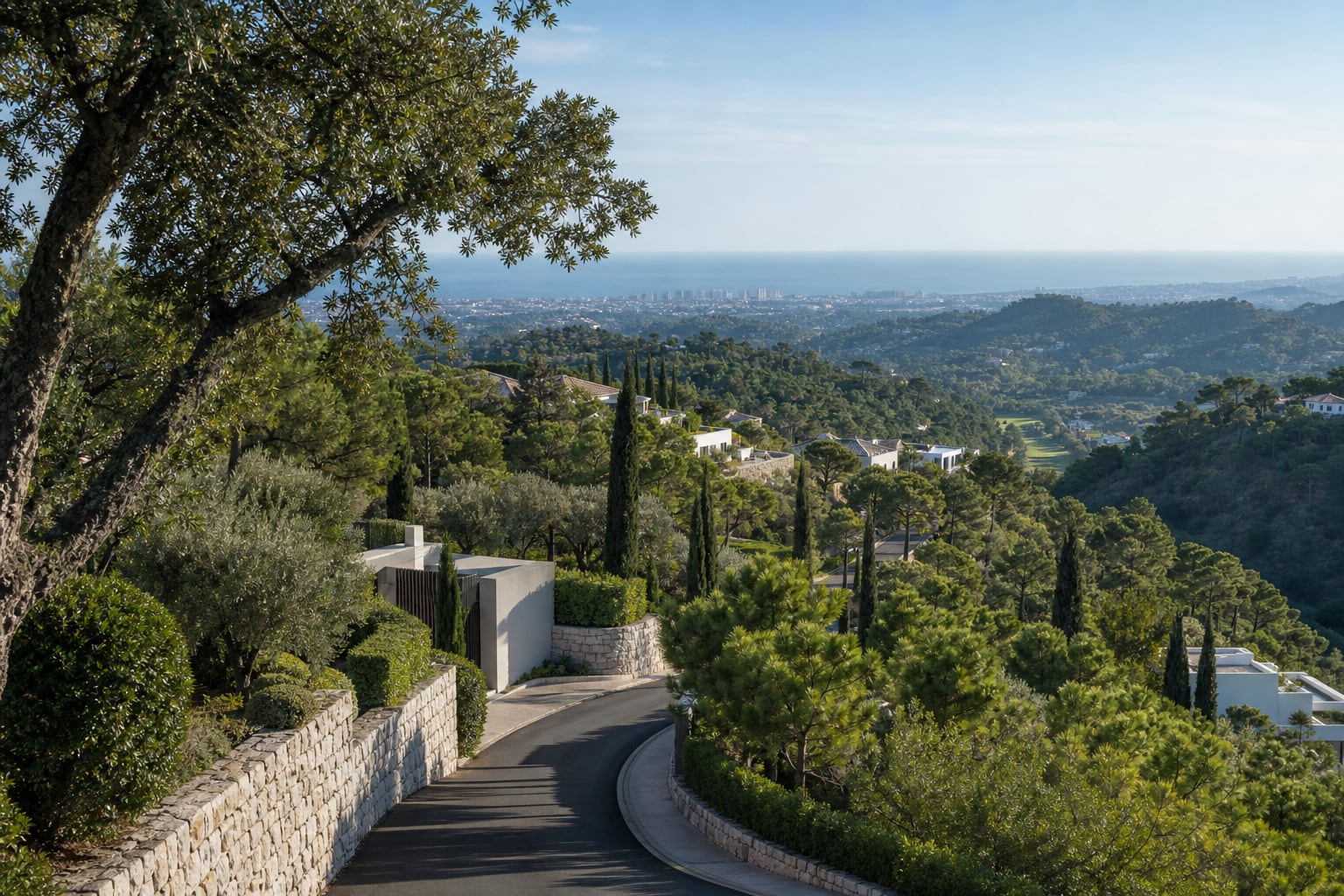
The hilltop village is one small corner of a municipality that spreads from roughly 430 metres above the sea down to twelve kilometres of coastline, wrapping almost entirely around the separate town of Fuengirola. Inside that footprint sit three property markets that behave nothing like one another, and a price level that lands a clear step below Marbella next door. Mijas is where buyers priced out of the Golden Mile or Nueva Andalucía come to get visibly more for their money — without leaving the western coast or the same forty-minute radius of Málaga airport.
One municipality, three addresses
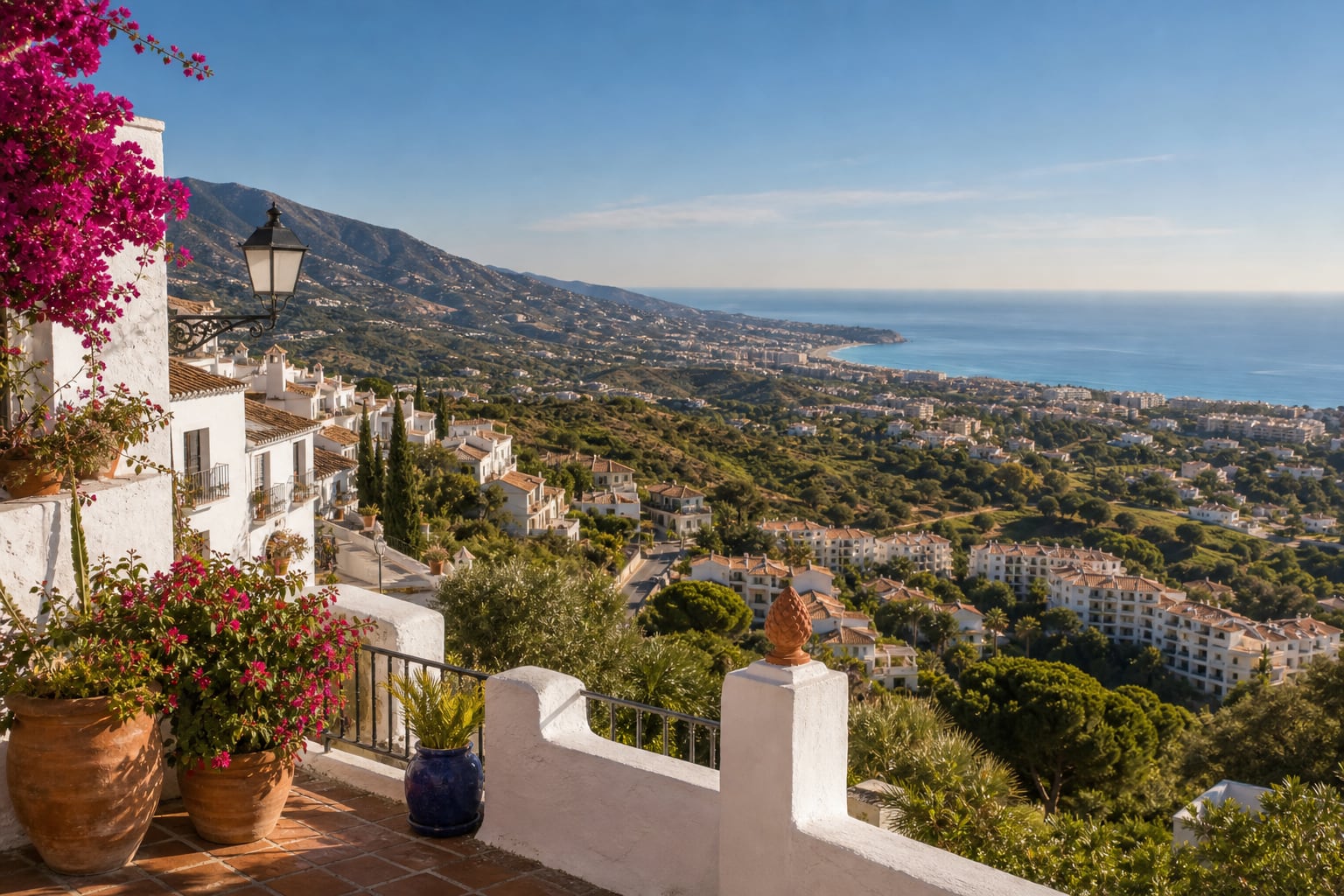
The first thing to understand is that "Mijas" on a property portal can mean three completely different places. There is Mijas Pueblo, the lime-washed village pinned to the side of the Sierra de Mijas, with its unusual oval bullring, its chapel cut into the rock, and views that reach the coast of Africa on a clear winter morning. There is Mijas Costa, the coastal belt — La Cala de Mijas, Sitio de Calahonda, Riviera del Sol, El Chaparral — where almost all foreign buying happens. And there is Las Lagunas, the workaday inland town pressed up against Fuengirola, where most of the municipality''s 90,000-plus residents actually live and where local-market value is keenest.
The distances explain the appeal. Mijas Pueblo sits about 22 kilometres from Málaga airport and roughly 35 kilometres — around twenty-five minutes — from Marbella. La Cala de Mijas, on the coast, is almost exactly halfway between Marbella and Málaga city, which means a buyer there is within half an hour of two airports'' worth of restaurants, hospitals and international schools in either direction. For families who want Marbella''s infrastructure without Marbella''s price tag, that midpoint position is the whole argument.
The centre of gravity for international buyers is firmly on the coast. The village is bought for character and views; Las Lagunas is bought by locals and by investors chasing yield rather than glamour; and the Mijas Costa strip is where the new-build cranes, the golf resorts and the holiday-rental demand all concentrate.
What it actually costs in 2026
The headline number tells the story. As of late May 2026, asking prices in La Cala de Mijas averaged €4,942 per square metre across nearly 2,000 listings, with entry-level flats starting around €187,000. Up in the village, Mijas Pueblo ran at a near-identical €4,935 per square metre in May — a figure that had jumped more than six per cent in a single month, a reminder of how thin the supply of village stock has become.
The genuine value pocket is Sitio de Calahonda, the large, established coastal urbanisation at the eastern end of the municipality, where prices sat closer to €4,027 per square metre in spring 2026 and where more than five hundred properties were on the market from as little as €130,000. Calahonda is where a buyer trades a little polish for a lot of square metres: it is a deep, mature resale market of villas and apartments built largely between the 1980s and the 2000s, with the beach on one side and the A-7 on the other.
Set those numbers against the western towns and the discount is obvious. Marbella''s Golden Mile trades close to €7,000 per square metre, and the streets of Nueva Andalucía''s golf valley sit in the mid-€5,000s. A buyer moving fifteen minutes east into Mijas Costa is looking at something like a fifth to a third off the same money — for a home that may be newer, larger and a shorter drive to the airport. Holiday-rental demand along this stretch is strong and seasonal, and while gross yields vary with the property and the licence, the rental case here tends to be more straightforward than in the prime western enclaves where purchase prices are far higher.
The golf engine underneath the market
Few municipalities on the coast are as defined by golf as Mijas. The town''s own register lists around ten clubs inside its boundaries — Calanova, Cerrado del Águila, Chaparral, La Siesta, La Noria, Mijas Golf''s Los Lagos, and the three full eighteen-hole courses of La Cala Resort among them. For a buyer, that density matters because golf-anchored homes hold their value and let more easily; a fairway view and a tee time five minutes from the door are exactly what the northern-European rental market is paying for.
El Chaparral Golf Club is the most quietly distinctive of them — an eighteen-hole course laid out just 700 metres from the beach and less than half an hour from both Málaga airport and Marbella, and the only course on the coast built as six par-threes, six par-fours and six par-fives. Low-season green fees start from around €50, with twilight and early-bird rates lower still, and its Andalusian clubhouse and TreeTops restaurant stay open year-round. The new-build villas going up around it — projects such as El Chaparral''s Sunset Villas — show how directly the property pipeline tracks the courses.
La Cala Resort, inland from the town it shares a name with, is one of the largest golf resorts in southern Europe, with three championship courses — America, Asia and Europa — plus a short course and an academy. It is also the focus of the municipality''s biggest residential build-out: a roughly €120 million joint venture between Taylor Wimpey España and FBD that plans to deliver around a thousand homes across the resort over the coming years, an unusual scale of single-site supply for the western coast.
New build, resale, and who is buying
The new-build wave in Mijas is concentrated on the coastal strip and, above all, around La Cala Golf. Schemes such as The Meadows, a run of three-bedroom townhouses due for completion in October 2026, and Taylor Wimpey''s Solana Village of apartments and penthouses, handed over in spring 2026, are typical of the current product: open-plan layouts, deep terraces, infinity pools, wellness zones and energy-efficient systems aimed squarely at international second-home and relocation buyers. Off-plan purchase here usually runs on staged payments through construction, which spreads the cost and is part of why northern-European buyers — many paying in cash, without a Spanish mortgage — have driven so much of the recent demand.
Resale tells the opposite story. Calahonda, Riviera del Sol and the older quarters of La Cala offer a deep stock of existing villas and apartments where condition is visible, communities are established, and timelines are short. Newer, design-led resale also exists higher up — developments such as Elysea Suites in the Mijas hills sit at the more contemporary end of the market. The practical trade-off across the municipality is consistent: new build for finish, technology and payment terms; resale for space, maturity and a quicker move.
On the costs that surround the purchase, the rules are the standard Andalusian ones — 10% IVA on a new build, 7% transfer tax on a resale, plus notary, registry and legal fees — but the exact figures and any reliefs depend entirely on the property and the buyer''s circumstances, and anyone buying here should take advice from a qualified Spanish abogado or gestor rather than relying on a rule of thumb.
The village, the boardwalk and the everyday
What makes Mijas hold buyers, rather than simply tempt them on price, is that the day-to-day works. Mijas Pueblo is a genuine working village — the donkey taxis share the square with a contemporary art centre, the rock-cut Virgen de la Peña chapel, and some of the best-value tables on the coast — not a film set that empties in October. The drive up from the coast takes a quarter of an hour, and the village stays busy with residents through the winter, when daytime temperatures on this coast rarely drop below the mid-teens and the sun is out for the better part of the day.
La Cala de Mijas has quietly become the most liveable town on this stretch — a real centre with a square, a church, a weekly market and a long seafront promenade that now links into the coastal boardwalk running for kilometres along the Mijas shore. Supermarkets, clinics, padel courts and the international schools and hospitals of Fuengirola are all minutes away. It is the kind of place where a holiday home slides easily into year-round living, which is precisely why so many buyers who arrive intending to visit twice a year end up staying.
For all the golf and the new build, the texture of life here is still the white village above and the long beach below — a combination very few towns on the coast can offer inside a single municipality.
The buyer''s case for Mijas
Put the pieces together and Mijas is the clearest value play on the western Costa del Sol: a fifth to a third cheaper per square metre than Marbella''s prime neighbourhoods, the same airport radius, more golf than almost any town on the coast, a strong rental market, and a genuine choice between off-plan new build at La Cala Golf and deep, established resale in Calahonda. For a buyer whose budget stops short of the Golden Mile but who is not willing to give up the coast or the convenience, the maths makes itself.
You can see the current range of new-build and resale homes across the municipality on our Mijas property listings, or browse the wider Costa del Sol portfolio. When you have a shortlist — or simply want to know which of the three Mijas markets fits how you actually plan to live — talk to the Domosmar team and we''ll walk you through pricing, availability and the buying process in real time.