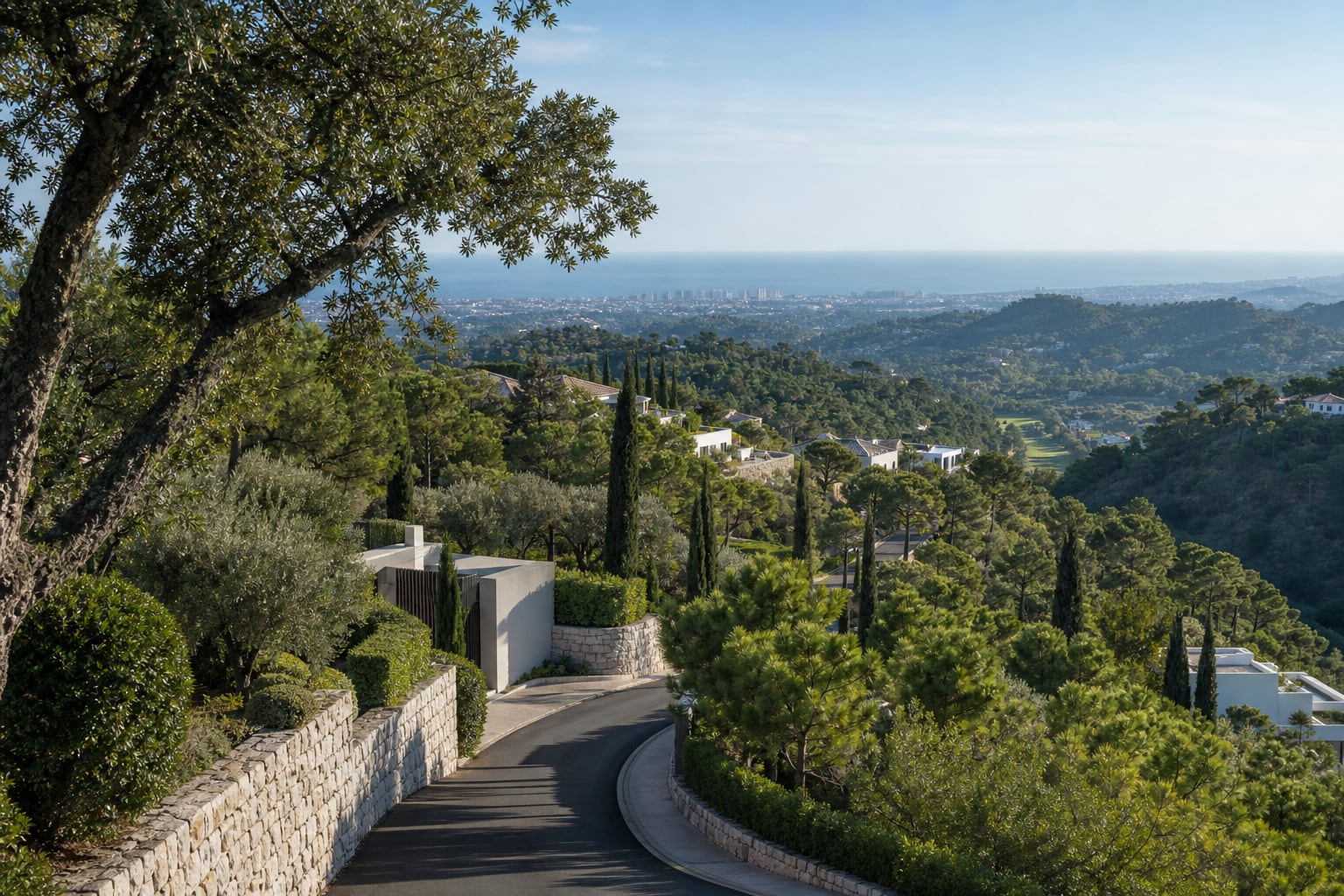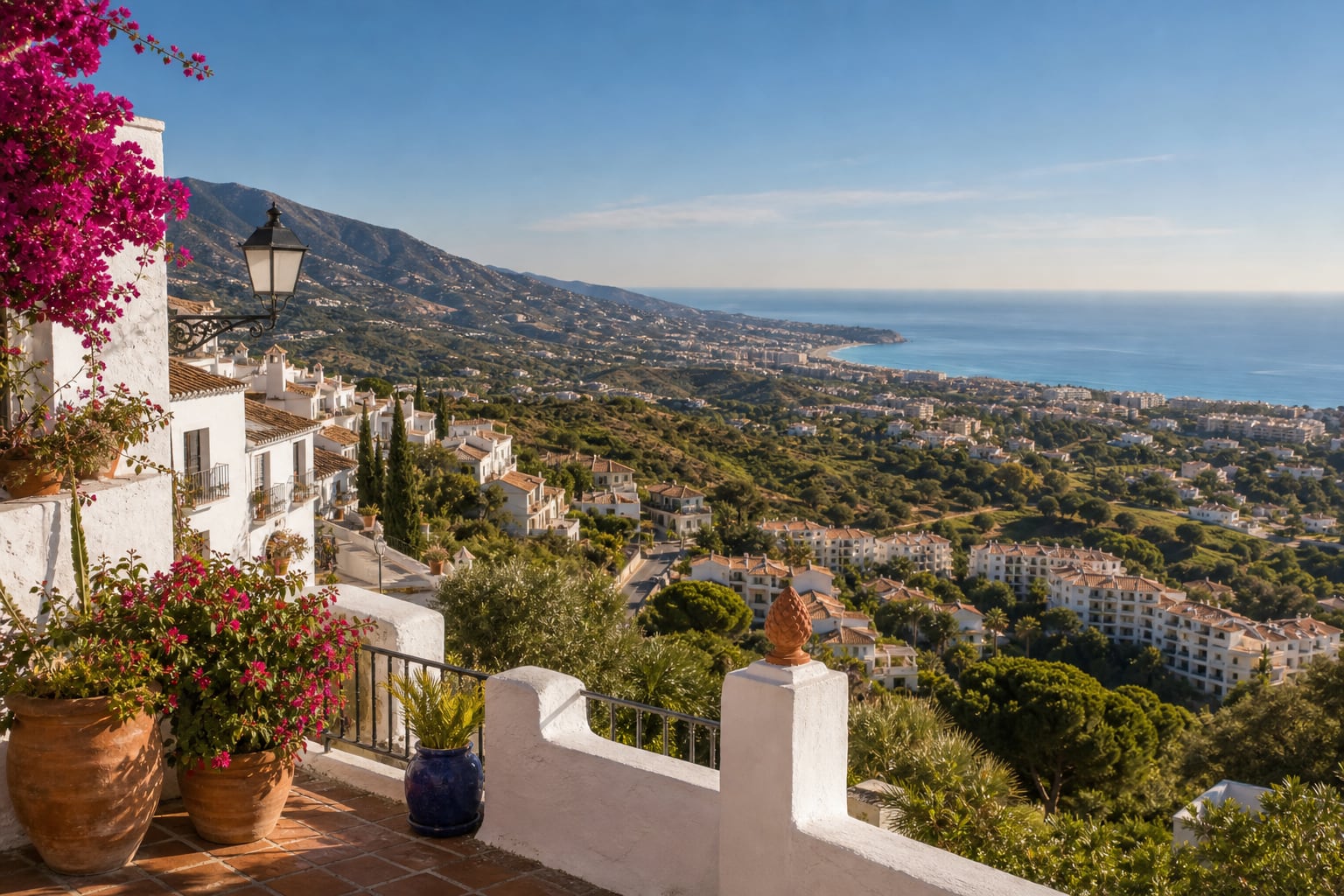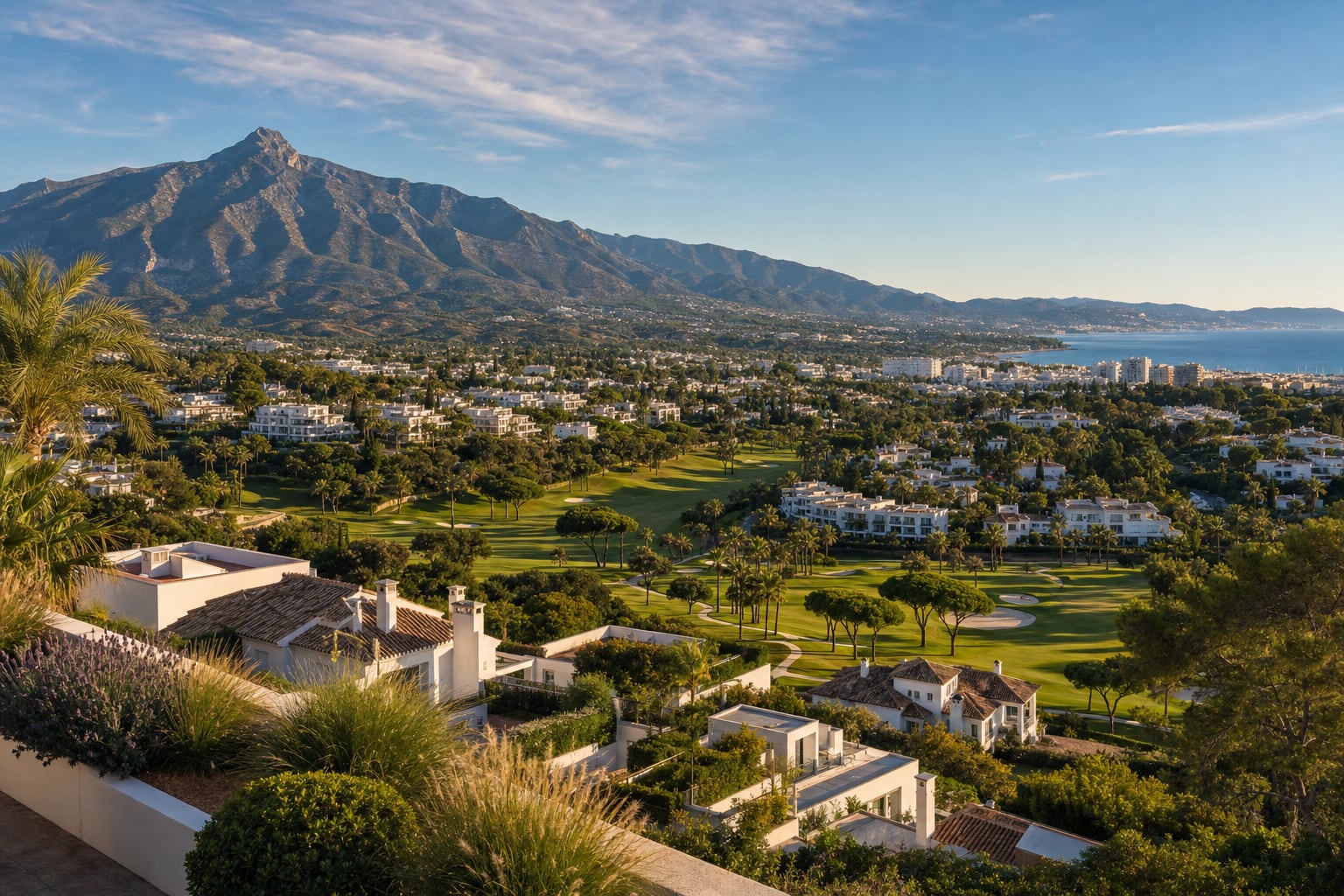
Five championship golf courses sit inside a single Marbella valley, their fairways woven so tightly between the residential streets that from many terraces you can watch a fourball play through. That density is the whole identity of Nueva Andalucía — the district Marbella simply calls the Golf Valley — and it explains why, decade after decade, this inland amphitheatre behind Puerto Banús stays near the top of nearly every serious buyer's shortlist. It is not beachfront, it does not carry a Golden Mile postcode, and it makes no attempt to. What it offers instead is space, green, and proximity: the glamour of the port a few minutes downhill, and a calmer, leafier home behind it.
For a buyer weighing where in Marbella to put their money, the valley is one of the more legible markets on the coast — its sub-zones are well defined, its golf is genuine rather than marketing, and its price data is deep. This is a guide to the numbers behind it in 2026, the micro-markets hiding inside the single name, and what daily life looks like once the moving van has gone.
A valley defined by its fairways
The golf came first, and the houses grew up around it. The anchor is Real Club de Golf Las Brisas, opened in 1968 to a design by the American architect Robert Trent Jones Sr — at the time widely rated among the finest courses in Europe, and still one of the most exclusive addresses in the valley. Jones liked the ground so much that, having just finished Sotogrande, he went on from Las Brisas to lay out Los Naranjos and, later, Valderrama. The lineage matters: this is not resort golf bolted onto a development, but a cluster of courses with real pedigree.
Around Las Brisas sit its neighbours, almost walking distance apart. Los Naranjos, the second Trent Jones course, opened in 1977 barely a kilometre away. La Quinta Golf & Country Club — 27 holes designed by the Ryder Cup winner Manuel Piñero and opened in 1989 — climbs the western slope toward Benahavís, while Aloha, dating from 1975, holds the centre of the valley. Add the public par-3 layout at Magna Marbella and you have a concentration of golf, within a couple of minutes' drive of one another, that no other district on the Costa del Sol can match. Green fees at the marquee courses sit in the region of €150 for eighteen holes in high season, and several admit non-members.
There is even a footnote in the valley's golf history that buyers still ask about. La Dama de Noche, opened beside the Centro Comercial Plaza in 1991, was Europe's first fully floodlit course, built for play after dark; it closed in 2017 and the site now operates as a golf school. The point for a property buyer is less the night golf than what the courses do to the place year-round: they keep the valley green, low-rise and open, and they put a premium on any home with a fairway or a mountain view rather than a wall.
What a square metre costs in 2026
Nueva Andalucía trades at a premium to Marbella as a whole. Idealista's price index put the average asking price for residential property in the district at €6,418 per square metre in January 2026, up around 5.5% on the previous spring and a touch above the broader Marbella average of roughly €6,260/m². Set that against neighbouring San Pedro de Alcántara, which trades nearer €5,300/m², and the valley's standing in the local hierarchy is clear: cheaper than the Golden Mile, dearer than the towns to either side, and stubbornly liquid.
As ever on this coast, the headline average flattens a wide internal range. A two-bedroom apartment in an older golf-side complex can still be found below the district mean, while a contemporary new-build villa with a fairway frontage in Las Brisas or La Cerquilla runs into many millions. Domosmar's current Nueva Andalucía listings map that spread plainly: apartments at Be Aloha from €475,000, the forest-edged Aloha Forest from about €1.15 million, and standalone villas such as Marein Natura and Villa Flora from €3.98 million and €5.5 million respectively. One valley, several price worlds.
The new-build versus resale choice carries a tax consequence worth modelling before you fall for a particular home. A resale purchase in Andalucía attracts transfer tax (ITP) of 7%, whereas a new-build bought from a developer is taxed at 10% IVA plus stamp duty (AJD), on top of notary, registry and legal fees. The valley offers plenty of both: tired but spacious 1980s and 1990s apartments ripe for reform, and a steady pipeline of modern, well-insulated developments with larger terraces and communal spa facilities that command a clear premium per square metre. Which way you lean depends on appetite for renovation, timeline and the running-cost picture — a calculation best run with a qualified Spanish abogado or gestor rather than from a brochure estimate.
The micro-markets inside one name
Locals do not really say "Nueva Andalucía" when they talk property; they name the urbanisation. Las Brisas, wrapped around the eponymous course, is the established blue-chip address — large plots, mature gardens, and the valley's highest villa prices. Aloha and Los Naranjos sit at the heart of the valley, a mix of villas, townhouse complexes and golf apartments that draws families wanting space and a course on the doorstep. La Cerquilla, higher and more private, is gated villa country with broad views back across the fairways to the sea.
Below them, closer to the coast road and Puerto Banús, the character shifts. The pockets around La Campana and the bullring — El Dorado, the apartment blocks near the Centro Comercial — are denser, more walkable, and more affordable, the natural entry point for a first apartment in the valley or a rental-focused buy. Higher up toward Benahavís, La Quinta blends into a resort enclave of its own around the Westin hotel, with newer developments and a slightly more self-contained feel.
The practical lesson for a buyer is that the right answer turns entirely on what the home is for. A trophy villa with privacy and a course view points to Las Brisas or La Cerquilla; a family home with golf and schools nearby to Aloha or Los Naranjos; a lock-up-and-leave apartment with rental potential to the lower, busier streets near the port. The single postcode hides at least four distinct decisions.
Life off the course
The valley's social spine is not a beach but a bullring. Every Saturday morning, the streets around the Nueva Andalucía bullring and the Centro Comercial Plaza fill with one of the largest open-air markets on the coast — more than 120 stalls of produce, clothes, ceramics and bric-a-brac, running roughly 9am to 2pm, a minute from Puerto Banús and a fixture of weekend life here. Around it, the Centro Plaza and the strip toward the port supply the everyday: supermarkets, cafés, gyms and a dense run of restaurants that means residents rarely need to drive far for dinner.
Proximity to Puerto Banús is the valley's quiet superpower. The marina, its restaurants, beach clubs and the El Corte Inglés department store sit perhaps five minutes downhill, close enough to use casually but far enough that the valley keeps its calm after the summer crowds thin. The beaches of Banús and San Pedro are a short drive rather than a stroll — the one genuine trade-off of buying inland — but for many owners the swap of a sea view for a garden, a pool and a fairway is the entire appeal.
Families are well served. Aloha College, a long-established British international school, sits on the valley's western edge, one of the cluster of international schools between Nueva Andalucía and San Pedro that makes this stretch of coast a magnet for relocating families. Private healthcare, padel clubs and the everyday machinery of year-round life are all within a few minutes — the valley works in February as well as August, which is more than some glossier addresses can claim.
Who buys here, and the case for 2026
The buyer base is broadly international and skews toward the 40-to-60 bracket — established professionals and families rather than first-time speculators — with a strong Scandinavian, British, Dutch and Belgian presence alongside Spanish and a growing share of buyers from further afield. They come for a recognisable combination: golf on the doorstep, Puerto Banús within reach, schools nearby, and a home with garden and pool rather than a tower block on the front line. That mix gives the valley an off-season pulse and a rental profile that holds up better than purely seasonal resorts.
Put it together and Nueva Andalucía reads as one of the safer convictions on the Costa del Sol: prices a clear tier below the Golden Mile but rising steadily, a deep and liquid resale market, five courses inside one valley, and a lifestyle that runs all year under the coast's reliable 300-plus days of sunshine. It is the address for a buyer who wants Marbella's amenities and golf without paying for, or living on top of, the beachfront. Anyone weighing it should also look at how it sits against its neighbours — the town of San Pedro next door, the gated hill of Sierra Blanca above the Golden Mile, or the value play further east at Benalmádena — before deciding the valley is the one.
To see what is currently available across the Golf Valley, from golf apartments to fairway villas, browse our current Nueva Andalucía listings or the wider Costa del Sol property collection, and speak to the Domosmar team for a buyer-led comparison of new-build and resale options matched to your budget, your timeline and how you actually plan to use the home.