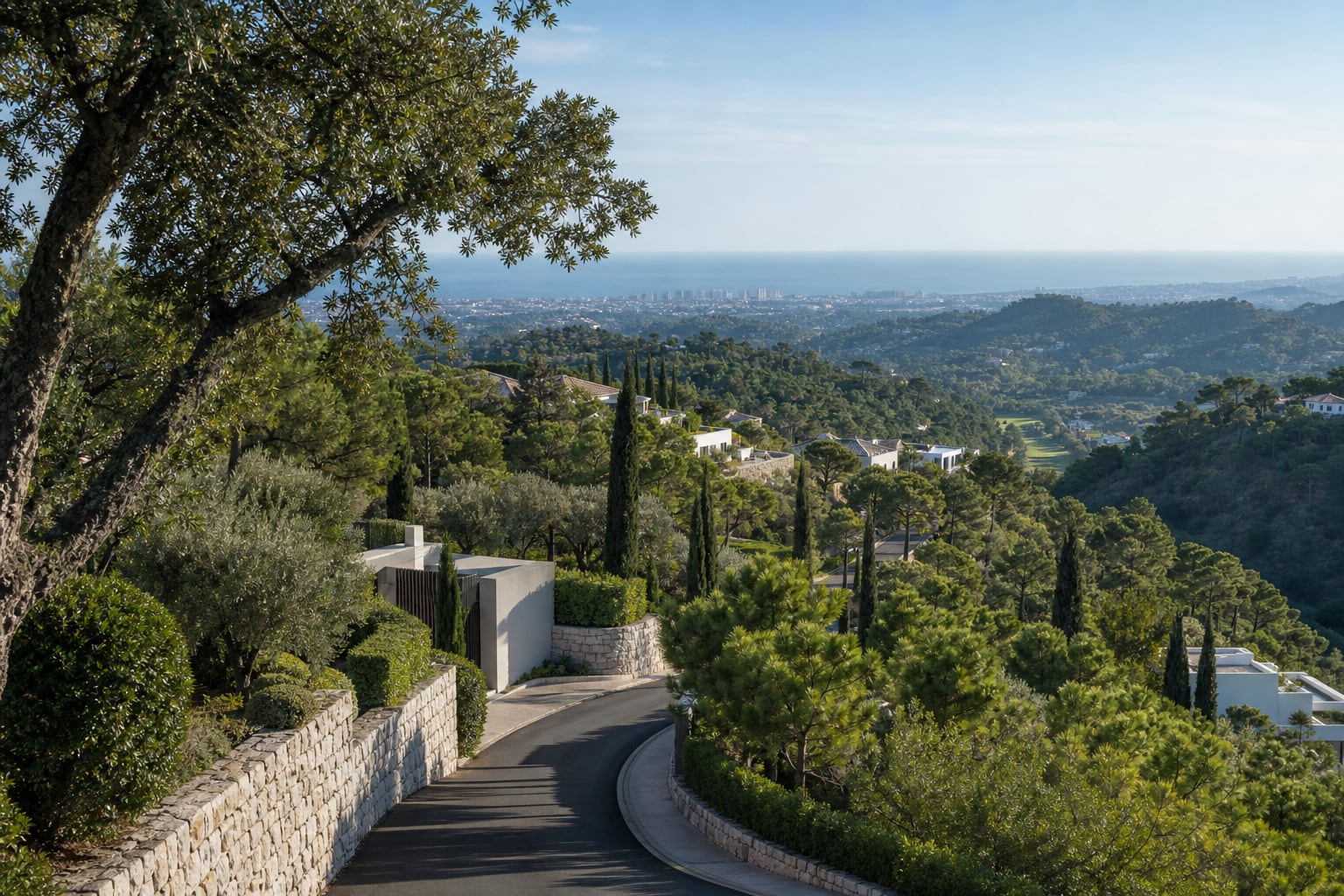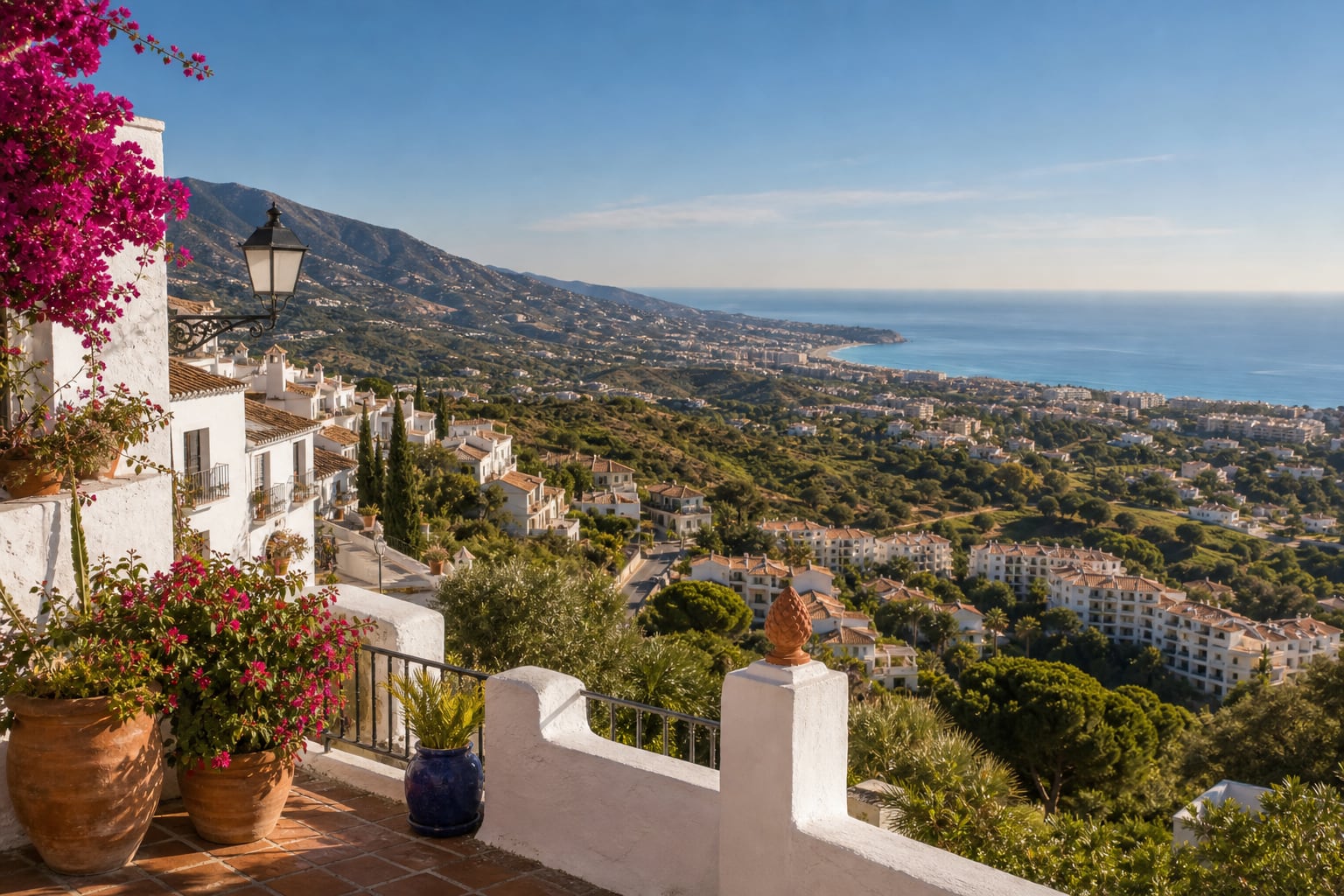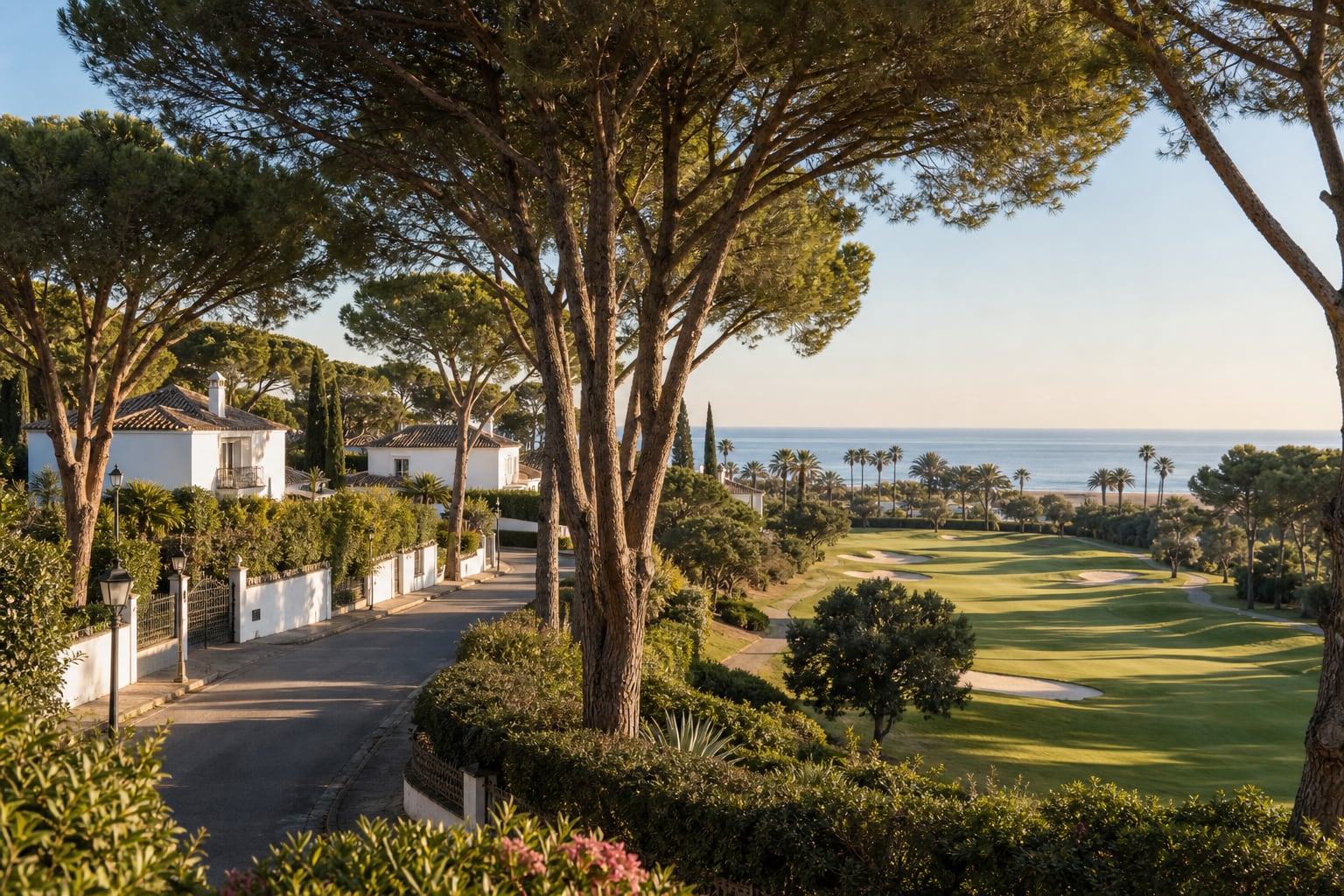
For €5,228 per square metre — the average asking price recorded across Guadalmina in Engel & Völkers' June 2026 market survey — a buyer acquires something the better-publicised corners of Marbella can no longer offer at any price: flat, pine-shaded villa streets running down to an open beach, arranged around the oldest golf club in Marbella. A short drive east, the Nagüeles–Milla de Oro area averages €6,789 per square metre; Nueva Andalucía, across the hill, €5,654 and sitting at its historical maximum. Guadalmina undercuts both — and most weeks it barely appears in the property press at all.
That silence is not an accident; it is the product. Guadalmina is where some of west Marbella's quietest money has been settling since the late 1950s, in an estate that predates almost everything the Costa del Sol is now famous for. For a buyer weighing the Marbella area in 2026, it deserves a proper map: what each half of the urbanisation costs, why its prices behave differently from the flashier micro-markets nearby, and what daily life beside a sixty-seven-year-old royal golf club actually involves.
Where Marbella quietly ends
Guadalmina is the westernmost residential quarter of Marbella municipality, folded into the district of San Pedro de Alcántara. Its western edge is a real frontier: the Guadalmina river, which gives the estate its name, marks the boundary where Marbella ends and Estepona's New Golden Mile begins. The A-7 coast road cuts the urbanisation into its two halves — Guadalmina Baja on the sea side, Guadalmina Alta on the hill side — and the distinction matters, because they are effectively two markets sharing one name.
The practical geography is hard to fault. Puerto Banús is roughly ten minutes' drive east; the restaurants and boulevard of San Pedro town are next door; Estepona old town is about fifteen minutes west; and Málaga airport is around fifty minutes by the AP-7. Yet Guadalmina itself contains almost none of the traffic that this connectivity implies. There is no strip of beach clubs, no nightlife corridor, no through-route worth taking. The estate's commercial life concentrates in the Centro Comercial de Guadalmina — a low-rise cluster of banks, cafés, pharmacies and estate agencies that functions as a village square and gives the surrounding streets their reason never to change.
First-time visitors often notice what is missing. There are no towers, no branded residences, and remarkably little for-sale signage. Turnover here is low and much of it happens off-market, between families who have owned for decades and buyers introduced by word of mouth. That opacity keeps Guadalmina out of the headlines — and keeps its pricing honest in ways the data below makes clear.
A golf club older than the coast's reputation
Everything in Guadalmina radiates outward from the golf. The Real Club de Golf Guadalmina was founded in 1959, making it the second-oldest golf club on the Costa del Sol and the oldest in Marbella — laid out before Puerto Banús existed, before the Golden Mile had its name, before golf tourism was an industry anyone had thought to invent. The original South Course was designed by Javier Arana, the most admired Spanish course architect of his era, with the beachfront Hotel Guadalmina rising in the same period as the estate's social anchor.
The North Course followed in 1973, shorter and hillier than its sibling, and today the club runs two 18-hole courses, a nine-hole par-3, and a covered driving range serving more than 2,000 members of seventeen nationalities. Its competitive history is substantial for a members' club: the Spanish Championship in 1965, the European PGA qualifying school in 1995 and 1996, the PGA championship in 1998. In 2008, King Juan Carlos I granted the club its royal appointment on its fiftieth anniversary.
For visitors, the published green fees are telling: €115 for eighteen holes on the North Course and €180 on the South, with the par-3 at €40 and a buggy at €45. Those are club prices, not resort prices — a different proposition from the trophy courses of Nueva Andalucía's Golf Valley, which we mapped in our guide to golf in the Golf Valley. Guadalmina golf is something residents do on a Tuesday, not something the property market performs for buyers on a fly-in weekend. The distinction shapes the whole neighbourhood.
The Baja: villa streets between the fairways and the sand
Guadalmina Baja is the estate's prime half: a low-density grid of villa plots threaded between the South Course and the Mediterranean, where mature gardens matter more than architecture and a house can be frontline golf, frontline beach, or — on a handful of coveted plots — within a short walk of both. This is one of the very few places in the Marbella area where flat, generous beachside villa land exists at all outside the Golden Mile, and it trades accordingly: tightly, slowly, and often privately.
Engel & Völkers' Q2 2026 breakdown puts average asking prices in the Baja's core at €5,228 per square metre for houses, up a measured 1.11% on the quarter. Villa listings on the main portals currently span roughly €3.25 million to €9.5 million, and the spread tells its own story: much of the housing stock dates from the 1970s and 1980s, and buyers increasingly pay for the plot and the postcode, then rebuild. A finished contemporary villa on a good street commands a substantial premium over those averages, which are pulled down by the very large plots that make the area what it is.
The Baja also holds one of the coast's most remarkable historical footnotes. At the beach end of the estate, beside the mouth of the river, stand the Las Bóvedas Roman baths — a vaulted thermal complex built in the second century AD and declared a national monument in 1931 — alongside the fourth-century early-Christian basilica of Vega del Mar. Historians associate the site with the Roman settlement of Cilniana, believed destroyed by the earthquake of 365 AD. Residents pass two millennia of history on the morning beach walk into San Pedro, where the promenade now runs unbroken toward Puerto Banús.
The Alta, Tiro de Pichón and the school run
Inland of the A-7, Guadalmina Alta wraps around the North Course with a more varied mix: townhouses, low-rise apartment communities and mid-sized villas that offer the same golf-estate calm at a meaningfully lower entry point. The Q2 2026 survey data puts Alta houses at €4,982 per square metre and apartments at €4,812 — roughly a fifth below equivalent space in the Baja's core. Between the two, the Urbanización Tiro de Pichón registers €5,099 for houses and €4,928 for apartments, appreciating steadily at around 1.4–1.6% per quarter.
What distinguishes the Alta for families is the school run — or rather, the absence of one. Colegio San José operates its Marbella campus inside the urbanisation itself, a bilingual Spanish-English school running from age three through the International Baccalaureate Diploma, and ranked by El Mundo among the hundred best schools in Spain — the first in Málaga province. Families who might otherwise anchor to Aloha College in Nueva Andalucía or Laude in San Pedro often shortlist Guadalmina Alta on the school's account alone, and it lends the neighbourhood a year-round, working rhythm that pure holiday urbanisations lack.
The estate's original anchor is meanwhile being rebuilt around its residents. The beachfront Hotel Guadalmina, opened in 1959, received Marbella town hall's approval in 2023 for a €55 million renovation intended to lift it from four stars to five-star gran lujo, expanding to some 250 rooms with new conference, spa and dining facilities. Owners in the Baja are watching with interest: a genuinely luxurious flagship hotel at the foot of the estate would do for Guadalmina's visibility what the Puente Romano and Marbella Club have long done for the Golden Mile — described zone by zone in our Golden Mile property guide.
What the 2026 numbers actually say
Zoom out to San Pedro de Alcántara as a whole and the direction of travel is unambiguous. House asking prices across the district average €5,040 per square metre, up 6.42% year on year — and up roughly 21% since 2022, when the same survey recorded €4,165. Apartments average €5,287, rising 5.75% in the past year after two consecutive years of gains near 11%. This is no longer the cheaper cousin west of Puerto Banús; it is a market converging on Marbella's established prime averages.
The comparison set matters. According to idealista's February 2026 price data, compiled in its review of the best areas to invest in Marbella, Los Monteros reached €8,772 per square metre after an 11.9% annual surge, the Nagüeles–Milla de Oro corridor stood at €6,789 (+6.9%), and Nueva Andalucía at €5,654 (+6.6%), its historical maximum. Against those numbers, Guadalmina's quiet 1.11% quarterly drift looks less like underperformance and more like what a mature, tightly held market does: it compounds without theatre.
The supply side explains the rest. There is no developable land left on the sea side of the A-7 here — the Baja's plot map was drawn in the 1950s and is finite in a way that few Costa del Sol addresses can claim. Demand, meanwhile, draws on the same pool documented across the Golden Triangle: a long-established British, Scandinavian and Spanish ownership base, joined increasingly by American buyers moving west from Marbella's more publicised districts in search of exactly the privacy Guadalmina was designed around. When a well-priced Baja villa does reach the open market, it rarely stays there long.
For a buyer in 2026, the case is straightforward. Guadalmina offers beachside villa land at averages roughly a fifth below the Golden Mile, apartments and townhouses from the high €4,000s per square metre, an in-estate school ranked among Spain's best, and the oldest royal golf club in Marbella at the centre of it all — with a €55 million hotel upgrade arriving as a catalyst. It is the rare Marbella micro-market where the fundamentals are generations old and the repricing is still under way. Transaction costs and taxes work exactly as elsewhere in Andalucía; our non-resident tax and cost guide sets out the full arithmetic.
If Guadalmina's particular blend of discretion, golf and beach matches what you are looking for, browse our current Costa del Sol properties — including new-build and resale options around San Pedro, Guadalmina and the New Golden Mile — or contact Domosmar for a no-pressure conversation about what is genuinely available, on and off the portals, in Marbella's original golf estate.