For the first time, the biggest group of foreign buyers walking into some Costa del Sol agencies is not British. According to the developer and estate agency GILMAR, US buyers became its leading foreign client group on the Costa del Sol in 2025, overtaking the Britons who have defined this coastline for half a century. That is a single company's figure, not a market-wide one — but it lands against a national pattern that is hard to argue with. Home purchases in Spain by US citizens rose 3% in 2025 even as total foreign purchases dipped, and deals by American buyers have tripled over the past six years while British purchases fell 16%, according to figures from Spain's General Council of Notaries reported by Reuters.
For a market that spends a lot of time watching British sentiment, sterling and the weather in Surrey, this is a genuine shift in the customer base. It is worth understanding precisely — because the numbers are smaller than the headlines suggest, and far more concentrated than they first appear.
Small nationally, decisive at the very top
Start with the caveat, because it matters. Foreigners made up roughly 19% of all Spanish home purchases in 2025, and within that, Americans accounted for about 2% of the national total. The British are still the largest single foreign group at around 8%. In pure volume, this remains a market led by Britons, Germans, Dutch and — increasingly — Moroccans and Italians. Anyone telling you the Americans have "taken over" the Costa del Sol is selling something.
What Americans have done is arrive at the top of the price ladder. In the first half of 2025 they paid the highest average price of any foreign nationality, at €3,465 per square metre — well above the overall foreign average of €2,417/m². The year before, the pattern was the same: US buyers topped the table at €3,390/m² in the second half of 2024, ahead of Swedes and Germans, according to notarial data compiled by Idealista. Reuters put the 2025 figure higher still, at an average of €3,501/m² — 29% more than the typical foreign buyer and close to double what Spanish residents pay.
The luxury agency Dils Lucas Fox reported that US clients became its second-largest foreign group, buying mainly homes priced above €3 million. That is the crux of it: Americans are a small share of transactions but a disproportionate share of the money, and almost all of that money lands in the prime and super-prime tiers where Marbella competes with Ibiza, the Balearics and the French Riviera.
A record year, and a change in who sets it
The American story sits inside a broader record. Foreign buyers completed 71,155 purchases in Spain in the first half of 2025, the first time transactions had passed 70,000 units since late 2022. Americans crossed 1,500 purchases in a single half-year for the first time on record, with US transactions up 14.3% year on year — the third-fastest growth of any nationality, behind Portugal and the Netherlands.
One detail in that data explains a lot about the Costa del Sol specifically. For most nationalities, the majority of buyers are residents already living in Spain. Americans are one of only two exceptions — alongside the Dutch — where non-resident purchases (829) outnumbered resident ones (735). In plain terms: a large share of American buyers are still living in the United States when they buy, treating a Marbella home as a second residence, a bolt-hole or an investment rather than a primary move. That is exactly the profile that fills the new-build and branded-residence pipeline the coast has been building for the last five years.
It also arrives with unusual timing. Spain closed its Golden Visa scheme to property buyers on 3 April 2025, the residency-by-investment route that many assumed underpinned wealthy non-EU demand. American purchases carried on rising regardless — a useful reminder that the visa was never the main draw for most buyers here.
Where the American money actually goes
A buyer paying comfortably above €3,000/m² in the Marbella area is not shopping in the value belt. That budget points to a fairly specific set of postcodes: the beachfront and hillside of the Milla de Oro, where Idealista's May 2026 data put the Nagüeles–Golden Mile district at around €6,800 per square metre, the highest in the municipality; the gated hill of Sierra Blanca above it; the golf-and-restaurant enclave of Nueva Andalucía; and, at the very top, the private estate of La Zagaleta in Benahavís, the highest-income municipality in Andalucía. Marbella's overall average asking price sat at roughly €5,600/m² in mid-2026, and Málaga is now the third most expensive province in Spain at around €4,680/m².
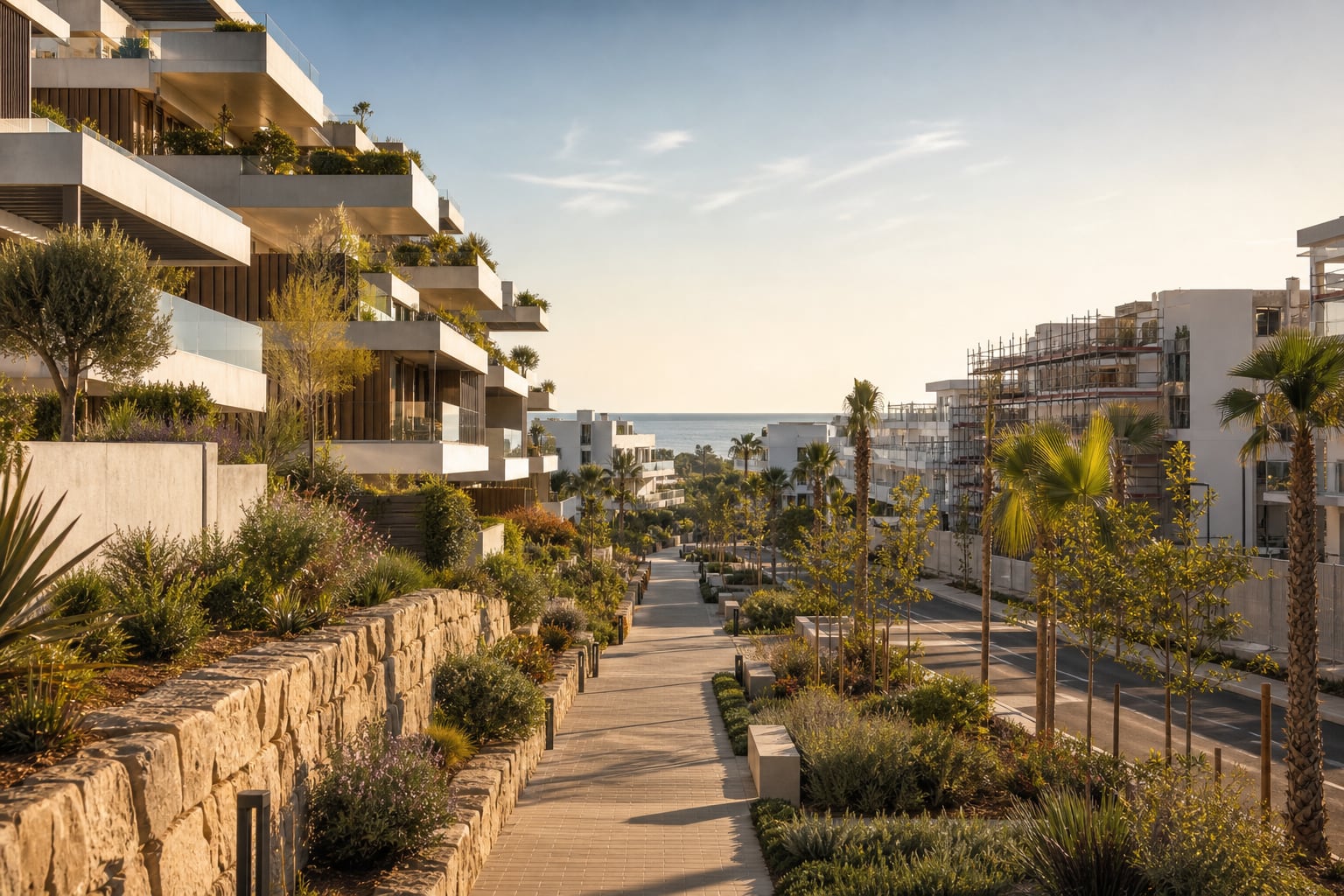
American buyers also skew heavily toward turnkey new build over renovation projects — a preference shaped by distance. If you are buying from New York or California, a finished apartment with a developer guarantee, a management company and a rental option is a very different proposition from a resale villa that needs a builder you cannot supervise. That preference maps neatly onto the coast's supply: the bulk of what is being delivered from Estepona through Marbella to Mijas is exactly this — designed, staged-payment, amenity-led new build.
There is a practical layer too. Málaga's Costa del Sol airport connects to most of Europe within three hours and to the US mainly via one-stop routes through Madrid, Lisbon or the northern European hubs — an easy enough journey for a home used several times a year. And the relocation case that agents report is not only about lifestyle: the cluster of private hospitals within twenty minutes of Marbella is one of the first questions American families with school-age children or older parents ask about.
What is driving it — and what to weigh
The agents quoted by Reuters point to a mix of motives: quality of life, a sense of safety, and a wish to diversify assets outside the United States. Currency has helped — a strong dollar stretches an American budget against euro-denominated prices, though analysts expect the underlying demand to persist even as the exchange rate moves. Some of it is relocation for personal reasons; some is straightforward second-home and investment buying by people who have simply discovered a coast their compatriots overlooked for decades. The honest summary is that no single factor explains it, and the trend has proved durable across different market conditions.
For a buyer of any nationality, the practical takeaway is about competition, not panic. A growing pool of cash-rich, price-tolerant American buyers concentrated in the top tiers adds support under prime Marbella values and tightens supply of the best beachfront and view-led stock. It does far less to the mid-market — the La Cala and Calahonda belt of Mijas, for instance, or inland Estepona — where British, Belgian, Dutch and Scandinavian demand still sets the pace and where value is easier to find. If you are competing for a Golden Mile penthouse, you should assume an American under-bidder now sits in the room. If you are buying a three-bedroom apartment near a golf course for €600,000, the picture is largely unchanged.
The opportunity beneath the trend
The arrival of American money is, at heart, a confidence signal. The world's most demanding second-home buyers — people who could choose Palm Beach, Los Cabos or the Riviera — are increasingly choosing the stretch between Estepona and Mijas, and they are paying the coast's highest per-square-metre prices to do it. For an owner, that broadens and deepens the future buyer pool. For a buyer entering now, it is a reason to move deliberately on prime, view-led and well-located new build before that pool grows further, while keeping a clear head about the mid-market, where the same urgency simply does not apply.
If you want to understand where your budget sits against this shifting demand, we can show you exactly what it buys today across Marbella, Estepona, Benahavís and the wider coast. Browse the current Costa del Sol new-build and resale collection, or talk to the Domosmar team for a straight, buyer-led read on where the value is — whichever passport you hold.