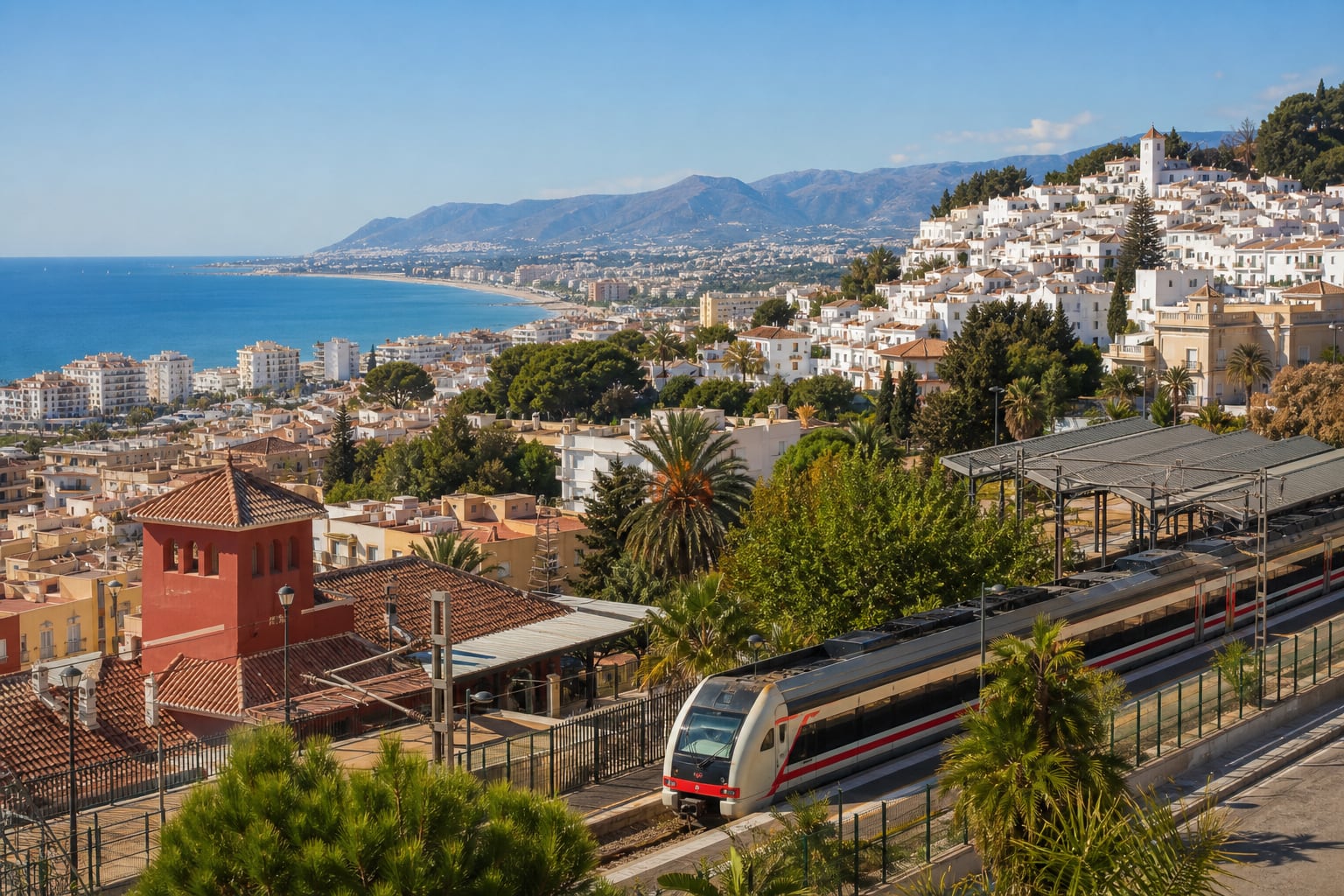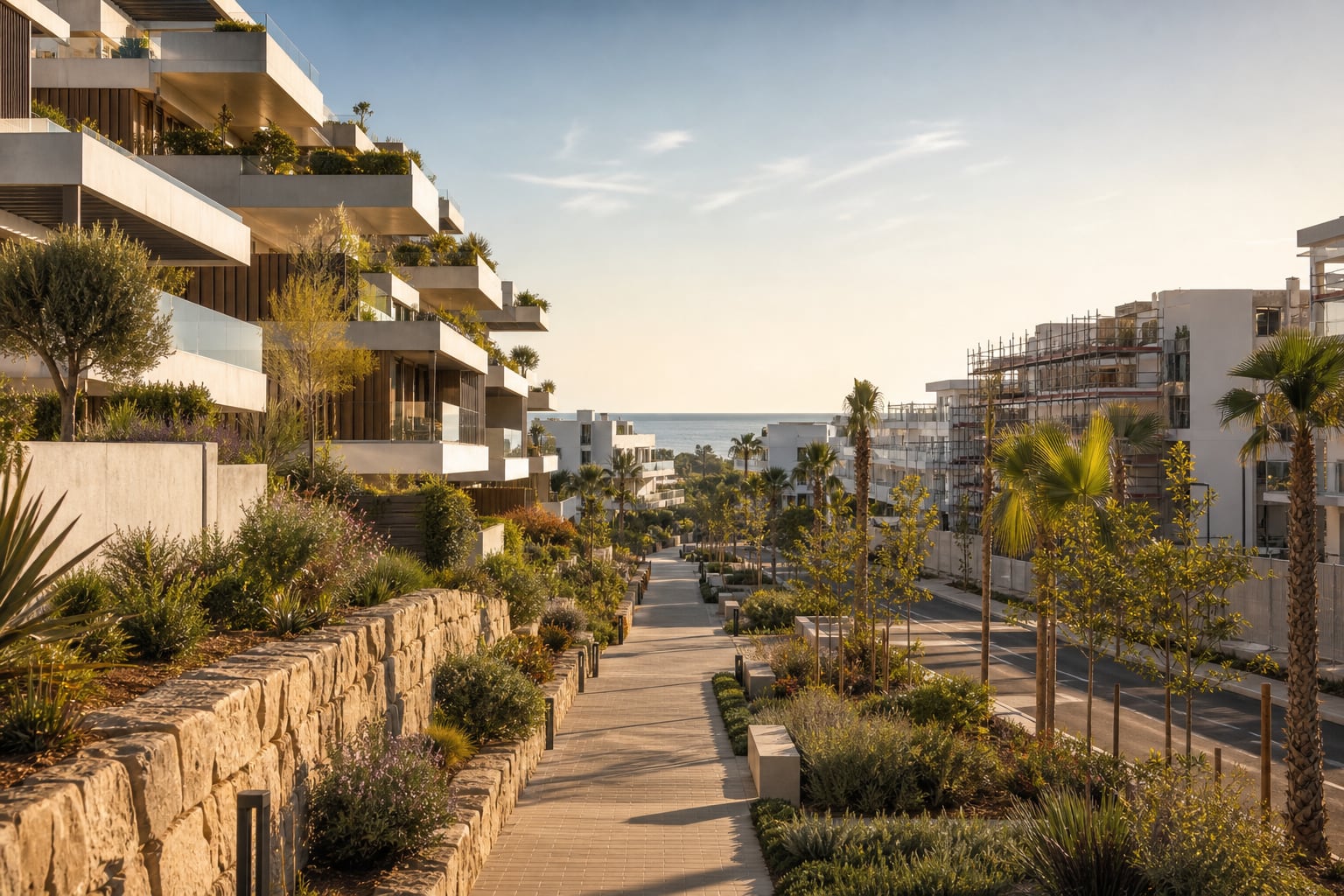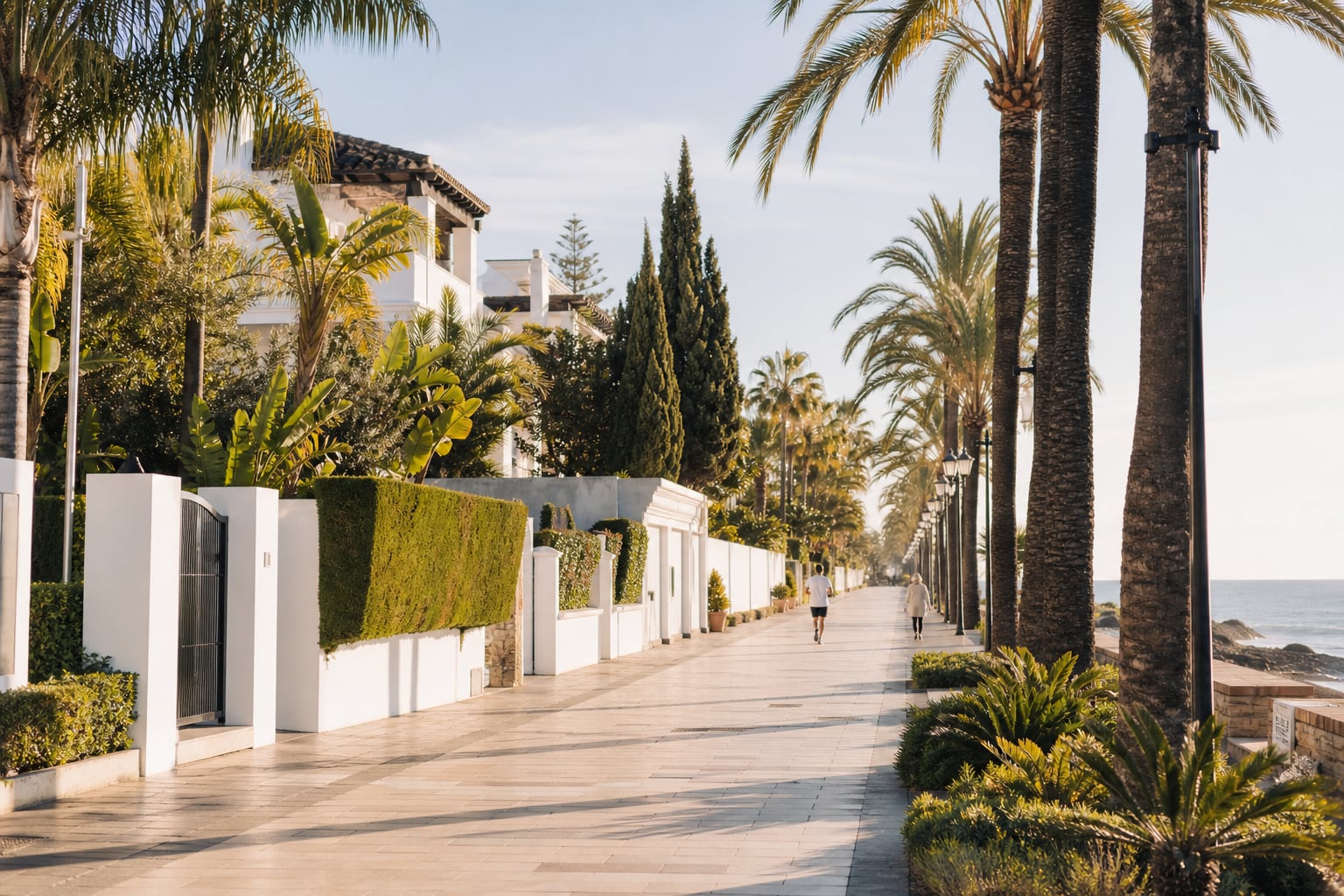
- Marbella had 173,420 registered residents at the start of 2026, almost 7,000 more than a year earlier. The town hall says residents now come from 155 different nationalities.
- International families are no longer a marginal group. Of the municipal register total, 63,206 residents were not Spanish nationals — about 36.4% — while 5,638 residents were born in the UK.
- The school map is also a property map. Aloha College in Nueva Andalucía has more than 900 pupils from 57 nationalities; the British International School of Marbella has grown to more than 650 pupils across two Nagüeles campuses.
- Family neighbourhoods span a wide price range. August 2026 asking prices averaged €8,336/m² in Nagüeles–Milla de Oro, €6,239/m² in Nueva Andalucía, €4,600/m² in San Pedro and €4,623/m² in Elviria–Cabopino.
- Schooling turns second-home logic on its head. For a permanent family, the everyday commute, storage, parking, bedroom count and year-round services can matter more than being 200 metres closer to the beach.
- Bottom line: Marbella increasingly behaves like an international residential city with a resort attached — and families should buy the Monday-morning routine, not only the August postcard.
On 3 September 2026, the first children in Málaga province go back to school. Early-years pupils aged 0 to 3 return today; the rest of Infantil and Primary begin on 10 September, and secondary pupils on the 15th. It is a useful moment to look at Marbella through a very different lens. The summer crowds are thinning, the school run is restarting, and the city is about to reveal the version of itself that matters to people who actually live here.
The numbers show why that distinction matters. Marbella's municipal register reached 173,420 residents at the start of 2026, almost 7,000 more than a year earlier. Residents represented 155 different nationalities. Aloha College has more than 900 pupils from 57 nationalities; the British International School of Marbella has more than 650. These are not numbers from a six-week resort economy. They describe a place with a deep international population that needs schools, supermarkets, healthcare, sport, offices, childcare, transport and homes that work on an ordinary Tuesday in February.
That changes the property question. A buyer moving with children is not simply choosing between Marbella, Nueva Andalucía, the Golden Mile and San Pedro. They are choosing a school run, a morning traffic pattern, an amount of storage, a level of walkability and a neighbourhood that still feels alive when the beach clubs close early. For many families, this is why Marbella is becoming something more interesting than a famous second-home address: it is becoming a genuine international base.
A City of 173,420, Not a Resort Population
The official local picture is unusually international. Marbella City Hall recorded 110,214 Spanish residents in its January 2026 padrón. Subtract that from the total and 63,206 residents were foreign nationals, about 36.4% of the municipal population. The town hall also counted residents from 155 nationalities, which gives Marbella a demographic profile closer to an international city district than to a conventional Mediterranean holiday town.
The British presence remains particularly relevant for Domosmar's market. The municipal data counted 5,638 residents born in the United Kingdom, an increase of 332 in a year. The same release highlighted sizeable communities with origins in Ukraine, Colombia, Morocco, Italy, Sweden, Venezuela, Germany, Paraguay, France and the United States. Marbella's international demand is therefore not a single-nationality story. That diversification matters because schools, property and services are supported by a broader permanent base.
There is one statistical wrinkle worth keeping clear. The town hall's padrón figure of 173,420 was 13,634 higher than the 159,786 figure then recognised by the national statistics office, INE. The municipality has publicly challenged that gap because national funding is partly tied to population. For a buyer, the exact administrative dispute is less important than the direction: whichever official measure you use, Marbella is a large permanent municipality, and the local register shows rapid growth.
The School Run Has Become a Property Map
Families often begin with a school shortlist and then discover that it quietly redraws the property map. The coast has several curriculum systems operating in parallel: British, Spanish, International Baccalaureate and other international programmes. That flexibility is a major strength, but it means the sensible home can be very different depending on where the children need to be at 8.45 every morning.
Aloha College Marbella is a good example of how established this ecosystem has become. Founded in 1982 in Nueva Andalucía, it now educates more than 900 pupils aged 3 to 18 from 57 nationalities, offering British international education alongside IB and A-Level pathways. On the Golden Mile side, the British International School of Marbella, founded in 2010, has grown to more than 650 students across two campuses in Nagüeles and teaches from age 2 to 18.
The established options continue east and west. Swans International School has operated in Marbella since 1971 with primary and secondary campuses around central Marbella and Sierra Blanca. The English International College in East Marbella had 440 pupils on roll at its 2025 inspection and teaches from nursery to Year 13. In San Pedro, Laude offers both British and Spanish curriculum routes from the early years through to 18. A family can therefore choose the education first and still have several very different residential markets within a practical radius.
| Family area | Aug 2026 asking €/m² | €1m arithmetic area | Nearby school examples | Typical appeal |
|---|---|---|---|---|
| Nagüeles–Milla de Oro | €8,336 | 120 m² | BISM, Swans secondary | Prime position, Golden Mile access, established villas and apartments |
| Nueva Andalucía | €6,239 | 160 m² | Aloha College | Golf Valley, family villas, townhouses and mature services |
| Marbella Pueblo | €5,170 | 193 m² | Swans primary, BISM within the wider central catchment | Walkability, town-centre life and year-round services |
| San Pedro de Alcántara | €4,600 | 217 m² | Laude San Pedro | More local-town feel, beachside areas and comparatively lower €/m² |
| Elviria–Cabopino | €4,623 | 216 m² | English International College | East Marbella beaches, larger residential zones and school proximity |
Four Family Geographies, Four Different Versions of Marbella
Nueva Andalucía is the obvious example of a resort district that has grown into a family neighbourhood. Its August 2026 asking average was €6,239/m². The price reflects more than proximity to Puerto Banús. It contains schools, supermarkets, sports clubs, golf courses, medical services and residential streets where school traffic matters more at 8.30 in the morning than nightlife does at midnight. For families who want a villa or townhouse with a garden and easy access to Aloha College, the Golf Valley remains one of the most coherent choices.
Nagüeles and the Golden Mile ask a different price for convenience and prestige. The €8,336/m² August asking average in Nagüeles–Milla de Oro was the highest of the broad family areas in our comparison. What you are buying is not simply a more expensive postcode. You are closer to central Marbella, the Golden Mile, several established schools and some of the city's deepest year-round restaurant and service infrastructure. For buyers who want to reduce daily driving without giving up prime location, that can justify the premium.
San Pedro is increasingly the counterweight. At €4,600/m², its broad asking average was about 45% below Nagüeles–Milla de Oro. It has its own town centre, promenade, shops and schools, and for many families that independence is the point. The home does not need to orbit central Marbella every day. A larger apartment or townhouse can make more sense than a smaller prestige address if children, pets, storage and working from home are part of the brief.
East Marbella, around Elviria and Cabopino, offers another version again. The August average of €4,623/m² was almost identical to San Pedro's, but the geography is more spread out. Families are often buying proximity to East Marbella schools, wider residential plots, beach access and a quieter daily rhythm. The trade-off is car dependence: two homes can be geographically close on a map and feel very different once the school run hits the A-7.
Permanent Life Changes the Property Specification
A holiday buyer can forgive a surprisingly inefficient home. One small wardrobe is fine when the family arrives with two suitcases. Street parking is manageable for a week. A beautiful open-plan living room can compensate for a tiny utility space because nobody is trying to wash five school uniforms before Monday morning. Permanent life is less romantic and more revealing.
The strongest family homes therefore tend to solve ordinary problems well. They have a genuine third or fourth bedroom rather than an occasional guest room, enough cupboards, a separate utility area, secure parking, easy school access and outdoor space that can be used after school rather than only admired from a terrace chair. Heating and cooling matter in both directions: good air conditioning is obvious in August, but insulation, glazing and comfortable winter temperatures become much more important when the home is occupied every day.
The live Domosmar catalogue illustrates where the new-build market is heading. On 3 September, it contained 31 available Marbella developments; 30 of them offered three bedrooms or more somewhere in the scheme. The median advertised starting price across those Marbella developments was about €1.466 million. That is not a census of the whole market, but it shows how strongly current new-build supply is aimed at larger, higher-value homes rather than the old formula of compact holiday apartments.
Renting First Can Be Sensible — but Prime Family Rentals Are Not Cheap
For a family relocating from London, Amsterdam, Dubai or Stockholm, renting for six or twelve months before buying can be an excellent way to test the school run and the neighbourhood. It is particularly useful when the children are entering a new curriculum or when one parent expects to work partly from home. The downside is that the rental market is expensive enough that the experiment has a real cost.
Idealista's August 2026 asking-rent index put Marbella at €23.7/m² per month. Nueva Andalucía was €23.9/m² and Nagüeles–Milla de Oro €27.7/m², while Elviria–Cabopino was lower at €17.8/m². On simple arithmetic, a 120 m² home at those area averages equates to roughly €2,844 a month in Marbella overall, €2,868 in Nueva Andalucía, €3,324 on the Golden Mile side and €2,136 in Elviria–Cabopino. Individual family villas and new-build units can be far higher, but the averages show why long-term renters eventually start comparing the cost of occupying with the cost of owning.
Year-Round Infrastructure Is What Turns a Resort Into a Base
Families expose the difference between a destination and a place to live. A resort can survive on restaurants that close in winter and shops designed for visitors. A residential city cannot. Marbella's permanent population supports a deeper ecosystem: multiple school systems, healthcare, sports clubs, supermarkets, professional services and neighbourhoods that have their own rhythm outside July and August.
The transport side reinforces that shift. As we covered recently in our guide to Málaga Airport and frequent-use second homes, the airport handled more than 16.27 million passengers in the first seven months of 2026 and now has a much deeper year-round route network than it did before the pandemic. For a family with grandparents, business commitments or university-age children in another country, that connectivity is part of the residential proposition, not a tourism statistic.
There is also a softer advantage. A city of 155 nationalities means arriving families do not need to be pioneers. They are joining existing communities. Children often enter classrooms where several classmates have also moved countries; parents find school networks that are already international; and the local economy is accustomed to clients who bank, work, own companies or receive income in more than one country. That reduces friction in ways that never appear in a property brochure.
Buy the Monday Morning, Not the August Postcard
The best family purchase in Marbella is rarely found by asking which area looks most impressive on a summer viewing. The better question is what 7.45 on a Monday morning feels like. How long is the school run? Can two cars leave the garage easily? Is there somewhere to work quietly? Where do bicycles, golf clubs, school bags and suitcases live? Can a teenager walk anywhere? Is the supermarket a two-minute stop or a 20-minute detour through traffic?
Once those questions are asked, Marbella becomes easier to read. Nueva Andalucía works particularly well for the Golf Valley and Aloha school community. Nagüeles and the Golden Mile buy prime position and central access at a premium. San Pedro offers a more independent town structure and materially lower asking prices. East Marbella gives families more choice around schools and residential space, but usually with a greater dependence on the car.
The larger point is positive. Marbella's family appeal is not being manufactured by a marketing campaign. It is visible in the population register, in schools with hundreds of international pupils, in the breadth of property types and in the fact that the city continues to function when the summer season ends. For buyers who want Spain to be a base rather than an escape, that may be one of Marbella's strongest advantages in 2026.
Sources & Data Notes
Population figures use Marbella City Hall's January 2026 municipal register. Asking sale and rental prices are Idealista market indices for August 2026 and are advertised prices, not completed transaction prices. School sizes and curricula are taken from school or official inspection sources. Domosmar development counts are a live catalogue snapshot from 3 September 2026 and should not be read as total market supply.
- Marbella City Hall — municipal population register, 27 January 2026
- Junta de Andalucía — Málaga school calendar 2026/27
- Idealista — Marbella asking sale-price report, August 2026
- Idealista — Marbella asking-rent report, August 2026
- Aloha College Marbella — school profile
- British International School of Marbella — school profile
If you are relocating with children, start with the school and the weekly routine, then choose the property around it. Browse current Marbella properties, explore Nueva Andalucía and the Golf Valley, or read our guide to day-to-day life on Marbella's Golden Mile. Families considering more space and value to the west can also compare Estepona properties. For a shortlist built around a particular school or commute, contact Domosmar and we will narrow the search around the way your family will actually live.