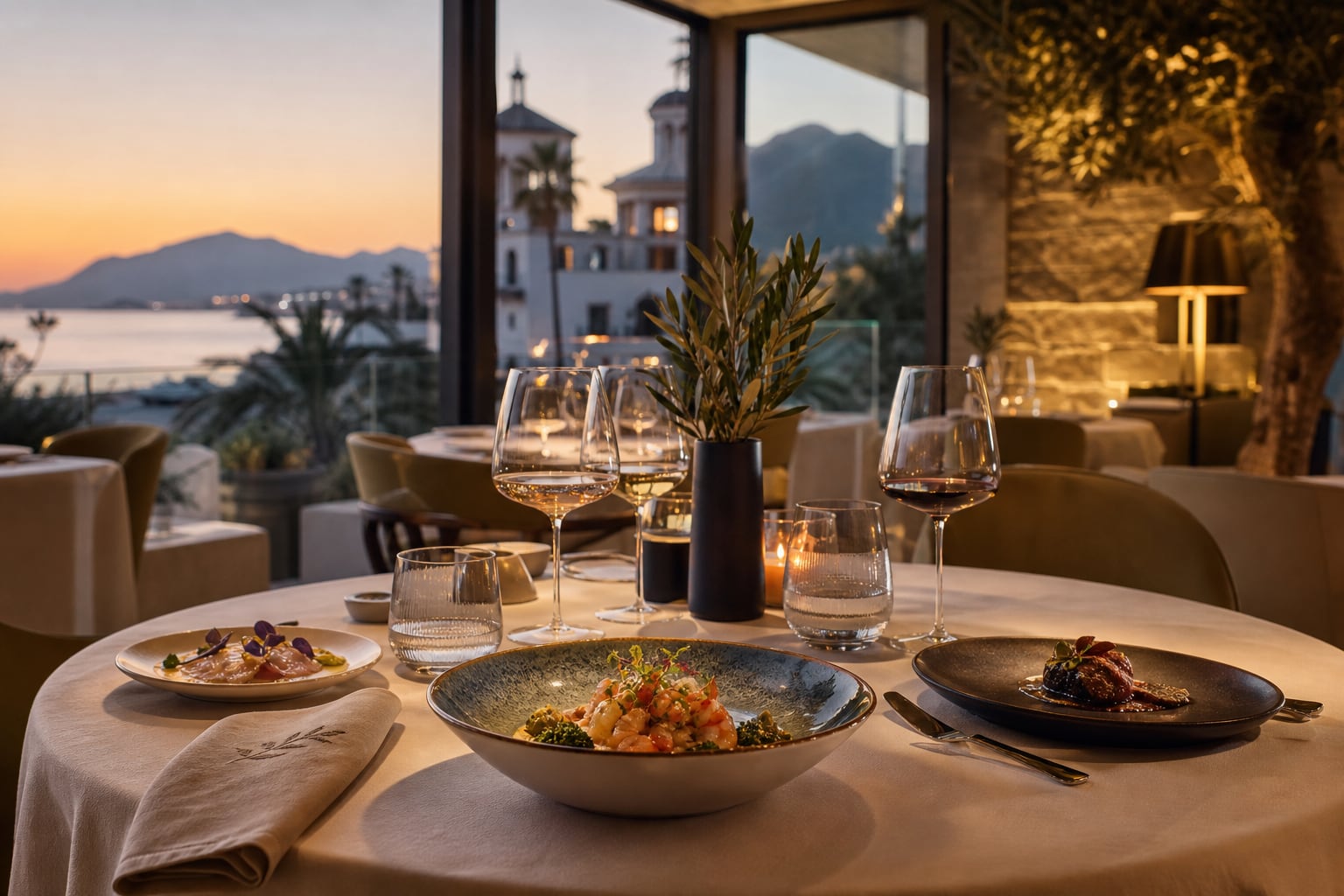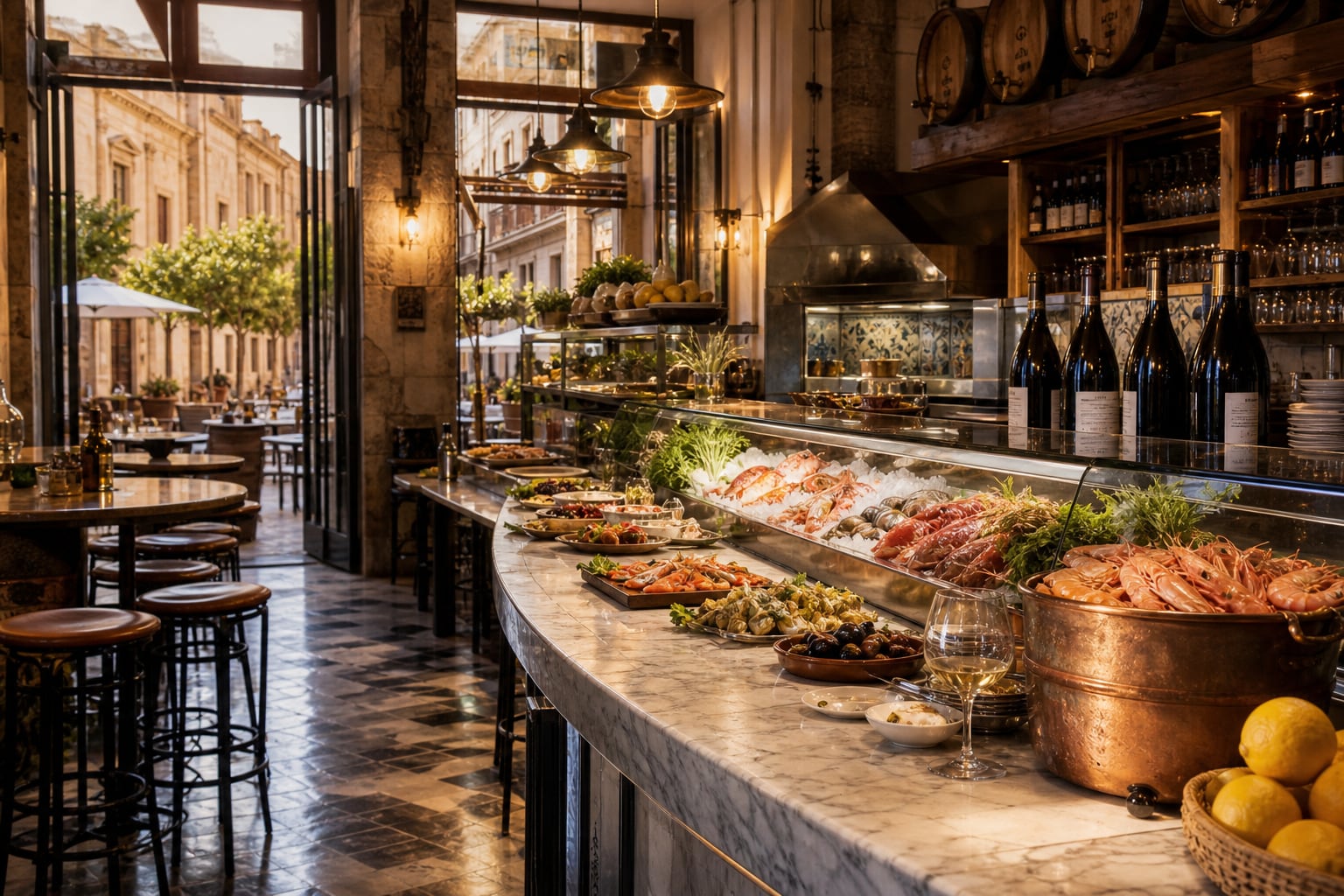
Málaga province now holds eleven Michelin stars across nine restaurants, and for the second year running the Spanish edition of the guide was unveiled not in Madrid or Barcelona but in Málaga city itself, at the FYCMA congress centre in November 2025. For a coast still better known abroad for sun-loungers than tasting menus, that is a quietly significant fact — and it matters more than it first appears to anyone weighing up a home around Marbella, because the city where those kitchens cluster sits roughly forty-five minutes east on the AP-7, about sixty kilometres from the Golden Mile.
Buyers tend to research Marbella, Estepona and Benahavís street by street and treat Málaga as the place the plane lands. That is a mistake. Over the last decade the provincial capital has turned itself into one of southern Europe''s more serious eating cities — and it has done so without losing the cheap, barrel-poured, market-stall culture that makes it worth the drive in the first place. What follows is not a tourist list but a buyer''s argument: a tour of four very different Málaga institutions, and why a real food city this close changes what it means to own a home on the western Costa del Sol.
The market that is still a market
Start where the city eats. The Mercado Central de Atarazanas, a block back from the Alameda Principal, is a nineteenth-century iron-and-glass hall built onto something far older: its great horseshoe-arch doorway survives from the fourteenth-century Nasrid shipyard that gave the building its name — atarazanas means dockyards in Arabic, from a time when the sea reached this far inland. The arch is the showpiece, but the point is everything beneath it.
Atarazanas is not a restored heritage attraction. It is a working market where fishmongers, butchers and greengrocers still trade every morning, and where a cluster of stand-up bars along the aisles will fry that morning''s boquerones — Málaga''s famous small anchovies — and pour a cold beer or a glass of local wine while you stand among the produce. A plate of grilled prawns, a few clams, a slice of tuna, eaten at market prices with no tablecloth in sight, is the most honest meal in the city.
For someone deciding whether the Costa del Sol can be a real home rather than a holiday, this matters. A coast where the produce culture is intact — where you can buy the fish that was landed at dawn and watch it cooked ten metres from the stall — is a coast you can cook in year-round, not just dine out in for three weeks each August. The same logic plays out closer to Marbella in the humbler beach kitchens; our piece on Marbella''s espeto de sardinas and beachfront life traces the chiringuito version of the same tradition.
Wine from the barrel, two centuries deep
Málaga''s drinking culture is built on sweet wine, and two institutions guard it. A short walk from the market on the Alameda Principal stands the Antigua Casa de Guardia, the oldest bar in the city, founded in 1840 and barely changed since. The wines — pajarete, a Pedro Ximénez monovariety, alongside Moscatel, dry seco añejo and the rest — are drawn straight from a wall of barrels, served in small glasses, and your running bill is still chalked in pencil on the worn wooden counter in front of you.
It is gloriously unpretentious: a stand-up, spit-and-sawdust tavern where a glass of the city''s historic sweet wine costs around two euros. These are the wines of the Málaga and Sierras de Málaga denominations — the Moscatel and Pedro Ximénez grown on the hills behind the coast — and tasting them at the bar that has poured them for nearly two centuries is the cheapest serious cultural experience on the whole Costa del Sol.
Its younger, grander cousin sits up in the old town beside the Roman theatre. El Pimpi, opened in 1971 in the cellars of an eighteenth-century mansion, is a warren of interconnected rooms hung with photographs and signed barrels — Picasso''s family, Antonio Banderas, who grew up in the city and is a co-owner — opening onto a terrace that looks straight up at the Moorish Alcazaba. It is busier and more polished than the Casa de Guardia, but the ritual is the same: sweet Málaga wine from the cask, a plate of jamón, the deep cool of an old bodega on a hot afternoon.
The stars and the everyday, on one map
At the other end of the spectrum is the marina. José Carlos García, on the Muelle Uno quay at Paseo de la Farola, has held a Michelin star since 2023 and renewed it in the 2026 guide. The chef built his name at the legendary family-run Café de París before opening this contemporary, terrace-fronted room over the yachts; the cooking is tasting-menu only and built on malagueño flavours — gazpachuelo, the warm emulsion soup of the local fishermen, the cold tomato-and-pepper pipirrana, clams and whiting from the bay.
What makes the province extraordinary is the density. Those eleven stars are spread across just nine restaurants, two of them with two stars apiece — Benito Gómez''s Bardal up in Ronda and Marcos Granda''s Skina in the heart of Marbella''s old town. The full constellation runs from José Carlos García, Kaleja and Back in Málaga city to Sollo in Fuengirola and Nintai near the coast, a spread that put Spain''s national tally at 357 Michelin stars when the 2026 guide was announced. A buyer in Estepona or Benahavís is not choosing between Marbella''s kitchens and Málaga''s; both sit on the same forty-minute axis.
That breadth is the real luxury — not a single famous table, but the ability to eat fried anchovies at a market stall on a Tuesday, a two-euro glass of Pedro Ximénez at an 1840 counter on a Thursday, and a Michelin tasting menu over the harbour on a Saturday, all within the same compact city and all reachable from a home an hour or less away. Few European coasts can offer that range at that distance.
Why a food city this close changes a home
Proximity is the whole argument. From most of the western Costa del Sol — Marbella, Estepona, Benahavís, Mijas — Málaga city is a drive of roughly forty-five minutes, and the same road carries the international airport, the Picasso Museum and the Pompidou, the Soho arts district and the restored historic centre. Owning here means a genuine city, not just a resort strip, is a casual evening out rather than an expedition. That changed materially when the province pulled in a record fourteen million tourists in 2025 and kept building the cultural and culinary infrastructure that volume demands.
It also reframes the price conversation. The western coast — the so-called Golden Triangle of Marbella, Estepona and Benahavís — has seen new-build values climb to around €7,000 per square metre in Estepona''s top segment on Idealista''s 2026 reporting, with Marbella''s averages comfortably higher still. Part of what underwrites those numbers is exactly this kind of lifestyle depth: 320 days of sunshine a year, 160 kilometres of beaches, and now a Michelin-dense capital city a short motorway hop east. The food scene is not a footnote to the property thesis; it is part of the asset.
The practical takeaway for a buyer is simple. When you weigh a home around Marbella, draw the circle wider than the urbanisation gate. The week that makes Costa del Sol ownership worth it is the one that includes a market lunch in Málaga, a glass of barrel wine in a two-hundred-year-old tavern, a long table by the marina — and the easy knowledge that all of it is closer than the next town over feels in most countries.
If a home within easy reach of all this is what you are after, you can browse Domosmar''s current Marbella and Costa del Sol homes or speak to the Domosmar team about which towns and developments put the region''s food city — and everything else on this coast — within your forty-five-minute radius. More of our area and lifestyle writing lives on the Domosmar blog.