On 11 September 2026, the antepenultimate stage of La Vuelta a España finishes at the top of Peñas Blancas — the 16-kilometre climb that rises directly out of Estepona to a summit at 1,003 metres above the Mediterranean. It will be the third time the Vuelta has decided a stage on this Costa del Sol mountain — confirmation, if any were needed, that the stretch of coast between Estepona and Marbella is not simply a beach resort but one of southern Europe's serious cycling addresses. For anyone who already rides, that is news. For anyone weighing where to buy a home around Marbella, it is also a useful tell.
The cycling scene here has built quietly over two decades, on the back of a particular geography: a coastal road that runs east–west, sea-level start points within minutes of climbs over a kilometre high, and a winter climate that allows training in shorts when most of northern Europe is on the indoor trainer. The result is a year-round community of riders — pro teams in pre-season camps, amateur racers, well-heeled cyclo-tourists, and a steadily growing layer of resident owners who happen to ride. Property is the quieter part of that story, but it is now visible enough that buyers ask about it before the second viewing rather than the tenth.
Peñas Blancas and the Vuelta verdict
The Peñas Blancas climb begins almost at sea level on the eastern edge of Estepona and rises 998 metres over 16 kilometres at an average gradient of 6.2%, with the road open to traffic but generally quiet once the first kilometre is behind you. Cycle Fiesta — one of the longest-running climb databases for Andalucía — ranks it among the best long climbs on the entire Costa del Sol, citing the open miradores over the Sierra Bermeja and the Mediterranean as much as the metrics. The Real Federación Española de Ciclismo has classified it as a mítica climb, a category reserved for routes considered nationally significant.
The Vuelta's history on the mountain reinforces all of that. Stage 19 of the 2026 race — the antepenultimate stage on 11 September — runs from Vélez-Málaga over four categorised passes before the long Peñas Blancas drag, finishing at the summit at the end of a roughly 200-kilometre day. Estepona's town hall has been preparing for the road closures since the route was confirmed. From the Peñas Blancas pass, riders with appetite for more can continue another 5.5 km to the TV tower at Los Reales at a steeper 7.7% average — the climb that turns Sierra Bermeja into the kind of training profile pro teams build whole camps around.
What matters for a buyer is not the watts on the climb but what the route signals. A stage of a Grand Tour does not finish on a mountain unless the road, the signage and the supporting infrastructure can handle it; and once a road carries that pedigree, the rest of the regional cycling economy organises around it. Hotel rooms that take bikes seriously, mechanics who know what a carbon frame needs at the end of a 4,000-metre climbing week, cafés that open at 6:30 so a 7am ride can leave on time — these things follow a road like Peñas Blancas, and they raise the standard of everything around it.
The everyday climbs — Istán, Ojén and Juanar
Most days, the cycling around Marbella is not about climbs that decide stage races. It is about a small, easily mapped set of routes that locals ride before work and that visiting pros use as base mileage. Three of them are worth knowing about by name.
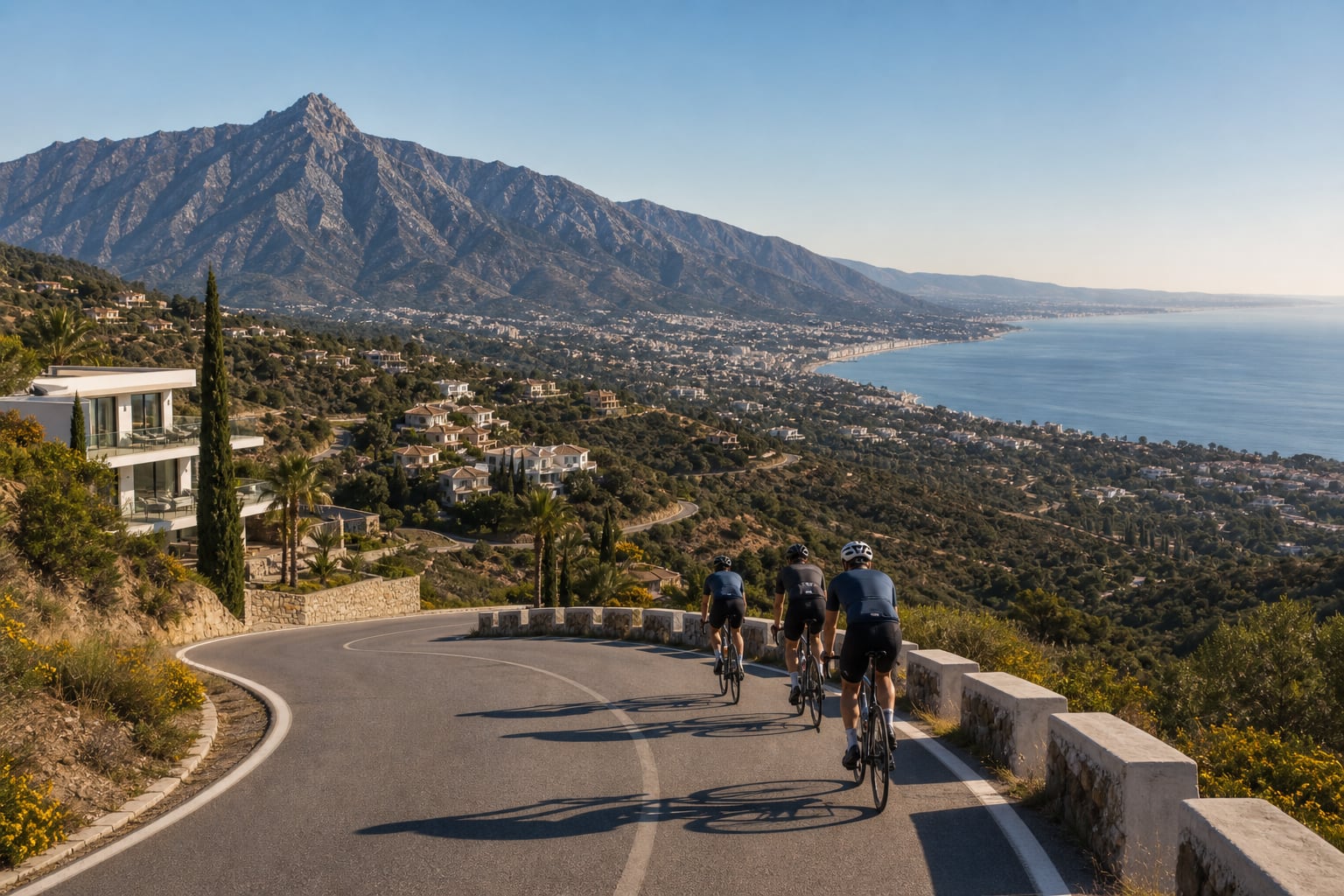
The road to Istán climbs inland from Marbella past the Embalse de la Concepción reservoir — roughly 15 kilometres out-and-back, about 400 metres of gain along the Río Verde valley, with a famously consistent gradient and almost no traffic outside village hours. It is the closest thing the area has to a "neutral" climb: hard enough to register, easy enough to ride at the end of a long week. The descent back into Marbella through the lower slopes of Sierra Blanca is one of the most reliable mood-fixers the coast has to offer.
Ojén, eight kilometres inland from Marbella up the A-355, is steeper and more compact — gradients touching 15% on the upper ramps, and a particularly grim switchback section locally nicknamed Los Caracoles (the Snails), where the road gains roughly 700 metres in under 10 km. Cyclists who train on the Ojén road tend to be the ones racing on it later in the season. Above the village, the Mirador del Juanar climb — a balcony of road carved into the south face of Sierra Blanca, topping out near 750 metres with a view that runs from Gibraltar in the west to the African coast on a clear day — is the area's classic "tourist climb": longer, easier than Ojén, and as photogenic as anything on the Costa del Sol.
Komoot, the route-planning platform, catalogues more than ten well-trodden road loops within an hour's pedal of Marbella's old town, and Strava heat-maps for any midweek morning show a consistent thread of riders threading through Nueva Andalucía, up to Istán, and back down through San Pedro along the coastal promenade. The 17-kilometre car-free seafront path between Marbella and San Pedro — the Senda Litoral — does most of the work of getting cyclists from town to the foot of the climbs without a stretch of busy A-7. None of it is glamorous on the page. It is the kind of routine that quietly makes a place liveable for people who ride.
The big day out — San Pedro to Ronda on the A-397
For anyone with one long day in the legs, the climb that defines the area is the A-397 from San Pedro de Alcántara up to Ronda. From the roundabout where the A-7 meets the A-397, the road rises 1,003 metres over roughly 20 kilometres at an average gradient of 4.9%, with maximum ramps around 10% and a summit at the Puerto del Madroño pass, 1,058 metres above sea level. The full route to Ronda itself is around 50 km one-way, with a section of rolling high country before the descent into the town's bullring district.
The road surface — re-laid by the Junta de Andalucía over the past several years — is now wide, well-maintained and consistently signed. Forums populated by visiting cyclists are unusually consistent on this point: the A-397 tarmac is "excellent throughout" by the standards of Spanish mountain roads. The trade-off is traffic, since the A-397 is the main link between Ronda and the coast; weekday mornings before nine, or Sunday mornings, are when serious riders go up. The view from the summit, over the cork forests of the Sierra Bermeja toward the white village of Pujerra and across the Genal valley, is one of the area's quiet rewards.
The full Marbella–Ronda–El Burgo–Monda loop — the route locals call the Gran Fondo — comes in at around 140 kilometres with 3,000 metres of climbing, threading through the white villages of the upper Guadalhorce before dropping back to the coast via Coín. It is the ride that pro teams use for a long endurance day in February and that ambitious club cyclists use as a once-a-month benchmark. For property buyers, it is the most direct evidence of why the area attracts the riders it does: a single day, from your front door, across some of the most interesting terrain on the southern Iberian peninsula, and home before the kitchen is busy with dinner.
Why the pros come here in February
The first reason is climate. AEMET, Spain's state meteorological agency, records the Marbella coast at roughly 2,900 to 3,000 sunshine hours a year — comfortably more than 320 sunny days in most reckonings — with January and February daytime highs typically in the 16 to 18°C range and overnight lows along the shore rarely dropping below 8 to 10°C. For a professional cyclist coming out of a Belgian or Norwegian winter, that is the difference between three hours of base mileage in arm-warmers and a five-hour ride in summer kit. The microclimate sheltered by Sierra Blanca, which blocks the cold northerly wind, is a documented effect rather than a marketing claim.
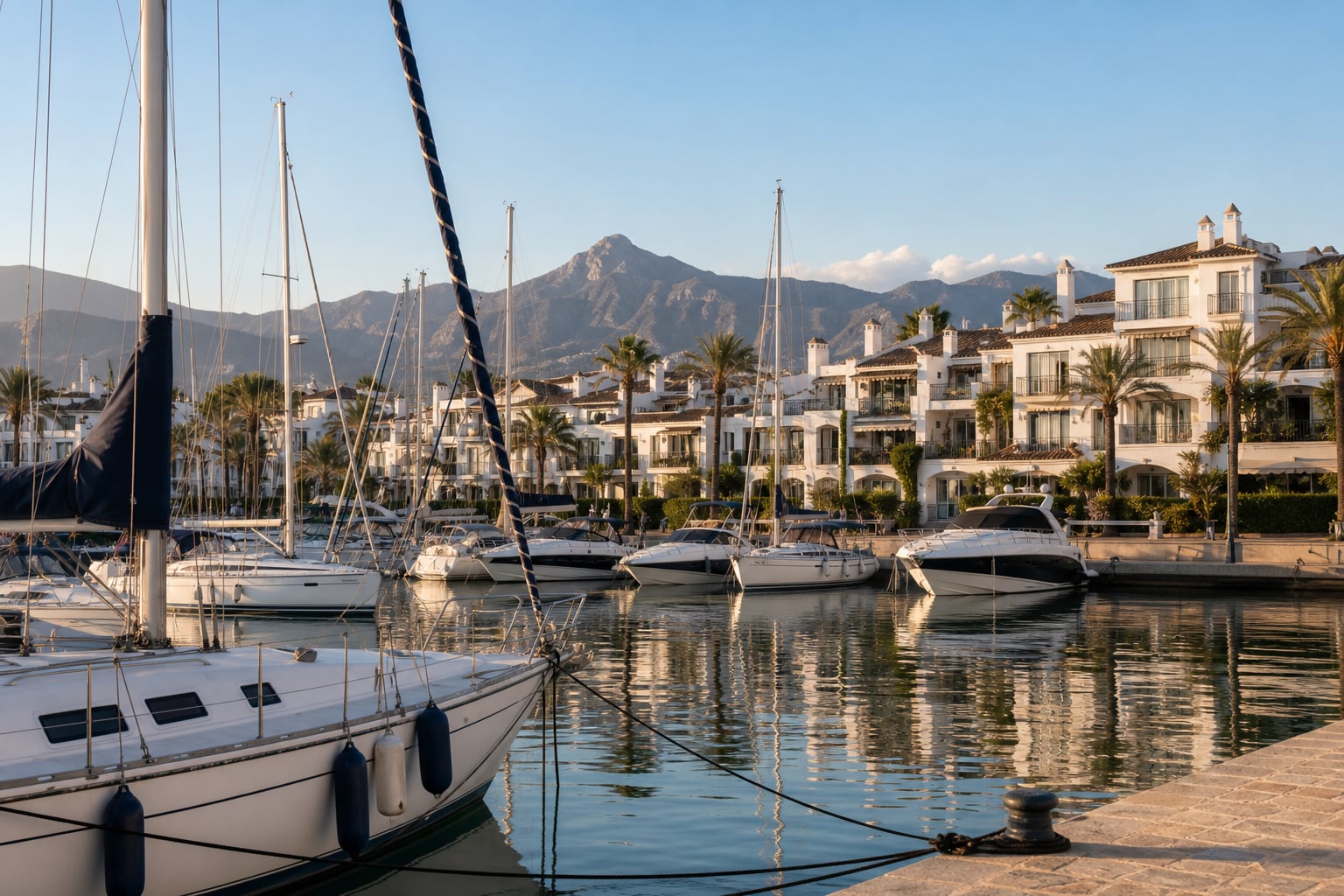
The second is infrastructure. Local bike rental and service operators along the A-7 corridor — from established outfits like Marbella Rent a Bike in the centre to the more recent boutique cycling hotels around San Pedro and Estepona — now stock professional-spec road bikes, run guided rides, and offer post-ride physiotherapy and recovery work. Teams from the WorldTour and major UCI Continental squads have used the Marbella–Estepona–Benahavís triangle as a pre-season camp base for more than a decade, and the broader Costa del Sol has been classified as a Bike Friendly destination by the Málaga provincial tourism authority since 2018.
The third reason is the event calendar. Beyond the Vuelta's periodic visits, Estepona launched its own Subida Mítica Sierra Bermeja — an official cycling competition straight up the Peñas Blancas climb — under the Real Federación Española de Ciclismo banner. The IRONMAN 70.3 Marbella triathlon, which uses the inland roads for its bike leg, draws several thousand competitors and far more spectators each spring. None of these on its own would shift a property market. Together, they explain why the cycling community here is no longer a seasonal visitor.
What it means for buyers around Marbella, Estepona and Benahavís
For most buyers, road cycling will not be the headline reason to choose Marbella, Estepona or Benahavís over another Mediterranean coast. But it is increasingly one of the lifestyle signals that quietly distinguishes one neighbourhood from another, in the same way that proximity to a championship golf course or a busy padel club has come to do.
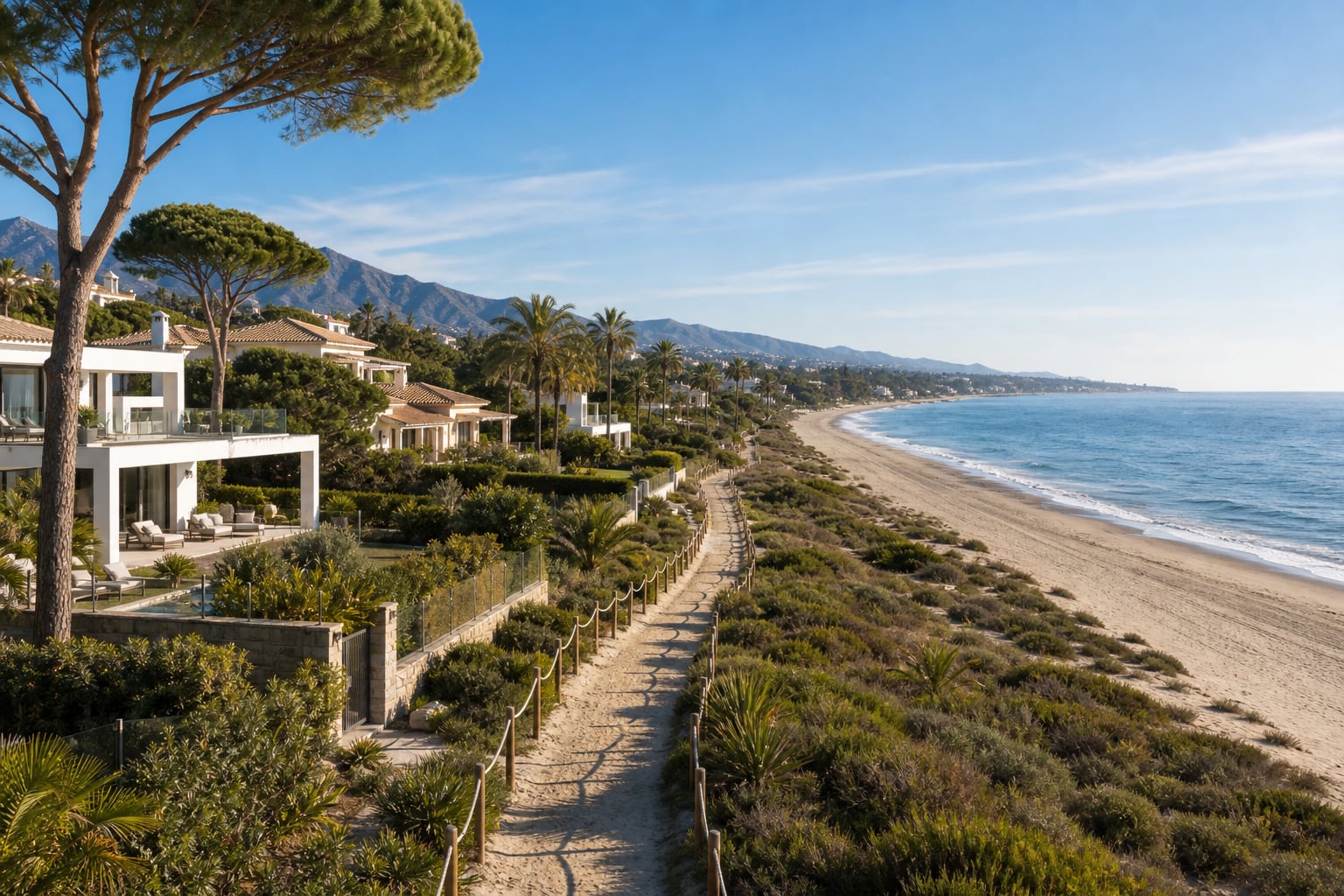
In practice, the cycling-friendly neighbourhoods cluster in a fairly predictable pattern. Nueva Andalucía sits at the foot of the Istán climb and the Ojén road, with the seafront Senda Litoral a few minutes away — the reason a number of resident pros and amateur racers base themselves there. San Pedro de Alcántara, slightly quieter than central Marbella, is the obvious choice for anyone whose weekly ride is the A-397 to Ronda; the climb literally begins at the town's northern roundabout. Along the New Golden Mile and into Estepona, the appeal is direct access to Peñas Blancas and the broader Sierra Bermeja network, plus the gentler coast roads through Casares Costa toward Sotogrande. In the hills above, Benahavís offers altitude, quieter climbing roads through La Quinta and Los Arqueros, and the kind of village geography where five Lycra-clad cyclists at a Sunday lunch are simply the norm.
The hard property numbers tend to follow the same coastal arc. Nueva Andalucía's average reached €5,654 per square metre in early 2026 — a fresh historical high — with the Marbella Golden Mile near €6,789 per square metre and the New Golden Mile pricing in a wide band as new-build completions arrive. None of that premium can be ascribed to cycling alone. But cycling sits inside the broader story of why those neighbourhoods hold their values: a sustained, year-round outdoor culture, a buyer base that uses the home for more than two weeks in August, and a growing alignment between the area's reputation and the reality on the ground.
For a buyer who actually rides, the practical questions are slightly more specific. Is there secure indoor bike storage and a wash-down point in the urbanisation? Is the access road safe to ride out of at first light? How far is the nearest stretch of Senda Litoral or the foot of a real climb? These are the kind of details an experienced local agent should be able to answer in the first conversation. If the questions matter to you, ask them — and shortlist accordingly.
Marbella-area property is bought for many reasons, and a road-cycling lifestyle is rarely the headline. But it is a useful proxy for what makes the coast genuinely liveable across a full year: a climate that supports outdoor routine in January as much as June, a road network that actually goes somewhere, and a community of residents — local, expatriate, sporting, retired — who organise their days around being outside. The cyclists are simply one of the most visible parts of that, and the part the Vuelta confirms in front of the world's cameras every few years.
If you are thinking about a home around Marbella, Estepona, San Pedro or Benahavís — for a year-round outdoor life, a winter training base, or simply a Mediterranean address that does not shut down in February — you can browse current new-build and resale listings across the area on our Costa del Sol property pages, or tell us how you actually use the day and we will build a shortlist around it — bikes, padel courts, golf bags or none of the above.