Between the AP-7 motorway and the white village of Casares, the MA-8300 climbs through cork oak and olive country past a single estate containing seven restaurants, a Nicklaus-branded golf academy and a 6,000 m² beach club down on the Bahía de Casares. Finca Cortesin is, by some distance, the densest concentration of culinary investment on the far western Costa del Sol — and it sits in a municipality of barely a few thousand registered residents, twenty minutes beyond the point where most Marbella visitors turn around.
That mismatch — serious kitchens, small town — is precisely what makes the food story of Casares worth a buyer's attention. Restaurants of this calibre do not appear by accident; they follow money, and money has been moving down this stretch of coast for a decade. The same municipality where a Michelin-starred Japanese kitchen operated inside a hacienda is now posting some of the steepest residential price growth on the Costa del Sol: Fotocasa's index puts the average asking price in Casares at 4,519 €/m² in May 2026, up roughly 17% in a single year. This guide covers where to eat and drink between the village, the coast and the vineyards next door in Manilva — and what the arrival of a genuine food scene has done to the property market underneath it.
One Estate, Seven Kitchens
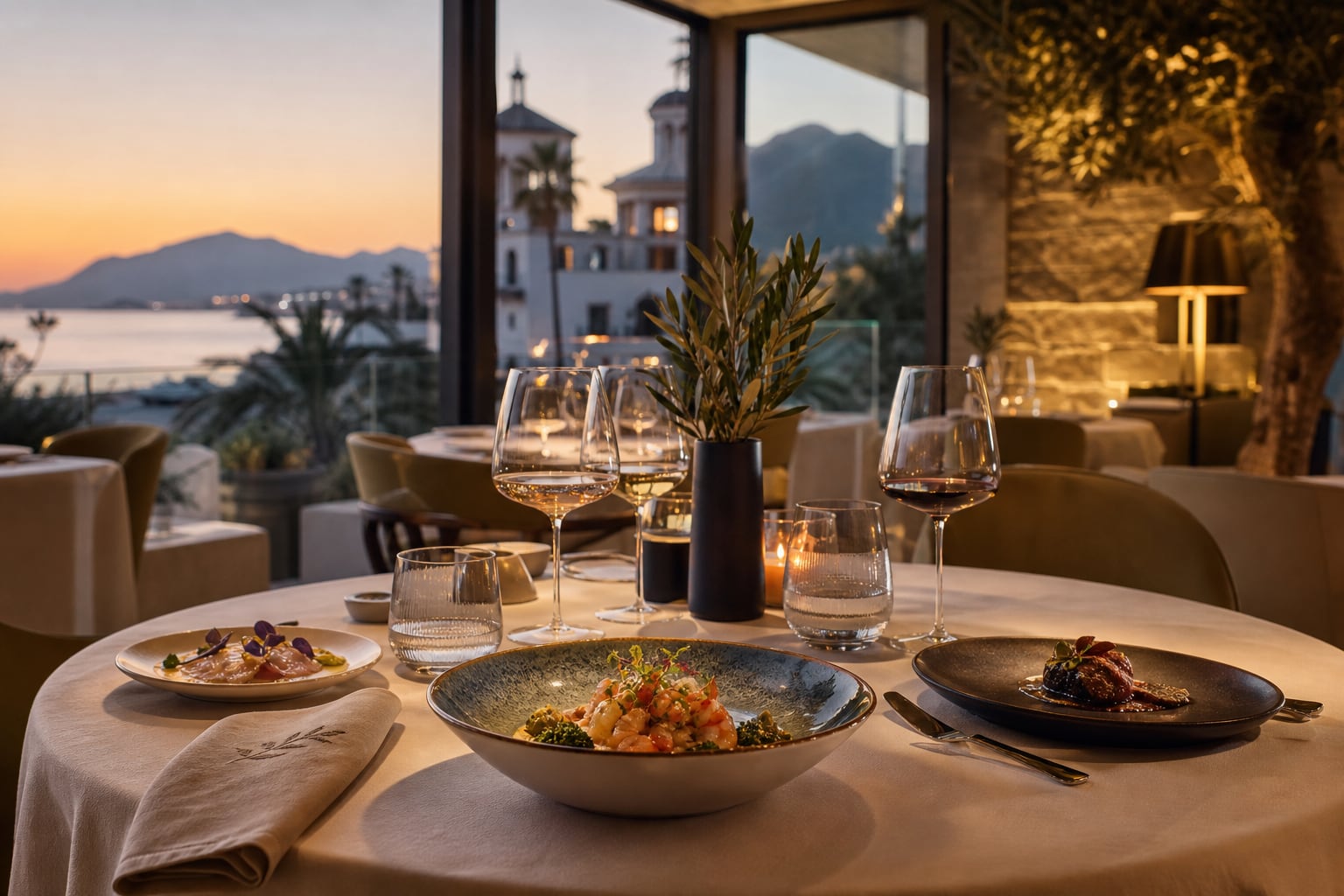
The anchor of the whole scene is Finca Cortesin, the resort on the Carretera de Casares that most golfers know as the host venue of the 2023 Solheim Cup. Its gastronomic reputation was built by Kabuki Raw, the Japanese-Andalusian kitchen that earned a Michelin star in 2015 working wild local fish into orthodox Edomae technique — bluefin from the almadraba boats of Cádiz served metres from an Andalusian courtyard. That chapter has since evolved: the resort's signature restaurant now trades as REI, with the same chef, Luis Olarra, still at the pass, serving traditional Asian dishes alongside a menu built on the encounter between Japanese technique and Mediterranean produce. It opens Tuesday to Saturday evenings, and booking ahead is not optional in summer.
REI is one of seven places to eat on the estate. El Jardín de Lutz, under chef Lutz Bösing, handles the Spanish repertoire from a terrace looking over old olive groves toward the sea. Don Giovanni is the southern outpost of Sicilian chef Andrea Tumbarello, whose Madrid restaurant holds a Repsol Sun; his pasta room operates Thursday to Monday evenings in the resort gardens. The Clubhouse serves seasonal cooking above the golf course, Pool 35 grills beside the 35-metre pool, the Blue Bar covers tapas and cocktails in the main lounge, and down on the shore at the Bahía de Casares the Beach Club spreads its 6,000 square metres of pine deck and Mediterranean menu behind Playa Ancha.
What matters for a buyer is that none of this is seasonal scaffolding. The resort operates year-round, the restaurants are open to non-guests, and the estate has steadily added residential product — from the La Reserva and Green 10 villas inside the grounds to the wider ring of urbanisations that have grown up around the golf course. Owning within ten minutes of this cluster means having a serious dinner answer to any Tuesday evening, in a part of the coast where, fifteen years ago, the alternatives were a venta on the old road or a drive to Estepona.
The Grill on the Casares Road
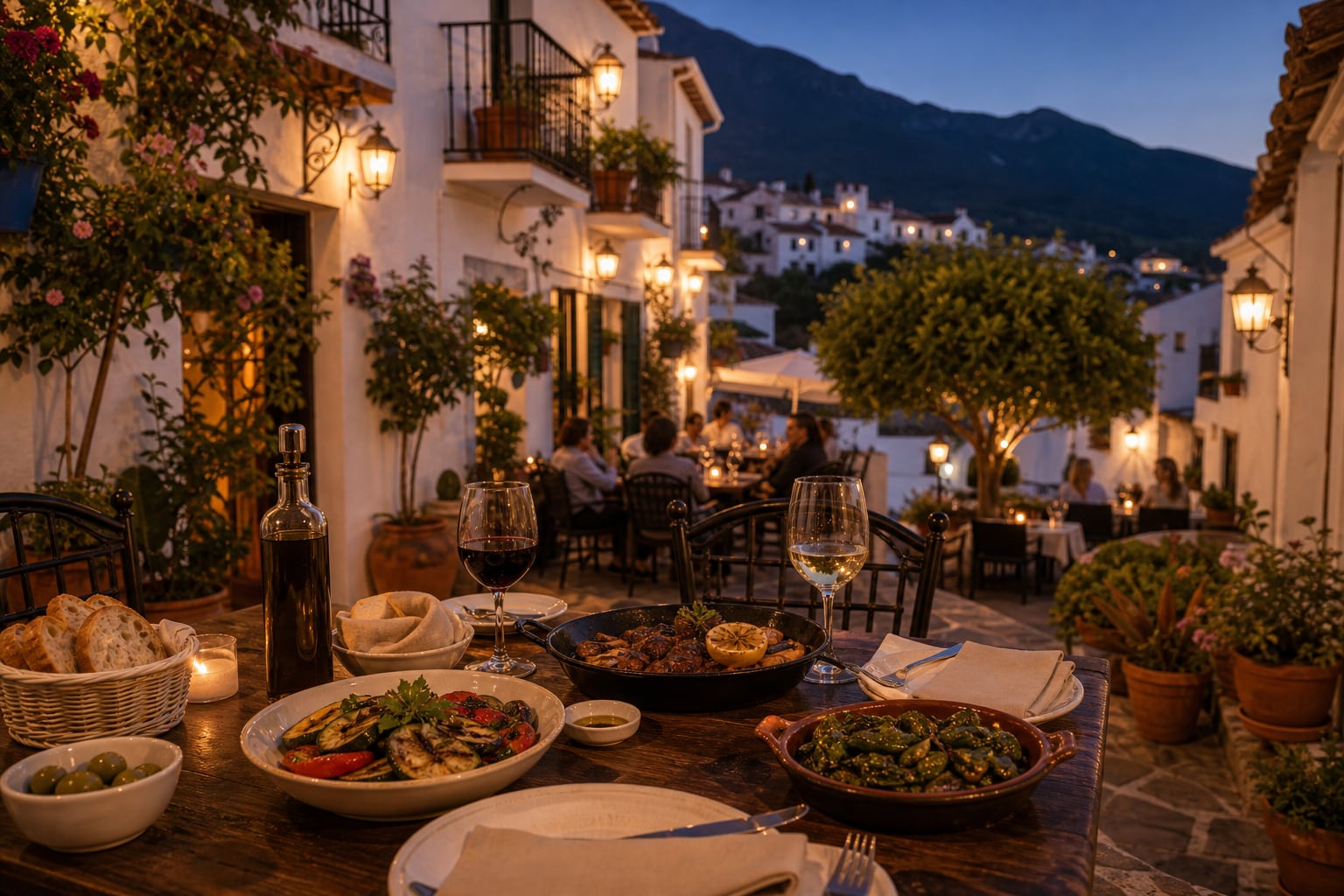
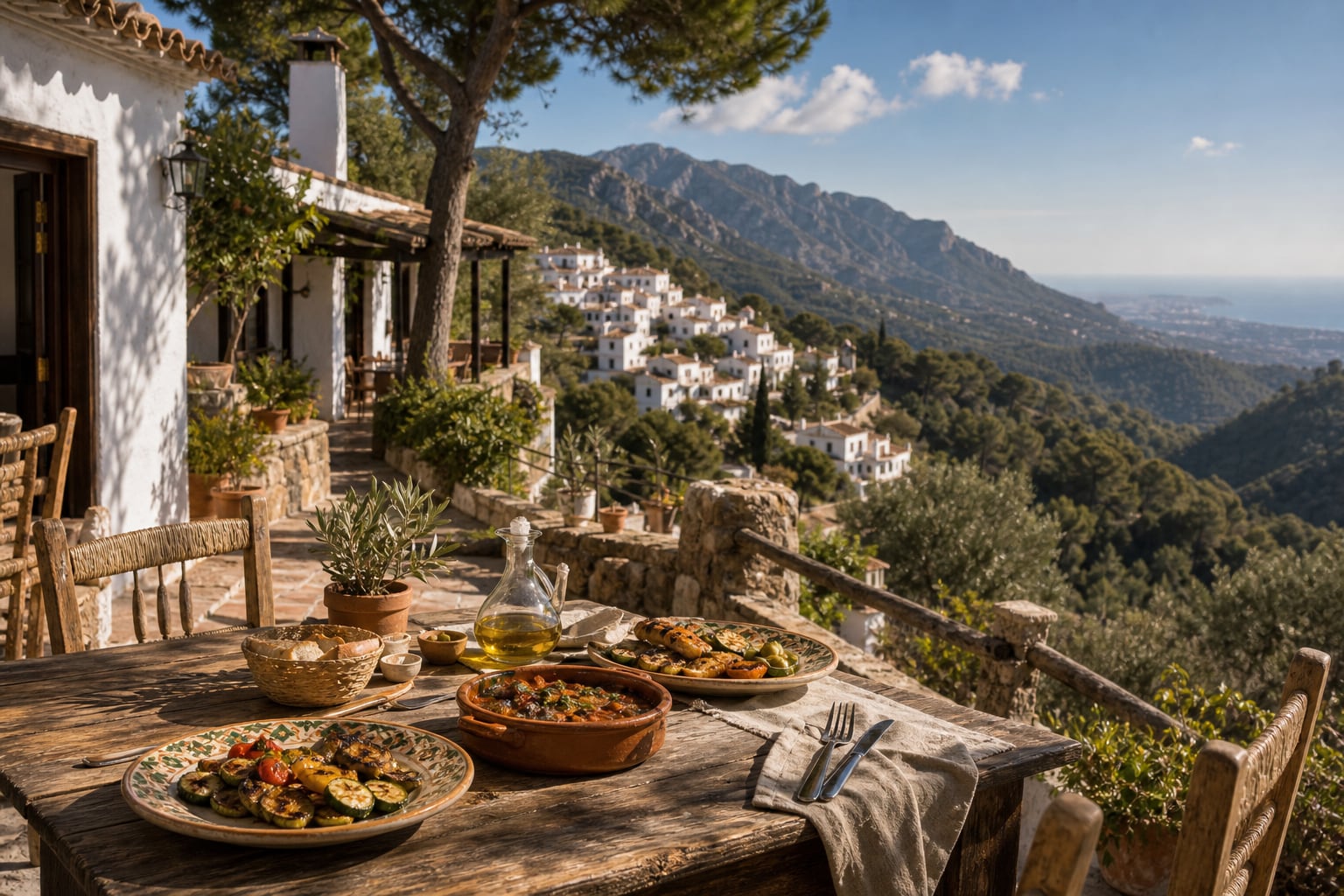
Twelve kilometres up the mountain road from the coast, just below the village itself, sits the restaurant locals are most likely to recommend: Sarmiento Brasa Andaluza, run by two brothers at Finca La Espileta, at kilometre 12.5 of the Carretera de Casares. The dining room and terrace face the full postcard view of the white village stacked beneath its Moorish castle, and everything that matters here comes off a wood-fired grill — the oldest cooking technique there is, applied with unusual discipline to Andalusian raw materials. The restaurant's own "legacy" project documents its suppliers by name: goat's cheese from Quesos Crestellina under the limestone ridge of the Sierra Crestellina above the village, locally farmed avocados, eggs from Loma La Jordana, tuna from Petaca Chico in Barbate.
It is worth planning around a short, lunch-weighted opening week — currently Wednesday and Saturday for lunch and dinner, Sunday for lunch only — and, at the time of writing, around the roads themselves: the A-7150 that links Manilva, Gaucín and Casares is closed for works, so the restaurant directs arrivals onto the MA-8300 from the AP-7, the same road that passes Finca Cortesin. The detour is no hardship. It is one of the better short drives on this coast, and it ends at a village that takes its food culture seriously for a place its size — Casares is the birthplace of Blas Infante, the father of Andalusian regionalism, and its old centre keeps a working ring of bars and ventas around the Plaza de España.
Down at sea level, Casares Costa runs to a different rhythm: chiringuitos and beach restaurants along Playa Ancha and the Marina de Casares serving grilled sardine espetos and fried fish through a season that, on this coast, stretches far beyond summer — the Costa del Sol's 300-plus days of annual sunshine keep terraces viable in February. For the texture of that beach-grill culture further east, our earlier piece on Estepona's food scene and the wines above the Costa del Sol picks up the same thread fifteen minutes up the A-7.
Moscatel With a Sea View
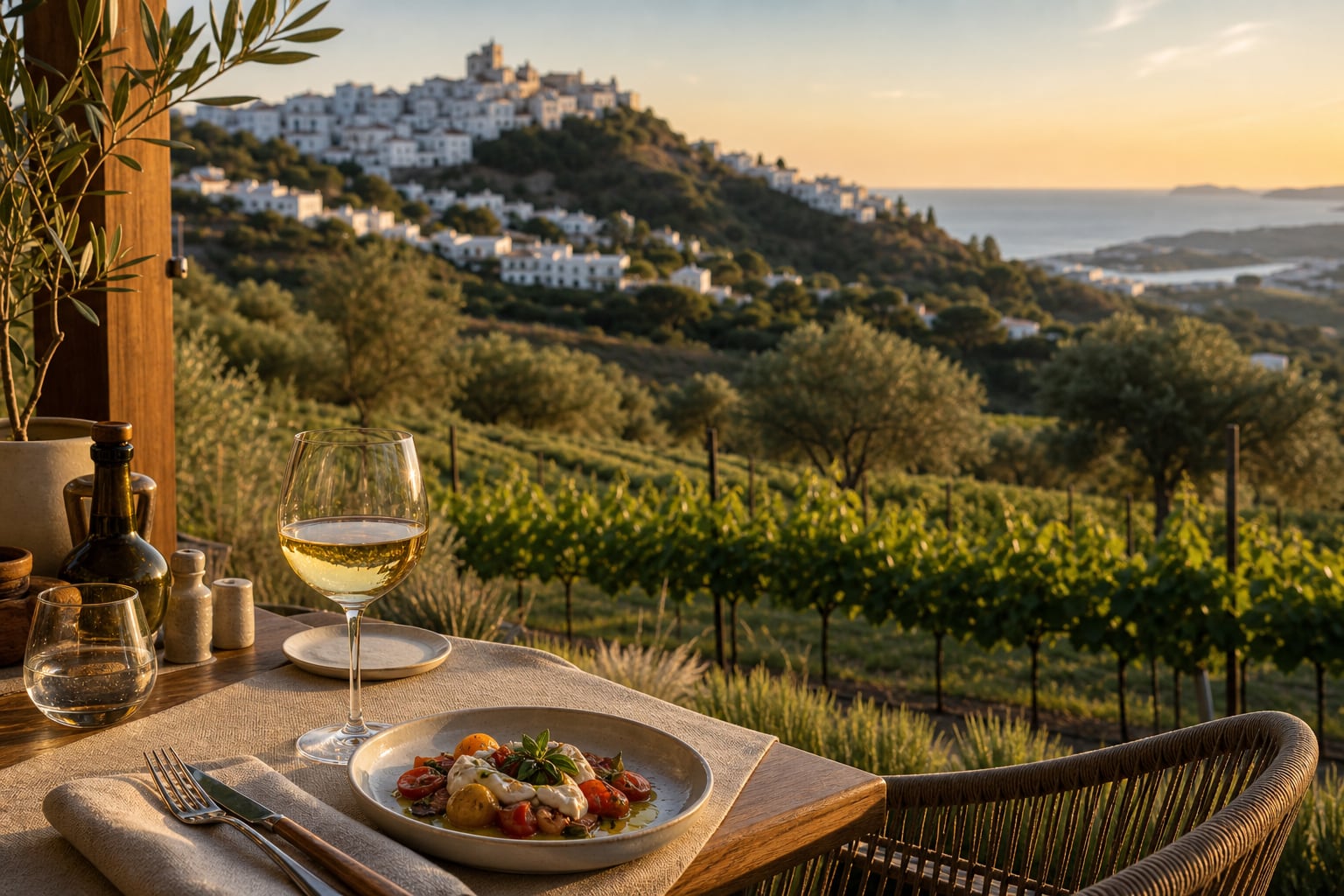
The wine story sits one municipality west. Manilva, directly across the border from Casares Costa, preserves some of the last working Moscatel de Alejandría vineyards on the Andalusian coast — old vines planted on slopes that face the Mediterranean rather than hide from it. The grape once covered these hills; most of it vanished into development and abandonment during the twentieth century. The recovery effort is led by Nilva, a small bodega in Manilva town whose Manilva Vineyard Recovery Project is gradually bringing the old parcels back into production.
Nilva's standard visit is the best two hours of wine tourism on this end of the coast: the CIVIMA wine museum (the Centro de Interpretación Viñas de Manilva, which traces the local industry back to the sixteenth century), the working bodega, and then the Viña del Peñoncillo itself, where Moscatel is tasted with tapas above a horizon of sea. The tour runs about two hours and costs 30€ per person, with summer visits timed to end at sunset over the water. For a region whose better-known wine country — the Sierras de Málaga DOP around Ronda — is an hour inland, having vines, museum and tasting room ten minutes from the beach is a quiet luxury few stretches of the Spanish coast can offer.
It also rounds out a genuinely complete weekend radius. From any home on Casares Costa you can reach a wood-fired mountain grill, a resort with seven kitchens, a starred-pedigree Japanese tasting menu and a recovering historic vineyard inside a fifteen-minute drive — with Finca Cortesin's championship golf course and Sotogrande's polo fields filling the daylight hours in between.
What the Table Does to the Market
Food scenes are not decoration on a property market; on this coast they are one of its leading indicators. The numbers in Casares now bear that out. According to Fotocasa's May 2026 price index, the municipality averages 4,519 €/m², with the average listed home valued at €595,600 — and asking prices up around 17% year on year across both larger and smaller properties. Within that average, the micro-markets diverge in instructive ways: Marina de Casares leads at 5,672 €/m², the village itself — Casares Pueblo — commands 5,243 €/m², the Casares Golf and Casares del Sol urbanisations sit at 4,467 €/m², Bahía de Casares at 4,402 €/m², and Doña Julia Golf remains the value entry at 3,474 €/m².
Two comparisons frame those figures. Neighbouring Estepona, with its far larger town and longer-established market, averages 5,194 €/m² on the same index — meaning most of Casares still trades at a meaningful discount to the municipality next door despite sharing the same sea, the same climate and, increasingly, the same calibre of restaurants. And the wider province is hardly standing still: Idealista's May 2026 report puts Málaga province at 4,158 €/m², up 11.8% in a year, which makes Casares's growth a case of a small market outrunning an already fast region rather than catching up to it.
Supply is the other half of the picture. Fotocasa counts over a thousand active sale listings in the municipality, a large share of them new build: the slopes between the AP-7 and the coast around Casares Golf and Doña Julia are among the busiest construction corridors west of Estepona. Current projects on our own books illustrate the range — The Place by Alcazaba offers two-to-four-bedroom apartments from €600,000 toward €1.5 million, while developments such as Skye Casares Golf and Alura Living put well-specified new two- and three-bedroom apartments in the €440,000–€865,000 band — price points that no longer exist for comparable new product in Marbella or most of Estepona. The full current selection is on our Casares properties page.
The buyer profile follows the food. The presence of a flagship resort with a starred culinary pedigree has pulled a wealthier, year-round demographic westward — the same pattern Benahavís rode a decade earlier, where a village restaurant cluster and a luxury enclave reinforced each other until the property market between them repriced. Casares is earlier in that curve, which is exactly the point.
Where the Opportunity Sits
For a buyer weighing the western corridor, the food scene around Finca Cortesin is a useful proxy for everything else that is happening here: infrastructure money, a maturing residential ring, and a lifestyle offer that no longer requires the drive to Marbella. The arithmetic is straightforward — a municipality averaging 4,519 €/m² beside one averaging 5,194 €/m², with the gap narrowing at double-digit annual rates, and a new-build pipeline still delivering three-bedroom homes under €550,000 within ten minutes of a resort that keeps seven kitchens running. Markets like this do not usually stay discounted once the reasons for the discount — remoteness, thin amenities, no name recognition — have demonstrably disappeared.
If you are considering a home near Casares, Manilva or the wider Estepona corridor, browse our current Costa del Sol property listings or talk to the Domosmar team — we know which urbanisations put you closest to the table, the tee and the vineyard, and which of them still trade below what the food scene says they should.