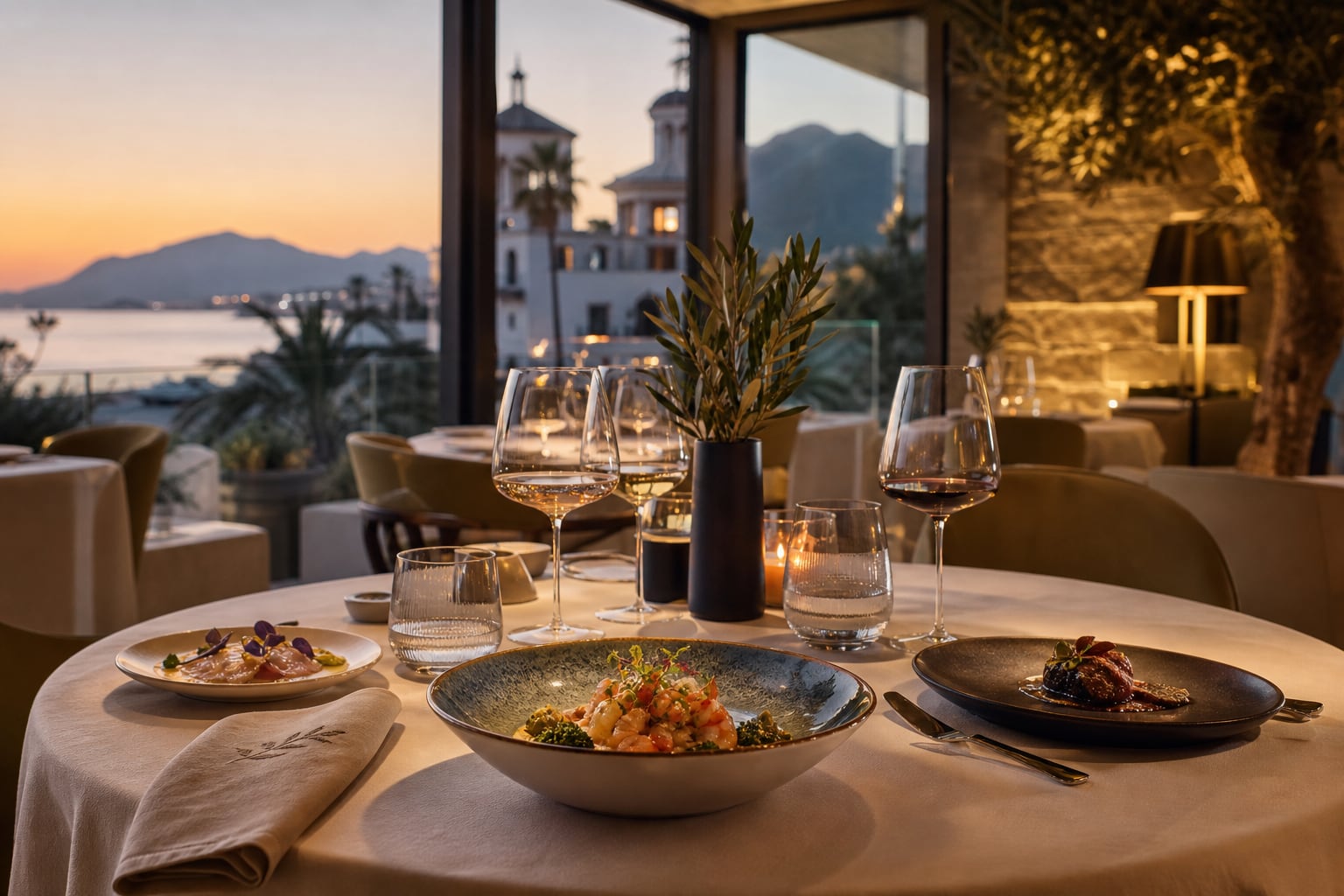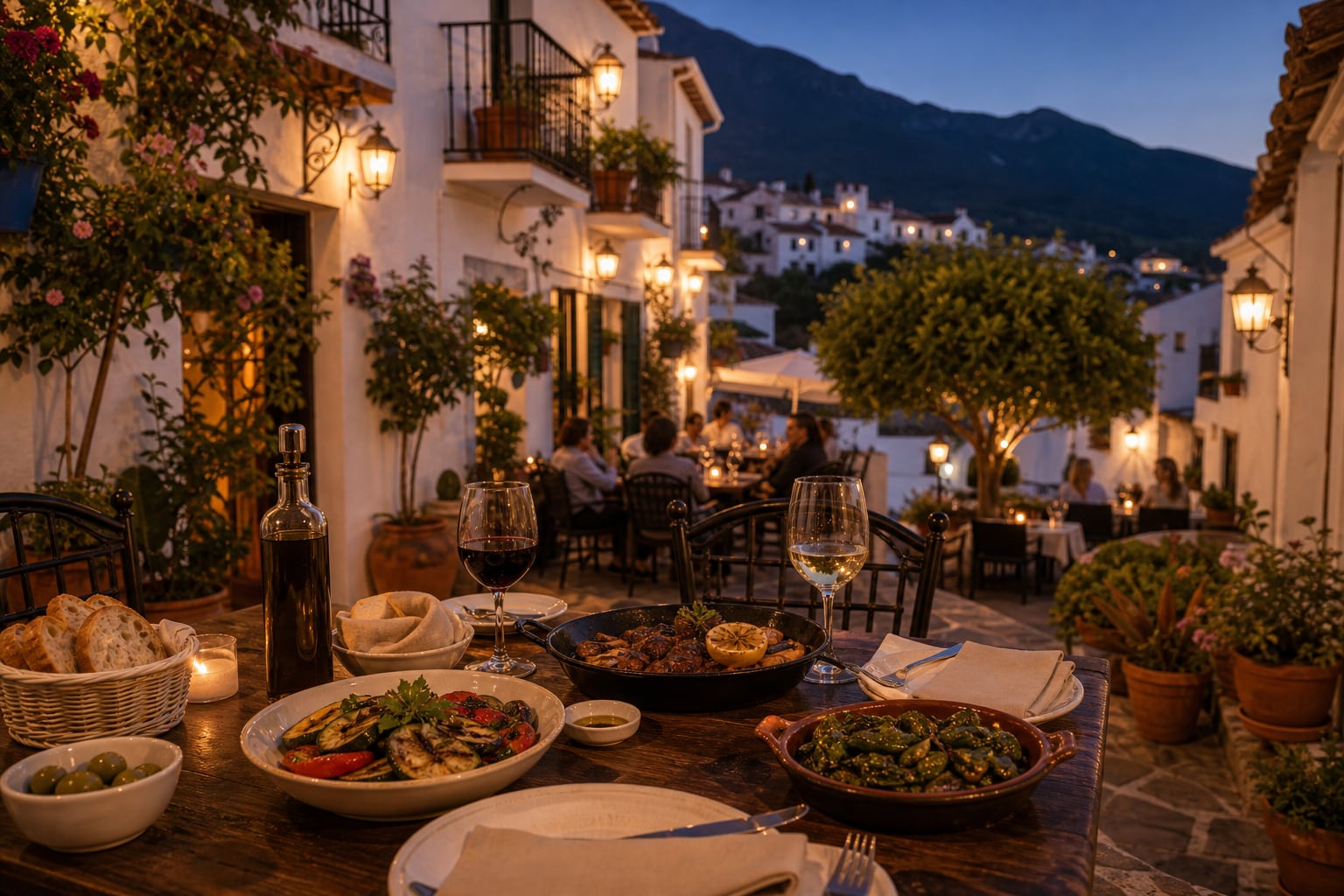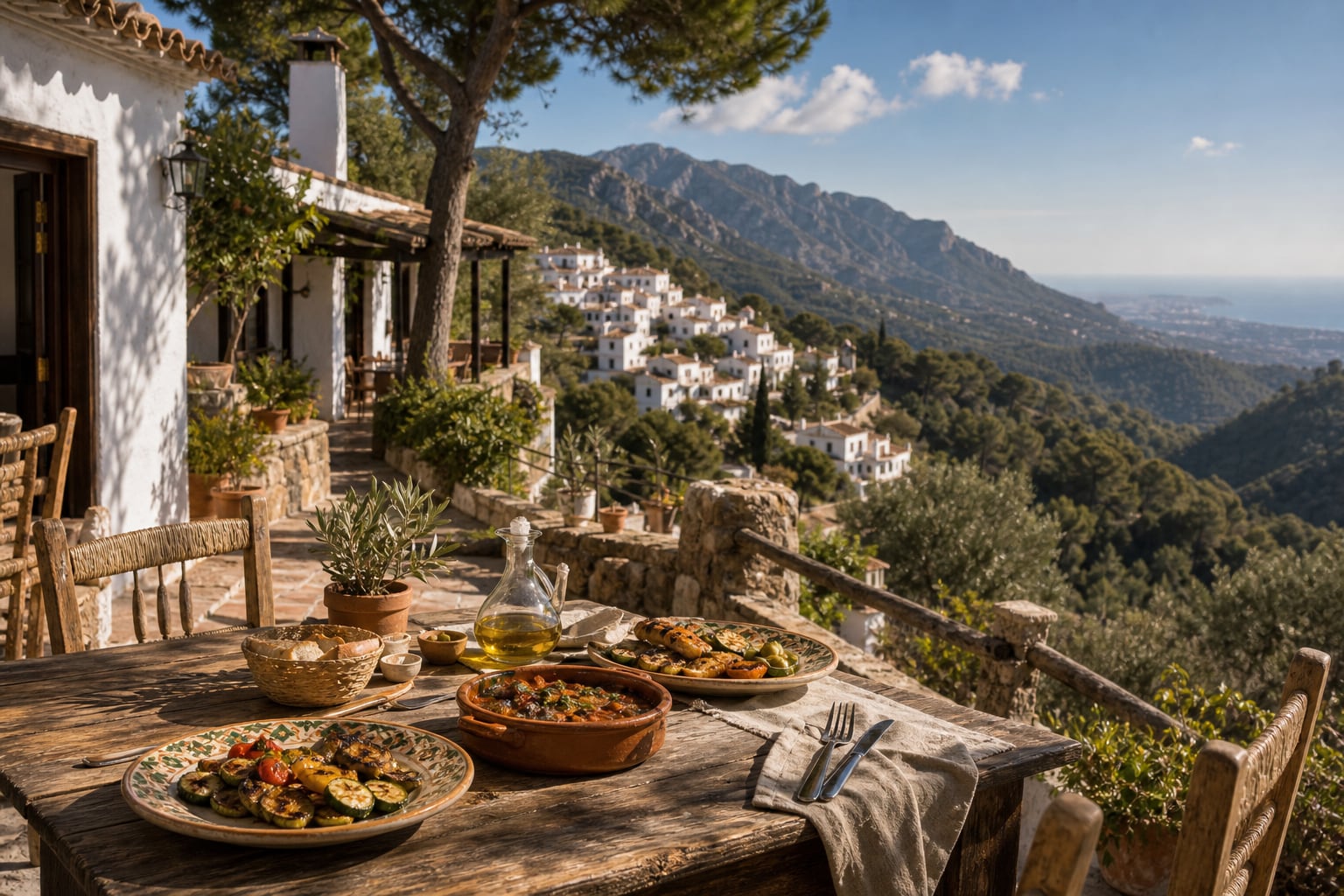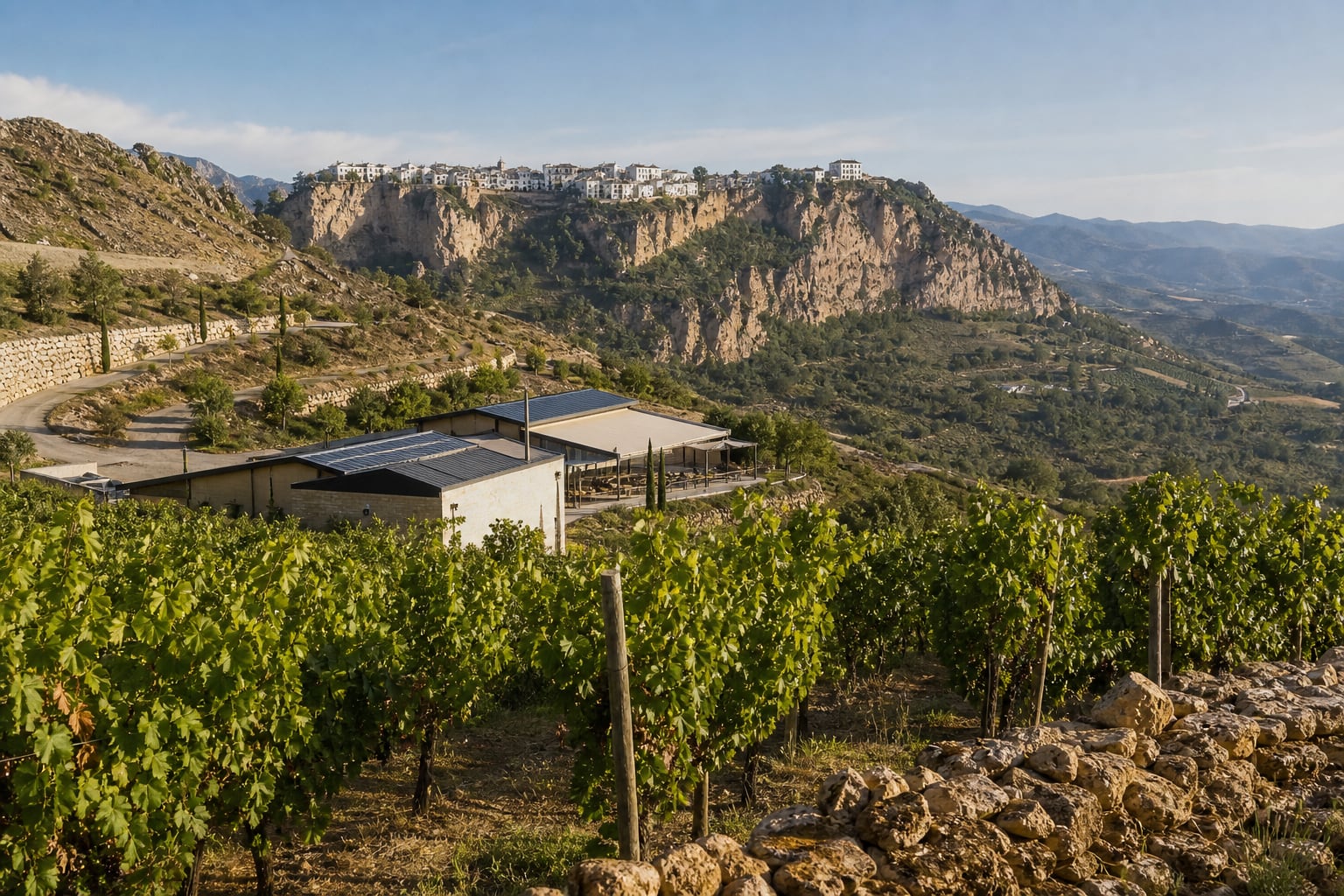
The wine on Marbella's better lists rarely comes from the coast. It comes down from 900 metres, an hour inland, off slopes that sit higher than any other vineyards in the province of Málaga. The Serranía de Ronda — the upland country wrapped around the cliff-top town of the same name — is the serious wine region of the Costa del Sol's hinterland, and for a buyer on the coast it is close enough to be a Sunday outing rather than a holiday.
That closeness is the whole argument for paying attention. From the western side of Marbella it is roughly 60 kilometres and an hour and a quarter up the A-397 to the vineyards — far enough to feel like a different Andalusia, near enough to be home by dinner. The wines belong to the Denominación de Origen Sierras de Málaga, the appellation created in 2001 for the province's dry table wines, and the Serranía de Ronda is its highest and most ambitious corner, with more than 250 hectares of vines and around two dozen estates that open their doors to visitors. This is a guide to that country — the road, the bodegas, the grapes and the two-star lunch at the end of it — and to why it belongs on the mental map of anyone buying a home between Estepona and Mijas.
An Hour Up the A-397
The drive is part of the wine. The A-397 leaves the coast at San Pedro de Alcántara and climbs north through the Sierra de las Nieves National Park, a designated park since 2021, in a steady sequence of hairpins and cork-oak forest that gains the better part of a thousand metres of altitude before it tips onto the Ronda plateau. It is a single-carriageway mountain road — wide enough, but not for overtaking, and best driven without a clock. The same ridges supply the upland walking we covered in our piece on hiking La Concha and the Sierra de las Nieves; the wine country sits on the far, inland side of that same massif.
What the altitude buys is a climate the coast cannot offer. Ronda sits at roughly 750 metres, the vineyards above it higher still, and the gap between hot days and cold nights — the diurnal range winemakers prize — is wide enough to keep acidity in the fruit through a southern Spanish summer. Generous winter rainfall, clay-and-limestone soils and the twin maritime influence of the Mediterranean and, further off, the Atlantic give the Serranía de Ronda a terroir that bears no resemblance to the beach forty minutes downhill. It is, by the reckoning of producers here, one of the southernmost serious wine regions in Europe.
For a coastal owner this matters in a practical way. The wine region is not a fly-in destination; it is an amenity of the western Costa del Sol, reachable for lunch from Nueva Andalucía, San Pedro, Benahavís or Estepona without an overnight bag. The Junta de Andalucía maps the producers as a formal Ruta de Vinos y Bodegas de la Serranía de Ronda, and a single day comfortably takes in two cellars, a tasting and a meal in the old town before the run back down the mountain.
The Bodegas Worth the Drive
The estate that put modern Ronda on serious wine lists is Cortijo Los Aguilares, five kilometres out of town on the Ronda–Campillos road, where the vines climb to around 900 metres under two-hundred-year-old holm oaks. It is best known for doing something most of southern Spain cannot — growing convincing Pinot Noir this far south — alongside Tempranillo, Petit Verdot, Grenache and Syrah. The cellar receives visitors Monday to Friday, 10am to 5pm, with tours in English, Spanish, French and Italian and Saturday mornings by request; the standard visit runs around 20€ per person. Booking ahead is essential.
For atmosphere, nothing on the route beats Bodega Descalzos Viejos, built into the shell of a sixteenth-century Trinitarian monastery on the lip of the Tajo gorge, a short walk down from the town centre. The frescoed chapel now shelters stainless steel and barrels, and the tasting comes with one of the better views in Andalusia. It is small, it is theatrical, and it sells almost everything it makes at the door — visits are by prior arrangement only.
North of the town, off the road to Ronda la Vieja, Bodega F. Schatz is the region's biodynamic pioneer: Friedrich Schatz arrived from South Tyrol in 1982 and farms a clutch of grapes almost no one else in Spain bothers with, from Lemberger to Muskattrollinger, on certified organic land. Nearby, Bodega Joaquín Fernández makes organic wines under the Finca Los Rutales label and keeps unusually civilised hours — generally open to visitors 11am to 2pm, Monday to Friday — while La Melonera, on the Paraje los Frontones off the A-374, runs a longer two-and-a-half-hour visit with tapas for around 20€ a head and has done as much as anyone to revive the region's near-forgotten native grape.
The pattern across all of them is the same, and it is the opposite of an industrial wine route: small production, family or owner-led tours, and an insistence that you call before you come. That is a feature, not a friction. It keeps the cellars quiet, the tastings unhurried and the experience closer to a private visit than a coach stop — which is precisely what a resident, rather than a tourist, wants on a free afternoon.
What Grows at 900 Metres
Ronda's reds are built mostly from international and Spanish classics — Cabernet Sauvignon, Merlot, Syrah, Petit Verdot and Tempranillo, with Grenache and that improbable Pinot Noir in the mix — and bottled as both young Tinto Joven and oak-aged Crianza. The whites lean on Chardonnay, Macabeo, Colombard and Sauvignon Blanc, made in a fresh, high-altitude style that locals pour with the fried and grilled fish of the coast below. The altitude is the signature: these are wines with more tension and lift than the Andalusian sun would suggest, because the nights up here do the work the days undo.
The more interesting story is the recovery of Romé, a native Andalusian red grape that all but vanished as growers planted French varieties through the late twentieth century. Several Ronda producers have gone back to it, treating it as the region's fingerprint rather than a curiosity — a thread of indigenous identity in a denominación otherwise dressed in Bordeaux and Burgundy clothes. It is the kind of bottle worth asking for by name; you will not find it on a supermarket shelf in Marbella.
There is a neat geographic symmetry to all this. The dry Moscatels and "Mountain Wines" of the coast — the bottles we paired with grilled sardines in our piece on Marbella's espeto de sardinas — come off the slate slopes facing the sea, while the structured reds come off the limestone behind the mountains. Between them, a buyer on this coast has two distinct wine regions inside an hour's drive in opposite directions, both flying the same Sierras de Málaga flag.
The Two-Star Lunch in the Gorge
A wine day in Ronda has a natural anchor, and it holds two Michelin stars. Bardal, the restaurant of Catalan-born chef Benito Gómez in the heart of the old town, is the gastronomic heavyweight of the whole Serranía — two MICHELIN stars and two Repsol Soles — and one of only a handful of two-star kitchens in all of Andalusia. It works through two tasting-menu formats, the Menú Bardal and the longer Gran Menú Bardal, priced at roughly 180€ and 215€ respectively, both pulling hard on the mountain larder around it: local game, cheeses, herbs and the produce of the Serranía. A table here is the reason to fix the date well in advance.
Ronda rewards the rest of the day too. The town is split by the Tajo, the gorge spanned by the eighteenth-century Puente Nuevo, with the oldest bullring in Spain on one side and a tangle of tapas bars and ventas on the other. Lunch need not run to three figures: the old town keeps a dense ring of bars serving the mountain's own cooking — sopa de la Serranía, locally raised pork, sheep's and goat's cheeses, game in season — at the prices a working Andalusian town expects to pay.
It is a different register from the coast entirely, and that is the appeal. After a season of beach clubs and chiringuitos — the world we mapped in our guide to eating around Finca Cortesin and Casares — a day at altitude among stone, vine and gorge is the counterweight that makes living here feel like more than a permanent holiday. The mountains are not scenery you look at from a terrace; they are somewhere you go.
Why a Coast Buyer Should Care
Wine country an hour inland does not show up on a property listing, but it belongs in the calculation. Part of what a home on this coast buys is a radius — the things you can reach and do without the airport, week in and week out — and the Serranía de Ronda widens that radius dramatically. With more than 300 days of sunshine a year on the coast and a national park, a wine route and a two-star kitchen all inside ninety minutes of the front door, the western Costa del Sol offers a depth of weekend life that a beach alone never could.
Geography rewards the right address. The homes best placed for Ronda are the ones that meet the A-397 first — Benahavís, Nueva Andalucía, San Pedro and the inland edge of Estepona — where the mountain road is a ten-minute approach rather than a cross-town crawl. It is the same logic that makes these areas convenient for the Golf Valley and the Sierra de las Nieves: position relative to the roads inland is quietly one of the more underrated factors in where life on this coast is easy versus where it is a constant negotiation with traffic.
If a home with the mountains genuinely within reach is what you are after — close to the sea, but with Ronda's vineyards an easy Sunday away — browse the current Domosmar property listings across Marbella, Benahavís, Estepona and the wider Costa del Sol, or speak to the Domosmar team. We can point you to the addresses that put the coast on your doorstep and the wine roads of the Serranía a short drive behind you.